Introduction to RoboticsVision-based ranging and Optical FiltersCSCI 4830/7000September 27, 2010NikolausCorrell
Review: SensingImportant: sensors report data in their own coordinate frameExamples from the exerciseAccelerometer of NaoLaser scannerTreat like forward kinematics
Laser Scanner
TodayPerception using visionRange information from VisionBasic Image ProcessingWhy is object recognition hard?-> “Computer Vision” with Jane Mulligan
Range sensingLast weekLaser scanner (phase shift)Infrared (path loss)Ultrasound (time-of-flight)TodayDepth from focusDepth from Stereo
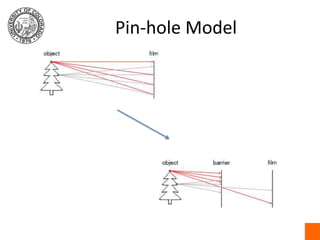
Pin-Hole CameraA. Efros
Pin-hole Model
Aperture
Thin LensObjects need to have the right distance to be in focus -> Depth-from-Focus method
Depth from Focus“in focus” + camera parameters= rangeHow to test whether an image is “crisp” or “blurry”?
Testing for focusUnit Step -> 2nd DerivativeIntuition: Images with high contrast have steep edges!
ConvolutionCalculate Laplacian / 2nd derivative by “convolving” image with 2D Kernel*
Depth from StereoDistance between stereo pair known + distance in the image -> distance to object
Stereo PairsZero crossings of Laplacians of GaussiansGaussians: blurred image (suppresses noise)Laplacians: edgesTest how far similar edges are apartEpipolar constraints are given by the geometry of the Stereo pair
Other example for Convolutions: Canny Edge Detector1.2.+3.4. Trace along ridges     (non-maximum suppression)15
Exercise: Thresholds1616http://homepages.inf.ed.ac.uk/rbf/HIPR2/adpthrsh.htmScreen shots by Gary Bradski, 2005
Exercise: Morphological Operations ExamplesMorphology - applying Min-Max. Filters and its combinationsDilatation IBOpening IoB= (IB)BErosion IBImage IClosing I•B= (IB)BTopHat(I)= I - (IB)BlackHat(I)= (IB) - IGrad(I)= (IB)-(IB)
Why is Object Recognition Hard?The difference between seeing and perception.Gary Bradski, 200919What to do?  Maybe we should try to find edges ….Gary Bradski, 2005
Depth discontinuity
Surface orientation discontinuity
Reflectance discontinuity (i.e., change in surface material properties)
Illumination discontinuity (e.g., shadow)Slide credit: Christopher Rasmussen20But, What’s an Edge?
To Deal With the Confusion, Your Brain has Rules...That can be wrong
We even see invisible edges…
And surfaces …
We need to deal with 3D Geometry24Perception is ambiguous … depending on your point of view!Graphic by Gary Bradski
And Lighting in 3DWhich square is darker?
Lighting is Ill-posed …Perception of surfaces depends on lighting assumptions26Gary Bradski (c) 200826
Contrast27Which one is male and which one is female?Illusion by: Richard Russell,Harvard UniversityRussell, R. (2009) A sex difference in facial pigmentation and its exaggeration by cosmetics. Perception, (38)1211-1219

Lecture 05