DEPARTMENT OF MECHANICAL ENGINEERING
Technical Seminar
on
“MULTI ROBOT SYSTEM FOR SPACE APPLICATION”
Presented by: MADHUKESH J G
(2GP20ME408)
Visvesvaraya Technological University, Belagavi, Karnataka
ವಿಶ್
ವ ೇಶ್
ವ ರಯ್ಯ ತಾಂತ್ರ
ಿ ಕ ವಿಶ್
ವ ವಿದ್ಯಯ ಲಯ್, ಬೆಳಗಾವಿ, ಕರ್ನಾಟಕ
GOVERNMENT ENGINEERING COLLEGE, KARWAR
2
CONTENTS
 INTRODUCTION
 WHAT IS SPACE ROBOTS
 WHY SPACE ROBOTS
 MULTI ROBOT SYSTEM
 DIAGRAM OF PATH PLANNING ALGORITHMS
 HOW ROBOTS WORKS IN SPACE
 STEP WISE MDE ATLAS METHODOLOGY
 TECHONOLOGIES USED
 PROPOSED MULTI ROBOT SYSTEM ARCHITCHERE
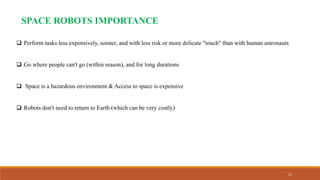
 SPACE ROBOTS IMPORTANCE
 TYPES OF SPACE ROBOTS
 CONCLUSION
 REFERENCE
3
INTRODUCTION
 Multi-Robot Systems includes all those groups formed by two or more robots sharing the same work
space. This general concept covers industrial robotic arms, humanoid robots, ground and aerial mobile
systems, and autonomous vehicles.To understand some of the problems being studied with multiple
robots.
 Although this work is exclusively oriented to MRS formed by autonomous mobile systems (UGVs and
UAVs) either homogeneous of heterogeneous, some concepts related to the classification of MRS and
their terminology are established.
 The space environment represents one of the most challenging applications of robotics.
 Robotics is a field that has been magnified by its association to space research.
 The most important thing to note is that the scale of success in space systems is same as that for
biological systems i.e., "SURVIVAL OF THE FITTEST“
4
What is Space Robotics
 Space robotics is the development of general purpose machines that are capable of surviving in the
space environment, performing exploration, construction, maintenance, servicing or other tasks.
 Humans control space robots from either a "local" control console or "remotely" controlled from
human operators on Earth. Space robots are generally designed to do multiple tasks.
5
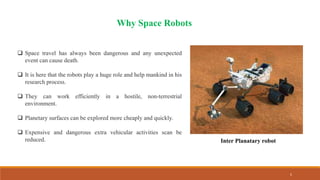
Why Space Robots
 Space travel has always been dangerous and any unexpected
event can cause death.
 It is here that the robots play a huge role and help mankind in his
research process.
 They can work efficiently in a hostile, non-terrestrial
environment.
 Planetary surfaces can be explored more cheaply and quickly.
 Expensive and dangerous extra vehicular activities scan be
reduced. Inter Planatary robot
6
Multi Robot System
Fig1.1 Examples of Homogeneous MRS. Fig. 1.2 Examples of Heterogeneous MRS.
7
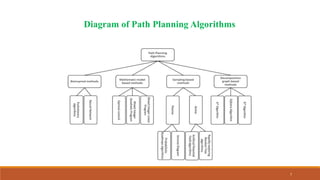
Diagram of Path Planning Algorithms
8
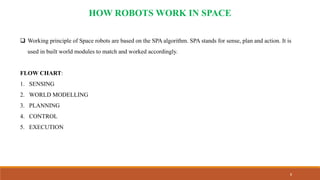
HOW ROBOTS WORK IN SPACE
 Working principle of Space robots are based on the SPA algorithm. SPA stands for sense, plan and action. It is
used in built world modules to match and worked accordingly.
FLOW CHART:
1. SENSING
2. WORLD MODELLING
3. PLANNING
4. CONTROL
5. EXECUTION
9
Stepwise MDE ATLAS M ethodology
ATLAS DSL
Simulation
Generate ATLAS
CI
Template
Robustness
Analyse results
10
Technologies Used
 Mapping and navigation
One of the basic functions of a space robot is to navigate its way cleverly through all obstacles that
come in its way. Mapping and navigation comprise of three more technologies.
 Obstacle avoidance
 Mapping
 Path planning
 Planning: It is a feature by which a robot understands the situation and decides a strategy to tackle it.
 Sequencing: Selection of a particular skill set which would result in perfect execution of a plan.
 Control: Performing the selected skill set to perfection.
11
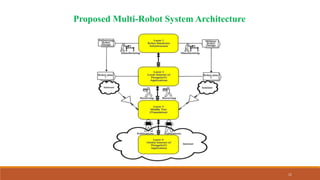
Proposed Multi-Robot System Architecture
12
SPACE ROBOTS IMPORTANCE
 Perform tasks less expensively, sooner, and with less risk or more delicate "touch" than with human astronauts
 Go where people can't go (within reason), and for long durations
 Space is a hazardous environment & Access to space is expensive
 Robots don't need to return to Earth (which can be very costly)
13
TYPES OF SPACE ROBOTS
PLANETARY ROVERS IN-ORBIT OPERATIONS
ASTRONAUT ASSISTANCE PROBES
14
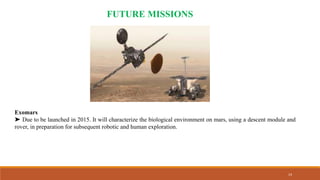
FUTURE MISSIONS
Exomars
➤ Due to be launched in 2015. It will characterize the biological environment on mars, using a descent module and
rover, in preparation for subsequent robotic and human exploration.
15
ADVANTAGES
 Perform tasks less expensively and sooner
 Less risk
 Go where people can go and for long durations
 Space is a hazarded environment
 Robots don't need to return to Earth
DISADVANTAGE
 It hard to implement
 It little-bit complex with every function
 Terrible at performing tasks suitable for wheels (landscape or high speeds)
 Technology (gyros, advanced servo designs)
 Not trustworthy
16
Conclusion
Multi-robot system architecture is described based on the internet of things technology. The IOT provides the multi-
robot system with scalability, wide range recovering, and easy communication. The system architecture contains 4
layers, one hardware layer and 3 soft- ware layers. The multi-robot system can be used in many applications like
health, space, and military. Terrorism case study for our multi-robot system is demonstrated to clarify how the anti-
terrorism human team can be trans- formed to the anti-terrorism robots team. Finally, the advantages of the proposed
system are discussed.
17
REFERENCES
1. Y. F. Cai and S. X. Yang, “Fuzzy Logic-Based Multi- Robot Cooperation for Object-Pushing,” International Conference on
Information and Automation, Shenzhen, 6-8 June 2011, pp. 273-278.
2. Alpaydin, E. (2004). Introduction to Machine Learning (Adaptive Com- putation and Machine Learning). The MIT Press.
ISBN 0262012111.
3. Arai, T., PagEllo, E., and ParKEr, L. (2002). Guest editorial: Ad- vanes in multirobot systems. IEEE Transactions on Robotics
and Automation, 18:655–661.
4. R., Moarref, S., & Topcu, U. (2013). Counter-strategy guided refinement of gr (1) temporal logic specifications. In Formal
Methods in Computer-Aided Design (FMCAD), IEEE, 2013, (pp. 26–33).
5. Amato, C., Konidaris, G., Cruz, G., Maynor, C. A., How, J. P., & Kael-bling, L. P. (2015). Planning for decentralized control of
multiple robots under uncertainty. In 2015 IEEE International Conference onRobotics and Automation (ICRA), (pp. 1241–1248
6. D. Kato, K. Sekiyama and T. Fukuda, “Autonomous Co-operation Planning for Heterogeneous Multi- Robot,” IEEE Workshop on
Robotic Intelligence in Informationally Struc- tured Space (RIISS), Nagoya, 11-15April 2011, pp. 63- 68.
18
THANK YOU

TECHNICAL SEMINAR.pptx

  • 1.
    DEPARTMENT OF MECHANICALENGINEERING Technical Seminar on “MULTI ROBOT SYSTEM FOR SPACE APPLICATION” Presented by: MADHUKESH J G (2GP20ME408) Visvesvaraya Technological University, Belagavi, Karnataka ವಿಶ್ ವ ೇಶ್ ವ ರಯ್ಯ ತಾಂತ್ರ ಿ ಕ ವಿಶ್ ವ ವಿದ್ಯಯ ಲಯ್, ಬೆಳಗಾವಿ, ಕರ್ನಾಟಕ GOVERNMENT ENGINEERING COLLEGE, KARWAR
  • 2.
    2 CONTENTS  INTRODUCTION  WHATIS SPACE ROBOTS  WHY SPACE ROBOTS  MULTI ROBOT SYSTEM  DIAGRAM OF PATH PLANNING ALGORITHMS  HOW ROBOTS WORKS IN SPACE  STEP WISE MDE ATLAS METHODOLOGY  TECHONOLOGIES USED  PROPOSED MULTI ROBOT SYSTEM ARCHITCHERE  SPACE ROBOTS IMPORTANCE  TYPES OF SPACE ROBOTS  CONCLUSION  REFERENCE
  • 3.
    3 INTRODUCTION  Multi-Robot Systemsincludes all those groups formed by two or more robots sharing the same work space. This general concept covers industrial robotic arms, humanoid robots, ground and aerial mobile systems, and autonomous vehicles.To understand some of the problems being studied with multiple robots.  Although this work is exclusively oriented to MRS formed by autonomous mobile systems (UGVs and UAVs) either homogeneous of heterogeneous, some concepts related to the classification of MRS and their terminology are established.  The space environment represents one of the most challenging applications of robotics.  Robotics is a field that has been magnified by its association to space research.  The most important thing to note is that the scale of success in space systems is same as that for biological systems i.e., "SURVIVAL OF THE FITTEST“
  • 4.
    4 What is SpaceRobotics  Space robotics is the development of general purpose machines that are capable of surviving in the space environment, performing exploration, construction, maintenance, servicing or other tasks.  Humans control space robots from either a "local" control console or "remotely" controlled from human operators on Earth. Space robots are generally designed to do multiple tasks.
  • 5.
    5 Why Space Robots Space travel has always been dangerous and any unexpected event can cause death.  It is here that the robots play a huge role and help mankind in his research process.  They can work efficiently in a hostile, non-terrestrial environment.  Planetary surfaces can be explored more cheaply and quickly.  Expensive and dangerous extra vehicular activities scan be reduced. Inter Planatary robot
  • 6.
    6 Multi Robot System Fig1.1Examples of Homogeneous MRS. Fig. 1.2 Examples of Heterogeneous MRS.
  • 7.
    7 Diagram of PathPlanning Algorithms
  • 8.
    8 HOW ROBOTS WORKIN SPACE  Working principle of Space robots are based on the SPA algorithm. SPA stands for sense, plan and action. It is used in built world modules to match and worked accordingly. FLOW CHART: 1. SENSING 2. WORLD MODELLING 3. PLANNING 4. CONTROL 5. EXECUTION
  • 9.
    9 Stepwise MDE ATLASM ethodology ATLAS DSL Simulation Generate ATLAS CI Template Robustness Analyse results
  • 10.
    10 Technologies Used  Mappingand navigation One of the basic functions of a space robot is to navigate its way cleverly through all obstacles that come in its way. Mapping and navigation comprise of three more technologies.  Obstacle avoidance  Mapping  Path planning  Planning: It is a feature by which a robot understands the situation and decides a strategy to tackle it.  Sequencing: Selection of a particular skill set which would result in perfect execution of a plan.  Control: Performing the selected skill set to perfection.
  • 11.
  • 12.
    12 SPACE ROBOTS IMPORTANCE Perform tasks less expensively, sooner, and with less risk or more delicate "touch" than with human astronauts  Go where people can't go (within reason), and for long durations  Space is a hazardous environment & Access to space is expensive  Robots don't need to return to Earth (which can be very costly)
  • 13.
    13 TYPES OF SPACEROBOTS PLANETARY ROVERS IN-ORBIT OPERATIONS ASTRONAUT ASSISTANCE PROBES
  • 14.
    14 FUTURE MISSIONS Exomars ➤ Dueto be launched in 2015. It will characterize the biological environment on mars, using a descent module and rover, in preparation for subsequent robotic and human exploration.
  • 15.
    15 ADVANTAGES  Perform tasksless expensively and sooner  Less risk  Go where people can go and for long durations  Space is a hazarded environment  Robots don't need to return to Earth DISADVANTAGE  It hard to implement  It little-bit complex with every function  Terrible at performing tasks suitable for wheels (landscape or high speeds)  Technology (gyros, advanced servo designs)  Not trustworthy
  • 16.
    16 Conclusion Multi-robot system architectureis described based on the internet of things technology. The IOT provides the multi- robot system with scalability, wide range recovering, and easy communication. The system architecture contains 4 layers, one hardware layer and 3 soft- ware layers. The multi-robot system can be used in many applications like health, space, and military. Terrorism case study for our multi-robot system is demonstrated to clarify how the anti- terrorism human team can be trans- formed to the anti-terrorism robots team. Finally, the advantages of the proposed system are discussed.
  • 17.
    17 REFERENCES 1. Y. F.Cai and S. X. Yang, “Fuzzy Logic-Based Multi- Robot Cooperation for Object-Pushing,” International Conference on Information and Automation, Shenzhen, 6-8 June 2011, pp. 273-278. 2. Alpaydin, E. (2004). Introduction to Machine Learning (Adaptive Com- putation and Machine Learning). The MIT Press. ISBN 0262012111. 3. Arai, T., PagEllo, E., and ParKEr, L. (2002). Guest editorial: Ad- vanes in multirobot systems. IEEE Transactions on Robotics and Automation, 18:655–661. 4. R., Moarref, S., & Topcu, U. (2013). Counter-strategy guided refinement of gr (1) temporal logic specifications. In Formal Methods in Computer-Aided Design (FMCAD), IEEE, 2013, (pp. 26–33). 5. Amato, C., Konidaris, G., Cruz, G., Maynor, C. A., How, J. P., & Kael-bling, L. P. (2015). Planning for decentralized control of multiple robots under uncertainty. In 2015 IEEE International Conference onRobotics and Automation (ICRA), (pp. 1241–1248 6. D. Kato, K. Sekiyama and T. Fukuda, “Autonomous Co-operation Planning for Heterogeneous Multi- Robot,” IEEE Workshop on Robotic Intelligence in Informationally Struc- tured Space (RIISS), Nagoya, 11-15April 2011, pp. 63- 68.
  • 18.