Introduction to RoboticsNavigationApril 5, 2010
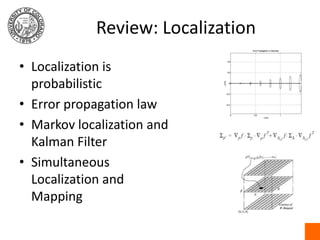
Review: LocalizationLocalization is probabilisticError propagation lawMarkov localization and Kalman FilterSimultaneous Localization and Mapping
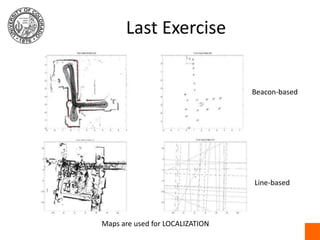
Last ExerciseBeacon-basedLine-basedMaps are used for LOCALIZATION
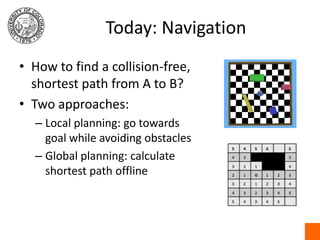
Today: NavigationHow to find a collision-free, shortest path from A to B?Two approaches:Local planning: go towards goal while avoiding obstaclesGlobal planning: calculate shortest path offline
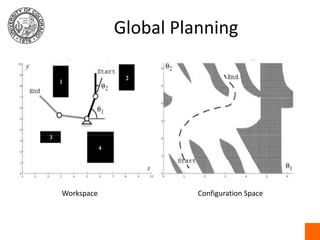
Global PlanningWorkspaceConfiguration Space
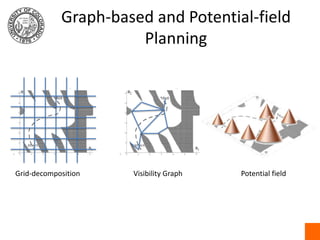
Graph-based and Potential-field PlanningGrid-decompositionVisibility GraphPotential field
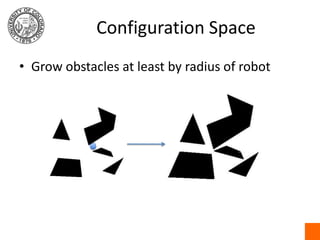
Configuration SpaceGrow obstacles at least by radius of robot
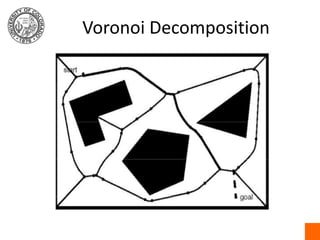
Voronoi Decomposition
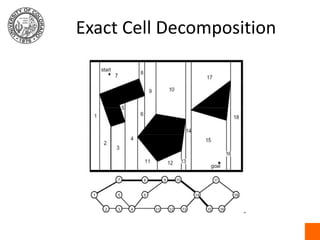
Exact Cell Decomposition
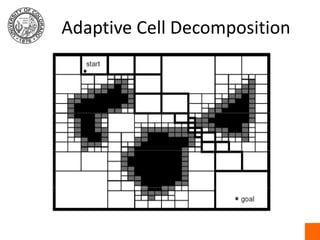
Adaptive Cell Decomposition
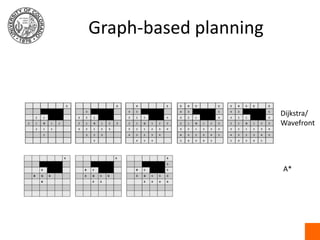
Graph-based planningDijkstra/WavefrontA*
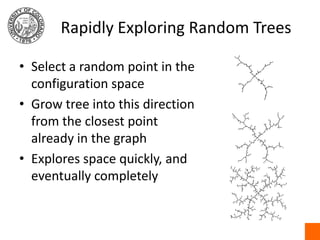
Rapidly Exploring Random TreesSelect a random point in the configuration spaceGrow tree into this direction from the closest point already in the graphExplores space quickly, and eventually completely
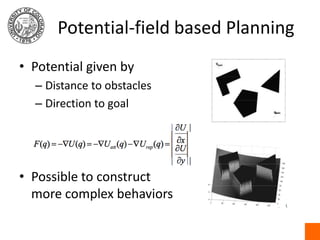
Potential-field based PlanningPotential given by Distance to obstaclesDirection to goalPossible to construct more complex behaviors
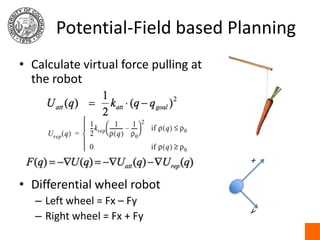
Calculate virtual force pulling at the robotDifferential wheel robotLeft wheel = Fx – FyRight wheel = Fx + FyPotential-Field based Planningxy
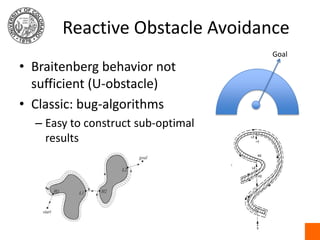
Reactive Obstacle AvoidanceGoalBraitenberg behavior not sufficient (U-obstacle)Classic: bug-algorithmsEasy to construct sub-optimal results
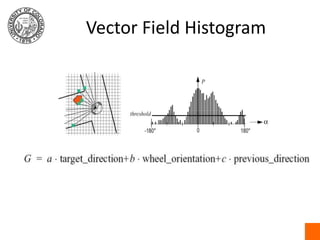
Vector Field Histogram
PracticeLocalization, actuation and obstacles are uncertainCombination of Local and Global Techniques
Debate OutlineConstructive speeches10 minutes pro10 minutes contraRebuttal 3 minutes affirmative3 minutes negativeDiscussion and cross examination5-10 minutes4 Debates total
DebatesSocial:Robots putting humans out of work is a risk that needs to be mitigated.Robots should not have the capability to autonomously discharge weapons.Robotic cars  should not be allowed to participate in urban traffic.…Technical:Swarms of simple robots are more attractive than monolithic, more capable robots.Robots do not need to be as cognitive as humans in order to be useful as making the environment intelligent is sufficient.Robots need to be made differently than from links, joints, and gears in order to reach the agility of people.…In both cases: debates should be driven by verifiable, technical arguments!
DebatesSocial:D1: Robots putting humans out of work is a risk that needs to be mitigated.D2: Robots should not have the capability to autonomously discharge weapons / drive around in cities (autonomous cars).Technical:D3: Robots do not need to be as cognitive as humans in order to be useful as making the environment intelligent is sufficient.D4: Robots need to be made differently than from links, joints, and gears in order to reach the agility of people.…In both cases: debates should be driven by verifiable, technical arguments!
Random assignments
OrganizationWeek 12 + 13: Debateshttp://courses.csail.mit.edu/6.141/spring2009/pub/debates/Debates.htmlWeek 14: Graduate student presentationsWeek 15: Final presentationsFinal exam: Monday, May 3 7:30 p.m. - 10:00 p.m.

Lecture 10: Navigation