MOLE
CONVERSIONSUnit 7: The Mole
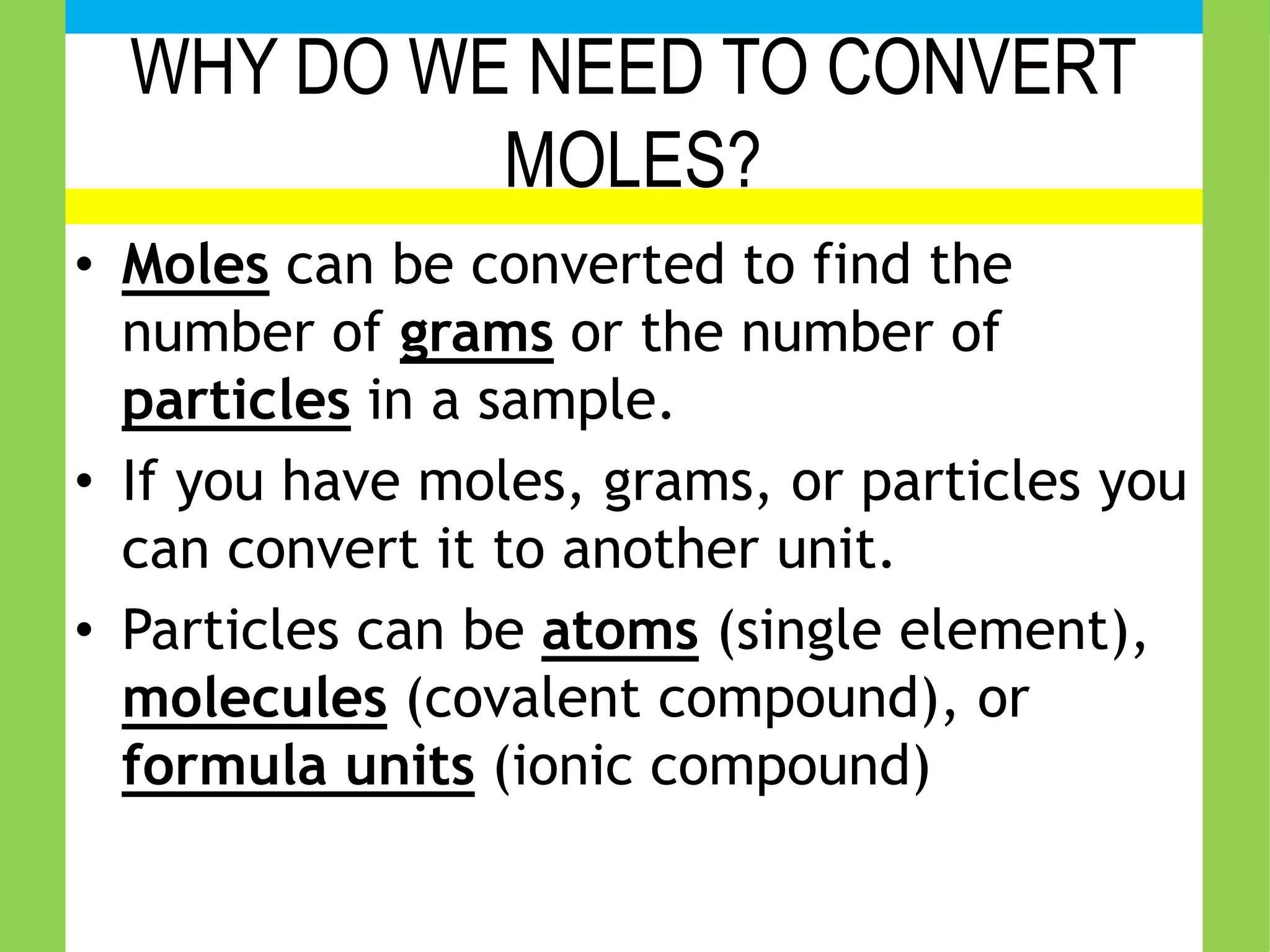
WHY DO WE NEED TO CONVERT
MOLES?
• Moles can be converted to find the
number of grams or the number of
particles in a sample.
• If you have moles, grams, or particles you
can convert it to another unit.
• Particles can be atoms (single element),
molecules (covalent compound), or
formula units (ionic compound)
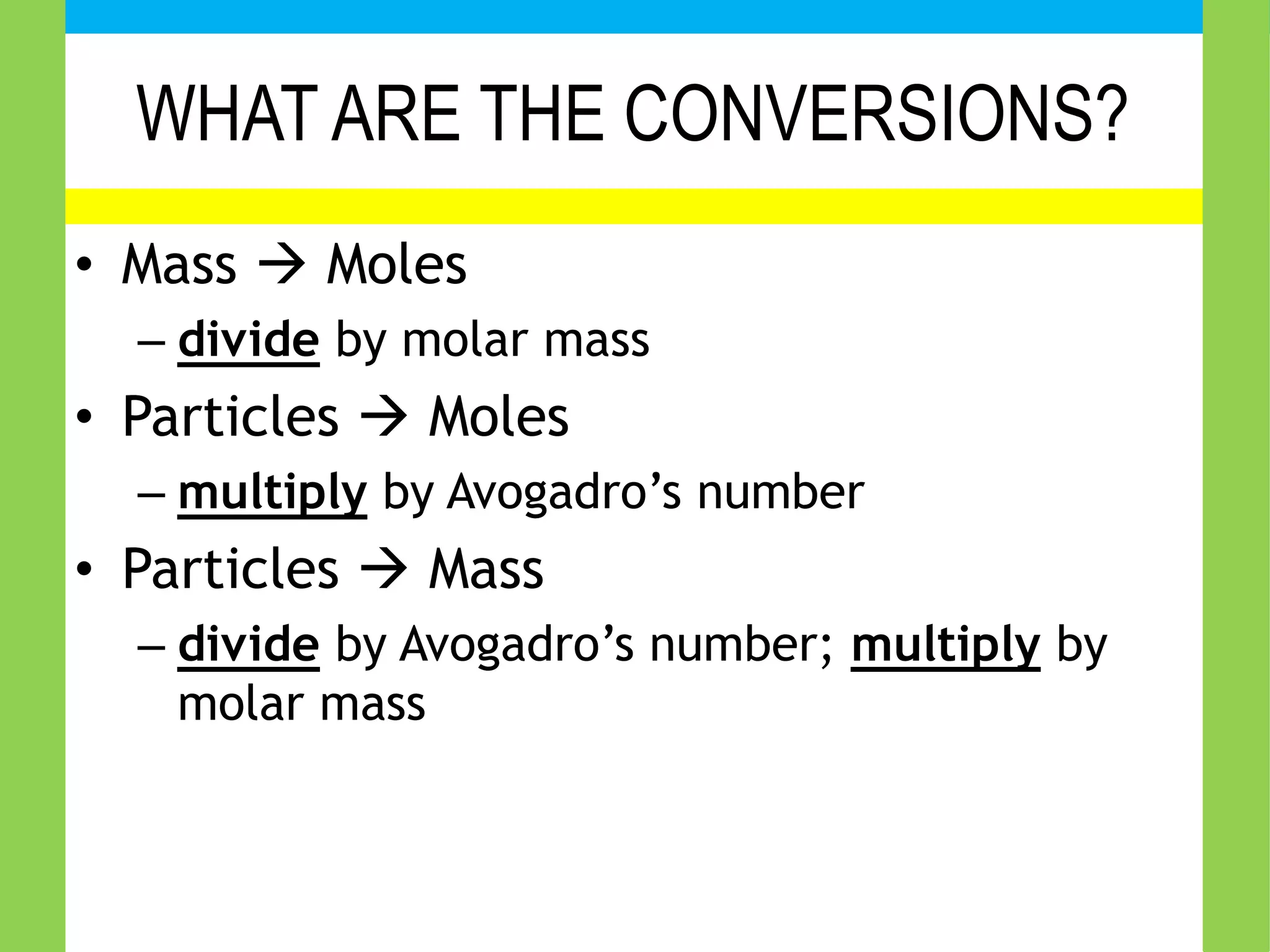
WHAT ARE THE CONVERSIONS?
• Mass  Moles
– divide by molar mass
• Particles  Moles
– multiply by Avogadro’s number
• Particles  Mass
– divide by Avogadro’s number; multiply by
molar mass
WHAT IS DIMENSIONALANALYSIS?
• Dimensional analysis is a way of
organizing calculations to keep track of
units.
• You must show your work this way – if you
get used to it now, stoichiometry (next
unit) will be easier!
PRACTICE
• How many moles are in 45.98 g of Na?
PRACTICE
• How many particles are in 2 moles of
NaCl?
PRACTICE
• How many grams are in 6.02x10²³
molecules of water?
PRACTICE
• How many moles are in 8.91x1024 atoms
of magnesium?

Mole conversions

  • 1.
  • 2.
    WHY DO WENEED TO CONVERT MOLES? • Moles can be converted to find the number of grams or the number of particles in a sample. • If you have moles, grams, or particles you can convert it to another unit. • Particles can be atoms (single element), molecules (covalent compound), or formula units (ionic compound)
  • 4.
    WHAT ARE THECONVERSIONS? • Mass  Moles – divide by molar mass • Particles  Moles – multiply by Avogadro’s number • Particles  Mass – divide by Avogadro’s number; multiply by molar mass
  • 5.
    WHAT IS DIMENSIONALANALYSIS? •Dimensional analysis is a way of organizing calculations to keep track of units. • You must show your work this way – if you get used to it now, stoichiometry (next unit) will be easier!
  • 6.
    PRACTICE • How manymoles are in 45.98 g of Na?
  • 7.
    PRACTICE • How manyparticles are in 2 moles of NaCl?
  • 8.
    PRACTICE • How manygrams are in 6.02x10²³ molecules of water?
  • 9.
    PRACTICE • How manymoles are in 8.91x1024 atoms of magnesium?