Moles, Molar Mass, and
Avogadro’s Number, Part 1
By Shawn P. Shields, Ph.D.
This work is licensed by Shawn P. Shields-Maxwell under a Creative Commons
Attribution-NonCommercial-ShareAlike 4.0 International License.
A Practical Problem Concerning
Atom Size…
Recall: Atomic Mass Units (amu)
One amu is equal to 1.6605  1027 kg
This is a VERY small amount of mass.
We know that the average mass of a water (H2O)
molecule is 18.02 amu…
…which would be 2.992  1026 kg, and very hard to
measure!
A Practical Problem Concerning
Atom Size…
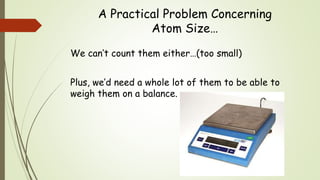
We can’t count them either…(too small)
Plus, we’d need a whole lot of them to be able to
weigh them on a balance.
A Practical Problem…
So, how could we solve this problem?
Observe:
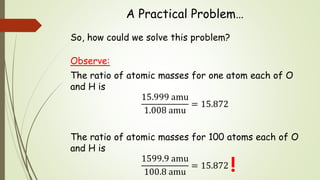
The ratio of atomic masses for one atom each of O
and H is
15.999 amu
1.008 amu
= 15.872
The ratio of atomic masses for 100 atoms each of O
and H is
1599.9 amu
100.8 amu
= 15.872 !
A Practical Problem…
We could keep on using larger numbers, and still get
the same result, so…
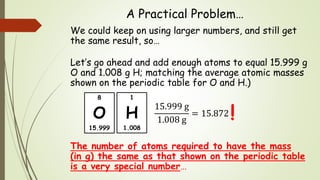
Let’s go ahead and add enough atoms to equal 15.999 g
O and 1.008 g H; matching the average atomic masses
shown on the periodic table for O and H.)
15.999 g
1.008 g
= 15.872
The number of atoms required to have the mass
(in g) the same as that shown on the periodic table
is a very special number…
!
8
O
15.999
1
H
1.008
Avogadro’s Number!
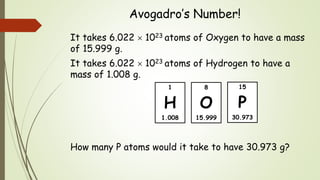
It takes 6.022  1023 atoms of Oxygen to have a mass
of 15.999 g.
It takes 6.022  1023 atoms of Hydrogen to have a
mass of 1.008 g.
How many P atoms would it take to have 30.973 g?
15
P
30.973
1
H
1.008
8
O
15.999
Avogadro’s Number!
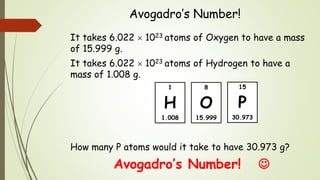
It takes 6.022  1023 atoms of Oxygen to have a mass
of 15.999 g.
It takes 6.022  1023 atoms of Hydrogen to have a
mass of 1.008 g.
How many P atoms would it take to have 30.973 g?
Avogadro’s Number! 
15
P
30.973
1
H
1.008
8
O
15.999
The Mole Concept
(A Chemist Counting Unit)
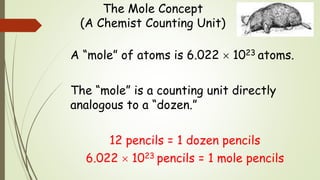
A “mole” of atoms is 6.022  1023 atoms.
The “mole” is a counting unit directly
analogous to a “dozen.”
12 pencils = 1 dozen pencils
6.022  1023 pencils = 1 mole pencils
The Mole Concept
(A Chemist Counting Unit)
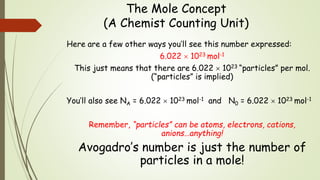
Here are a few other ways you’ll see this number expressed:
6.022  1023 mol-1
This just means that there are 6.022  1023 “particles” per mol.
(“particles” is implied)
You’ll also see NA = 6.022  1023 mol-1 and N0 = 6.022  1023 mol-1
Remember, “particles” can be atoms, electrons, cations,
anions…anything!
Avogadro’s number is just the number of
particles in a mole!
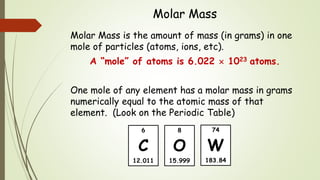
Molar Mass
Molar Mass is the amount of mass (in grams) in one
mole of particles (atoms, ions, etc).
A “mole” of atoms is 6.022  1023 atoms.
One mole of any element has a molar mass in grams
numerically equal to the atomic mass of that
element. (Look on the Periodic Table)
74
W
183.84
6
C
12.011
8
O
15.999
Molar Mass
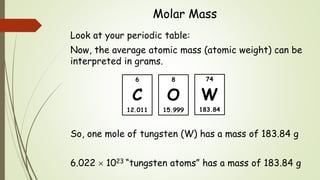
Look at your periodic table:
Now, the average atomic mass (atomic weight) can be
interpreted in grams.
So, one mole of tungsten (W) has a mass of 183.84 g
6.022  1023 “tungsten atoms” has a mass of 183.84 g
74
W
183.84
6
C
12.011
8
O
15.999
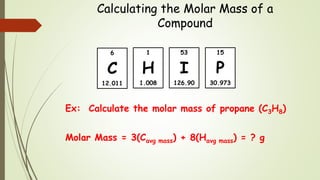
Calculating the Molar Mass of a
Compound
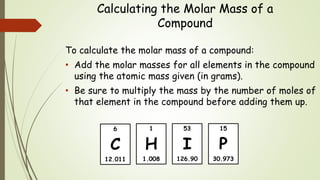
To calculate the molar mass of a compound:
• Add the molar masses for all elements in the compound
using the atomic mass given (in grams).
• Be sure to multiply the mass by the number of moles of
that element in the compound before adding them up.
1
H
1.008
6
C
12.011
53
I
126.90
15
P
30.973
Calculating the Molar Mass of a
Compound
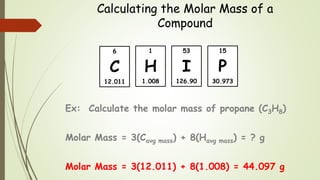
Ex: Calculate the molar mass of propane (C3H8)
Molar Mass = 3(Cavg mass) + 8(Havg mass) = ? g
1
H
1.008
6
C
12.011
53
I
126.90
15
P
30.973
Calculating the Molar Mass of a
Compound
Ex: Calculate the molar mass of propane (C3H8)
Molar Mass = 3(Cavg mass) + 8(Havg mass) = ? g
Molar Mass = 3(12.011) + 8(1.008) = 44.097 g
1
H
1.008
6
C
12.011
53
I
126.90
15
P
30.973
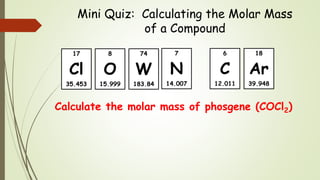
Mini Quiz: Calculating the Molar Mass
of a Compound
Calculate the molar mass of phosgene (COCl2)
18
Ar
39.948
6
C
12.011
8
O
15.999
7
N
14.007
17
Cl
35.453
74
W
183.84
Mini Quiz Solution
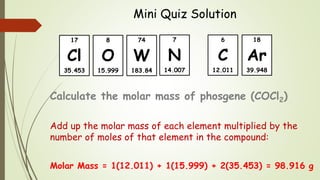
Calculate the molar mass of phosgene (COCl2)
Add up the molar mass of each element multiplied by the
number of moles of that element in the compound:
Molar Mass = 1(12.011) + 1(15.999) + 2(35.453) = 98.916 g
18
Ar
39.948
6
C
12.011
8
O
15.999
7
N
14.007
17
Cl
35.453
74
W
183.84
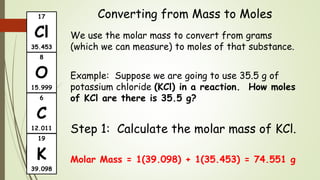
Converting from Mass to Moles
We use the molar mass to convert from grams
(which we can measure) to moles of that substance.
Example: Suppose we are going to use 35.5 g of
potassium chloride (KCl) in a reaction. How moles
of KCl are there is 35.5 g?
Step 1: Calculate the molar mass of KCl.
Molar Mass = 1(39.098) + 1(35.453) = 74.551 g
17
Cl
35.453
6
C
12.011
8
O
15.999
19
K
39.098
Converting from Mass to Moles
Example: Suppose we are going to use 35.5 g of
potassium chloride (KCl) in a reaction. How moles
of KCl are there is 35.5 g?
Step 1: Calculate the molar mass of KCl.
Molar Mass = 1(39.098) + 1(35.453) = 74.551 g
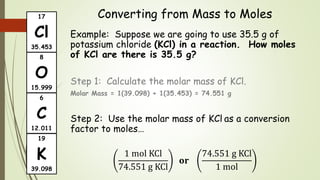
Step 2: Use the molar mass of KCl as a conversion
factor to moles…
1 mol KCl
74.551 g KCl
𝐨𝐫
74.551 g KCl
1 mol
17
Cl
35.453
6
C
12.011
8
O
15.999
19
K
39.098
Converting from Mass to Moles
Example: Suppose we are going to use 35.5 g of
potassium chloride (KCl) in a reaction. How moles of
KCl are there is 35.5 g?
Step 1: Calculate the molar mass of KCl.
Molar Mass = 1(39.098) + 1(35.453) = 74.551 g
Step 2: Use the molar mass of KCl as a conversion
factor to moles…
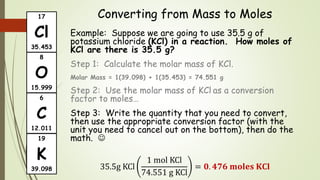
Step 3: Write the quantity that you need to convert,
then use the appropriate conversion factor (with the
unit you need to cancel out on the bottom), then do the
math. 
35.5g KCl
1 mol KCl
74.551 g KCl
= 𝟎. 𝟒𝟕𝟔 𝐦𝐨𝐥𝐞𝐬 𝐊𝐂𝐥
17
Cl
35.453
6
C
12.011
8
O
15.999
19
K
39.098
Converting Moles to Number of
Molecules (Atoms, Particles, etc.)
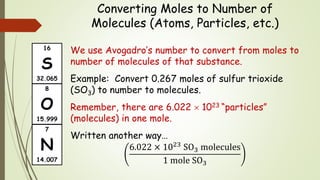
We use Avogadro’s number to convert from moles to
number of molecules of that substance.
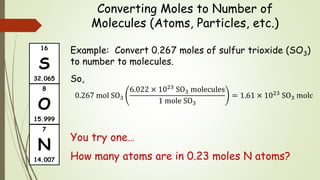
Example: Convert 0.267 moles of sulfur trioxide
(SO3) to number to molecules.
Remember, there are 6.022  1023 “particles”
(molecules) in one mole.
Written another way…
6.022 × 10²³ SO3 molecules
1 mole SO3
16
S
32.065
7
N
14.007
8
O
15.999
Converting Moles to Number of
Molecules (Atoms, Particles, etc.)
Example: Convert 0.267 moles of sulfur trioxide (SO3)
to number to molecules.
So,
0.267 mol SO3
6.022 × 10²³ SO3 molecules
1 mole SO3
= 1.61 × 10²³ SO3 molc
You try one…
How many atoms are in 0.23 moles N atoms?
16
S
32.065
7
N
14.007
8
O
15.999
Converting Moles to Number of
Molecules (Atoms, Particles, etc.)
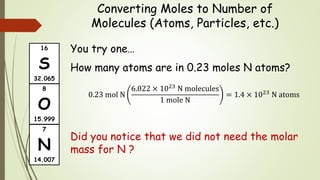
You try one…
How many atoms are in 0.23 moles N atoms?
0.23 mol N
6.022 × 10²³ N molecules
1 mole N
= 1.4 × 10²³ N atoms
Did you notice that we did not need the molar
mass for N ?
16
S
32.065
7
N
14.007
8
O
15.999
Converting Moles to Number of
Molecules (Atoms, Particles, etc.)
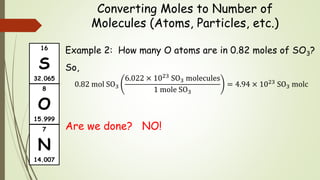
Example 2: How many O atoms are in 0.82 moles of SO3?
So,
0.82 mol SO3
6.022 × 10²³ SO3 molecules
1 mole SO3
= 4.94 × 10²³ SO3 molc
Are we done? NO!
16
S
32.065
7
N
14.007
8
O
15.999
Converting Moles to Number of
Molecules (Atoms, Particles, etc.)
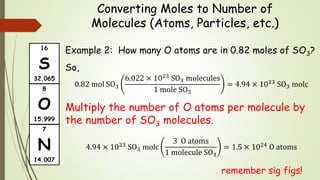
Example 2: How many O atoms are in 0.82 moles of SO3?
So,
0.82 mol SO3
6.022 × 10²³ SO3 molecules
1 mole SO3
= 4.94 × 10²³ SO3 molc
Multiply the number of O atoms per molecule by
the number of SO3 molecules.
4.94 × 10²³ SO3 molc
3 O atoms
1 molecule SO3
= 1.5 × 1024 O atoms
remember sig figs!
16
S
32.065
7
N
14.007
8
O
15.999
Converting Moles to Number of
Molecules (Atoms, Particles, etc.)
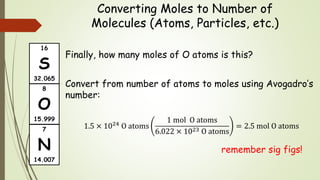
Finally, how many moles of O atoms is this?
Convert from number of atoms to moles using Avogadro’s
number:
1.5 × 1024 O atoms
1 mol O atoms
6.022 × 10²³ O atoms
= 2.5 mol O atoms
remember sig figs!
16
S
32.065
7
N
14.007
8
O
15.999

Moles molar mass_avonumb pt1

  • 1.
    Moles, Molar Mass,and Avogadro’s Number, Part 1 By Shawn P. Shields, Ph.D. This work is licensed by Shawn P. Shields-Maxwell under a Creative Commons Attribution-NonCommercial-ShareAlike 4.0 International License.
  • 2.
    A Practical ProblemConcerning Atom Size… Recall: Atomic Mass Units (amu) One amu is equal to 1.6605  1027 kg This is a VERY small amount of mass. We know that the average mass of a water (H2O) molecule is 18.02 amu… …which would be 2.992  1026 kg, and very hard to measure!
  • 3.
    A Practical ProblemConcerning Atom Size… We can’t count them either…(too small) Plus, we’d need a whole lot of them to be able to weigh them on a balance.
  • 4.
    A Practical Problem… So,how could we solve this problem? Observe: The ratio of atomic masses for one atom each of O and H is 15.999 amu 1.008 amu = 15.872 The ratio of atomic masses for 100 atoms each of O and H is 1599.9 amu 100.8 amu = 15.872 !
  • 5.
    A Practical Problem… Wecould keep on using larger numbers, and still get the same result, so… Let’s go ahead and add enough atoms to equal 15.999 g O and 1.008 g H; matching the average atomic masses shown on the periodic table for O and H.) 15.999 g 1.008 g = 15.872 The number of atoms required to have the mass (in g) the same as that shown on the periodic table is a very special number… ! 8 O 15.999 1 H 1.008
  • 6.
    Avogadro’s Number! It takes6.022  1023 atoms of Oxygen to have a mass of 15.999 g. It takes 6.022  1023 atoms of Hydrogen to have a mass of 1.008 g. How many P atoms would it take to have 30.973 g? 15 P 30.973 1 H 1.008 8 O 15.999
  • 7.
    Avogadro’s Number! It takes6.022  1023 atoms of Oxygen to have a mass of 15.999 g. It takes 6.022  1023 atoms of Hydrogen to have a mass of 1.008 g. How many P atoms would it take to have 30.973 g? Avogadro’s Number!  15 P 30.973 1 H 1.008 8 O 15.999
  • 8.
    The Mole Concept (AChemist Counting Unit) A “mole” of atoms is 6.022  1023 atoms. The “mole” is a counting unit directly analogous to a “dozen.” 12 pencils = 1 dozen pencils 6.022  1023 pencils = 1 mole pencils
  • 9.
    The Mole Concept (AChemist Counting Unit) Here are a few other ways you’ll see this number expressed: 6.022  1023 mol-1 This just means that there are 6.022  1023 “particles” per mol. (“particles” is implied) You’ll also see NA = 6.022  1023 mol-1 and N0 = 6.022  1023 mol-1 Remember, “particles” can be atoms, electrons, cations, anions…anything! Avogadro’s number is just the number of particles in a mole!
  • 10.
    Molar Mass Molar Massis the amount of mass (in grams) in one mole of particles (atoms, ions, etc). A “mole” of atoms is 6.022  1023 atoms. One mole of any element has a molar mass in grams numerically equal to the atomic mass of that element. (Look on the Periodic Table) 74 W 183.84 6 C 12.011 8 O 15.999
  • 11.
    Molar Mass Look atyour periodic table: Now, the average atomic mass (atomic weight) can be interpreted in grams. So, one mole of tungsten (W) has a mass of 183.84 g 6.022  1023 “tungsten atoms” has a mass of 183.84 g 74 W 183.84 6 C 12.011 8 O 15.999
  • 12.
    Calculating the MolarMass of a Compound To calculate the molar mass of a compound: • Add the molar masses for all elements in the compound using the atomic mass given (in grams). • Be sure to multiply the mass by the number of moles of that element in the compound before adding them up. 1 H 1.008 6 C 12.011 53 I 126.90 15 P 30.973
  • 13.
    Calculating the MolarMass of a Compound Ex: Calculate the molar mass of propane (C3H8) Molar Mass = 3(Cavg mass) + 8(Havg mass) = ? g 1 H 1.008 6 C 12.011 53 I 126.90 15 P 30.973
  • 14.
    Calculating the MolarMass of a Compound Ex: Calculate the molar mass of propane (C3H8) Molar Mass = 3(Cavg mass) + 8(Havg mass) = ? g Molar Mass = 3(12.011) + 8(1.008) = 44.097 g 1 H 1.008 6 C 12.011 53 I 126.90 15 P 30.973
  • 15.
    Mini Quiz: Calculatingthe Molar Mass of a Compound Calculate the molar mass of phosgene (COCl2) 18 Ar 39.948 6 C 12.011 8 O 15.999 7 N 14.007 17 Cl 35.453 74 W 183.84
  • 16.
    Mini Quiz Solution Calculatethe molar mass of phosgene (COCl2) Add up the molar mass of each element multiplied by the number of moles of that element in the compound: Molar Mass = 1(12.011) + 1(15.999) + 2(35.453) = 98.916 g 18 Ar 39.948 6 C 12.011 8 O 15.999 7 N 14.007 17 Cl 35.453 74 W 183.84
  • 17.
    Converting from Massto Moles We use the molar mass to convert from grams (which we can measure) to moles of that substance. Example: Suppose we are going to use 35.5 g of potassium chloride (KCl) in a reaction. How moles of KCl are there is 35.5 g? Step 1: Calculate the molar mass of KCl. Molar Mass = 1(39.098) + 1(35.453) = 74.551 g 17 Cl 35.453 6 C 12.011 8 O 15.999 19 K 39.098
  • 18.
    Converting from Massto Moles Example: Suppose we are going to use 35.5 g of potassium chloride (KCl) in a reaction. How moles of KCl are there is 35.5 g? Step 1: Calculate the molar mass of KCl. Molar Mass = 1(39.098) + 1(35.453) = 74.551 g Step 2: Use the molar mass of KCl as a conversion factor to moles… 1 mol KCl 74.551 g KCl 𝐨𝐫 74.551 g KCl 1 mol 17 Cl 35.453 6 C 12.011 8 O 15.999 19 K 39.098
  • 19.
    Converting from Massto Moles Example: Suppose we are going to use 35.5 g of potassium chloride (KCl) in a reaction. How moles of KCl are there is 35.5 g? Step 1: Calculate the molar mass of KCl. Molar Mass = 1(39.098) + 1(35.453) = 74.551 g Step 2: Use the molar mass of KCl as a conversion factor to moles… Step 3: Write the quantity that you need to convert, then use the appropriate conversion factor (with the unit you need to cancel out on the bottom), then do the math.  35.5g KCl 1 mol KCl 74.551 g KCl = 𝟎. 𝟒𝟕𝟔 𝐦𝐨𝐥𝐞𝐬 𝐊𝐂𝐥 17 Cl 35.453 6 C 12.011 8 O 15.999 19 K 39.098
  • 20.
    Converting Moles toNumber of Molecules (Atoms, Particles, etc.) We use Avogadro’s number to convert from moles to number of molecules of that substance. Example: Convert 0.267 moles of sulfur trioxide (SO3) to number to molecules. Remember, there are 6.022  1023 “particles” (molecules) in one mole. Written another way… 6.022 × 10²³ SO3 molecules 1 mole SO3 16 S 32.065 7 N 14.007 8 O 15.999
  • 21.
    Converting Moles toNumber of Molecules (Atoms, Particles, etc.) Example: Convert 0.267 moles of sulfur trioxide (SO3) to number to molecules. So, 0.267 mol SO3 6.022 × 10²³ SO3 molecules 1 mole SO3 = 1.61 × 10²³ SO3 molc You try one… How many atoms are in 0.23 moles N atoms? 16 S 32.065 7 N 14.007 8 O 15.999
  • 22.
    Converting Moles toNumber of Molecules (Atoms, Particles, etc.) You try one… How many atoms are in 0.23 moles N atoms? 0.23 mol N 6.022 × 10²³ N molecules 1 mole N = 1.4 × 10²³ N atoms Did you notice that we did not need the molar mass for N ? 16 S 32.065 7 N 14.007 8 O 15.999
  • 23.
    Converting Moles toNumber of Molecules (Atoms, Particles, etc.) Example 2: How many O atoms are in 0.82 moles of SO3? So, 0.82 mol SO3 6.022 × 10²³ SO3 molecules 1 mole SO3 = 4.94 × 10²³ SO3 molc Are we done? NO! 16 S 32.065 7 N 14.007 8 O 15.999
  • 24.
    Converting Moles toNumber of Molecules (Atoms, Particles, etc.) Example 2: How many O atoms are in 0.82 moles of SO3? So, 0.82 mol SO3 6.022 × 10²³ SO3 molecules 1 mole SO3 = 4.94 × 10²³ SO3 molc Multiply the number of O atoms per molecule by the number of SO3 molecules. 4.94 × 10²³ SO3 molc 3 O atoms 1 molecule SO3 = 1.5 × 1024 O atoms remember sig figs! 16 S 32.065 7 N 14.007 8 O 15.999
  • 25.
    Converting Moles toNumber of Molecules (Atoms, Particles, etc.) Finally, how many moles of O atoms is this? Convert from number of atoms to moles using Avogadro’s number: 1.5 × 1024 O atoms 1 mol O atoms 6.022 × 10²³ O atoms = 2.5 mol O atoms remember sig figs! 16 S 32.065 7 N 14.007 8 O 15.999