OncogenesOncogenes
Dr.CSBR.Prasad, M.D.,
Four classes of normal regulatory genes
• Growth-promoting Proto-oncogenes,
• Growth-inhibiting Tumor suppressor genes,
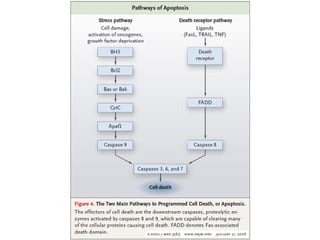
• Genes that regulate Apoptosis, and
• Genes involved in DNA repair
They are the principal targets of genetic damage
Oncogenes encode proteins that control
Cell proliferation,
Apoptosis,
Or both
Products of oncogenes
The products of oncogenes can be classified into
six broad groups:
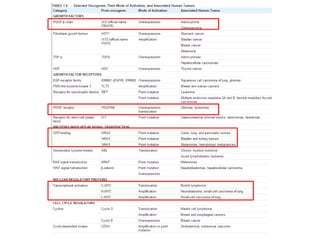
1.Growth factors
2.Growth factor receptors
3.Transcription factors
4.Signal transducers
5.Apoptosis regulators and
6.Chromatin remodelers
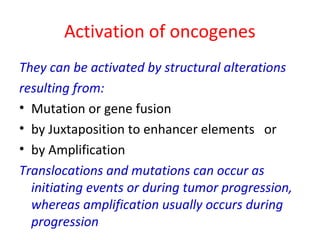
Activation of oncogenes
They can be activated by structural alterations
resulting from:
• Mutation or gene fusion
• by Juxtaposition to enhancer elements or
• by Amplification
Translocations and mutations can occur as
initiating events or during tumor progression,
whereas amplification usually occurs during
progression
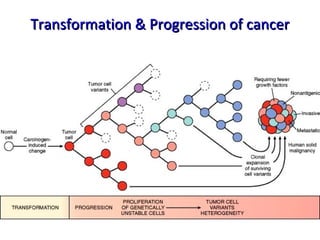
Transformation & Progression of cancerTransformation & Progression of cancer
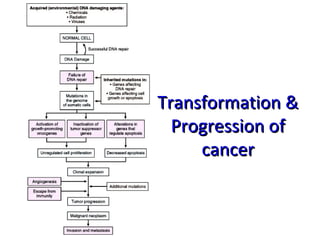
Transformation &Transformation &
Progression ofProgression of
cancercancer
Two main properties of cancers
They are:
• Autonomous &
• Eternal
Oncogenes
Genes that promote autonomous
cell growth in cancer cells are
called oncogenes
In short, cancer causing genes
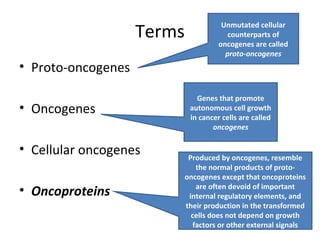
Terms
• Proto-oncogenes
• Oncogenes
• Cellular oncogenes
• Oncoproteins
Genes that promote
autonomous cell growth
in cancer cells are called
oncogenes
Unmutated cellular
counterparts of
oncogenes are called
proto-oncogenes
Produced by oncogenes, resemble
the normal products of proto-
oncogenes except that oncoproteins
are often devoid of important
internal regulatory elements, and
their production in the transformed
cells does not depend on growth
factors or other external signals
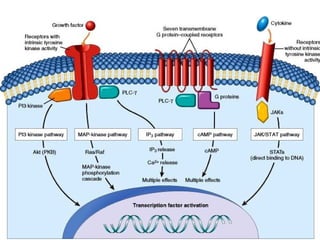
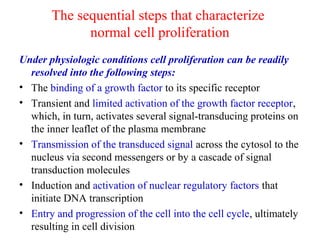
The sequential steps that characterize
normal cell proliferation
Under physiologic conditions cell proliferation can be readily
resolved into the following steps:  
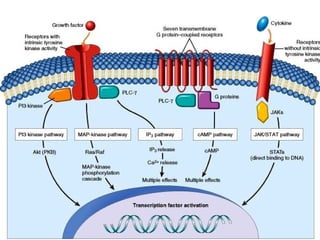
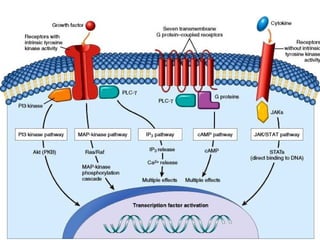
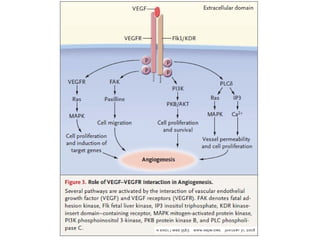
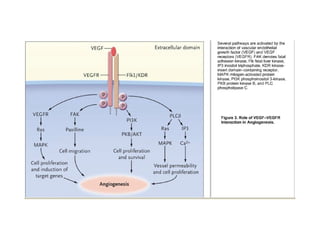
• The binding of a growth factor to its specific receptor
• Transient and limited activation of the growth factor receptor,
which, in turn, activates several signal-transducing proteins on
the inner leaflet of the plasma membrane
• Transmission of the transduced signal across the cytosol to the
nucleus via second messengers or by a cascade of signal
transduction molecules
• Induction and activation of nuclear regulatory factors that
initiate DNA transcription
• Entry and progression of the cell into the cell cycle, ultimately
resulting in cell division
Proto-oncogenes, Oncogenes, and OncoproteinsProto-oncogenes, Oncogenes, and Oncoproteins
 Proteins encoded by proto-oncogenes may function
as growth factors or their receptors, signal
transducers, transcription factors, or cell cycle
components
 Oncoproteins encoded by oncogenes generally
serve functions similar to their normal counterparts
However,
 the oncoproteins endow the cell with self-sufficiency
in growth
Growth Factors
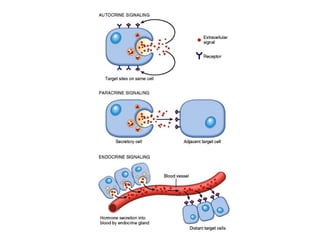
• Most soluble growth factors are made by one
cell type and act on a neighboring cell to
stimulate proliferation - paracrine action
• Cancer cells, however, acquire the ability to
synthesize the same growth factors to which
they are responsive, generating an autocrine
loop
• Note:
– In most instances the growth factor gene itself is not
altered or mutated
– They are forced to secrete large amounts of growth
factor
Growth Factors
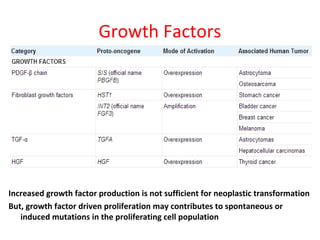
Increased growth factor production is not sufficient for neoplastic transformation
But, growth factor driven proliferation may contributes to spontaneous or
induced mutations in the proliferating cell population
Growth Factor Receptors
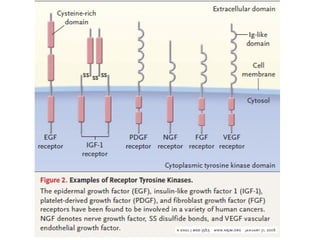
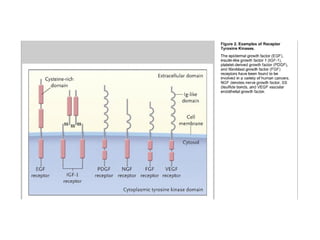
• GF receptors are transmembrane proteins
with an external ligand-binding domain and a
cytoplasmic tyrosine kinase domain
• GF binding results in dimerization of and
tyrosine phosphorylation of several
substances down the signalling cascade
• The oncogenic versions of these receptors are
associated with constitutive dimerization and
activation without binding to the growth
factor
Growth Factor Receptors
Growth factor receptors can be constitutively
activated in tumors by multiple different
mechanisms:
–Mutations
–Gene rearrangements
–Overexpression
Growth Factor Receptors
Example: RET oncogene
In MEN-2A: mutations in the RET extracellular domain
cause constitutive dimerization and activation,
leading to medullary thyroid carcinomas and
adrenal and parathyroid tumors.
In MEN-2B: mutations in the RET cytoplasmic domain
alter the substrate specificity of the tyrosine kinase
and lead to thyroid and adrenal tumors without
involvement of the parathyroid
Growth Factor Receptors
Example: c-Kit, PDGFR oncogene
• Greater than 90% of GIST have a
constitutively activating mutation in the
receptor tyrosine kinase c-KIT or PDGFR,
which are the receptors for stem cell factor
and PDGF, respectively
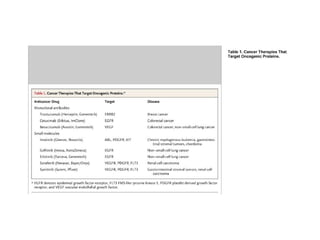
• Targeted therapy: Imatinib
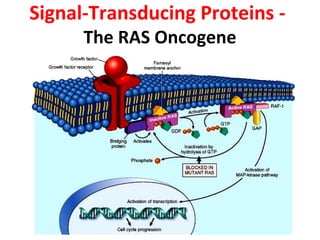
Signal-Transducing Proteins
• Most such proteins are strategically located
on the inner leaflet of the plasma membrane,
where they receive signals from outside the
cell (e.g., by activation of growth factor
receptors) and transmit them to the cell's
nucleus
Eg: RAS family of guanine triphosphate (GTP)-
binding proteins (G proteins)
Signal-Transducing Proteins -
The RAS Oncogene
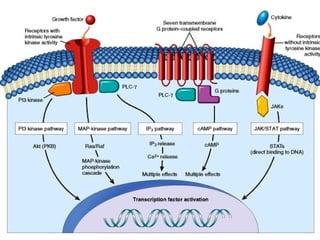
Alterations in Nonreceptor
Tyrosine Kinases
• Non-receptor-associated tyrosine kinases
normally function in signal transduction
pathways that regulate cell growth
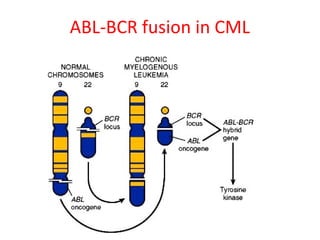
• Mutations take the form of chromosomal
translocations or rearrangements that create
fusion genes encoding constitutively active
tyrosine kinases
Eg: c-ABL tyrosine kinase: BCR-ABL fusion gene
- constitutively active, oncogenic BCR-ABL
tyrosine kinase - Imatinib
ABL-BCR fusion in CML
Transcription Factors
• A host of oncoproteins, including products of
the MYC, MYB, JUN, FOS, and REL oncogenes,
are transcription factors that regulate the
expression of growth-promoting genes, such
as cyclins
• Of these, MYC is most commonly involved in
human tumors
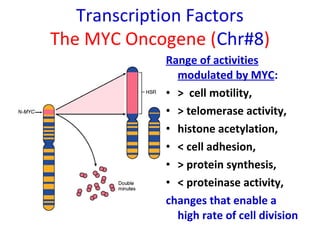
Transcription Factors
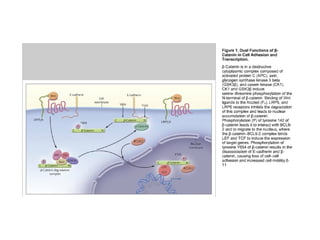
The MYC Oncogene (Chr#8)
Range of activities
modulated by MYC:
• > cell motility,
• > telomerase activity,
• histone acetylation,
• < cell adhesion,
• > protein synthesis,
• < proteinase activity,
changes that enable a
high rate of cell division
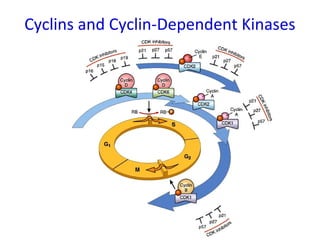
Cyclins and Cyclin-Dependent Kinases
END
Molecular biologyofca csbrp

Molecular biologyofca csbrp

  • 1.
  • 2.
    Four classes ofnormal regulatory genes • Growth-promoting Proto-oncogenes, • Growth-inhibiting Tumor suppressor genes, • Genes that regulate Apoptosis, and • Genes involved in DNA repair They are the principal targets of genetic damage
  • 3.
    Oncogenes encode proteinsthat control Cell proliferation, Apoptosis, Or both
  • 4.
    Products of oncogenes Theproducts of oncogenes can be classified into six broad groups: 1.Growth factors 2.Growth factor receptors 3.Transcription factors 4.Signal transducers 5.Apoptosis regulators and 6.Chromatin remodelers
  • 6.
    Activation of oncogenes Theycan be activated by structural alterations resulting from: • Mutation or gene fusion • by Juxtaposition to enhancer elements or • by Amplification Translocations and mutations can occur as initiating events or during tumor progression, whereas amplification usually occurs during progression
  • 7.
    Transformation & Progressionof cancerTransformation & Progression of cancer
  • 8.
    Transformation &Transformation & ProgressionofProgression of cancercancer
  • 9.
    Two main propertiesof cancers They are: • Autonomous & • Eternal
  • 10.
    Oncogenes Genes that promoteautonomous cell growth in cancer cells are called oncogenes In short, cancer causing genes
  • 11.
    Terms • Proto-oncogenes • Oncogenes •Cellular oncogenes • Oncoproteins Genes that promote autonomous cell growth in cancer cells are called oncogenes Unmutated cellular counterparts of oncogenes are called proto-oncogenes Produced by oncogenes, resemble the normal products of proto- oncogenes except that oncoproteins are often devoid of important internal regulatory elements, and their production in the transformed cells does not depend on growth factors or other external signals
  • 12.
    The sequential stepsthat characterize normal cell proliferation Under physiologic conditions cell proliferation can be readily resolved into the following steps:   • The binding of a growth factor to its specific receptor • Transient and limited activation of the growth factor receptor, which, in turn, activates several signal-transducing proteins on the inner leaflet of the plasma membrane • Transmission of the transduced signal across the cytosol to the nucleus via second messengers or by a cascade of signal transduction molecules • Induction and activation of nuclear regulatory factors that initiate DNA transcription • Entry and progression of the cell into the cell cycle, ultimately resulting in cell division
  • 14.
    Proto-oncogenes, Oncogenes, andOncoproteinsProto-oncogenes, Oncogenes, and Oncoproteins  Proteins encoded by proto-oncogenes may function as growth factors or their receptors, signal transducers, transcription factors, or cell cycle components  Oncoproteins encoded by oncogenes generally serve functions similar to their normal counterparts However,  the oncoproteins endow the cell with self-sufficiency in growth
  • 16.
    Growth Factors • Mostsoluble growth factors are made by one cell type and act on a neighboring cell to stimulate proliferation - paracrine action • Cancer cells, however, acquire the ability to synthesize the same growth factors to which they are responsive, generating an autocrine loop • Note: – In most instances the growth factor gene itself is not altered or mutated – They are forced to secrete large amounts of growth factor
  • 18.
    Growth Factors Increased growthfactor production is not sufficient for neoplastic transformation But, growth factor driven proliferation may contributes to spontaneous or induced mutations in the proliferating cell population
  • 20.
    Growth Factor Receptors •GF receptors are transmembrane proteins with an external ligand-binding domain and a cytoplasmic tyrosine kinase domain • GF binding results in dimerization of and tyrosine phosphorylation of several substances down the signalling cascade • The oncogenic versions of these receptors are associated with constitutive dimerization and activation without binding to the growth factor
  • 21.
    Growth Factor Receptors Growthfactor receptors can be constitutively activated in tumors by multiple different mechanisms: –Mutations –Gene rearrangements –Overexpression
  • 22.
    Growth Factor Receptors Example:RET oncogene In MEN-2A: mutations in the RET extracellular domain cause constitutive dimerization and activation, leading to medullary thyroid carcinomas and adrenal and parathyroid tumors. In MEN-2B: mutations in the RET cytoplasmic domain alter the substrate specificity of the tyrosine kinase and lead to thyroid and adrenal tumors without involvement of the parathyroid
  • 23.
    Growth Factor Receptors Example:c-Kit, PDGFR oncogene • Greater than 90% of GIST have a constitutively activating mutation in the receptor tyrosine kinase c-KIT or PDGFR, which are the receptors for stem cell factor and PDGF, respectively • Targeted therapy: Imatinib
  • 24.
    Signal-Transducing Proteins • Mostsuch proteins are strategically located on the inner leaflet of the plasma membrane, where they receive signals from outside the cell (e.g., by activation of growth factor receptors) and transmit them to the cell's nucleus Eg: RAS family of guanine triphosphate (GTP)- binding proteins (G proteins)
  • 25.
  • 26.
    Alterations in Nonreceptor TyrosineKinases • Non-receptor-associated tyrosine kinases normally function in signal transduction pathways that regulate cell growth • Mutations take the form of chromosomal translocations or rearrangements that create fusion genes encoding constitutively active tyrosine kinases Eg: c-ABL tyrosine kinase: BCR-ABL fusion gene - constitutively active, oncogenic BCR-ABL tyrosine kinase - Imatinib
  • 28.
  • 29.
    Transcription Factors • Ahost of oncoproteins, including products of the MYC, MYB, JUN, FOS, and REL oncogenes, are transcription factors that regulate the expression of growth-promoting genes, such as cyclins • Of these, MYC is most commonly involved in human tumors
  • 30.
    Transcription Factors The MYCOncogene (Chr#8) Range of activities modulated by MYC: • > cell motility, • > telomerase activity, • histone acetylation, • < cell adhesion, • > protein synthesis, • < proteinase activity, changes that enable a high rate of cell division
  • 31.
  • 32.

Editor's Notes

  • #7 They can be activated by structural alterations resulting from: mutation or gene fusion by juxtaposition to enhancer elements or by amplification Translocations and mutations can occur as initiating events or during tumor progression, whereas amplification usually occurs during progression.
  • #8 FIGURE 7-24  Tumor progression and generation of heterogeneity. New subclones arise from the descendants of the original transformed cell by multiple mutations. With progression the tumor mass becomes enriched for variants that are more adept at evading host defenses and are likely to be more aggressive.
  • #12 Produced by oncogenes, resemble the normal products of proto-oncogenes except that oncoproteins are often devoid of important internal regulatory elements, and their production in the transformed cells does not depend on growth factors or other external signals.

  • #15 Proteins encoded by proto-oncogenes may function as growth factors or their receptors, signal transducers, transcription factors, or cell cycle components Oncoproteins encoded by oncogenes generally serve functions similar to their normal counterparts However, mutations convert proto-oncogenes into constitutively active cellular oncogenes that are involved in tumor development because the oncoproteins they encode endow the cell with self-sufficiency in growth
  • #17 Growth Factors. Normal cells require stimulation by growth factors to undergo proliferation. Most soluble growth factors are made by one cell type and act on a neighboring cell to stimulate proliferation (paracrine action). Many cancer cells, however, acquire the ability to synthesize the same growth factors to which they are responsive, generating an autocrine loop. For example, many glioblastomas secrete platelet-derived growth factor (PDGF) and express the PDGF receptor, and many sarcomas make both transforming growth factor α (TGF-α) and its receptor. Although an autocrine loop is considered to be an important element in the pathogenesis of several tumors, in most instances the growth factor gene itself is not altered or mutated. More commonly, products of other oncogenes that lie along many signal transduction pathways, such as RAS, cause overexpression of growth factor genes, thus forcing the cells to secrete large amounts of growth factors, such as TGF-α. Nevertheless, increased growth factor production is not sufficient for neoplastic transformation. In all likelihood growth factor driven proliferation contributes to the malignant phenotype by increasing the risk of spontaneous or induced mutations in the proliferating cell population.
  • #19 increased growth factor production is not sufficient for neoplastic transformation. In all likelihood growth factor driven proliferation contributes to the malignant phenotype by increasing the risk of spontaneous or induced mutations in the proliferating cell population.
  • #30 In the human genome, Myc is located on chromosome 8 and is believed to regulate expression of 15% of all genes[2] through binding on Enhancer Box sequences (E-boxes) and recruiting histone acetyltransferases (HATs)
  • #32 FIGURE 7-29  Schematic illustration of the role of cyclins, CDKs, and CDK inhibitors (CDKIs) in regulating the cell cycle. The shaded arrows represent the phases of the cell cycle during which specific cyclin-CDK complexes are active. As illustrated, cyclin D–CDK4, cyclin D–CDK6, and cyclin E–CDK2 regulate the G1-to-S transition by phosphorylation of the RB protein (pRB). Cyclin A–CDK2 and cyclin A–CDK1 are active in the S phase. Cyclin B–CDK1 is essential for the G2-to-M transition. Two families of CDKIs can block activity of CDKs and progression through the cell cycle. The so-called INK4 inhibitors, composed of p16, p15, p18, and p19, act on cyclin D–CDK4 and cyclin D–CDK6. The other family of three inhibitors, p21, p27, and p57, can inhibit all CDKs. =================== Cyclins and Cyclin-Dependent Kinases. The ultimate outcome of all growth-promoting stimuli is the entry of quiescent cells into the cell cycle. Cancers may grow autonomously if the genes that drive the cell cycle become dysregulated by mutations or amplification. As described in Chapter 3 , the orderly progression of cells through the various phases of the cell cycle is orchestrated by cyclin-dependent kinases (CDKs), which are activated by binding to cyclins, so called because of the cyclic nature of their production and degradation. The CDK-cyclin complexes phosphorylate crucial target proteins that drive the cell through the cell cycle. On completion of this task, cyclin levels decline rapidly. More than 15 cyclins have been identified; cyclins D, E, A, and B appear sequentially during the cell cycle and bind to one or more CDK. The cell cycle may thus be seen as a relay race in which each lap is regulated by a distinct set of cyclins, and as one set of cyclins leaves the track, the next set takes over ( Fig. 7-29 and Table 7-7 ). =================