SOBIA RAFIQ
BIOCHEMISTRY DEPT

 Introduction
 Components
 Mechanism
 Products of pathway
 Association with cancer
 CNS disorders and AKT pathway
Content :

 PI3K-Akt-Mtor Pathway is an intracellular signal
transduction pathway.
 Promotes metabolism, proliferation, cell survival,
growth and angiogenesis in response to extracellular
signals.
 Key proteins are AKT and PI3K.
INTRODUCTION :

 The key molecules involved in this pathway are:
 Receptor tyrosine kinase (RTKs).
 Phosphatidylinositol 3-kinase (PI3K)
 Phosphatidylinositol-4,5-bisphosphate (PIP2)
 Phosphatidylinositol-3,4,5-triphosphate (PIP3)
 AKT/protein kinase B.
COMPONENTS OF
PATHWAY:
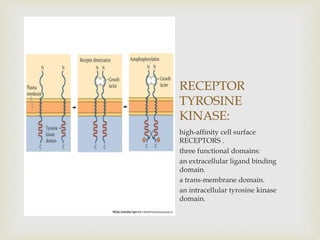
RECEPTOR
TYROSINE
KINASE:
high-affinity cell surface
RECEPTORS .
three functional domains:
an extracellular ligand binding
domain.
a trans-membrane domain.
an intracellular tyrosine kinase
domain.
PHOSPHATIDYLI
NOSITOL 3-
KINASE:
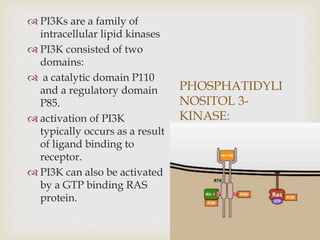
 PI3Ks are a family of
intracellular lipid kinases
 PI3K consisted of two
domains:
 a catalytic domain P110
and a regulatory domain
P85.
 activation of PI3K
typically occurs as a result
of ligand binding to
receptor.
 PI3K can also be activated
by a GTP binding RAS
protein.

 PIP2 and PIP3 are minor phospholipid components
of cell membranes.
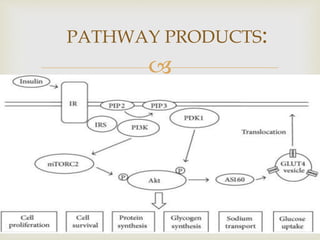
 In PI3K-AKT pathway, the 3 position phosphate
group of PIP3 can bind to AKT protein and
recruiting AKT protein at the plasma membrane.
 AKT can also be activated by
PDPK1.(Phosphoinositide-dependant protein kinase)
PIP2 AND PIP3

 AKT also named as protein kinase B.
 Serine/threonine-specific protein kinase
 Role in multiple cellular processes.
 Once activated, at threonine-308 and at serine 473 it
regulates the function via phosphorylation activation
or suppression of a broad array of proteins .
 Involved in different functions.
AKT:

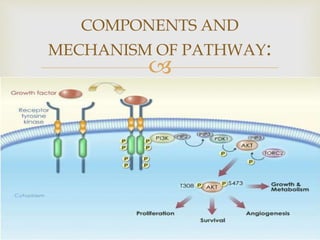
COMPONENTS AND
MECHANISM OF PATHWAY:

PATHWAY PRODUCTS:

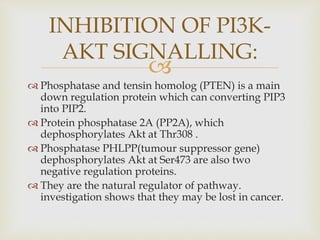
 Phosphatase and tensin homolog (PTEN) is a main
down regulation protein which can converting PIP3
into PIP2.
 Protein phosphatase 2A (PP2A), which
dephosphorylates Akt at Thr308 .
 Phosphatase PHLPP(tumour suppressor gene)
dephosphorylates Akt at Ser473 are also two
negative regulation proteins.
 They are the natural regulator of pathway.
investigation shows that they may be lost in cancer.
INHIBITION OF PI3K-
AKT SIGNALLING:

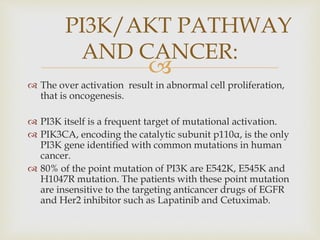
 The over activation result in abnormal cell proliferation,
that is oncogenesis.
 PI3K itself is a frequent target of mutational activation.
 PIK3CA, encoding the catalytic subunit p110α, is the only
PI3K gene identified with common mutations in human
cancer.
 80% of the point mutation of PI3K are E542K, E545K and
H1047R mutation. The patients with these point mutation
are insensitive to the targeting anticancer drugs of EGFR
and Her2 inhibitor such as Lapatinib and Cetuximab.
PI3K/AKT PATHWAY
AND CANCER:

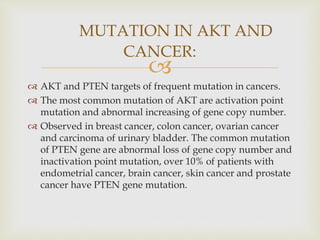
 AKT and PTEN targets of frequent mutation in cancers.
 The most common mutation of AKT are activation point
mutation and abnormal increasing of gene copy number.
 Observed in breast cancer, colon cancer, ovarian cancer
and carcinoma of urinary bladder. The common mutation
of PTEN gene are abnormal loss of gene copy number and
inactivation point mutation, over 10% of patients with
endometrial cancer, brain cancer, skin cancer and prostate
cancer have PTEN gene mutation.
MUTATION IN AKT AND
CANCER:

 Dysregulation of this node has been regarded as a
root cause of several neurodevelopmental diseases
such as:
 megalencephaly (“big brain”)
 microcephaly (“small brain”)
 autism spectrum disorders
 intellectual disability, schizophrenia, and epilepsy.
AKT PATHWAY AND
CNS:

 Dysregulation of this node has been regarded as a
root cause of several neurodevelopmental diseases
such as:
 megalencephaly (“big brain”)
 microcephaly (“small brain”)
 autism spectrum disorders
 intellectual disability, schizophrenia, and epilepsy.
AKT PATHWAY AND
CNS:

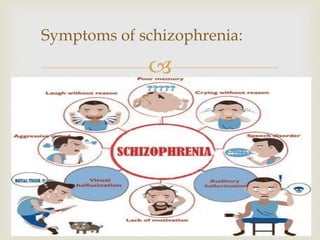
Symptoms of schizophrenia:

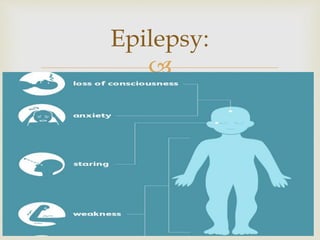
Epilepsy:

pI3K pathway

  • 1.
  • 2.
      Introduction  Components Mechanism  Products of pathway  Association with cancer  CNS disorders and AKT pathway Content :
  • 3.
      PI3K-Akt-Mtor Pathwayis an intracellular signal transduction pathway.  Promotes metabolism, proliferation, cell survival, growth and angiogenesis in response to extracellular signals.  Key proteins are AKT and PI3K. INTRODUCTION :
  • 4.
      The keymolecules involved in this pathway are:  Receptor tyrosine kinase (RTKs).  Phosphatidylinositol 3-kinase (PI3K)  Phosphatidylinositol-4,5-bisphosphate (PIP2)  Phosphatidylinositol-3,4,5-triphosphate (PIP3)  AKT/protein kinase B. COMPONENTS OF PATHWAY:
  • 5.
    RECEPTOR TYROSINE KINASE: high-affinity cell surface RECEPTORS. three functional domains: an extracellular ligand binding domain. a trans-membrane domain. an intracellular tyrosine kinase domain.
  • 6.
    PHOSPHATIDYLI NOSITOL 3- KINASE:  PI3Ksare a family of intracellular lipid kinases  PI3K consisted of two domains:  a catalytic domain P110 and a regulatory domain P85.  activation of PI3K typically occurs as a result of ligand binding to receptor.  PI3K can also be activated by a GTP binding RAS protein.
  • 7.
      PIP2 andPIP3 are minor phospholipid components of cell membranes.  In PI3K-AKT pathway, the 3 position phosphate group of PIP3 can bind to AKT protein and recruiting AKT protein at the plasma membrane.  AKT can also be activated by PDPK1.(Phosphoinositide-dependant protein kinase) PIP2 AND PIP3
  • 8.
      AKT alsonamed as protein kinase B.  Serine/threonine-specific protein kinase  Role in multiple cellular processes.  Once activated, at threonine-308 and at serine 473 it regulates the function via phosphorylation activation or suppression of a broad array of proteins .  Involved in different functions. AKT:
  • 9.
  • 10.
  • 11.
      Phosphatase andtensin homolog (PTEN) is a main down regulation protein which can converting PIP3 into PIP2.  Protein phosphatase 2A (PP2A), which dephosphorylates Akt at Thr308 .  Phosphatase PHLPP(tumour suppressor gene) dephosphorylates Akt at Ser473 are also two negative regulation proteins.  They are the natural regulator of pathway. investigation shows that they may be lost in cancer. INHIBITION OF PI3K- AKT SIGNALLING:
  • 12.
      The overactivation result in abnormal cell proliferation, that is oncogenesis.  PI3K itself is a frequent target of mutational activation.  PIK3CA, encoding the catalytic subunit p110α, is the only PI3K gene identified with common mutations in human cancer.  80% of the point mutation of PI3K are E542K, E545K and H1047R mutation. The patients with these point mutation are insensitive to the targeting anticancer drugs of EGFR and Her2 inhibitor such as Lapatinib and Cetuximab. PI3K/AKT PATHWAY AND CANCER:
  • 13.
      AKT andPTEN targets of frequent mutation in cancers.  The most common mutation of AKT are activation point mutation and abnormal increasing of gene copy number.  Observed in breast cancer, colon cancer, ovarian cancer and carcinoma of urinary bladder. The common mutation of PTEN gene are abnormal loss of gene copy number and inactivation point mutation, over 10% of patients with endometrial cancer, brain cancer, skin cancer and prostate cancer have PTEN gene mutation. MUTATION IN AKT AND CANCER:
  • 14.
      Dysregulation ofthis node has been regarded as a root cause of several neurodevelopmental diseases such as:  megalencephaly (“big brain”)  microcephaly (“small brain”)  autism spectrum disorders  intellectual disability, schizophrenia, and epilepsy. AKT PATHWAY AND CNS:
  • 15.
      Dysregulation ofthis node has been regarded as a root cause of several neurodevelopmental diseases such as:  megalencephaly (“big brain”)  microcephaly (“small brain”)  autism spectrum disorders  intellectual disability, schizophrenia, and epilepsy. AKT PATHWAY AND CNS:
  • 16.
  • 17.

Editor's Notes

  • #4  phosphatidylinositol 3–kinase (PI3K) AKT is a gene that was first found in retroviruses as AKT-8 so in humans it is also called as AKT. Angiogenisis is development of new blood vessels.
  • #6 Ligand binding dimerize the receptor sending signals to inside of cell through trans membrane domain. and further activation occur.
  • #12 (PH domain and Leucine rich repeat Protein Phosphatases) PHLPP