Lymphomas
Dr.CSBR.Prasad, M.D.
Lymphoreticular system
Techniques to study the nature of
lymphomas (1970 onwards)
• 1-Immunophenotyping
• 2-Cytogenetics
• 3-Molecular analysis
Immunophenotyping
• Helps to differentiate benign from
malignant process
• Helps to differentiate B & T cell neoplasms
• Helps to subcategorize B & T cell
lymphomas
Immunophenotyping
• Commonly three methods are used and they
yeild similar results.
1-Immunohistochemistry (IHC)
2-Immunofluorescence (IF)
3-Flow cytometry
Immunophenotyping
Attached enzymes (usually horse radish peroxidase or
alkaline phosphatase), or a fluorescent substance is tagged
to the antibodies
Immunophenotyping - IHC
Can you tell them apart?
One panel shows the small lymphoid cells from a case
of small lymphocytic lymphoma. The other shows
benign small lymphocytes from a reactive lymph
node. Which is which?
CD3, a pan-T-cell marker
Immunophenotyping - IHC
CD20 (L26), a pan-B-cell marker.
CD20 postivity in B-cell neoplasm
Immunophenotyping - IHC
• All lymphoid cells are reactive for CD45 (leukocyte common
antigen, or LCA).
• B-cells: are reactive for CD19, CD20 and CD22. Certain low-
grade B-cell lymphomas are reactive for two markers otherwise
usually found on T-cells: CD5 and CD43. Follicular center cell
lymphomas (as well as very different fish, lymphoblastic
lymphomas) are frequently CD10(+).
• T-cells: Pan T-cell markers (present on almost all T-cells)
include CD2, CD3, CD5, and CD7 (the early childhood
markers). Most T-cells mark with either CD4 (helper cells) or
CD8 (suppressor cells or cytotoxic cells).
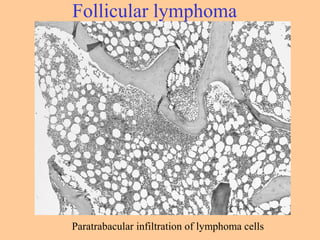
• Natural-killer cells: These are frequently associated with
CD16, CD56, or CD57.
Immunophenotyping – IHC
Cluster Designation Numbers
Immunophenotyping – Flow
cytometry
Techniques to study the nature of
lymphomas (1970 onwards)
• 1-Immunophenotyping
• 2-Cytogenetics
• 3-Molecular analysis
Cytogenetics
• Helps to identify translocation, deletions
etc.
• Examples:
Burkitt’s t(8;14)
Mantle cell lymphoma t(11;14)
ALCL t(2;5)
Follicular lymphoma t(14;18)
Techniques to study the nature of
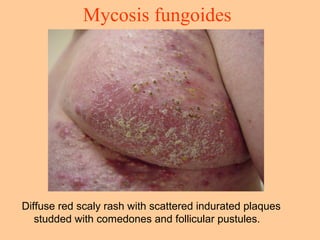
lymphomas
• Molecular analysis is used to find out
--Ig gene rearrangement in B-cell
malignancies and
--T-cell receptor gene rearrangement in
T-cell malignancies.
These rearrangements are too subtle to be
detected by conventional cytogenetics.
Important points regarding
lymphoid neoplasms
• There is no benign lymphoid neoplasm.
• Lymphomas are diagnosed by histological examination of the
lymphnode or the involved tissue.
• Some times it’s necessary to use markers to differentiate
reactive process from lymphomas.
• B-cell lymphomas are the most common variety (80-85%).
• In patients with lymphomas immune abnormalities are very
common. (infections, autoimmunity and second malignancy).
• NHL from the start is a widely disseminated neoplasm.
• Spread of NHL is unpredictable where as spread in HD is
predictable.
• Clinical presentation: NHL: 2/3 - nodal, 1/3 - extranodal
HD: ~100% nodal.
Classification of Lymphomas
Helps in :
1-recognising a lymphoma by their features.
2-grouping them to understand the biological
principle that underlie their apperance.
3-assessing the prognosis and give guidance
in Tx.
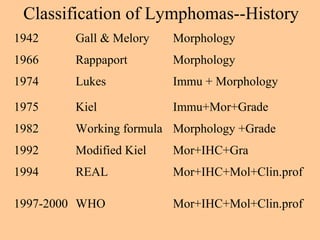
Classification of Lymphomas--History
1942 Gall & Melory Morphology
1966 Rappaport Morphology
1974 Lukes Immu + Morphology
1975 Kiel Immu+Mor+Grade
1982 Working formula Morphology +Grade
1992 Modified Kiel Mor+IHC+Gra
1994 REAL Mor+IHC+Mol+Clin.prof
1997-2000 WHO Mor+IHC+Mol+Clin.prof
Classification of NHL:
1. Non Gall-Rappaport lymphoma
2. Non Rappaport-Non-Gall-Lukes Lymphoma
3. Non Lukes-Kiel lymphoma
4. Non Rappaport-Non Kiel-Non Gall-Non
Lukes lymphoma
Classification of Lymphomas--History
Source: Letter published in ‘The Lancet.’ during late 70s.
• A large study at the NCI looked at 1175
cases of non-Hodgkin's lymphoma with
respect to different types of
classification.
• “… and concluded that each of the
classifications had clinical value but
none was clearly superior.” !!!!!!
Classification of Lymphomas--History
1942 Gall & Melory Morphology
1966 Rappaport Morphology
1974 Lukes Immu + Morphology
1975 Kiel Immu+Mor+Grade
1982 Working formula Morphology +Grade
1992 Modified Kiel Mor+IHC+Gra
1994 REAL Mor+IHC+Mol+Clin.prof
1997-2000 WHO Mor+IHC+Mol+Clin.prof
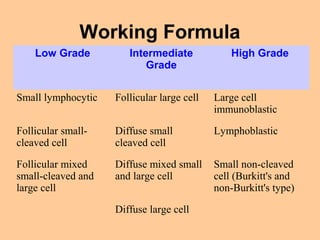
Working Formulation:
• based solely on the morphology of H&E
stained sections
• intended to translate among the previous
classifications, not to replace them.
• categories do have clinical validity
(therapeutic and prognostic)and are based on
relatively simple, reproducible morphologic
features.
Classification of Lymphomas--History
• The criteria are both architectural (low magnification) and cytological
(high magnification):
1. Architectural
diffuse proliferation
follicular proliferation
1. Cytological
Nuclear outline
cleaved (indented)
non-cleaved
Cell size
small
large
mixed small and large
Classification of Lymphomas--History
Working Formula
Low Grade Intermediate
Grade
High Grade
Small lymphocytic Follicular large cell Large cell
immunoblastic
Follicular small-
cleaved cell
Diffuse small
cleaved cell
Lymphoblastic
Follicular mixed
small-cleaved and
large cell
Diffuse mixed small
and large cell
Small non-cleaved
cell (Burkitt's and
non-Burkitt's type)
Diffuse large cell
• As the years have rolled by, many
lymphomas have been distinguished as
individual entities with the help of
immunologic, cytogenetic and
molecular techniques.
• These lymphomas appear to be unique
diseases.
Classification of Lymphomas--History
1942 Gall & Melory Morphology
1966 Rappaport Morphology
1974 Lukes Immu + Morphology
1975 Kiel Immu+Mor+Grade
1982 Working formula Morphology +Grade
1992 Modified Kiel Mor+IHC+Gra
1994 REAL Mor+IHC+Mol+Clin.prof
1997-2000 WHO Mor+IHC+Mol+Clin.prof
WHO classification of lymphomas:
1-The World Health Organization (WHO) classification is a
modification of the Revised European-American Lymphoma
(REAL) classification.
2-Lymphomas are classified based on Morphology, IHC,
Molecular abnormality and Clinical profile.
3-This classification recognizes 3 major categories of lymphoid
malignancies based on morphology and cell lineage (B-cell,
T/NK cell & Hodgkin’s Lymphoma).
4-Both lymphomas and lymphoid leukemias are included in this
classification.
ex: B cell CLL & SLL
Lymphoblastic lymphoma & T-cell acute lymphocytic
leukemia
WHO classification of lymphomas
•B-cell neoplasms
•Precursor B-cell neoplasms
•Precursor B-cell acute lymphoblastic leukemia (B ALL)
•Lymphoblastic lymphoma
•Peripheral B-cell neoplasms
•B-cell CLL/small lymphocytic lymphoma
•B-cell prolymphocytic leukemia
•Lymphoplasmacytic lymphoma/immunocytoma
•Mantle cell lymphoma
•Follicular lymphoma
•Extranodal marginal zone B-cell lymphoma of mucosa-associated
lymphoid tissue (MALT) type
•Nodal marginal zone lymphoma (with or without monocytoid B-cells)
•Splenic marginal zone lymphoma (with or without villous lymphocytes)
•Hairy cell leukemia
•Plasmacytoma/plasma cell myeloma
•Diffuse large B-cell lymphoma
•Burkitt lymphoma
•T-cell and putative NK-cell neoplasms
•Precursor T-cell neoplasms
•Precursor T-cell acute lymphoblastic leukemia (T-ALL)
•Lymphoblastic lymphoma
•Peripheral T-cell and NK-cell neoplasms
•T-cell CLL/prolymphocytic lymphoma
•T-cell granular lymphocytic leukemia
•Mycosis fungoides/Sézary syndrome
•Peripheral T-cell lymphoma, not otherwise characterized
•Hepatosplenic gamma/delta T-cell lymphoma
•Subcutaneous panniculitislike T-cell lymphoma
•Angioimmunoblastic T-cell lymphoma
•Extranodal T-cell/NK-cell lymphoma, nasal type
•Enteropathy-type intestinal T-cell lymphoma
•Adult T-cell lymphoma/leukemia (with human T-cell leukemia virus type 1 [HTLV-1])
•Anaplastic large cell lymphoma, primary systemic type
•Anaplastic large cell lymphoma, primary cutaneous type
•Aggressive NK-cell leukemia
WHO classification of lymphomas
Acute lymphoblastic leukemia
--Mostly ALLs with lymphomatous presentation are
of pre T-cell type.
--They present as mediatinal masses
(Lymphadenopathy, thymic involvement) and
splenomegaly.
--Tdt is positive in 95% of the cases (present in both
B & T)
--To differentiate B from T immunotyping is
required.
--It’s also important to differentiate ALL from
myeloid leukemia.
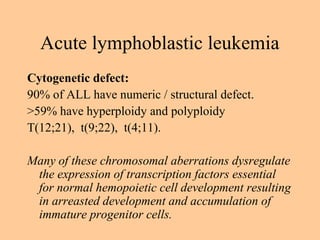
Cytogenetic defect:
90% of ALL have numeric / structural defect.
>59% have hyperploidy and polyploidy
T(12;21), t(9;22), t(4;11).
Many of these chromosomal aberrations dysregulate
the expression of transcription factors essential
for normal hemopoietic cell development resulting
in arreasted development and accumulation of
immature progenitor cells.
Acute lymphoblastic leukemia
Clinical features: Abrupt onset, anemia, fever, bleeding, Bone pain,
lymphadenopathy, hepatosplenomegaly, testicular involvement is
common in ALL, CNS manifestations.
Prognosis: In ALL is good.
90% achieve CR and 2/3 may be cured.
Worse prognosis:
-age <2years
-Presentation in adolescent and young adults
-peripheral blast count >1,00,000 (high tumor burden)
-presence of t(9;22)
Favourable prognosis:
-age between 2 & 10
-Low tumor burden
-early pre B-ALL phenotype
-t(12;21)
Acute lymphoblastic leukemia
CLL / SLL
Both are identical in morphologically, phenotypically and
genotypically.
But differ only in the degree of peripheral blood
lymphocytosis (CLL ab.lym.count >4000/cumm)
Histology:
1-Diffuse effacement of architecture of LN
2-populated by small lymphocytes
3-Proliferation centers (by prolymphocytes)
PBS & BM:
1-Lymphocytosis
2-Smudge cells
3-Non-paratrabacular aggregates of small lymphocytes.
Peripheral B-cell neoplasms
CLL / SLL
Proliferation center - prolymphocytes
CLL / SLL
Non-paratrabacular infiltration of lymphoma cells
CLL / SLL
Immunophenotyping:
B-cell markers CD19, CD20.
dim sIg.
characteristic CD23
Chrmosomal defects:
del 13q, 11q, 17q
Trisomy 12.
CF: >50y, often asymptomatic, Lymphadenopathy,
white count >2lakhs.
Richter syndrome
Lab: Hypogammaglobulinemia > infections
Autoantibodies > hemolytic anemia, &
CLL / SLL
A variant of SLL called "atypical SLL"
fails to express CD23; and like mantle
cell lymphoma it expresses bright CD20
and surface light chain and FMC7.
Often these are the cases with
trisomy12.
It may be mistaken for Mantle cell
lymphoma (cyclinD1+)
CLL / SLL
CLL/SLL
This lymphoma is very indolent but
relentless, with median survivals of
almost a decade.
Incurable
Follicular lymphoma
Most common form of NHL
Middle aged males
Histology:
Nodular & nodular diffuse growth patterns
Two cell types 1-Centrocyte, 2-centroblast
BM-Paratrabacular infiltration
Liver-portal triad infiltration
A follicular origin may also be inferred from a combination of
soft signs: immunophenotype (CD10+), cytogenetic t(14;18),
and morphologic (the presence of small cleaved B-cells).
Immunoprofiles:
CD19, 20, 10 +
sIg+
No CD5 (Differentiates from Mantle cell lymphoma)
BCL-2 over expression (differentiates it from reactive follicle)
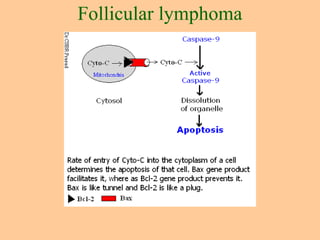
Follicular lymphoma
Cytogenetics:
Typical t(14;18)
Here H Ig gene of chr#14 is translocated to BCL-2 gene on chr#18.
This results in over expression of BCL2 and there by preventing
apoptosis.
CF: Indolent lymphoma and is incurable.
Survival 7-9yrs
Transformation to DLBL may occur (activation of c-Myc)
Follicular lymphoma
Follicular lymphoma
Follicles dispersed throughout the lymphnode with loss of
architecture
Follicular lymphoma
Follicular lymphoma
Berard’s grading of FL
Grades 1, 2 & 3
Follicular lymphoma
Paratrabacular infiltration of lymphoma cells
Follicular lymphoma
DLBCL
Males >60yrs
Histopath:
Large cells 4-5x the small lymphocyte
Diffuse growth pattern
Nucleus is round to oval vesicular with 2-3
nucleoli adjacent to the nuclear membrane.
There may be multinulceated giant cells
DLBCL
DLBCL
Several of these cells are excellent examples of the typical cell of large cell
lymphoma, the centroblast. It has open (clear) chromatin and several
moderately large nucleoli that cling to the nuclear membrane
DLBCL
The WHO classification of DLBCLs takes note of several
morphological variants:
• Centroblastic
• Immunoblastic
• T-cell/histiocyte-rich
• Lymphomatoid granulomatosis type
• Anaplastic B-cell
• Plasmablastic
as well as 3 specific subtypes:
• Mediastinal (thymic) large B-cell lymphoma
• Primary effusion lymphoma
• Intravascular large B-cell lymphoma
DLBCL-Intravascular lymphoma
Small blood vessels in the dermis plugged with tumor cells
Large vessel filled with lymphoma cells
DLBCL-Intravascular lymphoma
Angiotropic lymphoma, Large B-Cell
DLBCL-Intravascular lymphoma
DLBCL
Centroblastic type
Burkitt’s lymphoma
Burkitt's lymphomas come in at least 3 sorts, all of which are more prevalent in
males:
Endemic Burkitt's lymphoma (a WHO classification subtype): a childhood
lymphoma prevalent in equatorial Africa and intimately associated with both
Epstein-Barr virus infection and a characteristic translocation of the MYC gene.
Sporadic Burkitt's lymphoma (a WHO classification subtype): a world-wide
lymphoma affecting slightly older patients, also associated with MYC changes
but less so with EBV infection.
Burkitt's-like lymphoma (a WHO classification morphologic variant): a rather
different disease affecting an older population and not notably associated with
the MYC gene or EBV infection.
All 3 kinds have also been called "small non-cleaved cell lymphoma”
Molecular abnormalities:
All forms are associated with translocation of c-myc gene on
chr#8. The partner is usually the IgH locus on chr#14.
t(8;14) others t(8;22), t(2;8)
Immunophenotyping:
CD19, 20 and 10 +
BCL-6+
Clinical features:
Children and young adults
Extranodal sites are most commonly involved
Very aggressive
But, responds to chemotherapy well.
Burkitt’s lymphoma
Endemic burkitt’s most
commonly affects
Children and young
adults
&
Extranodal sites are
most commonly
involved
Burkitt’s lymphoma
Small non-cleaved cell, high magnification. Most nuclei have 1 or 2
prominent nucleoli. Note the "tingible body" macrophage at the left
with debris in its cytoplasm
Burkitt’s lymphoma
Burkitt’s lymphoma
Starry sky pattern
BURKITT'S CELL
Burkitt’s lymphoma
Mycosis fungoides / Sezary syndrome
NHL involving Helper T-cells (CD4+).
Has predilection to involve SKIN.
It’s an indolent lymphoma.
Stages: Premycotic phase, Plaque phase &
Tumor phase.
Mycosis fungoides
Histopathology:
• Infiltration of epidermis and upper dermis
by neoplastic T-cells.
• These cells have cerebriform nucleus (Sezry
cells)
• Extracutaneous spread occurs most
commonly to LN and BM.
Mycosis fungoides
Erythematous patches
Mycosis fungoides
Multiple confluent purple
0.5-2 cm nodules some
with overlying crust and
scale
Asymptomatic red plaques on chest, abdomen, back and proximal
extremities that waxed and waned for several years before they
were clinically evaluated and biopsied.
Mycosis fungoides
Diffuse red scaly rash with scattered indurated plaques
studded with comedones and follicular pustules.
Mycosis fungoides
There is a dense mononuclear cell infiltrate throughout
the dermis with focal epidermal erosion.
Mycosis fungoides
Exocytosis is present (arrow)
.
Mycosis fungoides
Numerous eosinophils and plasma cells are present in
the infiltrate.
Mycosis fungoides
Another high power view
showing prominent
lymphocytic exocytosis
without spongiosis or
keratinocyte hole
formation. Also note
the coarse collagen
fibers in the papillary
dermis
Mycosis fungoides
Immunohistochemical staining shows increased
numbers of CD4 positive lymphocytes.
Mycosis fungoides
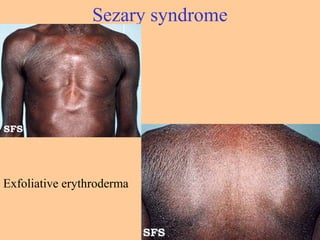
Sezary syndrome
Features:
• Generalized exfoliative erythroderma
• No tumefactions
• Associated with Leukemia of Sezary cells
• Indolent lymphoma with 8-9yrs survival
• Transformation to large cell lymphoma can
occur as a terminal event.
Sezary syndrome
Exfoliative erythroderma
Sezary syndrome
This is a cerebriform lymphocyte from a patient with Sezary's syndrome. It
is an abnormal lymphocyte. It has super-clumped chromatin with large
aggregates or blocks. The cytoplasm is blue and scanty.
Sezary syndrome
Sezary cells are atypical lymphocytes with a grooved or cerebriform nucleus seen
both in tissue and blood. The Sézary cell is named after the French dermatologist
Sézary A (1880-1956).
Blood criteria to define Sézary syndrome as recently
proposed by ISCL are the following:
• An absolute Sézary cell count of 1000 cells/cumm or more
• An increase in CD3 or CD4 positive cells resulting in a
CD4/CD8 ratio of 10 or more
• Aberrant expression of pan T cell markers by flow
cytometry, deficient CD7 expression
• Increased relative or absolute lymphocyte counts with
evidence of a T cell clone in the blood by Southern blot or
PCR technique
Sezary syndrome
ISCL-International Society for Cutaneous Lymphomas
Diagnosis of Sézary syndrome requires the presence
of the triad of
1. Erythroderma,
2. Lymphadenopathy and
3. 10% or more of atypical mononuclear cells in
the peripheral smear.
Many experts now consider a circulating Sézary cell
count which exceeds 1000 cells/cumm as
characteristic of Sézary syndrome.
Sezary syndrome
Primary Cutaneous ALCL
Vol 143 No. 1, January 2007
Crusted erosions, flaccid bullae with pus, well-circumscribed
shallow ulcers, and dusky, erythematous circinate plaques on the
extremities.
Vol 143 No. 1, January 2007
This 71-year-old woman had a 4month history of
generalized dermal plaques and subcutaneous nodules.
dermatlas.com
E N D
goto Hodgkin’s Lymphoma

Lymphomas 1-nhl

  • 1.
  • 2.
    Techniques to studythe nature of lymphomas (1970 onwards) • 1-Immunophenotyping • 2-Cytogenetics • 3-Molecular analysis
  • 3.
    Immunophenotyping • Helps todifferentiate benign from malignant process • Helps to differentiate B & T cell neoplasms • Helps to subcategorize B & T cell lymphomas
  • 4.
    Immunophenotyping • Commonly threemethods are used and they yeild similar results. 1-Immunohistochemistry (IHC) 2-Immunofluorescence (IF) 3-Flow cytometry
  • 5.
    Immunophenotyping Attached enzymes (usuallyhorse radish peroxidase or alkaline phosphatase), or a fluorescent substance is tagged to the antibodies
  • 6.
    Immunophenotyping - IHC Canyou tell them apart? One panel shows the small lymphoid cells from a case of small lymphocytic lymphoma. The other shows benign small lymphocytes from a reactive lymph node. Which is which?
  • 7.
    CD3, a pan-T-cellmarker Immunophenotyping - IHC CD20 (L26), a pan-B-cell marker.
  • 8.
    CD20 postivity inB-cell neoplasm Immunophenotyping - IHC
  • 9.
    • All lymphoidcells are reactive for CD45 (leukocyte common antigen, or LCA). • B-cells: are reactive for CD19, CD20 and CD22. Certain low- grade B-cell lymphomas are reactive for two markers otherwise usually found on T-cells: CD5 and CD43. Follicular center cell lymphomas (as well as very different fish, lymphoblastic lymphomas) are frequently CD10(+). • T-cells: Pan T-cell markers (present on almost all T-cells) include CD2, CD3, CD5, and CD7 (the early childhood markers). Most T-cells mark with either CD4 (helper cells) or CD8 (suppressor cells or cytotoxic cells). • Natural-killer cells: These are frequently associated with CD16, CD56, or CD57. Immunophenotyping – IHC Cluster Designation Numbers
  • 11.
  • 12.
    Techniques to studythe nature of lymphomas (1970 onwards) • 1-Immunophenotyping • 2-Cytogenetics • 3-Molecular analysis
  • 13.
    Cytogenetics • Helps toidentify translocation, deletions etc. • Examples: Burkitt’s t(8;14) Mantle cell lymphoma t(11;14) ALCL t(2;5) Follicular lymphoma t(14;18)
  • 14.
    Techniques to studythe nature of lymphomas • Molecular analysis is used to find out --Ig gene rearrangement in B-cell malignancies and --T-cell receptor gene rearrangement in T-cell malignancies. These rearrangements are too subtle to be detected by conventional cytogenetics.
  • 15.
    Important points regarding lymphoidneoplasms • There is no benign lymphoid neoplasm. • Lymphomas are diagnosed by histological examination of the lymphnode or the involved tissue. • Some times it’s necessary to use markers to differentiate reactive process from lymphomas. • B-cell lymphomas are the most common variety (80-85%). • In patients with lymphomas immune abnormalities are very common. (infections, autoimmunity and second malignancy). • NHL from the start is a widely disseminated neoplasm. • Spread of NHL is unpredictable where as spread in HD is predictable. • Clinical presentation: NHL: 2/3 - nodal, 1/3 - extranodal HD: ~100% nodal.
  • 16.
    Classification of Lymphomas Helpsin : 1-recognising a lymphoma by their features. 2-grouping them to understand the biological principle that underlie their apperance. 3-assessing the prognosis and give guidance in Tx.
  • 17.
    Classification of Lymphomas--History 1942Gall & Melory Morphology 1966 Rappaport Morphology 1974 Lukes Immu + Morphology 1975 Kiel Immu+Mor+Grade 1982 Working formula Morphology +Grade 1992 Modified Kiel Mor+IHC+Gra 1994 REAL Mor+IHC+Mol+Clin.prof 1997-2000 WHO Mor+IHC+Mol+Clin.prof
  • 18.
    Classification of NHL: 1.Non Gall-Rappaport lymphoma 2. Non Rappaport-Non-Gall-Lukes Lymphoma 3. Non Lukes-Kiel lymphoma 4. Non Rappaport-Non Kiel-Non Gall-Non Lukes lymphoma Classification of Lymphomas--History Source: Letter published in ‘The Lancet.’ during late 70s.
  • 19.
    • A largestudy at the NCI looked at 1175 cases of non-Hodgkin's lymphoma with respect to different types of classification. • “… and concluded that each of the classifications had clinical value but none was clearly superior.” !!!!!! Classification of Lymphomas--History
  • 20.
    Classification of Lymphomas--History 1942Gall & Melory Morphology 1966 Rappaport Morphology 1974 Lukes Immu + Morphology 1975 Kiel Immu+Mor+Grade 1982 Working formula Morphology +Grade 1992 Modified Kiel Mor+IHC+Gra 1994 REAL Mor+IHC+Mol+Clin.prof 1997-2000 WHO Mor+IHC+Mol+Clin.prof
  • 21.
    Working Formulation: • basedsolely on the morphology of H&E stained sections • intended to translate among the previous classifications, not to replace them. • categories do have clinical validity (therapeutic and prognostic)and are based on relatively simple, reproducible morphologic features. Classification of Lymphomas--History
  • 22.
    • The criteriaare both architectural (low magnification) and cytological (high magnification): 1. Architectural diffuse proliferation follicular proliferation 1. Cytological Nuclear outline cleaved (indented) non-cleaved Cell size small large mixed small and large Classification of Lymphomas--History
  • 23.
    Working Formula Low GradeIntermediate Grade High Grade Small lymphocytic Follicular large cell Large cell immunoblastic Follicular small- cleaved cell Diffuse small cleaved cell Lymphoblastic Follicular mixed small-cleaved and large cell Diffuse mixed small and large cell Small non-cleaved cell (Burkitt's and non-Burkitt's type) Diffuse large cell
  • 24.
    • As theyears have rolled by, many lymphomas have been distinguished as individual entities with the help of immunologic, cytogenetic and molecular techniques. • These lymphomas appear to be unique diseases.
  • 25.
    Classification of Lymphomas--History 1942Gall & Melory Morphology 1966 Rappaport Morphology 1974 Lukes Immu + Morphology 1975 Kiel Immu+Mor+Grade 1982 Working formula Morphology +Grade 1992 Modified Kiel Mor+IHC+Gra 1994 REAL Mor+IHC+Mol+Clin.prof 1997-2000 WHO Mor+IHC+Mol+Clin.prof
  • 26.
    WHO classification oflymphomas: 1-The World Health Organization (WHO) classification is a modification of the Revised European-American Lymphoma (REAL) classification. 2-Lymphomas are classified based on Morphology, IHC, Molecular abnormality and Clinical profile. 3-This classification recognizes 3 major categories of lymphoid malignancies based on morphology and cell lineage (B-cell, T/NK cell & Hodgkin’s Lymphoma). 4-Both lymphomas and lymphoid leukemias are included in this classification. ex: B cell CLL & SLL Lymphoblastic lymphoma & T-cell acute lymphocytic leukemia
  • 27.
    WHO classification oflymphomas •B-cell neoplasms •Precursor B-cell neoplasms •Precursor B-cell acute lymphoblastic leukemia (B ALL) •Lymphoblastic lymphoma •Peripheral B-cell neoplasms •B-cell CLL/small lymphocytic lymphoma •B-cell prolymphocytic leukemia •Lymphoplasmacytic lymphoma/immunocytoma •Mantle cell lymphoma •Follicular lymphoma •Extranodal marginal zone B-cell lymphoma of mucosa-associated lymphoid tissue (MALT) type •Nodal marginal zone lymphoma (with or without monocytoid B-cells) •Splenic marginal zone lymphoma (with or without villous lymphocytes) •Hairy cell leukemia •Plasmacytoma/plasma cell myeloma •Diffuse large B-cell lymphoma •Burkitt lymphoma
  • 28.
    •T-cell and putativeNK-cell neoplasms •Precursor T-cell neoplasms •Precursor T-cell acute lymphoblastic leukemia (T-ALL) •Lymphoblastic lymphoma •Peripheral T-cell and NK-cell neoplasms •T-cell CLL/prolymphocytic lymphoma •T-cell granular lymphocytic leukemia •Mycosis fungoides/Sézary syndrome •Peripheral T-cell lymphoma, not otherwise characterized •Hepatosplenic gamma/delta T-cell lymphoma •Subcutaneous panniculitislike T-cell lymphoma •Angioimmunoblastic T-cell lymphoma •Extranodal T-cell/NK-cell lymphoma, nasal type •Enteropathy-type intestinal T-cell lymphoma •Adult T-cell lymphoma/leukemia (with human T-cell leukemia virus type 1 [HTLV-1]) •Anaplastic large cell lymphoma, primary systemic type •Anaplastic large cell lymphoma, primary cutaneous type •Aggressive NK-cell leukemia WHO classification of lymphomas
  • 29.
    Acute lymphoblastic leukemia --MostlyALLs with lymphomatous presentation are of pre T-cell type. --They present as mediatinal masses (Lymphadenopathy, thymic involvement) and splenomegaly. --Tdt is positive in 95% of the cases (present in both B & T) --To differentiate B from T immunotyping is required. --It’s also important to differentiate ALL from myeloid leukemia.
  • 30.
    Cytogenetic defect: 90% ofALL have numeric / structural defect. >59% have hyperploidy and polyploidy T(12;21), t(9;22), t(4;11). Many of these chromosomal aberrations dysregulate the expression of transcription factors essential for normal hemopoietic cell development resulting in arreasted development and accumulation of immature progenitor cells. Acute lymphoblastic leukemia
  • 31.
    Clinical features: Abruptonset, anemia, fever, bleeding, Bone pain, lymphadenopathy, hepatosplenomegaly, testicular involvement is common in ALL, CNS manifestations. Prognosis: In ALL is good. 90% achieve CR and 2/3 may be cured. Worse prognosis: -age <2years -Presentation in adolescent and young adults -peripheral blast count >1,00,000 (high tumor burden) -presence of t(9;22) Favourable prognosis: -age between 2 & 10 -Low tumor burden -early pre B-ALL phenotype -t(12;21) Acute lymphoblastic leukemia
  • 32.
    CLL / SLL Bothare identical in morphologically, phenotypically and genotypically. But differ only in the degree of peripheral blood lymphocytosis (CLL ab.lym.count >4000/cumm) Histology: 1-Diffuse effacement of architecture of LN 2-populated by small lymphocytes 3-Proliferation centers (by prolymphocytes) PBS & BM: 1-Lymphocytosis 2-Smudge cells 3-Non-paratrabacular aggregates of small lymphocytes. Peripheral B-cell neoplasms
  • 33.
  • 34.
    Proliferation center -prolymphocytes CLL / SLL
  • 35.
    Non-paratrabacular infiltration oflymphoma cells CLL / SLL
  • 36.
    Immunophenotyping: B-cell markers CD19,CD20. dim sIg. characteristic CD23 Chrmosomal defects: del 13q, 11q, 17q Trisomy 12. CF: >50y, often asymptomatic, Lymphadenopathy, white count >2lakhs. Richter syndrome Lab: Hypogammaglobulinemia > infections Autoantibodies > hemolytic anemia, & CLL / SLL
  • 37.
    A variant ofSLL called "atypical SLL" fails to express CD23; and like mantle cell lymphoma it expresses bright CD20 and surface light chain and FMC7. Often these are the cases with trisomy12. It may be mistaken for Mantle cell lymphoma (cyclinD1+) CLL / SLL
  • 38.
    CLL/SLL This lymphoma isvery indolent but relentless, with median survivals of almost a decade. Incurable
  • 39.
    Follicular lymphoma Most commonform of NHL Middle aged males Histology: Nodular & nodular diffuse growth patterns Two cell types 1-Centrocyte, 2-centroblast BM-Paratrabacular infiltration Liver-portal triad infiltration
  • 40.
    A follicular originmay also be inferred from a combination of soft signs: immunophenotype (CD10+), cytogenetic t(14;18), and morphologic (the presence of small cleaved B-cells). Immunoprofiles: CD19, 20, 10 + sIg+ No CD5 (Differentiates from Mantle cell lymphoma) BCL-2 over expression (differentiates it from reactive follicle) Follicular lymphoma
  • 41.
    Cytogenetics: Typical t(14;18) Here HIg gene of chr#14 is translocated to BCL-2 gene on chr#18. This results in over expression of BCL2 and there by preventing apoptosis. CF: Indolent lymphoma and is incurable. Survival 7-9yrs Transformation to DLBL may occur (activation of c-Myc) Follicular lymphoma
  • 42.
  • 43.
    Follicles dispersed throughoutthe lymphnode with loss of architecture Follicular lymphoma
  • 44.
  • 45.
    Berard’s grading ofFL Grades 1, 2 & 3 Follicular lymphoma
  • 46.
    Paratrabacular infiltration oflymphoma cells Follicular lymphoma
  • 47.
    DLBCL Males >60yrs Histopath: Large cells4-5x the small lymphocyte Diffuse growth pattern Nucleus is round to oval vesicular with 2-3 nucleoli adjacent to the nuclear membrane. There may be multinulceated giant cells
  • 48.
  • 49.
    DLBCL Several of thesecells are excellent examples of the typical cell of large cell lymphoma, the centroblast. It has open (clear) chromatin and several moderately large nucleoli that cling to the nuclear membrane
  • 50.
    DLBCL The WHO classificationof DLBCLs takes note of several morphological variants: • Centroblastic • Immunoblastic • T-cell/histiocyte-rich • Lymphomatoid granulomatosis type • Anaplastic B-cell • Plasmablastic as well as 3 specific subtypes: • Mediastinal (thymic) large B-cell lymphoma • Primary effusion lymphoma • Intravascular large B-cell lymphoma
  • 51.
    DLBCL-Intravascular lymphoma Small bloodvessels in the dermis plugged with tumor cells
  • 52.
    Large vessel filledwith lymphoma cells DLBCL-Intravascular lymphoma
  • 53.
    Angiotropic lymphoma, LargeB-Cell DLBCL-Intravascular lymphoma
  • 54.
  • 55.
    Burkitt’s lymphoma Burkitt's lymphomascome in at least 3 sorts, all of which are more prevalent in males: Endemic Burkitt's lymphoma (a WHO classification subtype): a childhood lymphoma prevalent in equatorial Africa and intimately associated with both Epstein-Barr virus infection and a characteristic translocation of the MYC gene. Sporadic Burkitt's lymphoma (a WHO classification subtype): a world-wide lymphoma affecting slightly older patients, also associated with MYC changes but less so with EBV infection. Burkitt's-like lymphoma (a WHO classification morphologic variant): a rather different disease affecting an older population and not notably associated with the MYC gene or EBV infection. All 3 kinds have also been called "small non-cleaved cell lymphoma”
  • 56.
    Molecular abnormalities: All formsare associated with translocation of c-myc gene on chr#8. The partner is usually the IgH locus on chr#14. t(8;14) others t(8;22), t(2;8) Immunophenotyping: CD19, 20 and 10 + BCL-6+ Clinical features: Children and young adults Extranodal sites are most commonly involved Very aggressive But, responds to chemotherapy well. Burkitt’s lymphoma
  • 57.
    Endemic burkitt’s most commonlyaffects Children and young adults & Extranodal sites are most commonly involved Burkitt’s lymphoma
  • 58.
    Small non-cleaved cell,high magnification. Most nuclei have 1 or 2 prominent nucleoli. Note the "tingible body" macrophage at the left with debris in its cytoplasm Burkitt’s lymphoma
  • 59.
  • 60.
  • 61.
    Mycosis fungoides /Sezary syndrome NHL involving Helper T-cells (CD4+). Has predilection to involve SKIN. It’s an indolent lymphoma. Stages: Premycotic phase, Plaque phase & Tumor phase.
  • 62.
    Mycosis fungoides Histopathology: • Infiltrationof epidermis and upper dermis by neoplastic T-cells. • These cells have cerebriform nucleus (Sezry cells) • Extracutaneous spread occurs most commonly to LN and BM.
  • 63.
  • 64.
    Mycosis fungoides Multiple confluentpurple 0.5-2 cm nodules some with overlying crust and scale
  • 65.
    Asymptomatic red plaqueson chest, abdomen, back and proximal extremities that waxed and waned for several years before they were clinically evaluated and biopsied. Mycosis fungoides
  • 66.
    Diffuse red scalyrash with scattered indurated plaques studded with comedones and follicular pustules. Mycosis fungoides
  • 67.
    There is adense mononuclear cell infiltrate throughout the dermis with focal epidermal erosion. Mycosis fungoides
  • 68.
    Exocytosis is present(arrow) . Mycosis fungoides
  • 69.
    Numerous eosinophils andplasma cells are present in the infiltrate. Mycosis fungoides
  • 70.
    Another high powerview showing prominent lymphocytic exocytosis without spongiosis or keratinocyte hole formation. Also note the coarse collagen fibers in the papillary dermis Mycosis fungoides
  • 71.
    Immunohistochemical staining showsincreased numbers of CD4 positive lymphocytes. Mycosis fungoides
  • 72.
    Sezary syndrome Features: • Generalizedexfoliative erythroderma • No tumefactions • Associated with Leukemia of Sezary cells • Indolent lymphoma with 8-9yrs survival • Transformation to large cell lymphoma can occur as a terminal event.
  • 73.
  • 74.
    Sezary syndrome This isa cerebriform lymphocyte from a patient with Sezary's syndrome. It is an abnormal lymphocyte. It has super-clumped chromatin with large aggregates or blocks. The cytoplasm is blue and scanty.
  • 75.
    Sezary syndrome Sezary cellsare atypical lymphocytes with a grooved or cerebriform nucleus seen both in tissue and blood. The Sézary cell is named after the French dermatologist Sézary A (1880-1956).
  • 76.
    Blood criteria todefine Sézary syndrome as recently proposed by ISCL are the following: • An absolute Sézary cell count of 1000 cells/cumm or more • An increase in CD3 or CD4 positive cells resulting in a CD4/CD8 ratio of 10 or more • Aberrant expression of pan T cell markers by flow cytometry, deficient CD7 expression • Increased relative or absolute lymphocyte counts with evidence of a T cell clone in the blood by Southern blot or PCR technique Sezary syndrome ISCL-International Society for Cutaneous Lymphomas
  • 77.
    Diagnosis of Sézarysyndrome requires the presence of the triad of 1. Erythroderma, 2. Lymphadenopathy and 3. 10% or more of atypical mononuclear cells in the peripheral smear. Many experts now consider a circulating Sézary cell count which exceeds 1000 cells/cumm as characteristic of Sézary syndrome. Sezary syndrome
  • 78.
  • 79.
    Vol 143 No.1, January 2007 Crusted erosions, flaccid bullae with pus, well-circumscribed shallow ulcers, and dusky, erythematous circinate plaques on the extremities.
  • 80.
    Vol 143 No.1, January 2007
  • 81.
    Vol 143 No.1, January 2007
  • 82.
    This 71-year-old womanhad a 4month history of generalized dermal plaques and subcutaneous nodules. dermatlas.com
  • 84.
    E N D gotoHodgkin’s Lymphoma

Editor's Notes

  • #27 Both lymphomas and lymphoid leukemias are included in this classification because both solid and circulating phases are present in many lymphoid neoplasms and distinction between them is artificial.
  • #33 Proliferation centers populated by prolymphocytes is pathognomonic of CLL / SLL.
  • #38 To distinguish “atypical SLL” from mantle cell lymphoma, it is necessary to provide evidence that the genetic lesion of mantle cell lymphoma is not present, either cytogenetically by testing for t(11;14) or immunologically by staining for cyclinD1.
  • #80 A 51-year-old African American man presented with a 2-month history of a painful, nonpruritic, worsening cutaneous eruption that had started on his lower extremities and had spread over his entire body. The patient, whose medical history was otherwise unremarkable, denied systemic symptoms and had not taken any medications before the onset of the eruption. His condition initially improved on a regimen of high-dose oral steroids (prednisone, 60 mg/d) but flared when the dosage was tapered. Physical examination revealed crusted erosions, flaccid bullae with pus, well-circumscribed shallow ulcers, and dusky, erythematous circinate plaques on the scalp, face, trunk, and extremities
  • #83 There is an atypical mononuclear cell infiltrate that extends into the subcutaneous fat. These cells, which have vesicular nuclei with prominent nucleoli, focally infiltrate the epidermis in a pattern of tagging along the dermal-epidermal junction as well as epidermotropism. Within the infiltrate here is a component of small lymphocyte-like cells. The findings were consistent with an anaplastic large cell lymphoma with vascular involvement. REF: dermatlas.com
  • #84 There is an atypical mononuclear cell infiltrate that extends into the subcutaneous fat. These cells, which have vesicular nuclei with prominent nucleoli, focally infiltrate the epidermis in a pattern of tagging along the dermal-epidermal junction as well as epidermotropism. Within the infiltrate here is a component of small lymphocyte-like cells. The findings were consistent with an anaplastic large cell lymphoma with vascular involvement. REF: dermatlas.com
  • #85 Click on Hodgkin’s Lymphoma to goto Hodgkin’s disease power point presentation.