
Department of clinical biochemistry
university of Kashmir
Topic : Oncogenes And Tumor Suppressor Genes
ADIL WANI
 The cancer may be defined as autonomous proliferation of cells which are
unresponsive to growth factors or growth signals.
 Cancer Critical Genes :Two Categories
 Proto-oncogenes – normal constituents of cells whose function is to promote
proliferation or cell survival.
These genes can code for growth factors, growth factor receptors, signal
transduction proteins, intracellular kinases and transcription factors.
 Oncogenes – These are the mutant , over active or overexpressed forms
of the proto-oncogene.
 Tumor suppressor genes (normal growth suppressor genes)
-- encode proteins that inhibit proliferation, promote cell death, or
repair DNA
Activation (mutation) of oncogenes or absence /inactivation
of tumor suppressor genes can lead to cancer.
SRC is first discovered oncogene (Vogt & Martin)
Discovered in Rous sarcoma virus , carrying an oncogene (src) that
causes cancer in chickens (SRC protein tyr kinase).
First human oncogene discovered was ras (Mutant version of normal
proto-oncogene)
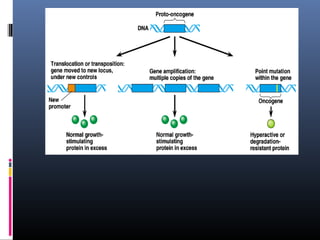
5 mechanisms of activation for oncogenes:-
1.Promoter insertion
2.Enhancer insertion
3.Chromosomal translocation e.g. myelogenous leukemia
4.Gene amplification .
5.Point mutations e.g. ras
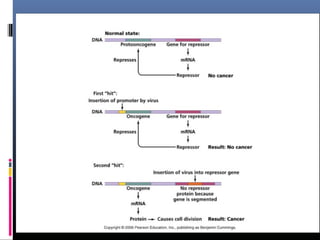
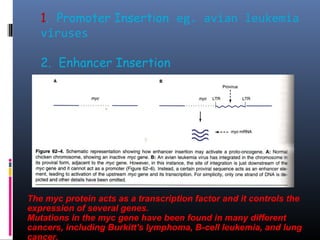
1. Promoter Insertion eg. avian leukemia
viruses
2. Enhancer Insertion
The myc protein acts as a transcription factor and it controls the
expression of several genes.
Mutations in the myc gene have been found in many different
cancers, including Burkitt's lymphoma, B-cell leukemia, and lung
cancer.
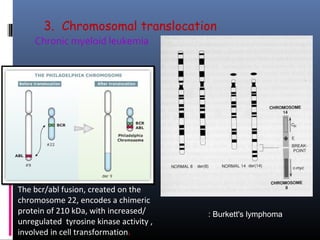
3. Chromosomal translocation
Chronic myeloid leukemia
The bcr/abl fusion, created on the 
chromosome 22, encodes a chimeric 
protein of 210 kDa, with increased/ 
unregulated  tyrosine kinase activity , 
involved in cell transformation.
: Burkett's lymphoma
4. Mutations
• In human tumors the most characterized oncogene
mutations are base substitutions (point mutations) that
change a single amino acid within the protein.
 
• Mutations activate proto-oncogenes through structural 
alterations. These alterations, which usually involve critical 
protein regulatory regions, often lead to the uncontrolled, 
continuous activity of the mutated protein. 
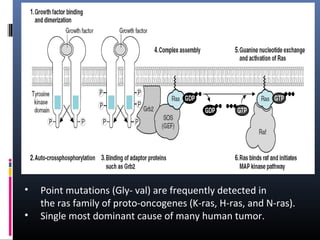
• Point mutations (Gly- val) are frequently detected in 
the ras family of proto-oncogenes (K-ras, H-ras, and N-ras). 
• Single most dominant cause of many human tumor.
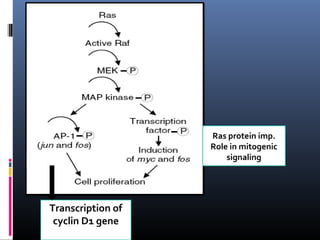
Transcription of
cyclin D1 gene
Ras protein imp.
Role in mitogenic
signaling
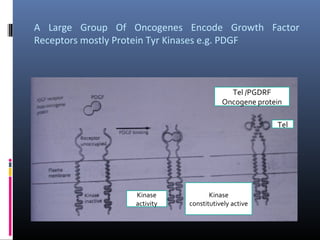
A  Large  Group  Of  Oncogenes  Encode  Growth  Factor 
Receptors mostly Protein Tyr Kinases e.g. PDGF
Tel
Tel /PGDRF
Oncogene protein
Kinase
activity
Kinase
constitutively active
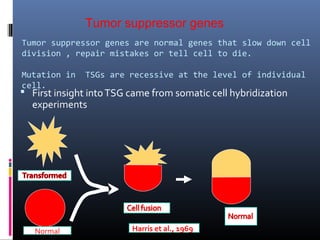
Tumor suppressor genes are normal genes that slow down cell
division , repair mistakes or tell cell to die.
Mutation in TSGs are recessive at the level of individual
cell.
 First insight intoTSG came from somatic cell hybridization
experiments
Normal Harris et al., 1969
Tumor suppressor genes
Studies of Rare Hereditary Cancer
Syndromes First Identified Tumor
Suppressor Genes
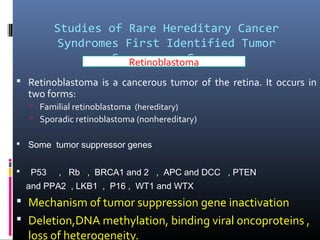
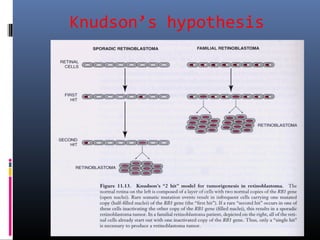
 Retinoblastoma is a cancerous tumor of the retina. It occurs in
two forms:
 Familial retinoblastoma (hereditary)
 Sporadic retinoblastoma (nonhereditary)
 Some tumor suppressor genes
 P53 , Rb , BRCA1 and 2 , APC and DCC , PTEN
and PPA2 , LKB1 , P16 , WT1 and WTX
 Mechanism of tumor suppression gene inactivation
 Deletion,DNA methylation, binding viral oncoproteins ,
loss of heterogeneity.
Retinoblastoma
Knudson’s hypothesis
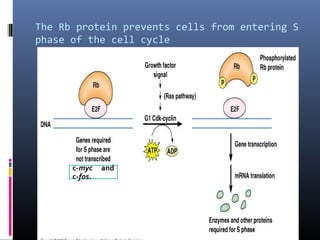
The Rb protein prevents cells from entering S
phase of the cell cycle
c-myc and
c-fos.
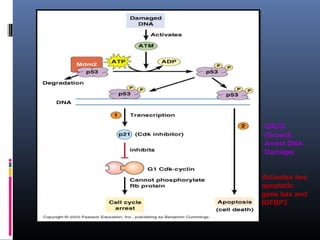
 P53
 Gene encodes a phosphoprotein with 53 kDa with 375 a.a
 It is a transcription factor regulating the cell cycle and apoptosis.
 It block the cells that have damaged DNA by triggering the production
of another protein P21, which blocks cell division until the damage is
repaired.
 If DNA damage is serve, P53 directs the cell to commit suicide by
apoptosis program
 Most tumors have a complete absence of P53 ,other show mutation that
lead to non function P53
 Inheritance of a mutation in p53 leads to Li-Fraumeni syndrome.
GADD
(Growth
Arrest DNA
Damage)
Activates two
apoptotic
gene bax and
IGFBP3
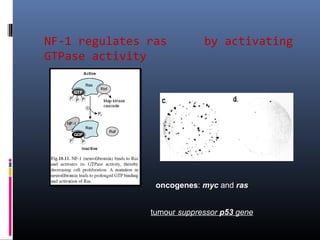
NF-1 regulates ras by activating
GTPase activity
oncogenes: myc and ras
tumour suppressor p53 gene
Human Papillomavirus (HPV
 The name anti-oncogene.
 Both Rb & P53 forms complex with some
HPVs
 HPV Synthesizes E7 &E6 Proteins.
 E7 now binds Rb protein preventing it from
biding E2F,hece myc remains free.
 E6 bind P53 and targets it for proteodomal
degredation.
END

Onocogene and tumor suppressor genes

  • 1.
    Department of clinicalbiochemistry university of Kashmir Topic : Oncogenes And Tumor Suppressor Genes ADIL WANI
  • 2.
     The cancermay be defined as autonomous proliferation of cells which are unresponsive to growth factors or growth signals.  Cancer Critical Genes :Two Categories  Proto-oncogenes – normal constituents of cells whose function is to promote proliferation or cell survival. These genes can code for growth factors, growth factor receptors, signal transduction proteins, intracellular kinases and transcription factors.  Oncogenes – These are the mutant , over active or overexpressed forms of the proto-oncogene.  Tumor suppressor genes (normal growth suppressor genes) -- encode proteins that inhibit proliferation, promote cell death, or repair DNA Activation (mutation) of oncogenes or absence /inactivation of tumor suppressor genes can lead to cancer.
  • 3.
    SRC is firstdiscovered oncogene (Vogt & Martin) Discovered in Rous sarcoma virus , carrying an oncogene (src) that causes cancer in chickens (SRC protein tyr kinase). First human oncogene discovered was ras (Mutant version of normal proto-oncogene) 5 mechanisms of activation for oncogenes:- 1.Promoter insertion 2.Enhancer insertion 3.Chromosomal translocation e.g. myelogenous leukemia 4.Gene amplification . 5.Point mutations e.g. ras
  • 6.
    1. Promoter Insertioneg. avian leukemia viruses 2. Enhancer Insertion The myc protein acts as a transcription factor and it controls the expression of several genes. Mutations in the myc gene have been found in many different cancers, including Burkitt's lymphoma, B-cell leukemia, and lung cancer.
  • 7.
    3. Chromosomal translocation Chronicmyeloid leukemia The bcr/abl fusion, created on the  chromosome 22, encodes a chimeric  protein of 210 kDa, with increased/  unregulated  tyrosine kinase activity ,  involved in cell transformation. : Burkett's lymphoma
  • 8.
    4. Mutations • Inhuman tumors the most characterized oncogene mutations are base substitutions (point mutations) that change a single amino acid within the protein.   • Mutations activate proto-oncogenes through structural  alterations. These alterations, which usually involve critical  protein regulatory regions, often lead to the uncontrolled,  continuous activity of the mutated protein. 
  • 9.
  • 10.
    Transcription of cyclin D1gene Ras protein imp. Role in mitogenic signaling
  • 11.
    A  Large  Group Of  Oncogenes  Encode  Growth  Factor  Receptors mostly Protein Tyr Kinases e.g. PDGF Tel Tel /PGDRF Oncogene protein Kinase activity Kinase constitutively active
  • 12.
    Tumor suppressor genesare normal genes that slow down cell division , repair mistakes or tell cell to die. Mutation in TSGs are recessive at the level of individual cell.  First insight intoTSG came from somatic cell hybridization experiments Normal Harris et al., 1969 Tumor suppressor genes
  • 13.
    Studies of RareHereditary Cancer Syndromes First Identified Tumor Suppressor Genes  Retinoblastoma is a cancerous tumor of the retina. It occurs in two forms:  Familial retinoblastoma (hereditary)  Sporadic retinoblastoma (nonhereditary)  Some tumor suppressor genes  P53 , Rb , BRCA1 and 2 , APC and DCC , PTEN and PPA2 , LKB1 , P16 , WT1 and WTX  Mechanism of tumor suppression gene inactivation  Deletion,DNA methylation, binding viral oncoproteins , loss of heterogeneity. Retinoblastoma
  • 14.
  • 15.
    The Rb proteinprevents cells from entering S phase of the cell cycle c-myc and c-fos.
  • 16.
     P53  Geneencodes a phosphoprotein with 53 kDa with 375 a.a  It is a transcription factor regulating the cell cycle and apoptosis.  It block the cells that have damaged DNA by triggering the production of another protein P21, which blocks cell division until the damage is repaired.  If DNA damage is serve, P53 directs the cell to commit suicide by apoptosis program  Most tumors have a complete absence of P53 ,other show mutation that lead to non function P53  Inheritance of a mutation in p53 leads to Li-Fraumeni syndrome.
  • 17.
  • 18.
    NF-1 regulates rasby activating GTPase activity oncogenes: myc and ras tumour suppressor p53 gene
  • 19.
    Human Papillomavirus (HPV The name anti-oncogene.  Both Rb & P53 forms complex with some HPVs  HPV Synthesizes E7 &E6 Proteins.  E7 now binds Rb protein preventing it from biding E2F,hece myc remains free.  E6 bind P53 and targets it for proteodomal degredation.
  • 20.