IMMUNODEFICIENCYIMMUNODEFICIENCY
DISORDERSDISORDERS
Dr.CSBR.Prasad, M.D.Dr.CSBR.Prasad, M.D.
APR-2015-CSBRP
Infectious consequences ofInfectious consequences of
immunodeficiencyimmunodeficiency
 Antibody deficienciesAntibody deficiencies
 Phagocyte deficienciesPhagocyte deficiencies oror
 Complement deficienciesComplement deficiencies
are associated with infections with extracellular pyogenicare associated with infections with extracellular pyogenic
bacteria (Pneumonia, Otitis media & skin infections)bacteria (Pneumonia, Otitis media & skin infections)
 Deficiencies of CMIDeficiencies of CMI
are associated with recurrent chronic viral, protozoal andare associated with recurrent chronic viral, protozoal and
fungal infectionsfungal infections
APR-2015-CSBRP
 Primary immunodeficiencyPrimary immunodeficiency
 Secondary immunodeficiencySecondary immunodeficiency
Origins of ImmunodeficiencyOrigins of Immunodeficiency
APR-2015-CSBRP
Origins of ImmunodeficiencyOrigins of Immunodeficiency
 Primary or CongenitalPrimary or Congenital
Inherited genetic defects in immune cellInherited genetic defects in immune cell
development or function or inherited deficiencydevelopment or function or inherited deficiency
in a particular immune moleculein a particular immune molecule
 Secondary or AcquiredSecondary or Acquired
A loss of previously functional immunity due toA loss of previously functional immunity due to
infection, toxicity, radiation, splenectomy, aginginfection, toxicity, radiation, splenectomy, aging
or malnutritionor malnutrition
APR-2015-CSBRP
APR-2015-CSBRP
APR-2015-CSBRP
APR-2015-CSBRP
Primary immunodeficienciesPrimary immunodeficiencies
APR-2015-CSBRP
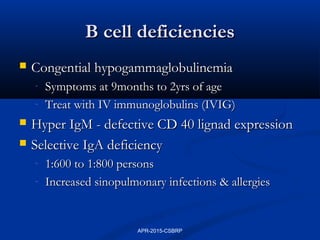
B cell deficienciesB cell deficiencies
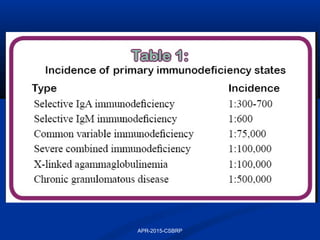
 Congential hypogammaglobulinemiaCongential hypogammaglobulinemia
- Symptoms at 9months to 2yrs of ageSymptoms at 9months to 2yrs of age
- Treat with IV immunoglobulins (IVIG)Treat with IV immunoglobulins (IVIG)
 Hyper IgM - defective CD 40 lignad expressionHyper IgM - defective CD 40 lignad expression
 Selective IgA deficiencySelective IgA deficiency
- 1:600 to 1:800 persons1:600 to 1:800 persons
- Increased sinopulmonary infections & allergiesIncreased sinopulmonary infections & allergies
APR-2015-CSBRP
APR-2015-CSBRP
T cell deficienciesT cell deficiencies
 Congenital Thymic aplasiaCongenital Thymic aplasia
 Chronic mucocutaneous candidiasisChronic mucocutaneous candidiasis
APR-2015-CSBRP
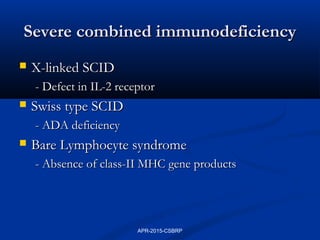
Severe combined immunodeficiencySevere combined immunodeficiency
 X-linked SCIDX-linked SCID
- Defect in IL-2 receptor- Defect in IL-2 receptor
 Swiss type SCIDSwiss type SCID
- ADA deficiency- ADA deficiency
 Bare Lymphocyte syndromeBare Lymphocyte syndrome
- Absence of class-II MHC gene products- Absence of class-II MHC gene products
APR-2015-CSBRP
Phagocytic deficienciesPhagocytic deficiencies
 Chronic Granulomatous DiseaseChronic Granulomatous Disease
- NADPH oxidase defect- NADPH oxidase defect
 Chediak-Higashi syndromeChediak-Higashi syndrome
- Abnormal lysosome formation- Abnormal lysosome formation
 Leucocyte Adhesion DeficiencyLeucocyte Adhesion Deficiency
- Absence of leucocyte adhesion molecules- Absence of leucocyte adhesion molecules
APR-2015-CSBRP
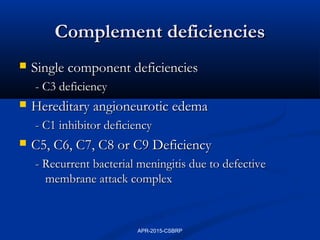
Complement deficienciesComplement deficiencies
 Single component deficienciesSingle component deficiencies
- C3 deficiency- C3 deficiency
 Hereditary angioneurotic edemaHereditary angioneurotic edema
- C1 inhibitor deficiency- C1 inhibitor deficiency
 C5, C6, C7, C8 or C9 DeficiencyC5, C6, C7, C8 or C9 Deficiency
- Recurrent bacterial meningitis due to defective- Recurrent bacterial meningitis due to defective
membrane attack complexmembrane attack complex
APR-2015-CSBRP
Primary immunodeficienciesPrimary immunodeficiencies
 ADA deficiencyADA deficiency
 X-Linked AgammaglobulinemiaX-Linked Agammaglobulinemia
 Hyper-IgM SyndromeHyper-IgM Syndrome
 Isolated IgA DeficiencyIsolated IgA Deficiency
 Di George Syndrome (Thymic Hypoplasia)Di George Syndrome (Thymic Hypoplasia)
 Severe Combined Immunodeficiency DiseasesSevere Combined Immunodeficiency Diseases
 Wiskott-Aldrich SyndromeWiskott-Aldrich Syndrome
APR-2015-CSBRP
APR-2015-CSBRP
APR-2015-CSBRP
Causes of AcquiredCauses of Acquired
ImmunodeficiencyImmunodeficiency
 CancerCancer
 Cytotoxic drugs / RadiationCytotoxic drugs / Radiation
 MalnutritionMalnutrition
 SplenectomySplenectomy
 Immunosuppressive therapyImmunosuppressive therapy
 Stress / emotionsStress / emotions
 Aging (thymic atrophy)Aging (thymic atrophy)
 InfectionsInfections
APR-2015-CSBRP
ACQUIREDACQUIRED
IMMUNODEFICIENCYIMMUNODEFICIENCY
SYNDROMESYNDROME
APR-2015-CSBRP
 IntroductionIntroduction
 At risk groupsAt risk groups
 Routes of transmissionRoutes of transmission
 HIV structureHIV structure
 Pathogenesis of HIVPathogenesis of HIV
 Clinical featuresClinical features
 Morphologic changesMorphologic changes
 Lab diagnosisLab diagnosis
APR-2015-CSBRP
INTRODUCTIONINTRODUCTION
 Caused by retrovirus- humanCaused by retrovirus- human
immunodeficiency virus (HIV)immunodeficiency virus (HIV)
 Profound immunosuppressionProfound immunosuppression
 Opportunistic infectionsOpportunistic infections
 Secondary neoplasmSecondary neoplasm
 Neurologic manifestationsNeurologic manifestations
APR-2015-CSBRP
AT RISK GROUPSAT RISK GROUPS
 Homosexual or bisexual menHomosexual or bisexual men
 Intravenous drug abusersIntravenous drug abusers
 HemophiliacsHemophiliacs
 Recipients of blood and blood componentsRecipients of blood and blood components
 Heterosexual contactsHeterosexual contacts
APR-2015-CSBRP
ROUTES OF TRANSMISSIONROUTES OF TRANSMISSION
 Sexual transmissionSexual transmission
 Parenteral inoculationParenteral inoculation
 Passage of virus from infected mothers toPassage of virus from infected mothers to
their newbornstheir newborns
APR-2015-CSBRP
STRUCTURE OF HIVSTRUCTURE OF HIV
 Major capsid protein –Major capsid protein –
p24p24
 Nucleocapsid protein –Nucleocapsid protein –
p7/p9p7/p9
 2 copies of genomic2 copies of genomic
RNARNA
 3 viral enzymes3 viral enzymes
(protease, reverse(protease, reverse
transcriptase, integrase)transcriptase, integrase)
APR-2015-CSBRP
APR-2015-CSBRP
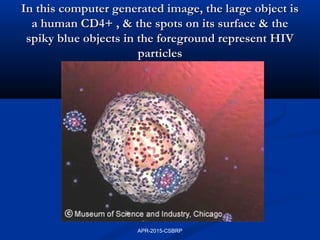
In this computer generated image, the large object isIn this computer generated image, the large object is
a human CD4+ , & the spots on its surface & thea human CD4+ , & the spots on its surface & the
spiky blue objects in the foreground represent HIVspiky blue objects in the foreground represent HIV
particlesparticles
APR-2015-CSBRP
TYPES OF HIVTYPES OF HIV
APR-2015-CSBRP
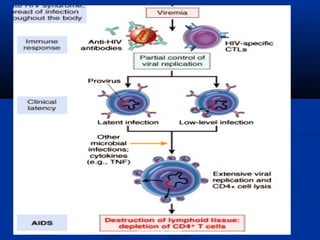
PATHOGENESIS OF HIVPATHOGENESIS OF HIV
There areThere are two major targetstwo major targets of HIV infection:of HIV infection:
 The immune system andThe immune system and
 The central nervous systemThe central nervous system..
APR-2015-CSBRP
PATHOGENESIS OF HIVPATHOGENESIS OF HIV
 HIV -1 infects T cells & macrophagesHIV -1 infects T cells & macrophages
 Viral replication in the regional LNViral replication in the regional LN
 Viremia & widespread seeding of lymphoid tissueViremia & widespread seeding of lymphoid tissue
 Viremia is controlled by host immune response, soViremia is controlled by host immune response, so
patient enters a clinical latency phasepatient enters a clinical latency phase
 Partial viral replicationPartial viral replication
 Erosion of CD4 cellsErosion of CD4 cells
 CD4 numbers declineCD4 numbers decline
 Full blown AIDSFull blown AIDS
APR-2015-CSBRP
APR-2015-CSBRP
APR-2015-CSBRP
HIV LIFE CYCLEHIV LIFE CYCLE
Entry- HIV can only replicate inside human cellsEntry- HIV can only replicate inside human cells
 gp120/CD4 bindinggp120/CD4 binding
 Conformational change in gp120Conformational change in gp120
 gp120/CD4 bind CCR-5 or CXCR-4gp120/CD4 bind CCR-5 or CXCR-4
 Conformational change in gp41Conformational change in gp41
 gp41 membrane penetrationgp41 membrane penetration
 Membrane fusionMembrane fusion
The contents of the HIV particle are then released into theThe contents of the HIV particle are then released into the
cell, leaving the envelope behindcell, leaving the envelope behind
APR-2015-CSBRP
APR-2015-CSBRP
APR-2015-CSBRP
APR-2015-CSBRP
Reverse Transcription and IntegrationReverse Transcription and Integration
 Once inside the cell, enzyme reverse transcriptaseOnce inside the cell, enzyme reverse transcriptase
converts the viral RNA into DNA.converts the viral RNA into DNA.
 This DNA is spliced into the human DNA by theThis DNA is spliced into the human DNA by the
HIV enzyme integraseHIV enzyme integrase
 Once integrated, the HIV DNA is known asOnce integrated, the HIV DNA is known as
provirusprovirus
APR-2015-CSBRP
Transcription and TranslationTranscription and Translation
 HIV provirus may lie dormant within a cell .HIV provirus may lie dormant within a cell .
 But when the cell becomes activated, it treats HIV genesBut when the cell becomes activated, it treats HIV genes
in much the same way as human genesin much the same way as human genes
 First it converts them into messenger RNA (using humanFirst it converts them into messenger RNA (using human
enzymes)enzymes)
 Then the messenger RNA is transported outside theThen the messenger RNA is transported outside the
nucleus, and is used as a blueprint for producing newnucleus, and is used as a blueprint for producing new
HIV proteins and enzymesHIV proteins and enzymes
APR-2015-CSBRP
Assembly, Budding and MaturationAssembly, Budding and Maturation
 HIV genetic material + HIV proteins & enzymes formHIV genetic material + HIV proteins & enzymes form
new viral particles.new viral particles.
 Enzyme protease - cuts long strands of protein intoEnzyme protease - cuts long strands of protein into
smaller pieces, which are used to construct mature viralsmaller pieces, which are used to construct mature viral
corescores
 The newly matured HIV particles are ready to infectThe newly matured HIV particles are ready to infect
another cell.another cell.
 Once person is infected, they pass HIV to others in theirOnce person is infected, they pass HIV to others in their
body fluidbody fluid
APR-2015-CSBRP
This electron microscope photo showsThis electron microscope photo shows
newly formed HIV particles buddingnewly formed HIV particles budding
from a human cellfrom a human cell
APR-2015-CSBRP
An HIV particle budding from a cellAn HIV particle budding from a cell
APR-2015-CSBRP
MECHANISM OF CD4 LOSSMECHANISM OF CD4 LOSS
Chronic T cell activationChronic T cell activation
 Viral replication in infected CD4 T cellsViral replication in infected CD4 T cells
death of infected cellsdeath of infected cells
 Activation of uninfected CD4 T cellsActivation of uninfected CD4 T cells
activation induced cell deathactivation induced cell death
 Expression of HIV peptides on infected CD4 TExpression of HIV peptides on infected CD4 T
cells killing of infected cells by virus specific CTLScells killing of infected cells by virus specific CTLS
APR-2015-CSBRP
APR-2015-CSBRP
MAJOR ABNORMALITIES OFMAJOR ABNORMALITIES OF
IMMUNE FUNCTION IN AIDSIMMUNE FUNCTION IN AIDS
 LYMPHOPENIALYMPHOPENIA
 DECREASED T-CELL FUNCTION INDECREASED T-CELL FUNCTION IN
VIVOVIVO
 Loss of memory T cellsLoss of memory T cells
 Susceptibility to opportunistic infectionsSusceptibility to opportunistic infections
 Susceptibility to neoplasmSusceptibility to neoplasm
 Decreased DTHDecreased DTH
APR-2015-CSBRP
 ALTERED T-CELL FUNCTION IN VITROALTERED T-CELL FUNCTION IN VITRO
 decreased specific cytotoxicitydecreased specific cytotoxicity
 decreased IL-2 and TNF-G productiondecreased IL-2 and TNF-G production
 POLYCLONAL B-CELL ACTIVATIONPOLYCLONAL B-CELL ACTIVATION
 HypergammaglobulinemiaHypergammaglobulinemia
 ALTERED MONOCYTE OR MACROPHAGEALTERED MONOCYTE OR MACROPHAGE
FUNCTIONSFUNCTIONS
 decreased chemotaxis & phagocytosisdecreased chemotaxis & phagocytosis
APR-2015-CSBRP
NATURAL HISTORY OF AIDSNATURAL HISTORY OF AIDS
 An acute retroviral syndromeAn acute retroviral syndrome
 A middle, chronic phaseA middle, chronic phase
 Full-blown AIDSFull-blown AIDS
APR-2015-CSBRP
SYMPTOMSSYMPTOMS
EARLYEARLY
 FeverFever
 HeadacheHeadache
 TirednessTiredness
 Enlarged lymph nodes (glands of the immuneEnlarged lymph nodes (glands of the immune
system easily felt in the neck and groin)system easily felt in the neck and groin)
APR-2015-CSBRP
LATELATE
 Lack of energy & Weight lossLack of energy & Weight loss
 Frequent fevers and sweatsFrequent fevers and sweats
 Persistent or frequent yeast infections (oral orPersistent or frequent yeast infections (oral or
vaginal)vaginal)
 Persistent skin rashes or flaky skinPersistent skin rashes or flaky skin
 Pelvic inflammatory diseasePelvic inflammatory disease
APR-2015-CSBRP
CNS INVOLVEMENTCNS INVOLVEMENT
 MeningoencephalitisMeningoencephalitis
 Aseptic meningitisAseptic meningitis
 Peripheral neuropathyPeripheral neuropathy
 AIDS-dementia complexAIDS-dementia complex
APR-2015-CSBRP
OPPORTUNISTICOPPORTUNISTIC
INFECTIONSINFECTIONS
 Protozoal and helminthicProtozoal and helminthic
 FungalFungal
 BacterialBacterial
 ViralViral
APR-2015-CSBRP
OPPORTUNISTIC INFECTIONSOPPORTUNISTIC INFECTIONS
BacterialBacterial MycTB, MAI Copmplex, SalmonellaMycTB, MAI Copmplex, Salmonella
ParasiticParasitic
Toxoplasma, CryptosporidiumToxoplasma, Cryptosporidium
Microsporidium, LeishmaniaMicrosporidium, Leishmania
FungalFungal
Pneumocystis carinii, CryptococcusPneumocystis carinii, Cryptococcus
neoformans, Candida, Histoplasmaneoformans, Candida, Histoplasma
Coccidioidis immitisCoccidioidis immitis
VirusesViruses Herpes, CMV, Varicella zoasterHerpes, CMV, Varicella zoaster
APR-2015-CSBRP
X-ray- There is increased white (opacity) in the lower lungsX-ray- There is increased white (opacity) in the lower lungs
on both sides, characteristic ofon both sides, characteristic of PneumocystisPneumocystis pneumonipneumoni
APR-2015-CSBRP
Hairy LeucoplakiaHairy Leucoplakia
APR-2015-CSBRP
CryptococcosisCryptococcosis
APR-2015-CSBRP
CryptococcosisCryptococcosis
APR-2015-CSBRP
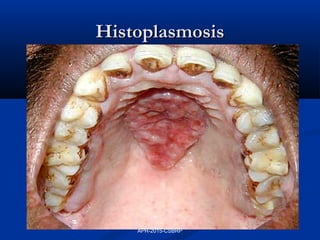
HistoplasmosisHistoplasmosis
APR-2015-CSBRP
HistoplasmosisHistoplasmosis
APR-2015-CSBRP
HistoplasmosisHistoplasmosis
APR-2015-CSBRP
NEOPLASMSNEOPLASMS
 Kaposi’s sarcomaKaposi’s sarcoma
 B-cell non-Hodgkin’s lymphomaB-cell non-Hodgkin’s lymphoma
 Primary effusion lymphomasPrimary effusion lymphomas
 Primary lymphoma of the brainPrimary lymphoma of the brain
 Invasive cancer of uterine CxInvasive cancer of uterine Cx
APR-2015-CSBRP
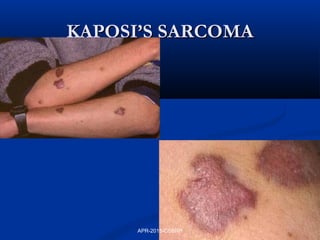
KAPOSI’S SARCOMAKAPOSI’S SARCOMA
APR-2015-CSBRP
KAPOSI’S SARCOMAKAPOSI’S SARCOMA
APR-2015-CSBRP
KAPOSI’S SARCOMAKAPOSI’S SARCOMA
APR-2015-CSBRP
APR-2015-CSBRP
LAB DIAGNOSISLAB DIAGNOSIS
 SPECIFICSPECIFIC
 ELISA, western blot & IFELISA, western blot & IF
 Ag detection by recombinant DNA techniquesAg detection by recombinant DNA techniques
 INDIRECT TESTSINDIRECT TESTS
 CD4 & CD8 cell countsCD4 & CD8 cell counts
 Lymph node biopsyLymph node biopsy
 Platelet countsPlatelet counts
APR-2015-CSBRP
APR-2015-CSBRP
APR-2015-CSBRP
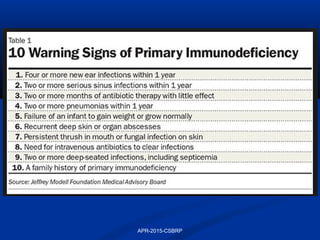
When to suspect PrimaryWhen to suspect Primary
Immunodeficiency?Immunodeficiency?
 Recurrent infectionsRecurrent infections
 Recurrent Otitis mediaRecurrent Otitis media
 Recurrent infections by capsulated organismsRecurrent infections by capsulated organisms
 AspleniaAsplenia
 Absence of tonsilsAbsence of tonsils
 Absence of thymusAbsence of thymus
 Partial albinismPartial albinism
 HypocalcemiaHypocalcemia
APR-2015-CSBRP
E N DE N D
APR-2015-CSBRP
APR-2015-CSBRP
Hyper IgE Syndrome
- extremely high levels of IgE; often also IgD
- characteristic facies in children; dermatitis and pyogenic infections (staphylococci affecting
lungs, joints, skin: Job’s syndrome, after the Biblical sufferer). Respiratory allergies are rare, and
the dermatitis is quite distinct from that of the atopic form. Associate abnormalities in tooh root
resorbtion (not loosing the primary teeth). Reduced bone density (fractures). Very rare
autoimmunity and malignancies.
- elevated numbers of eosinophils in blood and sputum; some impairments in secondary
humoral responses, chemotaxis of neutrophils.
- some forms are autosomal dominant
- some associate defects in IgE catabolism
- some have low propensity in IFN gamma production by Th, but not increased IL-4; possible
mutations in the IL-4Ralpha receptor chain (common for IL-4 and IL-13) resulting in increased
signaling
- Antibiotics; surgery; no effect for IFNgamma or BMT/HCT
APR-2015-CSBRP
Hyper-IgE syndromeHyper-IgE syndrome
APR-2015-CSBRP
Hyper-IgE syndrome. Also known as Job syndrome, this immunodeficiency has a distinct facial
expression with mild asymmetry, prominent jaw, and wide nasal ala. Eczematous skin lesions, recurrent
staphylococcal skin infections, recurrent episodes of pneumonias often due to Staphylococcus aureus,
pneumatoceles, and mucocutaneous candidiasis are common.
Hyper IgM Syndrome
-5 types; the most common is secondary to CD40L-deficiency affecting Th cells
-HIGM2: autosomally inherited mutations in AID: in contrast with HIGM1, no hypermutation detectable and
different opportunistic infections (as CD40L is normal); abnormal giant CGs with many IgD and IgM harboring
B lymphocytes, enlarged lymphoid organs.
-HIGM3: autosomal recessive mutations CD40; very similar to X-linked HIGM1, with deficits of cell mediated
immunity
-HIGM4 - similar to, and milder than HIGM2, but impaired humoral immune responses (opportunistic bacterial
and mycobacterial infections). Hypermutation is not affected. CD40, CD40L, AID, UNG, NEMO are normal,
but defects downstream of CD40 signaling and DNA-repair prevent class switch
- HIGM5 - very similar to HIGM2, with susceptibility to bacterial (not opportunistic) infections. The defect lies
in uracil DNA glycosilase UNG, that acts downstream of AID, removing the uracil residues deaminated by AID,
removal that initiate the double-stranded breaks required for class switch.
- HIGM-NEMO (HIGM associated with X-linked hypohydrotic ectodermal dysplasia) is a mild form of HIGM;
sparse hair and abnormal or missing teeth, lack swat glands. Impaired responses to polysaccharides, but also of
cell-mediated immunity. Frequent opportunistic bacterial and mycobacterial infections. NEMO = NF-kappaB
essential modulator, part of the IKK (IbB kinase) complex that phosphorylates IkB - the inhobitor of the NF-kB.
That stands that NF-kB is involved in the CD40-indiced class switch, but details are still missing
APR-2015-CSBRP
DiGeorge syndrome
-complex disorder affecting thymus genesis (~1:4 000
live births)
-abnormal facies (long narrow face, small mouth,
prominent nose, hooded or full upper eyelids, low-set
cupped ears), small hands, abundant hair on the head,
cardiac and renal malformations, cleft palate, neural
tube defects, parahypothyroidism, recurrent infections.
-translocations or large (2Mbp) deletions 22q1,
(sometimes associated with maternal alcoholism,
diabetes, chemicals), and possible TBX1 mutation, a
transcription factor involved also in aortal
development, GSCL (goosecoid-like) - involved in
neurogenesis, and HIRA, a corepressor involved in
embryonic histone transcription in heart, cranium,
pharyngeal arches.
-T cells, if present, display abnormal tendency to
spontaneous apoptosis. NK and B counts appear
normal
-murine equivalent: nude defect. DiGeorge syndrome. The characteristic facies of infants
with DiGeorge syndrome include widened epicanthal folds,
flattened nasal bridge, short philtrum, recessed chin, rounded
small mouth, and low set, posteriorly rotated ears with simplified
helices.
APR-2015-CSBRP
APR-2015-CSBRP
APR-2015-CSBRP
APR-2015-CSBRP
SCID. This patient typifies the wasted infant with SCID
with failure to thrive and repeated infections. This patient has
no human leukocyte antigen/mixed leukocyte culture matched
siblings and at the time (circa 1970s) was not a candidate for a
mismatched bone marrow transplant. This child succumbed to
his infections.
APR-2015-CSBRP
AT, Ataxia-Telangiectasia
-autosomal recessive, progressive cerebellar ataxia, oculocutaneous telangiectasia, variable CID
recurrent severe lung infections, sins infections, hypo IgA, IgE, IgG2, IgG4; hypersensitive to ionizing
radiation, increased risk of cancer (lymphomas, acute leukemias), autoimmunity.
Due to neurological defects, patients confined to weelchair before age 20, and die before 30. No effective
treatment.
Defects: in ATM gene (ataxia telangiectasia mutated), that encodes a PI3K family protein that
phosphorylated p53, thus preventing it’s interaction with Mdm2 and subsequent ubiquitin-directed
degradation.
Ataxia telangiectasia (AT). This patient demonstrates
facial cellulitis and periorbital telangiectasias. The AT mutated
gene produces pleiotropic changes in cellular response to
radiation, cell cycle control, and intracellular transport of
proteins that manifest themselves in choreoathetosis, cerebellar
ataxia, susceptibility to malignancies, and humoral and
cellular (T-cell) deficiency. Patients with AT frequently have
greatly elevated serum levels of a-fetoprotein due to defective
liver metabolism. Patient died at less than 10 years of age.
APR-2015-CSBRP
WAS Wiscott-Aldrich Syndrome
-X-linked recessive heterogenous disorder, WAS protein gene.
WASP is expressed by all hematopoietic cells; is involved in HSC
survival.
~1/3 patients (classic WAS) CID, eczema, thrombocytopenia;
increased susceptibility to viral, pyogenic, opportunistic infecitons,
autoimmunity, allergy, lymphomas)
~1/5 patients: only some of the above (Thrombocytopenia, XLT)
WASP is critical for both lymphocyte and platelet survival. DTH
responses are affected; normal IgG but reduced IgM and elevated
IgA and E levels.
- unclear mechanism; WASP binds to SH3-containing signaling
molecules, Src kinases, Grb2 adaptor protein, PLC gamma, Btk,
nut also with the cytoskeleton (acting as direct effector of the
GTPase Cdc42, a regulator of the cytoskeleton organization). All
these are important in T cell activation.
IV-IG, splenectomy, BMT/HCT
Wiskott-Aldrich syndrome (WAS). Recurrent
bacterial,
fungal, and, in this case, viral (Herpes simplex)
infections
plague patients with WAS. Equally a problem
is that of
bleeding into eczematous skin lesions, mucosal
surfaces,
and other tissues because of concomitant
thrombocytopenia
and small platelet size. The long-term
prognosis is complicated
by an increased risk of malignancies and
autoimmune
disorders. Patient died at age of 14.
APR-2015-CSBRP

6 immunology-csbrp

  • 1.
  • 2.
    Infectious consequences ofInfectiousconsequences of immunodeficiencyimmunodeficiency  Antibody deficienciesAntibody deficiencies  Phagocyte deficienciesPhagocyte deficiencies oror  Complement deficienciesComplement deficiencies are associated with infections with extracellular pyogenicare associated with infections with extracellular pyogenic bacteria (Pneumonia, Otitis media & skin infections)bacteria (Pneumonia, Otitis media & skin infections)  Deficiencies of CMIDeficiencies of CMI are associated with recurrent chronic viral, protozoal andare associated with recurrent chronic viral, protozoal and fungal infectionsfungal infections APR-2015-CSBRP
  • 3.
     Primary immunodeficiencyPrimaryimmunodeficiency  Secondary immunodeficiencySecondary immunodeficiency Origins of ImmunodeficiencyOrigins of Immunodeficiency APR-2015-CSBRP
  • 4.
    Origins of ImmunodeficiencyOriginsof Immunodeficiency  Primary or CongenitalPrimary or Congenital Inherited genetic defects in immune cellInherited genetic defects in immune cell development or function or inherited deficiencydevelopment or function or inherited deficiency in a particular immune moleculein a particular immune molecule  Secondary or AcquiredSecondary or Acquired A loss of previously functional immunity due toA loss of previously functional immunity due to infection, toxicity, radiation, splenectomy, aginginfection, toxicity, radiation, splenectomy, aging or malnutritionor malnutrition APR-2015-CSBRP
  • 5.
  • 6.
  • 7.
  • 8.
  • 9.
    B cell deficienciesBcell deficiencies  Congential hypogammaglobulinemiaCongential hypogammaglobulinemia - Symptoms at 9months to 2yrs of ageSymptoms at 9months to 2yrs of age - Treat with IV immunoglobulins (IVIG)Treat with IV immunoglobulins (IVIG)  Hyper IgM - defective CD 40 lignad expressionHyper IgM - defective CD 40 lignad expression  Selective IgA deficiencySelective IgA deficiency - 1:600 to 1:800 persons1:600 to 1:800 persons - Increased sinopulmonary infections & allergiesIncreased sinopulmonary infections & allergies APR-2015-CSBRP
  • 10.
  • 11.
    T cell deficienciesTcell deficiencies  Congenital Thymic aplasiaCongenital Thymic aplasia  Chronic mucocutaneous candidiasisChronic mucocutaneous candidiasis APR-2015-CSBRP
  • 12.
    Severe combined immunodeficiencySeverecombined immunodeficiency  X-linked SCIDX-linked SCID - Defect in IL-2 receptor- Defect in IL-2 receptor  Swiss type SCIDSwiss type SCID - ADA deficiency- ADA deficiency  Bare Lymphocyte syndromeBare Lymphocyte syndrome - Absence of class-II MHC gene products- Absence of class-II MHC gene products APR-2015-CSBRP
  • 13.
    Phagocytic deficienciesPhagocytic deficiencies Chronic Granulomatous DiseaseChronic Granulomatous Disease - NADPH oxidase defect- NADPH oxidase defect  Chediak-Higashi syndromeChediak-Higashi syndrome - Abnormal lysosome formation- Abnormal lysosome formation  Leucocyte Adhesion DeficiencyLeucocyte Adhesion Deficiency - Absence of leucocyte adhesion molecules- Absence of leucocyte adhesion molecules APR-2015-CSBRP
  • 14.
    Complement deficienciesComplement deficiencies Single component deficienciesSingle component deficiencies - C3 deficiency- C3 deficiency  Hereditary angioneurotic edemaHereditary angioneurotic edema - C1 inhibitor deficiency- C1 inhibitor deficiency  C5, C6, C7, C8 or C9 DeficiencyC5, C6, C7, C8 or C9 Deficiency - Recurrent bacterial meningitis due to defective- Recurrent bacterial meningitis due to defective membrane attack complexmembrane attack complex APR-2015-CSBRP
  • 15.
    Primary immunodeficienciesPrimary immunodeficiencies ADA deficiencyADA deficiency  X-Linked AgammaglobulinemiaX-Linked Agammaglobulinemia  Hyper-IgM SyndromeHyper-IgM Syndrome  Isolated IgA DeficiencyIsolated IgA Deficiency  Di George Syndrome (Thymic Hypoplasia)Di George Syndrome (Thymic Hypoplasia)  Severe Combined Immunodeficiency DiseasesSevere Combined Immunodeficiency Diseases  Wiskott-Aldrich SyndromeWiskott-Aldrich Syndrome APR-2015-CSBRP
  • 16.
  • 17.
  • 18.
    Causes of AcquiredCausesof Acquired ImmunodeficiencyImmunodeficiency  CancerCancer  Cytotoxic drugs / RadiationCytotoxic drugs / Radiation  MalnutritionMalnutrition  SplenectomySplenectomy  Immunosuppressive therapyImmunosuppressive therapy  Stress / emotionsStress / emotions  Aging (thymic atrophy)Aging (thymic atrophy)  InfectionsInfections APR-2015-CSBRP
  • 19.
  • 20.
     IntroductionIntroduction  Atrisk groupsAt risk groups  Routes of transmissionRoutes of transmission  HIV structureHIV structure  Pathogenesis of HIVPathogenesis of HIV  Clinical featuresClinical features  Morphologic changesMorphologic changes  Lab diagnosisLab diagnosis APR-2015-CSBRP
  • 21.
    INTRODUCTIONINTRODUCTION  Caused byretrovirus- humanCaused by retrovirus- human immunodeficiency virus (HIV)immunodeficiency virus (HIV)  Profound immunosuppressionProfound immunosuppression  Opportunistic infectionsOpportunistic infections  Secondary neoplasmSecondary neoplasm  Neurologic manifestationsNeurologic manifestations APR-2015-CSBRP
  • 22.
    AT RISK GROUPSATRISK GROUPS  Homosexual or bisexual menHomosexual or bisexual men  Intravenous drug abusersIntravenous drug abusers  HemophiliacsHemophiliacs  Recipients of blood and blood componentsRecipients of blood and blood components  Heterosexual contactsHeterosexual contacts APR-2015-CSBRP
  • 23.
    ROUTES OF TRANSMISSIONROUTESOF TRANSMISSION  Sexual transmissionSexual transmission  Parenteral inoculationParenteral inoculation  Passage of virus from infected mothers toPassage of virus from infected mothers to their newbornstheir newborns APR-2015-CSBRP
  • 24.
    STRUCTURE OF HIVSTRUCTUREOF HIV  Major capsid protein –Major capsid protein – p24p24  Nucleocapsid protein –Nucleocapsid protein – p7/p9p7/p9  2 copies of genomic2 copies of genomic RNARNA  3 viral enzymes3 viral enzymes (protease, reverse(protease, reverse transcriptase, integrase)transcriptase, integrase) APR-2015-CSBRP
  • 25.
  • 26.
    In this computergenerated image, the large object isIn this computer generated image, the large object is a human CD4+ , & the spots on its surface & thea human CD4+ , & the spots on its surface & the spiky blue objects in the foreground represent HIVspiky blue objects in the foreground represent HIV particlesparticles APR-2015-CSBRP
  • 27.
    TYPES OF HIVTYPESOF HIV APR-2015-CSBRP
  • 28.
    PATHOGENESIS OF HIVPATHOGENESISOF HIV There areThere are two major targetstwo major targets of HIV infection:of HIV infection:  The immune system andThe immune system and  The central nervous systemThe central nervous system.. APR-2015-CSBRP
  • 29.
    PATHOGENESIS OF HIVPATHOGENESISOF HIV  HIV -1 infects T cells & macrophagesHIV -1 infects T cells & macrophages  Viral replication in the regional LNViral replication in the regional LN  Viremia & widespread seeding of lymphoid tissueViremia & widespread seeding of lymphoid tissue  Viremia is controlled by host immune response, soViremia is controlled by host immune response, so patient enters a clinical latency phasepatient enters a clinical latency phase  Partial viral replicationPartial viral replication  Erosion of CD4 cellsErosion of CD4 cells  CD4 numbers declineCD4 numbers decline  Full blown AIDSFull blown AIDS APR-2015-CSBRP
  • 30.
  • 31.
  • 32.
    HIV LIFE CYCLEHIVLIFE CYCLE Entry- HIV can only replicate inside human cellsEntry- HIV can only replicate inside human cells  gp120/CD4 bindinggp120/CD4 binding  Conformational change in gp120Conformational change in gp120  gp120/CD4 bind CCR-5 or CXCR-4gp120/CD4 bind CCR-5 or CXCR-4  Conformational change in gp41Conformational change in gp41  gp41 membrane penetrationgp41 membrane penetration  Membrane fusionMembrane fusion The contents of the HIV particle are then released into theThe contents of the HIV particle are then released into the cell, leaving the envelope behindcell, leaving the envelope behind APR-2015-CSBRP
  • 33.
  • 34.
  • 35.
  • 36.
    Reverse Transcription andIntegrationReverse Transcription and Integration  Once inside the cell, enzyme reverse transcriptaseOnce inside the cell, enzyme reverse transcriptase converts the viral RNA into DNA.converts the viral RNA into DNA.  This DNA is spliced into the human DNA by theThis DNA is spliced into the human DNA by the HIV enzyme integraseHIV enzyme integrase  Once integrated, the HIV DNA is known asOnce integrated, the HIV DNA is known as provirusprovirus APR-2015-CSBRP
  • 37.
    Transcription and TranslationTranscriptionand Translation  HIV provirus may lie dormant within a cell .HIV provirus may lie dormant within a cell .  But when the cell becomes activated, it treats HIV genesBut when the cell becomes activated, it treats HIV genes in much the same way as human genesin much the same way as human genes  First it converts them into messenger RNA (using humanFirst it converts them into messenger RNA (using human enzymes)enzymes)  Then the messenger RNA is transported outside theThen the messenger RNA is transported outside the nucleus, and is used as a blueprint for producing newnucleus, and is used as a blueprint for producing new HIV proteins and enzymesHIV proteins and enzymes APR-2015-CSBRP
  • 38.
    Assembly, Budding andMaturationAssembly, Budding and Maturation  HIV genetic material + HIV proteins & enzymes formHIV genetic material + HIV proteins & enzymes form new viral particles.new viral particles.  Enzyme protease - cuts long strands of protein intoEnzyme protease - cuts long strands of protein into smaller pieces, which are used to construct mature viralsmaller pieces, which are used to construct mature viral corescores  The newly matured HIV particles are ready to infectThe newly matured HIV particles are ready to infect another cell.another cell.  Once person is infected, they pass HIV to others in theirOnce person is infected, they pass HIV to others in their body fluidbody fluid APR-2015-CSBRP
  • 39.
    This electron microscopephoto showsThis electron microscope photo shows newly formed HIV particles buddingnewly formed HIV particles budding from a human cellfrom a human cell APR-2015-CSBRP
  • 40.
    An HIV particlebudding from a cellAn HIV particle budding from a cell APR-2015-CSBRP
  • 41.
    MECHANISM OF CD4LOSSMECHANISM OF CD4 LOSS Chronic T cell activationChronic T cell activation  Viral replication in infected CD4 T cellsViral replication in infected CD4 T cells death of infected cellsdeath of infected cells  Activation of uninfected CD4 T cellsActivation of uninfected CD4 T cells activation induced cell deathactivation induced cell death  Expression of HIV peptides on infected CD4 TExpression of HIV peptides on infected CD4 T cells killing of infected cells by virus specific CTLScells killing of infected cells by virus specific CTLS APR-2015-CSBRP
  • 42.
  • 43.
    MAJOR ABNORMALITIES OFMAJORABNORMALITIES OF IMMUNE FUNCTION IN AIDSIMMUNE FUNCTION IN AIDS  LYMPHOPENIALYMPHOPENIA  DECREASED T-CELL FUNCTION INDECREASED T-CELL FUNCTION IN VIVOVIVO  Loss of memory T cellsLoss of memory T cells  Susceptibility to opportunistic infectionsSusceptibility to opportunistic infections  Susceptibility to neoplasmSusceptibility to neoplasm  Decreased DTHDecreased DTH APR-2015-CSBRP
  • 44.
     ALTERED T-CELLFUNCTION IN VITROALTERED T-CELL FUNCTION IN VITRO  decreased specific cytotoxicitydecreased specific cytotoxicity  decreased IL-2 and TNF-G productiondecreased IL-2 and TNF-G production  POLYCLONAL B-CELL ACTIVATIONPOLYCLONAL B-CELL ACTIVATION  HypergammaglobulinemiaHypergammaglobulinemia  ALTERED MONOCYTE OR MACROPHAGEALTERED MONOCYTE OR MACROPHAGE FUNCTIONSFUNCTIONS  decreased chemotaxis & phagocytosisdecreased chemotaxis & phagocytosis APR-2015-CSBRP
  • 45.
    NATURAL HISTORY OFAIDSNATURAL HISTORY OF AIDS  An acute retroviral syndromeAn acute retroviral syndrome  A middle, chronic phaseA middle, chronic phase  Full-blown AIDSFull-blown AIDS APR-2015-CSBRP
  • 46.
    SYMPTOMSSYMPTOMS EARLYEARLY  FeverFever  HeadacheHeadache TirednessTiredness  Enlarged lymph nodes (glands of the immuneEnlarged lymph nodes (glands of the immune system easily felt in the neck and groin)system easily felt in the neck and groin) APR-2015-CSBRP
  • 47.
    LATELATE  Lack ofenergy & Weight lossLack of energy & Weight loss  Frequent fevers and sweatsFrequent fevers and sweats  Persistent or frequent yeast infections (oral orPersistent or frequent yeast infections (oral or vaginal)vaginal)  Persistent skin rashes or flaky skinPersistent skin rashes or flaky skin  Pelvic inflammatory diseasePelvic inflammatory disease APR-2015-CSBRP
  • 48.
    CNS INVOLVEMENTCNS INVOLVEMENT MeningoencephalitisMeningoencephalitis  Aseptic meningitisAseptic meningitis  Peripheral neuropathyPeripheral neuropathy  AIDS-dementia complexAIDS-dementia complex APR-2015-CSBRP
  • 49.
    OPPORTUNISTICOPPORTUNISTIC INFECTIONSINFECTIONS  Protozoal andhelminthicProtozoal and helminthic  FungalFungal  BacterialBacterial  ViralViral APR-2015-CSBRP
  • 50.
    OPPORTUNISTIC INFECTIONSOPPORTUNISTIC INFECTIONS BacterialBacterialMycTB, MAI Copmplex, SalmonellaMycTB, MAI Copmplex, Salmonella ParasiticParasitic Toxoplasma, CryptosporidiumToxoplasma, Cryptosporidium Microsporidium, LeishmaniaMicrosporidium, Leishmania FungalFungal Pneumocystis carinii, CryptococcusPneumocystis carinii, Cryptococcus neoformans, Candida, Histoplasmaneoformans, Candida, Histoplasma Coccidioidis immitisCoccidioidis immitis VirusesViruses Herpes, CMV, Varicella zoasterHerpes, CMV, Varicella zoaster APR-2015-CSBRP
  • 51.
    X-ray- There isincreased white (opacity) in the lower lungsX-ray- There is increased white (opacity) in the lower lungs on both sides, characteristic ofon both sides, characteristic of PneumocystisPneumocystis pneumonipneumoni APR-2015-CSBRP
  • 52.
  • 53.
  • 54.
  • 55.
  • 56.
  • 57.
  • 58.
    NEOPLASMSNEOPLASMS  Kaposi’s sarcomaKaposi’ssarcoma  B-cell non-Hodgkin’s lymphomaB-cell non-Hodgkin’s lymphoma  Primary effusion lymphomasPrimary effusion lymphomas  Primary lymphoma of the brainPrimary lymphoma of the brain  Invasive cancer of uterine CxInvasive cancer of uterine Cx APR-2015-CSBRP
  • 59.
  • 60.
  • 61.
  • 62.
  • 63.
    LAB DIAGNOSISLAB DIAGNOSIS SPECIFICSPECIFIC  ELISA, western blot & IFELISA, western blot & IF  Ag detection by recombinant DNA techniquesAg detection by recombinant DNA techniques  INDIRECT TESTSINDIRECT TESTS  CD4 & CD8 cell countsCD4 & CD8 cell counts  Lymph node biopsyLymph node biopsy  Platelet countsPlatelet counts APR-2015-CSBRP
  • 64.
  • 65.
  • 66.
    When to suspectPrimaryWhen to suspect Primary Immunodeficiency?Immunodeficiency?  Recurrent infectionsRecurrent infections  Recurrent Otitis mediaRecurrent Otitis media  Recurrent infections by capsulated organismsRecurrent infections by capsulated organisms  AspleniaAsplenia  Absence of tonsilsAbsence of tonsils  Absence of thymusAbsence of thymus  Partial albinismPartial albinism  HypocalcemiaHypocalcemia APR-2015-CSBRP
  • 67.
    E N DEN D APR-2015-CSBRP
  • 68.
  • 69.
    Hyper IgE Syndrome -extremely high levels of IgE; often also IgD - characteristic facies in children; dermatitis and pyogenic infections (staphylococci affecting lungs, joints, skin: Job’s syndrome, after the Biblical sufferer). Respiratory allergies are rare, and the dermatitis is quite distinct from that of the atopic form. Associate abnormalities in tooh root resorbtion (not loosing the primary teeth). Reduced bone density (fractures). Very rare autoimmunity and malignancies. - elevated numbers of eosinophils in blood and sputum; some impairments in secondary humoral responses, chemotaxis of neutrophils. - some forms are autosomal dominant - some associate defects in IgE catabolism - some have low propensity in IFN gamma production by Th, but not increased IL-4; possible mutations in the IL-4Ralpha receptor chain (common for IL-4 and IL-13) resulting in increased signaling - Antibiotics; surgery; no effect for IFNgamma or BMT/HCT APR-2015-CSBRP
  • 70.
    Hyper-IgE syndromeHyper-IgE syndrome APR-2015-CSBRP Hyper-IgEsyndrome. Also known as Job syndrome, this immunodeficiency has a distinct facial expression with mild asymmetry, prominent jaw, and wide nasal ala. Eczematous skin lesions, recurrent staphylococcal skin infections, recurrent episodes of pneumonias often due to Staphylococcus aureus, pneumatoceles, and mucocutaneous candidiasis are common.
  • 71.
    Hyper IgM Syndrome -5types; the most common is secondary to CD40L-deficiency affecting Th cells -HIGM2: autosomally inherited mutations in AID: in contrast with HIGM1, no hypermutation detectable and different opportunistic infections (as CD40L is normal); abnormal giant CGs with many IgD and IgM harboring B lymphocytes, enlarged lymphoid organs. -HIGM3: autosomal recessive mutations CD40; very similar to X-linked HIGM1, with deficits of cell mediated immunity -HIGM4 - similar to, and milder than HIGM2, but impaired humoral immune responses (opportunistic bacterial and mycobacterial infections). Hypermutation is not affected. CD40, CD40L, AID, UNG, NEMO are normal, but defects downstream of CD40 signaling and DNA-repair prevent class switch - HIGM5 - very similar to HIGM2, with susceptibility to bacterial (not opportunistic) infections. The defect lies in uracil DNA glycosilase UNG, that acts downstream of AID, removing the uracil residues deaminated by AID, removal that initiate the double-stranded breaks required for class switch. - HIGM-NEMO (HIGM associated with X-linked hypohydrotic ectodermal dysplasia) is a mild form of HIGM; sparse hair and abnormal or missing teeth, lack swat glands. Impaired responses to polysaccharides, but also of cell-mediated immunity. Frequent opportunistic bacterial and mycobacterial infections. NEMO = NF-kappaB essential modulator, part of the IKK (IbB kinase) complex that phosphorylates IkB - the inhobitor of the NF-kB. That stands that NF-kB is involved in the CD40-indiced class switch, but details are still missing APR-2015-CSBRP
  • 72.
    DiGeorge syndrome -complex disorderaffecting thymus genesis (~1:4 000 live births) -abnormal facies (long narrow face, small mouth, prominent nose, hooded or full upper eyelids, low-set cupped ears), small hands, abundant hair on the head, cardiac and renal malformations, cleft palate, neural tube defects, parahypothyroidism, recurrent infections. -translocations or large (2Mbp) deletions 22q1, (sometimes associated with maternal alcoholism, diabetes, chemicals), and possible TBX1 mutation, a transcription factor involved also in aortal development, GSCL (goosecoid-like) - involved in neurogenesis, and HIRA, a corepressor involved in embryonic histone transcription in heart, cranium, pharyngeal arches. -T cells, if present, display abnormal tendency to spontaneous apoptosis. NK and B counts appear normal -murine equivalent: nude defect. DiGeorge syndrome. The characteristic facies of infants with DiGeorge syndrome include widened epicanthal folds, flattened nasal bridge, short philtrum, recessed chin, rounded small mouth, and low set, posteriorly rotated ears with simplified helices. APR-2015-CSBRP
  • 73.
  • 74.
  • 75.
  • 76.
    SCID. This patienttypifies the wasted infant with SCID with failure to thrive and repeated infections. This patient has no human leukocyte antigen/mixed leukocyte culture matched siblings and at the time (circa 1970s) was not a candidate for a mismatched bone marrow transplant. This child succumbed to his infections. APR-2015-CSBRP
  • 77.
    AT, Ataxia-Telangiectasia -autosomal recessive,progressive cerebellar ataxia, oculocutaneous telangiectasia, variable CID recurrent severe lung infections, sins infections, hypo IgA, IgE, IgG2, IgG4; hypersensitive to ionizing radiation, increased risk of cancer (lymphomas, acute leukemias), autoimmunity. Due to neurological defects, patients confined to weelchair before age 20, and die before 30. No effective treatment. Defects: in ATM gene (ataxia telangiectasia mutated), that encodes a PI3K family protein that phosphorylated p53, thus preventing it’s interaction with Mdm2 and subsequent ubiquitin-directed degradation. Ataxia telangiectasia (AT). This patient demonstrates facial cellulitis and periorbital telangiectasias. The AT mutated gene produces pleiotropic changes in cellular response to radiation, cell cycle control, and intracellular transport of proteins that manifest themselves in choreoathetosis, cerebellar ataxia, susceptibility to malignancies, and humoral and cellular (T-cell) deficiency. Patients with AT frequently have greatly elevated serum levels of a-fetoprotein due to defective liver metabolism. Patient died at less than 10 years of age. APR-2015-CSBRP
  • 78.
    WAS Wiscott-Aldrich Syndrome -X-linkedrecessive heterogenous disorder, WAS protein gene. WASP is expressed by all hematopoietic cells; is involved in HSC survival. ~1/3 patients (classic WAS) CID, eczema, thrombocytopenia; increased susceptibility to viral, pyogenic, opportunistic infecitons, autoimmunity, allergy, lymphomas) ~1/5 patients: only some of the above (Thrombocytopenia, XLT) WASP is critical for both lymphocyte and platelet survival. DTH responses are affected; normal IgG but reduced IgM and elevated IgA and E levels. - unclear mechanism; WASP binds to SH3-containing signaling molecules, Src kinases, Grb2 adaptor protein, PLC gamma, Btk, nut also with the cytoskeleton (acting as direct effector of the GTPase Cdc42, a regulator of the cytoskeleton organization). All these are important in T cell activation. IV-IG, splenectomy, BMT/HCT Wiskott-Aldrich syndrome (WAS). Recurrent bacterial, fungal, and, in this case, viral (Herpes simplex) infections plague patients with WAS. Equally a problem is that of bleeding into eczematous skin lesions, mucosal surfaces, and other tissues because of concomitant thrombocytopenia and small platelet size. The long-term prognosis is complicated by an increased risk of malignancies and autoimmune disorders. Patient died at age of 14. APR-2015-CSBRP

Editor's Notes

  • #6 TAP deficiency syndrome: (TAP complex, the peptide transporter complex associated with antigen presentation. TAP --- transporter associated with antigen presentation. Bare lymphocyte syndrome (BLS) is characterized by a severe down-regulation of HLA class I and/or class II molecules. In type 1 BLS the defect is confined to HLA class I molecules, while in type 2 BLS HLA class II molecules are down-regulated [1]. Characterization of 22 patients with type 1 BLS over the last 22 years has revealed the existence of several clinically and immunologically distinct disease subsets. HLA CLASS I ASSEMBLY AND THE ROLE OF THE TAP COMPLEX: HLA class I molecules are highly polymorphic transmembrane glycoproteins expressed to variable levels on the surface of all nucleated cells in the body. HLA class I molecules have the dual role of presenting intracellular antigenic peptides to cytotoxic T lymphocytes (CTL), and modulating the activity of cells bearing HLA class I binding receptors, such as natural killer (NK) cells and γδ T cells [21–24] (Fig. 1). Failure to express HLA class I molecules on the surface of malignant or virus-infected cells sensitizes them for lysis by NK and γδ T cells [25]. Furthermore, presentation of self-peptides via HLA class I molecules is critical for the selection of cytotoxic T cells in the thymus .
  • #36 Frequency of CCR5Δ32 mutation and HIV susceptibility in Indian population A 32 bp deletion (CCR5Δ32, rs333) in the CCR5 gene has been found to protect individuals against HIV infection. The frequency of CCR5Δ32 was extremely low in the Indian population. The pooled allele frequency of the CCR5Δ32 mutation in India is shown in the map. There is a high-to-low gradient from north to south with the maximum of about 6% in a north Indian population. This correlates with antenatal clinical HIV prevalence surveys that report high frequency of HIV in south Indian populations as compared to the North. However, even the frequency of 6% in the North-west is much lower when compared to the Caucasian population of Europe (16%).
  • #53 This 18-year-old Human Immunodeficiency Virus positive woman was evaluated in dentistry for white plaques in her mouth. The white vertically oriented corrugated plaques on the side of the tongure are typical and should suggest the diagnosis of Human Immunodeficiency Virus infection even in an otherwise healthy patient. Recent studies have made it clear that Epstein Bar Virus is the pathogen. Similar findings may be seen in idiopathic and tobacco associated leukoplakia and hypertrophic candidiasis. vertically oriented corrugated white plaques.
  • #54 This 38-year-old woman with acquired immunodeficiency syndrome and a low CD4 count developed increasing numbers of molluscum-like papules on her face with dissemination to her trunk and extremities several months earlier. Cerebrospinal fluid cultures grew Cryptococcus neoformans. symmetric widely disseminated 1-4 mm umbilicated dome shaped papules with a central hemorrhagic crust.
  • #71 Hyper-IgE syndrome. Also known as Job syndrome, this immunodeficiency has a distinct facial expression with mild asymmetry, prominent jaw, and wide nasal ala. Eczematous skin lesions, recurrent staphylococcal skin infections, recurrent episodes of pneumonias often due to Staphylococcus aureus, pneumatoceles, and mucocutaneous candidiasis are common. Delayed shedding of primary teeth and skeletal abnormalities including severe scoliosis and recurrent pathologic fractures further characterize these patients. The morbidity of this disease varies, and some patients survive into adulthood, as did the patient pictured here. Written permission of the patient was obtained for use of this picture for medical publication through the courtesy of Dr Charlotte Cunningham-Rundles, Mount Sinai Medical Center, New York, NY, and the Immune Deficiency Foundation, Towson, Md. JACI 120-982, 2007