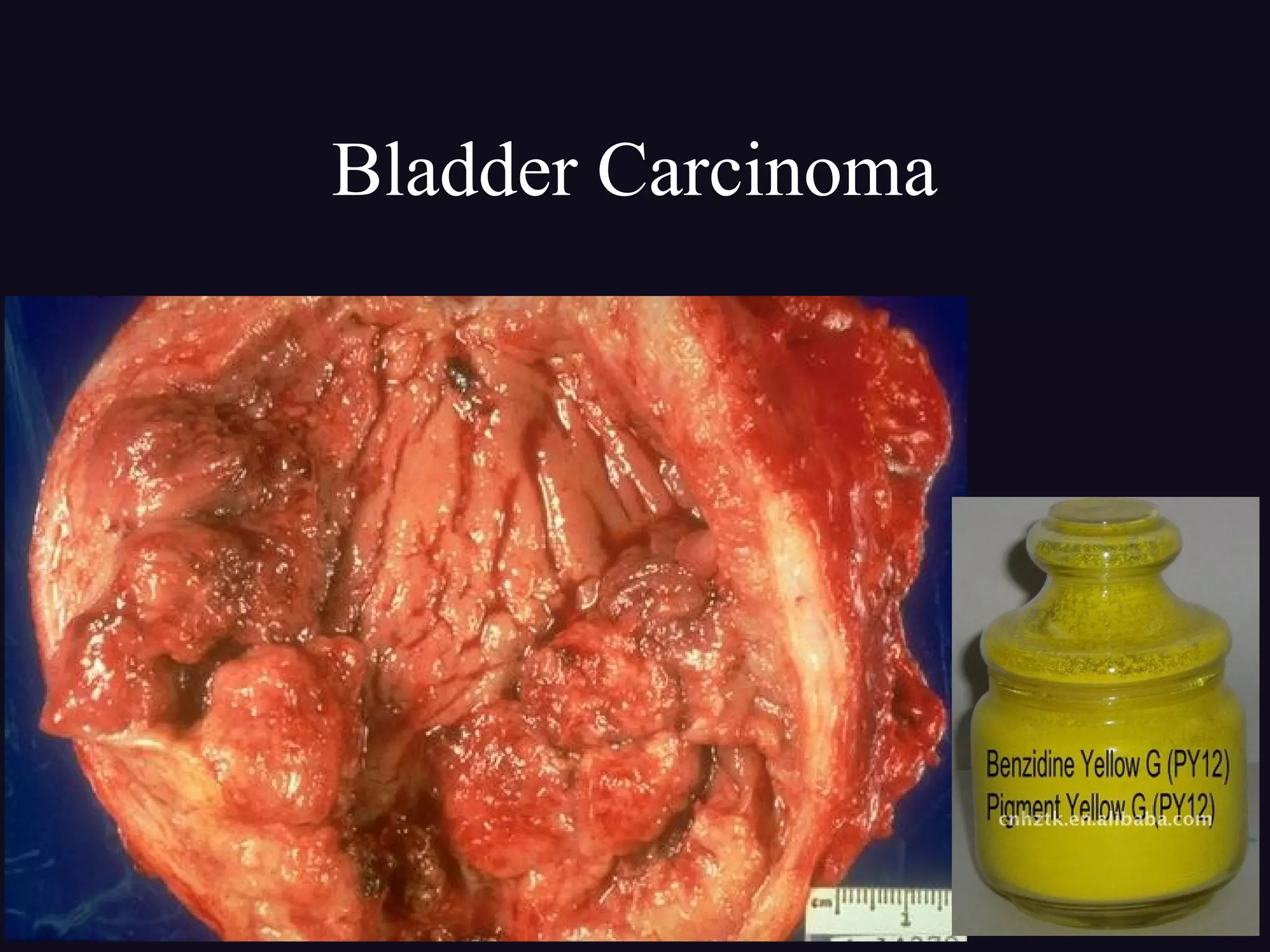
Bladder Carcinoma
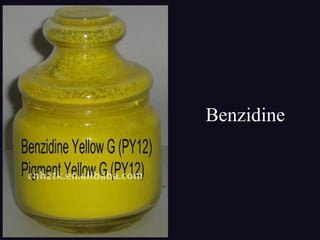
Benzidine
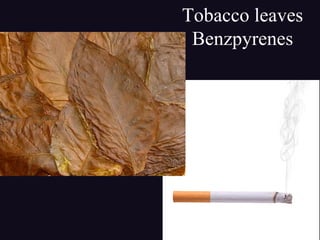
Tobacco leaves
Benzpyrenes
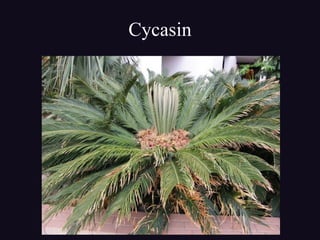
Cycasin
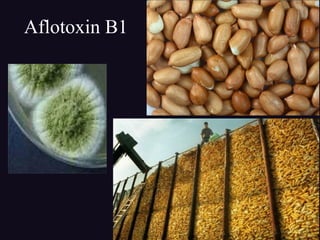
Aflotoxin B1
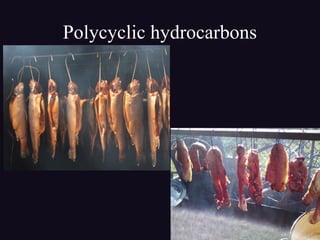
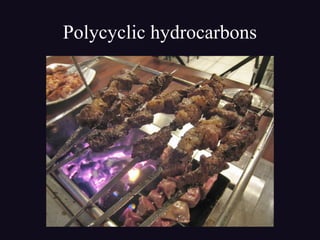
Polycyclic hydrocarbons
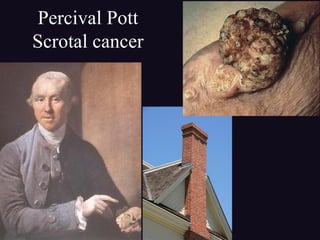
Percival Pott
Scrotal cancer
Chemical Carcinogens
Biological Carcinogens
Dr.CSBR.Prasad, M.D.,
Carcinogens
• Agents causing cancer (thro’ genetic damage)
• Classification
• Chemical
• Physical
• Hormonal
• Biological
• History:
• 18th
Century Sir Percival Pott
• Scrotal skin cancer in chimney sweepers
• Exposure to soot
Chemical Carcinogen
• Synthetic
• Naturally occurring
• Directly acting (no metabolic activity)
• Indirectly acting (procarcinogens, needs metabolic activity)
• Initiators (irreversible DNA damage)
• Promoters (reversible non DNA damage)
Initiation
• Induction of mutation in genome of cells
• Initiated cells are not transformed cells
• They have no growth autonomy/unique
phenotype
• In contrast to normal cells, can give rise to
tumors when appropriately stimulated by
promoting agents
Promotion
• Process of tumor induction in a previously
initiated cell by chemicals.
• The effect of promoters is short lived and
reversible
• They do not affect DNA
• Non tumorigenic by themselves
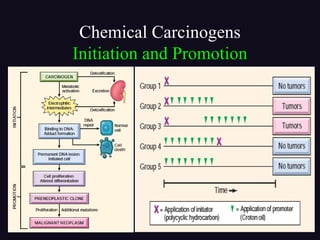
Chemical Carcinogens
Initiation and Promotion
Major Chemical Carcinogens
• Direct-Acting Carcinogens
– Alkylating Agents
• Anticancer drugs (cyclophosphamide , chlorambucil , nitrosoureas)
• β-Propiolactone, Dimethyl sulfate, Diepoxybutane
– Acylating Agents
• 1-Acetyl-imidazole, 2-Dimethylcarbamyl chloride
• Procarcinogens That Require Metabolic Activation
– Polycyclic and Heterocyclic Aromatic Hydrocarbons
• Benz(a)anthracene, Benzo(a)pyrene, Dibenz(a,h)anthracene,
• 3-Methylcholanthrene, 7,12-Dimethylbenz(a)anthracene
– Aromatic Amines, Amides, Azo Dyes
• 2-Naphthylamine (β-naphthylamine), Benzidine, 2-Acetylaminofluorene,
Dimethylaminoazobenzene (butter yellow)
– Natural Plant and Microbial Products
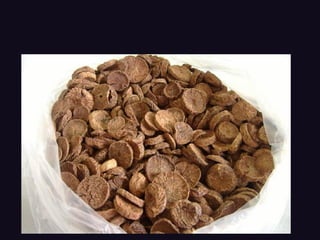
• Aflatoxin B1, Griseofulvin, Cycasin, Safrole, Betel nuts
• Others
• Nitrosamine and amides, Vinyl chloride, nickel, chromium, Insecticides,
fungicides, Polychlorinated biphenyls
Concept of initiation and promotion
sequence
• Initiation - exposure of cells to sufficient
dose of carcinogen
• Potenial to induce tumor
• Initiation alone is insufficient
• Permanent DNA damage- mutation.
• Rapid and irreversible
• Promoters can induce tumor in an initiated
cell, by themselves are not tumorigenic
• The cellular changes resulting from
application of promoters do not affect
DNA directly and are reversible
Property of direct acting &
ultimate carcinogens
• Highly reactive electrophiles (electron
deficient) react with nucleophilic (electron
rich) sites in the cell
• Non enzymatic reactions - covalent adducts
b/n carcinogen & nucleotide DNA
• Electron rich sites in cell:
– DNA
– RNA
– Proteins
Epoxides
• From hydrocarbons
• Structure of Cyclic ether
• Highly reactive chemicals
• Can form adducts with many cellular
elements
Adducts
• An adduct (from the Latin adductus,
"drawn toward") is a product of a direct
addition of two or more distinct molecules,
resulting in a single reaction product
containing all atoms of all components
• Covalent adducts: can damage DNA, RNA
and proteins
Metabolic action of carcinogens
• Most carcinogens need activation to form
ultimate carcinogens
• Other metabolic pathways detoxify
• Carcinogenic potency
– Inherent reactivity of electrophilic derivative
– Balance b/n metabolic activation and
inactivation
Metabolic action of carcinogens
• Carcinogenesis is regulated in part by
polymorphism in the genes that encode the
genes
• Age, sex and nutritional status determine
the internal dose of toxicants
Molecular targets of chemical
carcinogens
• Mutations affecting oncogenes, tumor suppressor
genes and genes that regulate apoptosis and genes
involved in DNA repair
• DNA is the primary target
• No single or unique alteration with initiation
• Each class of carcinogen produces limited pattern
of DNA damage
• Each carcinogen produces molecular ‘fingerprint’
that links specific chemical with their mutational
effect
Initiated cell
• Unrepaired DNA alterations are essential first step
in initiating tumor
• Damaged DNA template must replicate to be
inheritable and permanent
• Quiescent cells may never be affected by
carcinogens, unless mitogenically stimulated
• Concurrent exposure to viruses, parasites,
hormones induce proliferation
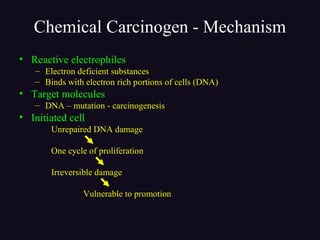
Chemical Carcinogen - Mechanism
• Reactive electrophiles
– Electron deficient substances
– Binds with electron rich portions of cells (DNA)
• Target molecules
– DNA – mutation - carcinogenesis
• Initiated cell
Unrepaired DNA damage
One cycle of proliferation
Irreversible damage
Vulnerable to promotion
Promotion of Carcinogenesis
• Phenols, artificial sweeteners
• No sudden change
• Need sufficient time and dose
• Changes reversible
• Enhance the effect of carcinogens
• Acts through growth factor pathway
Promotion of carcinogenesis
• Tumor promotion steps- multiple steps.
Proliferation of preneoplastic cells
Malignant conversion
Tumor progression (depends on cells &
stroma)
Promotion of carcinogenesis
• The effect of promoters are pleiotropic
• Induction of cell proliferation is a sine qua
none phenomenon of promoters
• They act via signal transduction pathways
ex.,protein kinase C,
• Activation of PKC - series of
phosphorylations- cell proliferation and
differentiation
Promotion of carcinogenesis
• Involved in clonal expansion and aberrant
differentiation of initiated cells
Carcinogenic chemicals
• Direct acting alkylating agents
• Polycyclic aromatic hydrocarbons
• Aromatic amines and azo dyes
• Naturally occurring carcinogens
• Nitrosamines and amides
• Miscellaneous agents
Carcinogenic chemicals
Direct acting alkylating agents
• Activation dependent, weak carcinogens
• Used as anticancer drugs
• Induce lymphoid neoplasms, leukemia etc.,
• Powerful immunosuppressive agents
• Eg: Cyclophosphamide, Busulfan
• Interact with DNA and damage
Carcinogenic chemicals
Polycyclic aromatic hydrocarbons
• Source: Combustion of smoke, smoked
meat, animal fat processing broiled meat,
smoked fish
• Induce lung and bladder cancer
• Most potent carcinogens known
• Require metabolic activation
• Skin paint - skin cancer
• Subcutaneous injection - sarcoma
Carcinogenic chemicals
Aromatic amines & azo dyes
• Source: food coloring agents
Eg: Butter yellow, Scarlet red
• Beta naphthylaimine – rubber industry -
bladder cancer
Carcinogenic chemicals
Naturally occurring carcinogens
• Source: moldy grains, peanuts, rice -
aspergillus flavus - aflatoxin
B1.
• Potent hepatocarcinogen
• Correlates with increased incidence in china
/ Africa
Carcinogenic chemicals
Nitrosamines and amides
• Source: Nitrostable amines and nitrates
used as food preservative - bacteria convert
them to nitrites
• Induce gastric cancers
Carcinogenic chemicals
miscellaneous agents
• Asbestos - Bronchogenic ca. Mesothelioma,GI
cancers
• Asbestos + smoking = many fold risk ca lung
• Vinyl chloride - hemangiosarcoma liver
• Chromiun & nickle - Ca lung - volatile
industrial environment pollutant
• Arsenic – skin cancer
• Hormones –endometrial cancer
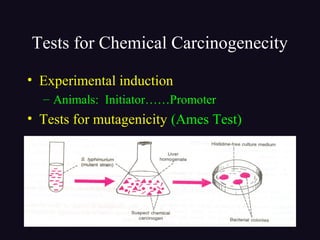
Tests for Chemical Carcinogenecity
• Experimental induction
– Animals: Initiator……Promoter
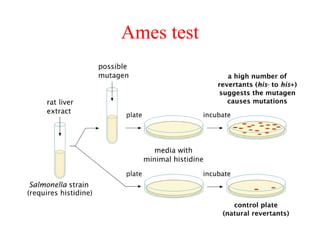
• Tests for mutagenicity (Ames Test)
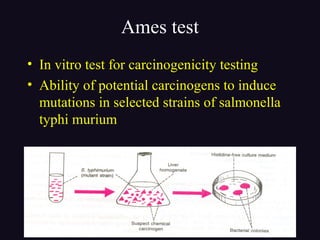
Ames test
• In vitro test for carcinogenicity testing
• Ability of potential carcinogens to induce
mutations in selected strains of salmonella
typhi murium
Ames test
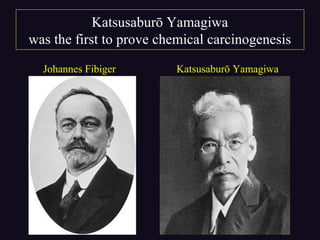
Katsusaburō Yamagiwa
was the first to prove chemical carcinogenesis
Johannes Fibiger Katsusaburō Yamagiwa
Physical Carcinogens
• Radiation
• UV rays of sunlight
• Ionizing radiation
– Medical
– Occupational
• Non radiation
• Mechanical irritation
– Stone in the bladder
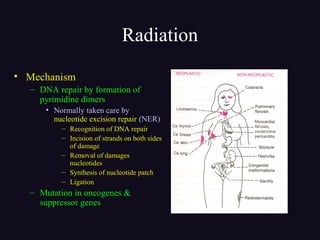
Radiation
• Mechanism
– DNA repair by formation of
pyrimidine dimers
• Normally taken care by
nucleotide excision repair (NER)
– Recognition of DNA repair
– Incision of strands on both sides
of damage
– Removal of damages
nucleotides
– Synthesis of nucleotide patch
– Ligation
– Mutation in oncogenes &
suppressor genes
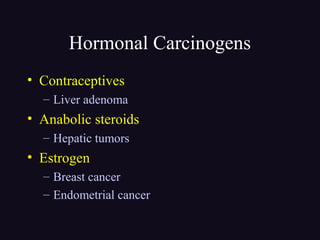
Hormonal Carcinogens
• Contraceptives
– Liver adenoma
• Anabolic steroids
– Hepatic tumors
• Estrogen
– Breast cancer
– Endometrial cancer
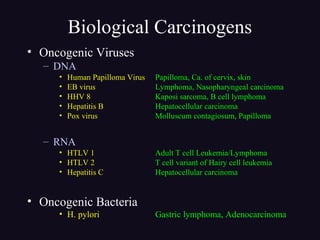
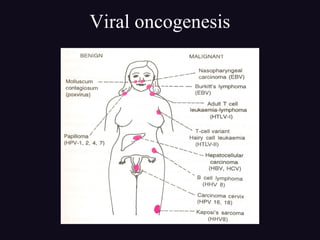
Biological Carcinogens
• Oncogenic Viruses
– DNA
• Human Papilloma Virus Papilloma, Ca. of cervix, skin
• EB virus Lymphoma, Nasopharyngeal carcinoma
• HHV 8 Kaposi sarcoma, B cell lymphoma
• Hepatitis B Hepatocellular carcinoma
• Pox virus Molluscum contagiosum, Papilloma
– RNA
• HTLV 1 Adult T cell Leukemia/Lymphoma
• HTLV 2 T cell variant of Hairy cell leukemia
• Hepatitis C Hepatocellular carcinoma
• Oncogenic Bacteria
• H. pylori Gastric lymphoma, Adenocarcinoma
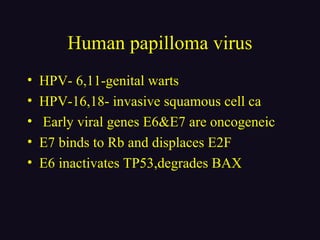
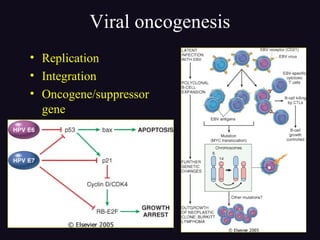
Human papilloma virus
• HPV- 6,11-genital warts
• HPV-16,18- invasive squamous cell ca
• Early viral genes E6&E7 are oncogeneic
• E7 binds to Rb and displaces E2F
• E6 inactivates TP53,degrades BAX
Viral oncogenesis
• Replication
• Integration
• Oncogene/suppressor
gene
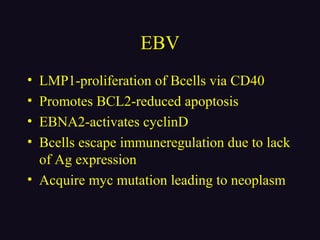
EBV
• LMP1-proliferation of Bcells via CD40
• Promotes BCL2-reduced apoptosis
• EBNA2-activates cyclinD
• Bcells escape immuneregulation due to lack
of Ag expression
• Acquire myc mutation leading to neoplasm
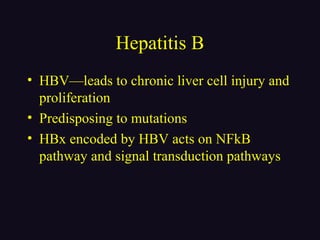
Hepatitis B
• HBV—leads to chronic liver cell injury and
proliferation
• Predisposing to mutations
• HBx encoded by HBV acts on NFkB
pathway and signal transduction pathways
Viral oncogenesis
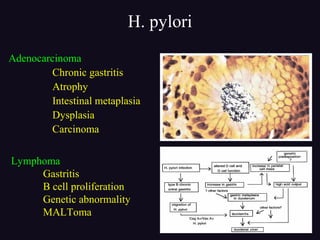
H. pylori
Adenocarcinoma
Chronic gastritis
Atrophy
Intestinal metaplasia
Dysplasia
Carcinoma
Lymphoma
Gastritis
B cell proliferation
Genetic abnormality
MALToma
E N D

Chemical biologicalcarcinogens csbrp

  • 1.
  • 2.
  • 4.
  • 5.
  • 6.
  • 7.
  • 8.
  • 10.
  • 11.
  • 12.
    Carcinogens • Agents causingcancer (thro’ genetic damage) • Classification • Chemical • Physical • Hormonal • Biological • History: • 18th Century Sir Percival Pott • Scrotal skin cancer in chimney sweepers • Exposure to soot
  • 13.
    Chemical Carcinogen • Synthetic •Naturally occurring • Directly acting (no metabolic activity) • Indirectly acting (procarcinogens, needs metabolic activity) • Initiators (irreversible DNA damage) • Promoters (reversible non DNA damage)
  • 14.
    Initiation • Induction ofmutation in genome of cells • Initiated cells are not transformed cells • They have no growth autonomy/unique phenotype • In contrast to normal cells, can give rise to tumors when appropriately stimulated by promoting agents
  • 15.
    Promotion • Process oftumor induction in a previously initiated cell by chemicals. • The effect of promoters is short lived and reversible • They do not affect DNA • Non tumorigenic by themselves
  • 16.
  • 17.
    Major Chemical Carcinogens •Direct-Acting Carcinogens – Alkylating Agents • Anticancer drugs (cyclophosphamide , chlorambucil , nitrosoureas) • β-Propiolactone, Dimethyl sulfate, Diepoxybutane – Acylating Agents • 1-Acetyl-imidazole, 2-Dimethylcarbamyl chloride • Procarcinogens That Require Metabolic Activation – Polycyclic and Heterocyclic Aromatic Hydrocarbons • Benz(a)anthracene, Benzo(a)pyrene, Dibenz(a,h)anthracene, • 3-Methylcholanthrene, 7,12-Dimethylbenz(a)anthracene – Aromatic Amines, Amides, Azo Dyes • 2-Naphthylamine (β-naphthylamine), Benzidine, 2-Acetylaminofluorene, Dimethylaminoazobenzene (butter yellow) – Natural Plant and Microbial Products • Aflatoxin B1, Griseofulvin, Cycasin, Safrole, Betel nuts • Others • Nitrosamine and amides, Vinyl chloride, nickel, chromium, Insecticides, fungicides, Polychlorinated biphenyls
  • 18.
    Concept of initiationand promotion sequence • Initiation - exposure of cells to sufficient dose of carcinogen • Potenial to induce tumor • Initiation alone is insufficient • Permanent DNA damage- mutation. • Rapid and irreversible • Promoters can induce tumor in an initiated cell, by themselves are not tumorigenic
  • 19.
    • The cellularchanges resulting from application of promoters do not affect DNA directly and are reversible
  • 20.
    Property of directacting & ultimate carcinogens • Highly reactive electrophiles (electron deficient) react with nucleophilic (electron rich) sites in the cell • Non enzymatic reactions - covalent adducts b/n carcinogen & nucleotide DNA • Electron rich sites in cell: – DNA – RNA – Proteins
  • 21.
    Epoxides • From hydrocarbons •Structure of Cyclic ether • Highly reactive chemicals • Can form adducts with many cellular elements
  • 22.
    Adducts • An adduct(from the Latin adductus, "drawn toward") is a product of a direct addition of two or more distinct molecules, resulting in a single reaction product containing all atoms of all components • Covalent adducts: can damage DNA, RNA and proteins
  • 23.
    Metabolic action ofcarcinogens • Most carcinogens need activation to form ultimate carcinogens • Other metabolic pathways detoxify • Carcinogenic potency – Inherent reactivity of electrophilic derivative – Balance b/n metabolic activation and inactivation
  • 24.
    Metabolic action ofcarcinogens • Carcinogenesis is regulated in part by polymorphism in the genes that encode the genes • Age, sex and nutritional status determine the internal dose of toxicants
  • 25.
    Molecular targets ofchemical carcinogens • Mutations affecting oncogenes, tumor suppressor genes and genes that regulate apoptosis and genes involved in DNA repair • DNA is the primary target • No single or unique alteration with initiation • Each class of carcinogen produces limited pattern of DNA damage • Each carcinogen produces molecular ‘fingerprint’ that links specific chemical with their mutational effect
  • 26.
    Initiated cell • UnrepairedDNA alterations are essential first step in initiating tumor • Damaged DNA template must replicate to be inheritable and permanent • Quiescent cells may never be affected by carcinogens, unless mitogenically stimulated • Concurrent exposure to viruses, parasites, hormones induce proliferation
  • 27.
    Chemical Carcinogen -Mechanism • Reactive electrophiles – Electron deficient substances – Binds with electron rich portions of cells (DNA) • Target molecules – DNA – mutation - carcinogenesis • Initiated cell Unrepaired DNA damage One cycle of proliferation Irreversible damage Vulnerable to promotion
  • 28.
    Promotion of Carcinogenesis •Phenols, artificial sweeteners • No sudden change • Need sufficient time and dose • Changes reversible • Enhance the effect of carcinogens • Acts through growth factor pathway
  • 29.
    Promotion of carcinogenesis •Tumor promotion steps- multiple steps. Proliferation of preneoplastic cells Malignant conversion Tumor progression (depends on cells & stroma)
  • 30.
    Promotion of carcinogenesis •The effect of promoters are pleiotropic • Induction of cell proliferation is a sine qua none phenomenon of promoters • They act via signal transduction pathways ex.,protein kinase C, • Activation of PKC - series of phosphorylations- cell proliferation and differentiation
  • 31.
    Promotion of carcinogenesis •Involved in clonal expansion and aberrant differentiation of initiated cells
  • 32.
    Carcinogenic chemicals • Directacting alkylating agents • Polycyclic aromatic hydrocarbons • Aromatic amines and azo dyes • Naturally occurring carcinogens • Nitrosamines and amides • Miscellaneous agents
  • 33.
    Carcinogenic chemicals Direct actingalkylating agents • Activation dependent, weak carcinogens • Used as anticancer drugs • Induce lymphoid neoplasms, leukemia etc., • Powerful immunosuppressive agents • Eg: Cyclophosphamide, Busulfan • Interact with DNA and damage
  • 34.
    Carcinogenic chemicals Polycyclic aromatichydrocarbons • Source: Combustion of smoke, smoked meat, animal fat processing broiled meat, smoked fish • Induce lung and bladder cancer • Most potent carcinogens known • Require metabolic activation • Skin paint - skin cancer • Subcutaneous injection - sarcoma
  • 35.
    Carcinogenic chemicals Aromatic amines& azo dyes • Source: food coloring agents Eg: Butter yellow, Scarlet red • Beta naphthylaimine – rubber industry - bladder cancer
  • 36.
    Carcinogenic chemicals Naturally occurringcarcinogens • Source: moldy grains, peanuts, rice - aspergillus flavus - aflatoxin B1. • Potent hepatocarcinogen • Correlates with increased incidence in china / Africa
  • 37.
    Carcinogenic chemicals Nitrosamines andamides • Source: Nitrostable amines and nitrates used as food preservative - bacteria convert them to nitrites • Induce gastric cancers
  • 38.
    Carcinogenic chemicals miscellaneous agents •Asbestos - Bronchogenic ca. Mesothelioma,GI cancers • Asbestos + smoking = many fold risk ca lung • Vinyl chloride - hemangiosarcoma liver • Chromiun & nickle - Ca lung - volatile industrial environment pollutant • Arsenic – skin cancer • Hormones –endometrial cancer
  • 39.
    Tests for ChemicalCarcinogenecity • Experimental induction – Animals: Initiator……Promoter • Tests for mutagenicity (Ames Test)
  • 40.
    Ames test • Invitro test for carcinogenicity testing • Ability of potential carcinogens to induce mutations in selected strains of salmonella typhi murium
  • 41.
  • 42.
    Katsusaburō Yamagiwa was thefirst to prove chemical carcinogenesis Johannes Fibiger Katsusaburō Yamagiwa
  • 43.
    Physical Carcinogens • Radiation •UV rays of sunlight • Ionizing radiation – Medical – Occupational • Non radiation • Mechanical irritation – Stone in the bladder
  • 44.
    Radiation • Mechanism – DNArepair by formation of pyrimidine dimers • Normally taken care by nucleotide excision repair (NER) – Recognition of DNA repair – Incision of strands on both sides of damage – Removal of damages nucleotides – Synthesis of nucleotide patch – Ligation – Mutation in oncogenes & suppressor genes
  • 45.
    Hormonal Carcinogens • Contraceptives –Liver adenoma • Anabolic steroids – Hepatic tumors • Estrogen – Breast cancer – Endometrial cancer
  • 46.
  • 47.
    Biological Carcinogens • OncogenicViruses – DNA • Human Papilloma Virus Papilloma, Ca. of cervix, skin • EB virus Lymphoma, Nasopharyngeal carcinoma • HHV 8 Kaposi sarcoma, B cell lymphoma • Hepatitis B Hepatocellular carcinoma • Pox virus Molluscum contagiosum, Papilloma – RNA • HTLV 1 Adult T cell Leukemia/Lymphoma • HTLV 2 T cell variant of Hairy cell leukemia • Hepatitis C Hepatocellular carcinoma • Oncogenic Bacteria • H. pylori Gastric lymphoma, Adenocarcinoma
  • 48.
    Human papilloma virus •HPV- 6,11-genital warts • HPV-16,18- invasive squamous cell ca • Early viral genes E6&E7 are oncogeneic • E7 binds to Rb and displaces E2F • E6 inactivates TP53,degrades BAX
  • 49.
    Viral oncogenesis • Replication •Integration • Oncogene/suppressor gene
  • 50.
    EBV • LMP1-proliferation ofBcells via CD40 • Promotes BCL2-reduced apoptosis • EBNA2-activates cyclinD • Bcells escape immuneregulation due to lack of Ag expression • Acquire myc mutation leading to neoplasm
  • 51.
    Hepatitis B • HBV—leadsto chronic liver cell injury and proliferation • Predisposing to mutations • HBx encoded by HBV acts on NFkB pathway and signal transduction pathways
  • 52.
  • 53.
    H. pylori Adenocarcinoma Chronic gastritis Atrophy Intestinalmetaplasia Dysplasia Carcinoma Lymphoma Gastritis B cell proliferation Genetic abnormality MALToma
  • 54.

Editor's Notes

  • #24 An adduct (from the Latin adductus, "drawn toward") is a product of a direct addition of two or more distinct molecules, resulting in a single reaction product containing all atoms of all components.
  • #44 Johannes Andreas Grib Fibiger (23 April 1867 – 30 January 1928) was a Danish scientist, physician, and professor of pathological anatomy who won the 1926 Nobel Prize in Physiology or Medicine. Fibiger had claimed to find an organism he called Spiroptera carcinoma that caused cancer in mice and rats. He received a Nobel prize for this discovery. Later, it was shown that this specific organism was not the primary cause of the tumors. Moreover, Katsusaburo Yamagiwa, only two years later in 1915 successfully induced squamous cell carcinoma by painting crude coal tar on the inner surface of rabbits' ears. Yamagiwa's work has become the primary basis for this line of research.[1] Because of this, some consider Fibiger's Nobel Prize to be undeserved particularly because Yamagiwa did not receive the prize.[2] Encyclopædia Britannica's guide to Nobel Prizes in cancer research mentions Yamagiwa's work as a milestone without mentioning Fibiger.