Nutritional disorders
Dr.CSBR.Prasad, MD.
Vitamins
• Definition:
Organic micronutrients found in a large
variety of foods, which are essential for our
health.
They act as critical catalytic co-factors /
prosthetic groups on enzymes in vital
metabolic reactions.
Vitamins
Classification:
1-Water soluble vitamins (B-complex and Vit-C)
2-Fat soluble vitamins (Vit-A, D, E, K)
• Fat soluble vitamins:
Deficiencies occur mainly due to interference
with their absorption
---Pancreatic diseases
---Liver diseases
---Intestinal malabsorption syndromes
Vitamins
• Clinical features:
• 1-Night blindness
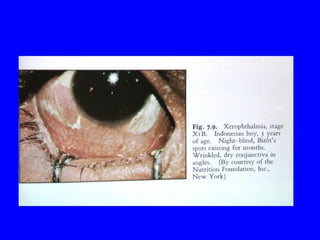
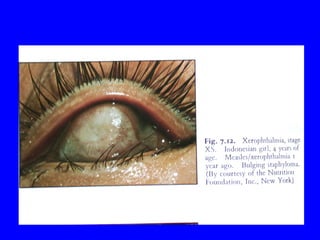
• 2-Keratomalasia
• 3-Papular desquamation
• 4-Frequent respiratory tract infections
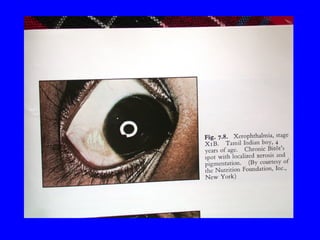
• 5-Bitot’s spots.
Vitamin-A deficiency
Vitamin-A
• Chemistry:
1-Retinol (Retinol, Vit-A1,
Dehydroretinol, Vit-A2)
2-Availability in diet (2 forms)
----as vitamin-A itself (retinol)
----as provitamin precurssors (carotenoids)
(imp: ß-carotene)
• Factors influencing absorption:
1-Dietory fat and proteins
2-Vit-E (prevents its destructions by oxidation)
Vitamin-A
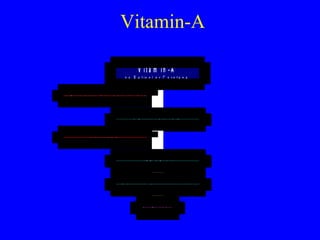
E s t e r if ic a t io n w it h p a lm it ic a c id
h y d r o ly s is
T a r g e t t is s u e
e n t e r s b lo o d a n d b o u n d t o R B P
F r e e R e t in o l
R e t in y l p a lm it a te
V i t a m i n - A
a s R e t in o l o r C a r o t e n e
Vitamin-A
• Requirements (per day):
Infants 1500IU
Adults 4000-5000IU
Pregnancy & lactation 6000-8000IU
Vitamin-A
• Serum levels
Carotenes 90-220 µg/100ml
Vit-A 30-70 µg/100ml
• Liver reserves
25-200µg/gm of liver
Vitamin-A
Vitamin-A deficiency
• Causes:
1-Inadequate diet (very high tissue reserves)
2-Disease of the liver or biliary tract
3-Sprue
4-Severe intestinal disease
5-Generalized protein deficiency (Fall in RBP)
“Vitamin-A deficiency is usually
secondary to malabsorption or other
situations affecting fat absorption”
Irrespctive of the cause in Vit-A
deficiency plasma levels fall.
Vitamin-A
Vitamin-A deficiency
• Disease states:
1-night blindness
2-epithelial metaplasia
3-xerophthalmia
4-keratomalacia
5-follicular keratosis
6-disturbances in bone growth.
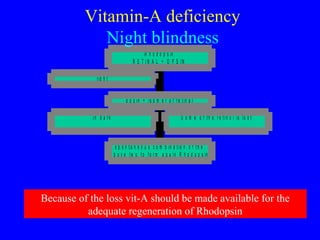
lig h t
in d a r k S o m e o f t h e r e t in o l is lo s t
s p o n t a n e o u s c o m b in a t io n o f t h e
a b o v e tw o t o fo r m a g a in R h o d o p s in
o p s in + is o m e r o f r e t in a l
R h o d o p s in
R E T I N A L + O P S IN
Vitamin-A deficiency
Night blindness
Because of the loss vit-A should be made available for the
adequate regeneration of Rhodopsin
• Vit-A is necessary for the maintanance of
specialized epithelial surfaces (ex: GIT,
Respiratory, GUT, Skin)
• Vit-A deficiency induces excessive
keratinization.
Vitamin-A deficiency
Epithelial metaplsia
• Epithelium:
• 1-other than stratified squamous will under
go atrophy and metaplasia (to stra.squ.epi)
• 2-stratified squamous epithelium will under
go excessive keratinization
• 3-non-keratinizing stratified squamous
epithelium (ex; cornea, conjunctiva, vagina)
become keratinized.
Vitamin-A deficiency
Epithelial metaplsia
• It’s well established in animals but, strong
evidence in humans is lacking.
• 1-Deficiency retards normal growth
• 2-Excess of Vit-A stimulates bone growth
• 3-Epiphyseal bone formation is especially
affected
• 4-Increased growth rate accompanied by
bone resorption leads to increased fragility
Vitamin-A deficiency
Disturbances in bone growth
• Eyes:
1-Cornea & conjunctiva become keratinized
2-Goblet mucous cells on the surface will disappear
3-Lining of the ducts of lacrimal glands will be replaced by str.squ.epith.
4-Keratin debri form plugs in the ducts
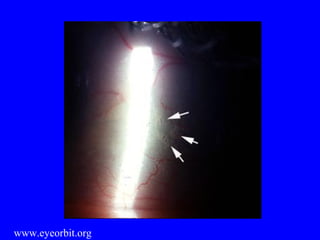
5-Mucosal surfaces become dry and rough (Xerophthalmia)
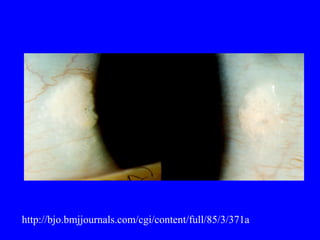
6-Keratin debri accumulate in conjunctiva producing plaques (BITOT’s
spots)
7-Visual acuity is impaired by keratinization & thinning of corneal
mucosa resulting in ulceration and softening of cornea
(KERATOMALACIA) may lead to perforation
Vitamin-A deficiency
Pathology
• Respiratory tract:
• Atrophy of ciliated columnar epithelium
• Squamous metaplasia with keratinization
• Impairement of cilialry action & keratin
debri accumulation results in recurrent
infections.
Vitamin-A deficiency
Pathology
• Urinary tract (esp. renal pelvis and bladder):
• Keratinization of keratin debri formation.
• Keratin debri acts as a nidus for stone
development
• Calculi formation results in infections and
hematuria.
Vitamin-A deficiency
Pathology
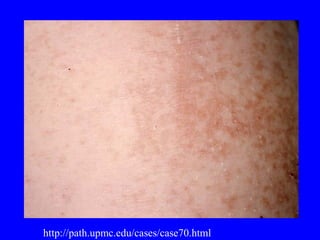
• SKIN:
• Hyperplasia and hyperkeratinization of
epidermis
• Plugging of hair shafts and seaceous gland
ducts by piled up keratin
• Sand paper like skin (Phrynoderma)
Vitamin-A deficiency
Pathology
“Similar keratin plugs in salivary gland ducts
and pancreatic ducts produces significant
digestive disturbances”.
Vitamin-A deficiency
Pathology
• Clinical features:
• 1-Night blindness
• 2-Keratomalasia
• 3-Papular desquamation
• 4-Frequent respiratory tract infections
• 5-Bitot’s spots.
Vitamin-A deficiency
Pathology
• Acute
• Chronic
Vitamin-A TOXICITY
• Acute:
Head ache, dizziness, vomiting and diarrhea
Raised ICT
Occur when >350,000 units are given as in
children
Vitamin-A TOXICITY
• Chronic:
Bone pain,
Loss of hair,
Skin desquamation,
Anorexia,
Raised ICT.
Occurs if doses >60,000units are given daily
Vitamin-A TOXICITY
www.eyeorbit.org
http://bjo.bmjjournals.com/cgi/content/full/85/3/371a
www.eyeorbit.org
http://mark.asci.ncsu.edu/nutrit~1/NutritionSlides
http://path.upmc.edu/cases/case70.html
www.codfish.com/
E N D

Vit a-csbrp

  • 1.
  • 2.
    Vitamins • Definition: Organic micronutrientsfound in a large variety of foods, which are essential for our health. They act as critical catalytic co-factors / prosthetic groups on enzymes in vital metabolic reactions.
  • 3.
    Vitamins Classification: 1-Water soluble vitamins(B-complex and Vit-C) 2-Fat soluble vitamins (Vit-A, D, E, K)
  • 4.
    • Fat solublevitamins: Deficiencies occur mainly due to interference with their absorption ---Pancreatic diseases ---Liver diseases ---Intestinal malabsorption syndromes Vitamins
  • 5.
    • Clinical features: •1-Night blindness • 2-Keratomalasia • 3-Papular desquamation • 4-Frequent respiratory tract infections • 5-Bitot’s spots. Vitamin-A deficiency
  • 6.
    Vitamin-A • Chemistry: 1-Retinol (Retinol,Vit-A1, Dehydroretinol, Vit-A2) 2-Availability in diet (2 forms) ----as vitamin-A itself (retinol) ----as provitamin precurssors (carotenoids) (imp: ß-carotene)
  • 7.
    • Factors influencingabsorption: 1-Dietory fat and proteins 2-Vit-E (prevents its destructions by oxidation) Vitamin-A
  • 8.
    E s te r if ic a t io n w it h p a lm it ic a c id h y d r o ly s is T a r g e t t is s u e e n t e r s b lo o d a n d b o u n d t o R B P F r e e R e t in o l R e t in y l p a lm it a te V i t a m i n - A a s R e t in o l o r C a r o t e n e Vitamin-A
  • 9.
    • Requirements (perday): Infants 1500IU Adults 4000-5000IU Pregnancy & lactation 6000-8000IU Vitamin-A
  • 10.
    • Serum levels Carotenes90-220 µg/100ml Vit-A 30-70 µg/100ml • Liver reserves 25-200µg/gm of liver Vitamin-A
  • 11.
    Vitamin-A deficiency • Causes: 1-Inadequatediet (very high tissue reserves) 2-Disease of the liver or biliary tract 3-Sprue 4-Severe intestinal disease 5-Generalized protein deficiency (Fall in RBP)
  • 12.
    “Vitamin-A deficiency isusually secondary to malabsorption or other situations affecting fat absorption” Irrespctive of the cause in Vit-A deficiency plasma levels fall. Vitamin-A
  • 13.
    Vitamin-A deficiency • Diseasestates: 1-night blindness 2-epithelial metaplasia 3-xerophthalmia 4-keratomalacia 5-follicular keratosis 6-disturbances in bone growth.
  • 14.
    lig h t ind a r k S o m e o f t h e r e t in o l is lo s t s p o n t a n e o u s c o m b in a t io n o f t h e a b o v e tw o t o fo r m a g a in R h o d o p s in o p s in + is o m e r o f r e t in a l R h o d o p s in R E T I N A L + O P S IN Vitamin-A deficiency Night blindness Because of the loss vit-A should be made available for the adequate regeneration of Rhodopsin
  • 15.
    • Vit-A isnecessary for the maintanance of specialized epithelial surfaces (ex: GIT, Respiratory, GUT, Skin) • Vit-A deficiency induces excessive keratinization. Vitamin-A deficiency Epithelial metaplsia
  • 16.
    • Epithelium: • 1-otherthan stratified squamous will under go atrophy and metaplasia (to stra.squ.epi) • 2-stratified squamous epithelium will under go excessive keratinization • 3-non-keratinizing stratified squamous epithelium (ex; cornea, conjunctiva, vagina) become keratinized. Vitamin-A deficiency Epithelial metaplsia
  • 17.
    • It’s wellestablished in animals but, strong evidence in humans is lacking. • 1-Deficiency retards normal growth • 2-Excess of Vit-A stimulates bone growth • 3-Epiphyseal bone formation is especially affected • 4-Increased growth rate accompanied by bone resorption leads to increased fragility Vitamin-A deficiency Disturbances in bone growth
  • 18.
    • Eyes: 1-Cornea &conjunctiva become keratinized 2-Goblet mucous cells on the surface will disappear 3-Lining of the ducts of lacrimal glands will be replaced by str.squ.epith. 4-Keratin debri form plugs in the ducts 5-Mucosal surfaces become dry and rough (Xerophthalmia) 6-Keratin debri accumulate in conjunctiva producing plaques (BITOT’s spots) 7-Visual acuity is impaired by keratinization & thinning of corneal mucosa resulting in ulceration and softening of cornea (KERATOMALACIA) may lead to perforation Vitamin-A deficiency Pathology
  • 19.
    • Respiratory tract: •Atrophy of ciliated columnar epithelium • Squamous metaplasia with keratinization • Impairement of cilialry action & keratin debri accumulation results in recurrent infections. Vitamin-A deficiency Pathology
  • 20.
    • Urinary tract(esp. renal pelvis and bladder): • Keratinization of keratin debri formation. • Keratin debri acts as a nidus for stone development • Calculi formation results in infections and hematuria. Vitamin-A deficiency Pathology
  • 21.
    • SKIN: • Hyperplasiaand hyperkeratinization of epidermis • Plugging of hair shafts and seaceous gland ducts by piled up keratin • Sand paper like skin (Phrynoderma) Vitamin-A deficiency Pathology
  • 22.
    “Similar keratin plugsin salivary gland ducts and pancreatic ducts produces significant digestive disturbances”. Vitamin-A deficiency Pathology
  • 23.
    • Clinical features: •1-Night blindness • 2-Keratomalasia • 3-Papular desquamation • 4-Frequent respiratory tract infections • 5-Bitot’s spots. Vitamin-A deficiency Pathology
  • 24.
  • 25.
    • Acute: Head ache,dizziness, vomiting and diarrhea Raised ICT Occur when >350,000 units are given as in children Vitamin-A TOXICITY
  • 26.
    • Chronic: Bone pain, Lossof hair, Skin desquamation, Anorexia, Raised ICT. Occurs if doses >60,000units are given daily Vitamin-A TOXICITY
  • 27.
  • 28.
  • 29.
  • 30.
  • 37.
  • 38.
  • 39.
  • 40.
  • 41.
  • 42.
  • 43.
  • 44.