MODULE 9 DENIAL OF SERVICE
Objective Denial of Service(D0S) Attack Types of DoS Attacks Tools that facilitate DoS Attack BOTs Distributed Denial of Service (DDoS) Attack Worms and their role in DDoS attack Reflected DoS Attack DDoS Countermeasures
Terminologies A Denial of Service (DoS) attack: It is an attack through which a person can render a system unusable, or significantly slow it down for legitimate users, by overloading its resources A Distributed Denial of Service (DDoS) On the Internet, a distributed denial-of-service (DDoS) attack is one in which a multitude of compromised systems attack a single target, thereby causing denial of service for users of the targeted system
Goal of DoS The goal of DoS is not to gain unauthorized access to machines or data,but to prevent legitimate users of a service from using it Attackers may: Attempt to flood a network, thereby preventing legitimate network traffic Attempt to disrupt connections between two machines, thereby preventing access to a service Attempt to prevent a particular individual from accessing a service Attempt to disrupt service to a specific system or person
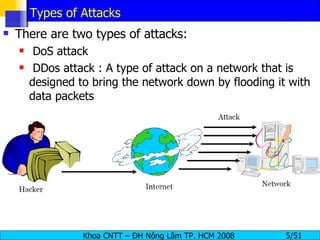
Types of Attacks There are two types of attacks: DoS attack DDos attack : A type of attack on a network that is designed to bring the network down by flooding it with data packets
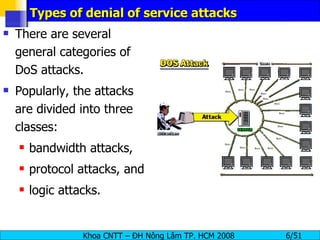
Types of denial of service attacks There are several general categories of DoS attacks. Popularly, the attacks are divided into three classes:  bandwidth attacks,  protocol attacks, and logic attacks.
DoS Attack Classification Smurf Buffer Overflow Attack Ping of death Teardrop SYN Attack
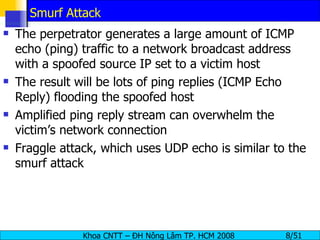
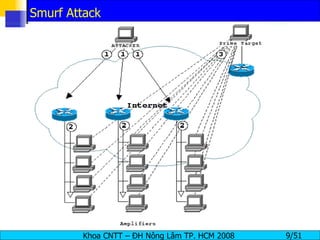
Smurf Attack The perpetrator generates a large amount of ICMP echo (ping) traffic to a network broadcast address with a spoofed source IP set to a victim host The result will be lots of ping replies (ICMP Echo Reply) flooding the spoofed host Amplified ping reply stream can overwhelm the victim’s network connection Fraggle attack, which uses UDP echo is similar to the smurf attack
Smurf Attack
Buffer Overflow Attack Buffer overflow occurs any time the program writes more information into the buffer than the space allocated in the memory The attacker can overwrite the data that controls the program execution path and hijack the control of the program to execute the attacker’s code instead of the process code Sending email messages that have attachments with 256-character file names can cause buffer overflow
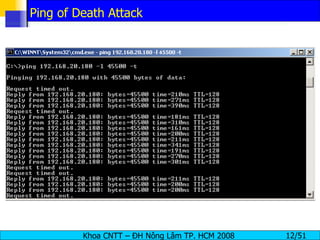
Ping of Death Attack The attacker deliberately sends an IP packet larger than the 65,536 bytes allowed by the IP protocol Fragmentation allows a single IP packet to be broken down into smaller segments The fragments can add up to more than the allowed 65,536 bytes. The operating system, unable to handle oversized packets freezes, reboots, or simply crashes The identity of the attacker sending the oversized packet can be easily spoofed Example: Ping of Death causes blue screen of death in Windows NT
Ping of Death Attack
Teardrop Attack IP requires that a packet that is too large for the next router to handle should be divided into fragments The attacker's IP puts a confusing offset value in the second or later fragment  If the receiving operating system is not able to aggregate the packets accordingly, it can crash the system It is a UDP attack, which uses overlapping offset fields to bring down hosts
SYN Attack The attacker sends bogus TCP SYN requests to a victim server. The host allocates resources (memory sockets) to the connection Prevents the server from responding to the legitimate Requests  This attack exploits the three-way handshake  Malicious flooding by large volumes of TCP SYN packets to the victim’s system with spoofed source IP addresses can cause DoS
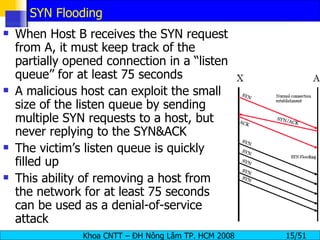
SYN Flooding When Host B receives the SYN request from A, it must keep track of the partially opened connection in a “listen queue” for at least 75 seconds A malicious host can exploit the small size of the listen queue by sending multiple SYN requests to a host, but never replying to the SYN&ACK The victim’s listen queue is quickly filled up This ability of removing a host from the network for at least 75 seconds can be used as a denial-of-service attack
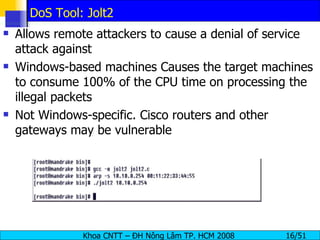
DoS Tool: Jolt2 Allows remote attackers to cause a denial of service attack against Windows-based machines Causes the target machines to consume 100% of the CPU time on processing the illegal packets Not Windows-specific. Cisco routers and other gateways may be vulnerable
DoS Tool: Bubonic.c Bubonic.c is a DoS exploit that can be run against Windows 2000 machines It works by randomly sending TCP packets with random settings with the goal of increasing the load of the machine, so that it eventually crashes
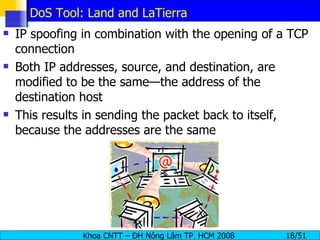
DoS Tool: Land and LaTierra IP spoofing in combination with the opening of a TCP connection Both IP addresses, source, and destination, are modified to be the same—the address of the destination host This results in sending the packet back to itself, because the addresses are the same
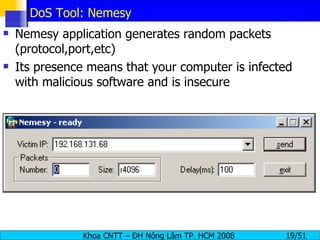
DoS Tool: Nemesy Nemesy application generates random packets (protocol,port,etc) Its presence means that your computer is infected with malicious software and is insecure
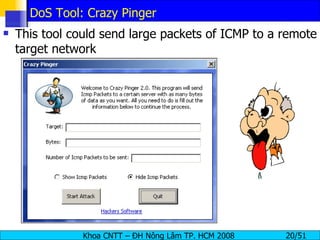
DoS Tool: Crazy Pinger This tool could send large packets of ICMP to a remote target network
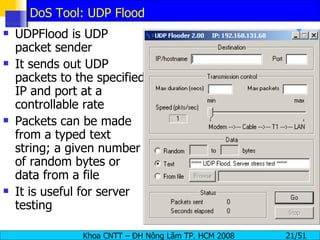
DoS Tool: UDP Flood UDPFlood is UDP packet sender It sends out UDP packets to the specified IP and port at a controllable rate Packets can be made from a typed text string; a given number of random bytes or data from a file It is useful for server testing
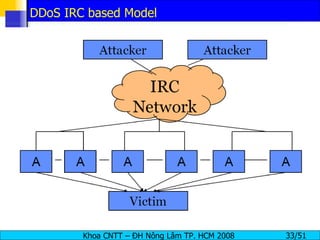
Bot (Derived from the Word RoBOT) IRC  bot is also called  zombie  or  drone Internet Relay Chat  (IRC) is a form of real-time communication over the Internet. It is mainly designed for group (one-to-many) communication in discussion forums called channels The bot joins a specific IRC channel on an IRC server and waits for further commands The attacker can remotely control the bot and use it for fun and also for profit
Botnets Botnets consist of a multitude of machines They are used for DDoS attacks A relatively small botnet with only 1,000 bots has a combined bandwidth that is probably higher than the Internet connection of most corporate systems (1,000 home PCs with an average upstream of 128KBit/s can offer more than 100MBit/s)
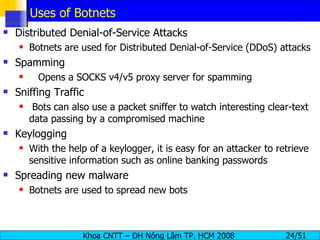
Uses of Botnets Distributed Denial-of-Service Attacks Botnets are used for Distributed Denial-of-Service (DDoS) attacks Spamming   Opens a SOCKS v4/v5 proxy server for spamming Sniffing Traffic Bots can also use a packet sniffer to watch interesting clear-text data passing by a compromised machine Keylogging With the help of a keylogger, it is easy for an attacker to retrieve sensitive information such as online banking passwords  Spreading new malware Botnets are used to spread new bots
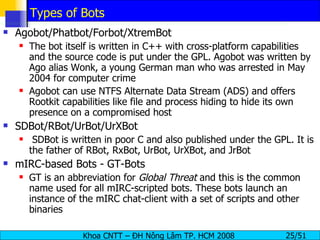
Types of Bots Agobot/Phatbot/Forbot/XtremBot The bot itself is written in C++ with cross-platform capabilities and the source code is put under the GPL. Agobot was written by Ago alias Wonk, a young German man who was arrested in May 2004 for computer crime Agobot can use NTFS Alternate Data Stream (ADS) and offers Rootkit capabilities like file and process hiding to hide its own presence on a compromised host SDBot/RBot/UrBot/UrXBot SDBot is written in poor C and also published under the GPL. It is the father of RBot, RxBot, UrBot, UrXBot, and JrBot mIRC-based Bots - GT-Bots GT is an abbreviation for  Global Threat  and this is the common name used for all mIRC-scripted bots. These bots launch an instance of the mIRC chat-client with a set of scripts and other binaries
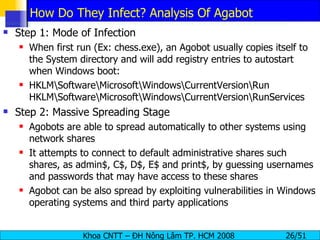
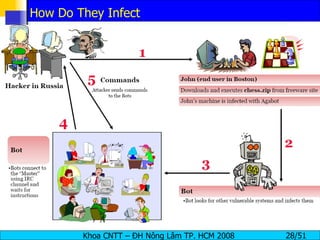
How Do They Infect? Analysis Of Agabot Step 1: Mode of Infection When first run (Ex: chess.exe), an Agobot usually copies itself to the System directory and will add registry entries to autostart when Windows boot: HKLM\Software\Microsoft\Windows\CurrentVersion\Run HKLM\Software\Microsoft\Windows\CurrentVersion\RunServices Step 2: Massive Spreading Stage  Agobots are able to spread automatically to other systems using network shares It attempts to connect to default administrative shares such shares, as admin$, C$, D$, E$ and print$, by guessing usernames and passwords that may have access to these shares Agobot can be also spread by exploiting vulnerabilities in Windows operating systems and third party applications
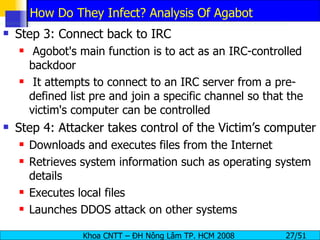
How Do They Infect? Analysis Of Agabot Step 3: Connect back to IRC Agobot's main function is to act as an IRC-controlled backdoor It attempts to connect to an IRC server from a pre-defined list pre and join a specific channel so that the victim's computer can be controlled Step 4: Attacker takes control of the Victim’s computer Downloads and executes files from the Internet Retrieves system information such as operating system details Executes local files Launches DDOS attack on other systems
How Do They Infect
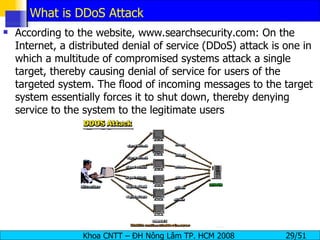
What is DDoS Attack According to the website, www.searchsecurity.com: On the Internet, a distributed denial of service (DDoS) attack is one in which a multitude of compromised systems attack a single target, thereby causing denial of service for users of the targeted system. The flood of incoming messages to the target system essentially forces it to shut down, thereby denying service to the system to the legitimate users
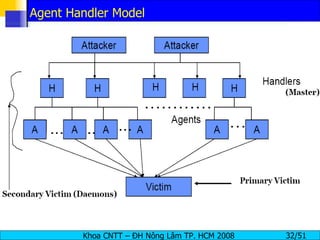
Characteristics of DDoS Attacks DDoS Attack is a large-scale and coordinated attack on the availability of services of a victim system The services under attack are those of the “primary victim,” while the compromised systems used to launch the attack are often called the “secondary victims” This makes it difficult to detect because attacks originate from several IP addresses  If a single IP address is attacking a company, it can block that address at its firewall. If it is 30,000, this is extremely difficult Perpetrator is able to multiply the effectiveness of the Denial of Service significantly by harnessing the resources of multiple unwitting accomplice computers which serve as attack platforms
DDOS Unstoppable DDoS attacks rely on finding thousands of vulnerable, Internet-connected systems and systematically compromising them using known vulnerabilities Once the DDoS attack has been launched, it is hard to stop Packets arriving at your firewall may be blocked there, but they may just as easily overwhelm the incoming side of your Internet connection If the source addresses of these packets have been spoofed, then you will have no way of knowing if they reflect the true source of the attack until you track down some of the alleged sources The sheer volume of sources involved in DDoS attacks makes it difficult to stop
Agent Handler Model
DDoS IRC based Model
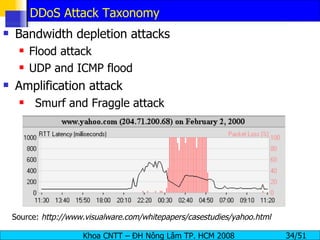
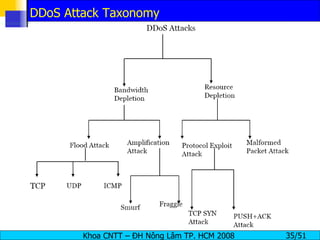
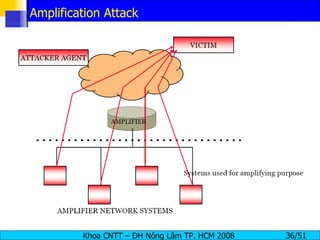
DDoS Attack Taxonomy Bandwidth depletion attacks Flood attack UDP and ICMP flood Amplification attack Smurf and Fraggle attack Source:  http://www.visualware.com/whitepapers/casestudies/yahoo.html
DDoS Attack Taxonomy
Amplification Attack
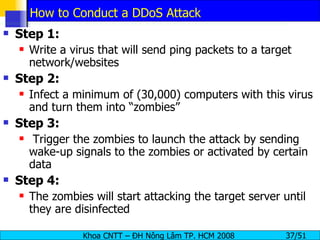
How to Conduct a DDoS Attack Step 1: Write a virus that will send ping packets to a target network/websites Step 2: Infect a minimum of (30,000) computers with this virus and turn them into “zombies” Step 3: Trigger the zombies to launch the attack by sending wake-up signals to the zombies or activated by certain data Step 4: The zombies will start attacking the target server until they are disinfected
The Reflected DoS Attacks
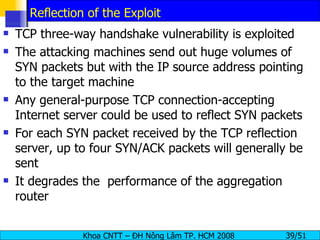
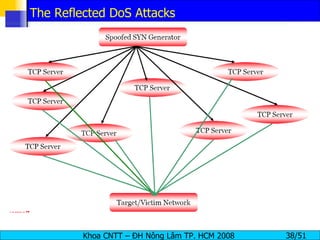
Reflection of the Exploit TCP three-way handshake vulnerability is exploited The attacking machines send out huge volumes of SYN packets but with the IP source address pointing to the target machine Any general-purpose TCP connection-accepting Internet server could be used to reflect SYN packets For each SYN packet received by the TCP reflection server, up to four SYN/ACK packets will generally be sent It degrades the  performance of the aggregation router
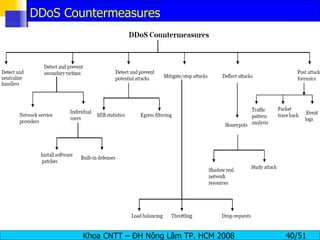
DDoS Countermeasures
Taxonomy of DDoS Countermeasures Three essential components: Preventing secondary victims and detecting and neutralizing handlers Detecting or preventing the attack, mitigating or stopping the attack, and deflecting the attack The post-attack component which involves network forensics
Preventing Secondary Victims A heightened awareness of security issues and prevention techniques from all Internet users Agent programs should be scanned for in the systems Installing anti-virus and anti-Trojan software, and keeping these up-to-date can prevent installation of the agent programs Daunting for the average “web-surfer,” recent work has proposed built-in defensive mechanisms in the core hardware and software of computing systems
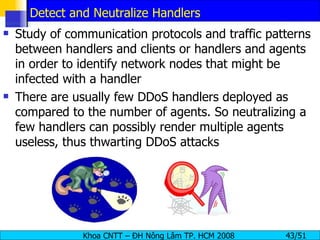
Detect and Neutralize Handlers Study of communication protocols and traffic patterns between handlers and clients or handlers and agents in order to identify network nodes that might be infected with a handler There are usually few DDoS handlers deployed as compared to the number of agents. So neutralizing a few handlers can possibly render multiple agents useless, thus thwarting DDoS attacks
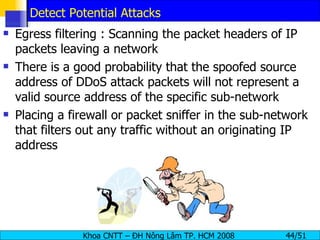
Detect Potential Attacks Egress filtering : Scanning the packet headers of IP packets leaving a network There is a good probability that the spoofed source address of DDoS attack packets will not represent a valid source address of the specific sub-network Placing a firewall or packet sniffer in the sub-network that filters out any traffic without an originating IP address
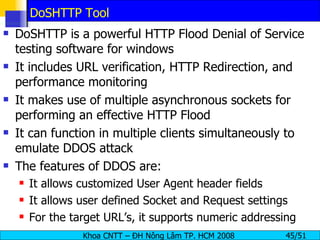
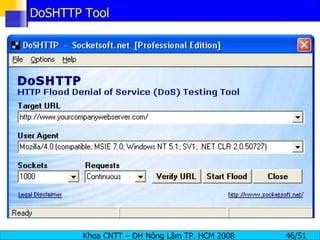
DoSHTTP Tool DoSHTTP is a powerful HTTP Flood Denial of Service testing software for windows It includes URL verification, HTTP Redirection, and performance monitoring It makes use of multiple asynchronous sockets for performing an effective HTTP Flood It can function in multiple clients simultaneously to emulate DDOS attack The features of DDOS are: It allows customized User Agent header fields It allows user defined Socket and Request settings For the target URL’s, it supports numeric addressing
DoSHTTP Tool
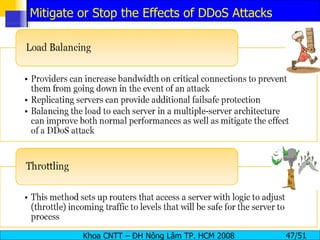
Mitigate or Stop the Effects of DDoS Attacks
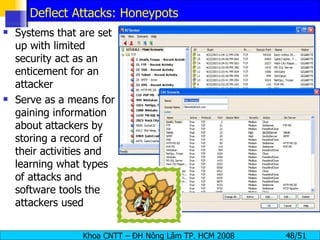
Deflect Attacks: Honeypots Systems that are set up with limited security act as an enticement for an attacker Serve as a means for gaining information about attackers by storing a record of their activities and learning what types of attacks and software tools the attackers used
Post-attack Forensics Traffic pattern analysis: Data can be analyzed—post-attack—to look for specific characteristics within the attacking traffic This characteristic data can be used for updating load balancing and throttling countermeasures DDoS attack traffic patterns can help network administrators to develop new filtering techniques for preventing it from entering or leaving their networks
Packet Traceback Packet Traceback allows back tracing the attacker’s traffic and possibly identifying the attacker Additionally, when the attacker sends vastly different types of attacking traffic, this method assists in providing the victim’s system with information that might help develop filters to block the attack Event Logs: It keeps logs of the DDoS attack information in order to do a forensic analysis, and to assist law enforcement in the event the attacker does severe financial damage
 

Module 9 Dos

  • 1.
    MODULE 9 DENIALOF SERVICE
  • 2.
    Objective Denial ofService(D0S) Attack Types of DoS Attacks Tools that facilitate DoS Attack BOTs Distributed Denial of Service (DDoS) Attack Worms and their role in DDoS attack Reflected DoS Attack DDoS Countermeasures
  • 3.
    Terminologies A Denialof Service (DoS) attack: It is an attack through which a person can render a system unusable, or significantly slow it down for legitimate users, by overloading its resources A Distributed Denial of Service (DDoS) On the Internet, a distributed denial-of-service (DDoS) attack is one in which a multitude of compromised systems attack a single target, thereby causing denial of service for users of the targeted system
  • 4.
    Goal of DoSThe goal of DoS is not to gain unauthorized access to machines or data,but to prevent legitimate users of a service from using it Attackers may: Attempt to flood a network, thereby preventing legitimate network traffic Attempt to disrupt connections between two machines, thereby preventing access to a service Attempt to prevent a particular individual from accessing a service Attempt to disrupt service to a specific system or person
  • 5.
    Types of AttacksThere are two types of attacks: DoS attack DDos attack : A type of attack on a network that is designed to bring the network down by flooding it with data packets
  • 6.
    Types of denialof service attacks There are several general categories of DoS attacks. Popularly, the attacks are divided into three classes: bandwidth attacks, protocol attacks, and logic attacks.
  • 7.
    DoS Attack ClassificationSmurf Buffer Overflow Attack Ping of death Teardrop SYN Attack
  • 8.
    Smurf Attack Theperpetrator generates a large amount of ICMP echo (ping) traffic to a network broadcast address with a spoofed source IP set to a victim host The result will be lots of ping replies (ICMP Echo Reply) flooding the spoofed host Amplified ping reply stream can overwhelm the victim’s network connection Fraggle attack, which uses UDP echo is similar to the smurf attack
  • 9.
  • 10.
    Buffer Overflow AttackBuffer overflow occurs any time the program writes more information into the buffer than the space allocated in the memory The attacker can overwrite the data that controls the program execution path and hijack the control of the program to execute the attacker’s code instead of the process code Sending email messages that have attachments with 256-character file names can cause buffer overflow
  • 11.
    Ping of DeathAttack The attacker deliberately sends an IP packet larger than the 65,536 bytes allowed by the IP protocol Fragmentation allows a single IP packet to be broken down into smaller segments The fragments can add up to more than the allowed 65,536 bytes. The operating system, unable to handle oversized packets freezes, reboots, or simply crashes The identity of the attacker sending the oversized packet can be easily spoofed Example: Ping of Death causes blue screen of death in Windows NT
  • 12.
  • 13.
    Teardrop Attack IPrequires that a packet that is too large for the next router to handle should be divided into fragments The attacker's IP puts a confusing offset value in the second or later fragment If the receiving operating system is not able to aggregate the packets accordingly, it can crash the system It is a UDP attack, which uses overlapping offset fields to bring down hosts
  • 14.
    SYN Attack Theattacker sends bogus TCP SYN requests to a victim server. The host allocates resources (memory sockets) to the connection Prevents the server from responding to the legitimate Requests This attack exploits the three-way handshake Malicious flooding by large volumes of TCP SYN packets to the victim’s system with spoofed source IP addresses can cause DoS
  • 15.
    SYN Flooding WhenHost B receives the SYN request from A, it must keep track of the partially opened connection in a “listen queue” for at least 75 seconds A malicious host can exploit the small size of the listen queue by sending multiple SYN requests to a host, but never replying to the SYN&ACK The victim’s listen queue is quickly filled up This ability of removing a host from the network for at least 75 seconds can be used as a denial-of-service attack
  • 16.
    DoS Tool: Jolt2Allows remote attackers to cause a denial of service attack against Windows-based machines Causes the target machines to consume 100% of the CPU time on processing the illegal packets Not Windows-specific. Cisco routers and other gateways may be vulnerable
  • 17.
    DoS Tool: Bubonic.cBubonic.c is a DoS exploit that can be run against Windows 2000 machines It works by randomly sending TCP packets with random settings with the goal of increasing the load of the machine, so that it eventually crashes
  • 18.
    DoS Tool: Landand LaTierra IP spoofing in combination with the opening of a TCP connection Both IP addresses, source, and destination, are modified to be the same—the address of the destination host This results in sending the packet back to itself, because the addresses are the same
  • 19.
    DoS Tool: NemesyNemesy application generates random packets (protocol,port,etc) Its presence means that your computer is infected with malicious software and is insecure
  • 20.
    DoS Tool: CrazyPinger This tool could send large packets of ICMP to a remote target network
  • 21.
    DoS Tool: UDPFlood UDPFlood is UDP packet sender It sends out UDP packets to the specified IP and port at a controllable rate Packets can be made from a typed text string; a given number of random bytes or data from a file It is useful for server testing
  • 22.
    Bot (Derived fromthe Word RoBOT) IRC bot is also called zombie or drone Internet Relay Chat (IRC) is a form of real-time communication over the Internet. It is mainly designed for group (one-to-many) communication in discussion forums called channels The bot joins a specific IRC channel on an IRC server and waits for further commands The attacker can remotely control the bot and use it for fun and also for profit
  • 23.
    Botnets Botnets consistof a multitude of machines They are used for DDoS attacks A relatively small botnet with only 1,000 bots has a combined bandwidth that is probably higher than the Internet connection of most corporate systems (1,000 home PCs with an average upstream of 128KBit/s can offer more than 100MBit/s)
  • 24.
    Uses of BotnetsDistributed Denial-of-Service Attacks Botnets are used for Distributed Denial-of-Service (DDoS) attacks Spamming Opens a SOCKS v4/v5 proxy server for spamming Sniffing Traffic Bots can also use a packet sniffer to watch interesting clear-text data passing by a compromised machine Keylogging With the help of a keylogger, it is easy for an attacker to retrieve sensitive information such as online banking passwords Spreading new malware Botnets are used to spread new bots
  • 25.
    Types of BotsAgobot/Phatbot/Forbot/XtremBot The bot itself is written in C++ with cross-platform capabilities and the source code is put under the GPL. Agobot was written by Ago alias Wonk, a young German man who was arrested in May 2004 for computer crime Agobot can use NTFS Alternate Data Stream (ADS) and offers Rootkit capabilities like file and process hiding to hide its own presence on a compromised host SDBot/RBot/UrBot/UrXBot SDBot is written in poor C and also published under the GPL. It is the father of RBot, RxBot, UrBot, UrXBot, and JrBot mIRC-based Bots - GT-Bots GT is an abbreviation for Global Threat and this is the common name used for all mIRC-scripted bots. These bots launch an instance of the mIRC chat-client with a set of scripts and other binaries
  • 26.
    How Do TheyInfect? Analysis Of Agabot Step 1: Mode of Infection When first run (Ex: chess.exe), an Agobot usually copies itself to the System directory and will add registry entries to autostart when Windows boot: HKLM\Software\Microsoft\Windows\CurrentVersion\Run HKLM\Software\Microsoft\Windows\CurrentVersion\RunServices Step 2: Massive Spreading Stage Agobots are able to spread automatically to other systems using network shares It attempts to connect to default administrative shares such shares, as admin$, C$, D$, E$ and print$, by guessing usernames and passwords that may have access to these shares Agobot can be also spread by exploiting vulnerabilities in Windows operating systems and third party applications
  • 27.
    How Do TheyInfect? Analysis Of Agabot Step 3: Connect back to IRC Agobot's main function is to act as an IRC-controlled backdoor It attempts to connect to an IRC server from a pre-defined list pre and join a specific channel so that the victim's computer can be controlled Step 4: Attacker takes control of the Victim’s computer Downloads and executes files from the Internet Retrieves system information such as operating system details Executes local files Launches DDOS attack on other systems
  • 28.
  • 29.
    What is DDoSAttack According to the website, www.searchsecurity.com: On the Internet, a distributed denial of service (DDoS) attack is one in which a multitude of compromised systems attack a single target, thereby causing denial of service for users of the targeted system. The flood of incoming messages to the target system essentially forces it to shut down, thereby denying service to the system to the legitimate users
  • 30.
    Characteristics of DDoSAttacks DDoS Attack is a large-scale and coordinated attack on the availability of services of a victim system The services under attack are those of the “primary victim,” while the compromised systems used to launch the attack are often called the “secondary victims” This makes it difficult to detect because attacks originate from several IP addresses If a single IP address is attacking a company, it can block that address at its firewall. If it is 30,000, this is extremely difficult Perpetrator is able to multiply the effectiveness of the Denial of Service significantly by harnessing the resources of multiple unwitting accomplice computers which serve as attack platforms
  • 31.
    DDOS Unstoppable DDoSattacks rely on finding thousands of vulnerable, Internet-connected systems and systematically compromising them using known vulnerabilities Once the DDoS attack has been launched, it is hard to stop Packets arriving at your firewall may be blocked there, but they may just as easily overwhelm the incoming side of your Internet connection If the source addresses of these packets have been spoofed, then you will have no way of knowing if they reflect the true source of the attack until you track down some of the alleged sources The sheer volume of sources involved in DDoS attacks makes it difficult to stop
  • 32.
  • 33.
  • 34.
    DDoS Attack TaxonomyBandwidth depletion attacks Flood attack UDP and ICMP flood Amplification attack Smurf and Fraggle attack Source: http://www.visualware.com/whitepapers/casestudies/yahoo.html
  • 35.
  • 36.
  • 37.
    How to Conducta DDoS Attack Step 1: Write a virus that will send ping packets to a target network/websites Step 2: Infect a minimum of (30,000) computers with this virus and turn them into “zombies” Step 3: Trigger the zombies to launch the attack by sending wake-up signals to the zombies or activated by certain data Step 4: The zombies will start attacking the target server until they are disinfected
  • 38.
  • 39.
    Reflection of theExploit TCP three-way handshake vulnerability is exploited The attacking machines send out huge volumes of SYN packets but with the IP source address pointing to the target machine Any general-purpose TCP connection-accepting Internet server could be used to reflect SYN packets For each SYN packet received by the TCP reflection server, up to four SYN/ACK packets will generally be sent It degrades the performance of the aggregation router
  • 40.
  • 41.
    Taxonomy of DDoSCountermeasures Three essential components: Preventing secondary victims and detecting and neutralizing handlers Detecting or preventing the attack, mitigating or stopping the attack, and deflecting the attack The post-attack component which involves network forensics
  • 42.
    Preventing Secondary VictimsA heightened awareness of security issues and prevention techniques from all Internet users Agent programs should be scanned for in the systems Installing anti-virus and anti-Trojan software, and keeping these up-to-date can prevent installation of the agent programs Daunting for the average “web-surfer,” recent work has proposed built-in defensive mechanisms in the core hardware and software of computing systems
  • 43.
    Detect and NeutralizeHandlers Study of communication protocols and traffic patterns between handlers and clients or handlers and agents in order to identify network nodes that might be infected with a handler There are usually few DDoS handlers deployed as compared to the number of agents. So neutralizing a few handlers can possibly render multiple agents useless, thus thwarting DDoS attacks
  • 44.
    Detect Potential AttacksEgress filtering : Scanning the packet headers of IP packets leaving a network There is a good probability that the spoofed source address of DDoS attack packets will not represent a valid source address of the specific sub-network Placing a firewall or packet sniffer in the sub-network that filters out any traffic without an originating IP address
  • 45.
    DoSHTTP Tool DoSHTTPis a powerful HTTP Flood Denial of Service testing software for windows It includes URL verification, HTTP Redirection, and performance monitoring It makes use of multiple asynchronous sockets for performing an effective HTTP Flood It can function in multiple clients simultaneously to emulate DDOS attack The features of DDOS are: It allows customized User Agent header fields It allows user defined Socket and Request settings For the target URL’s, it supports numeric addressing
  • 46.
  • 47.
    Mitigate or Stopthe Effects of DDoS Attacks
  • 48.
    Deflect Attacks: HoneypotsSystems that are set up with limited security act as an enticement for an attacker Serve as a means for gaining information about attackers by storing a record of their activities and learning what types of attacks and software tools the attackers used
  • 49.
    Post-attack Forensics Trafficpattern analysis: Data can be analyzed—post-attack—to look for specific characteristics within the attacking traffic This characteristic data can be used for updating load balancing and throttling countermeasures DDoS attack traffic patterns can help network administrators to develop new filtering techniques for preventing it from entering or leaving their networks
  • 50.
    Packet Traceback PacketTraceback allows back tracing the attacker’s traffic and possibly identifying the attacker Additionally, when the attacker sends vastly different types of attacking traffic, this method assists in providing the victim’s system with information that might help develop filters to block the attack Event Logs: It keeps logs of the DDoS attack information in order to do a forensic analysis, and to assist law enforcement in the event the attacker does severe financial damage
  • 51.