December 27,2016 1
DoS & DDoS Attack
INTRODUCTION:
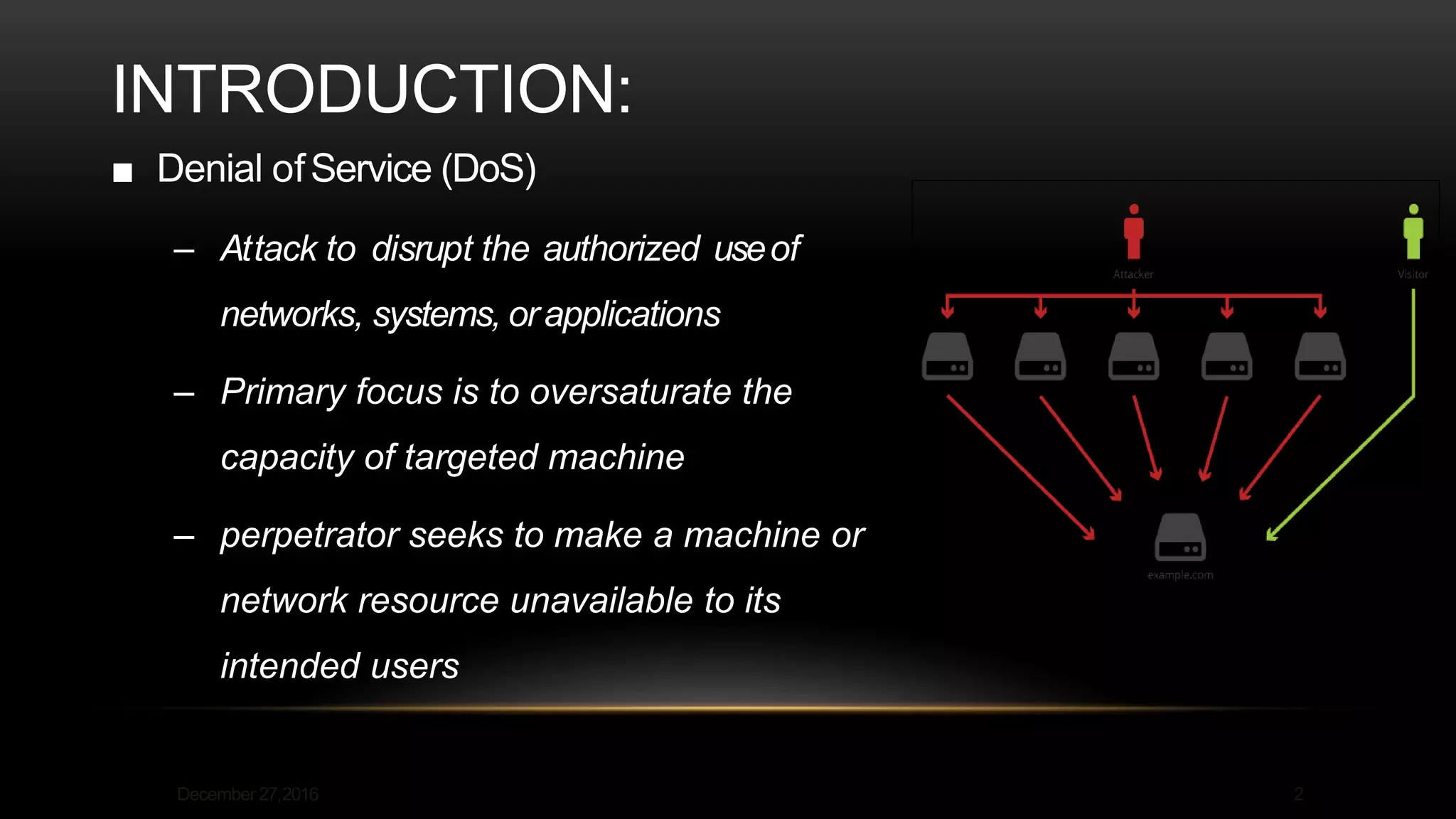
■ Denial ofService (DoS)
– Attack to disrupt the authorized useof
networks, systems, orapplications
– Primary focus is to oversaturate the
capacity of targeted machine
– perpetrator seeks to make a machine or
network resource unavailable to its
intended users
December 27,2016 2
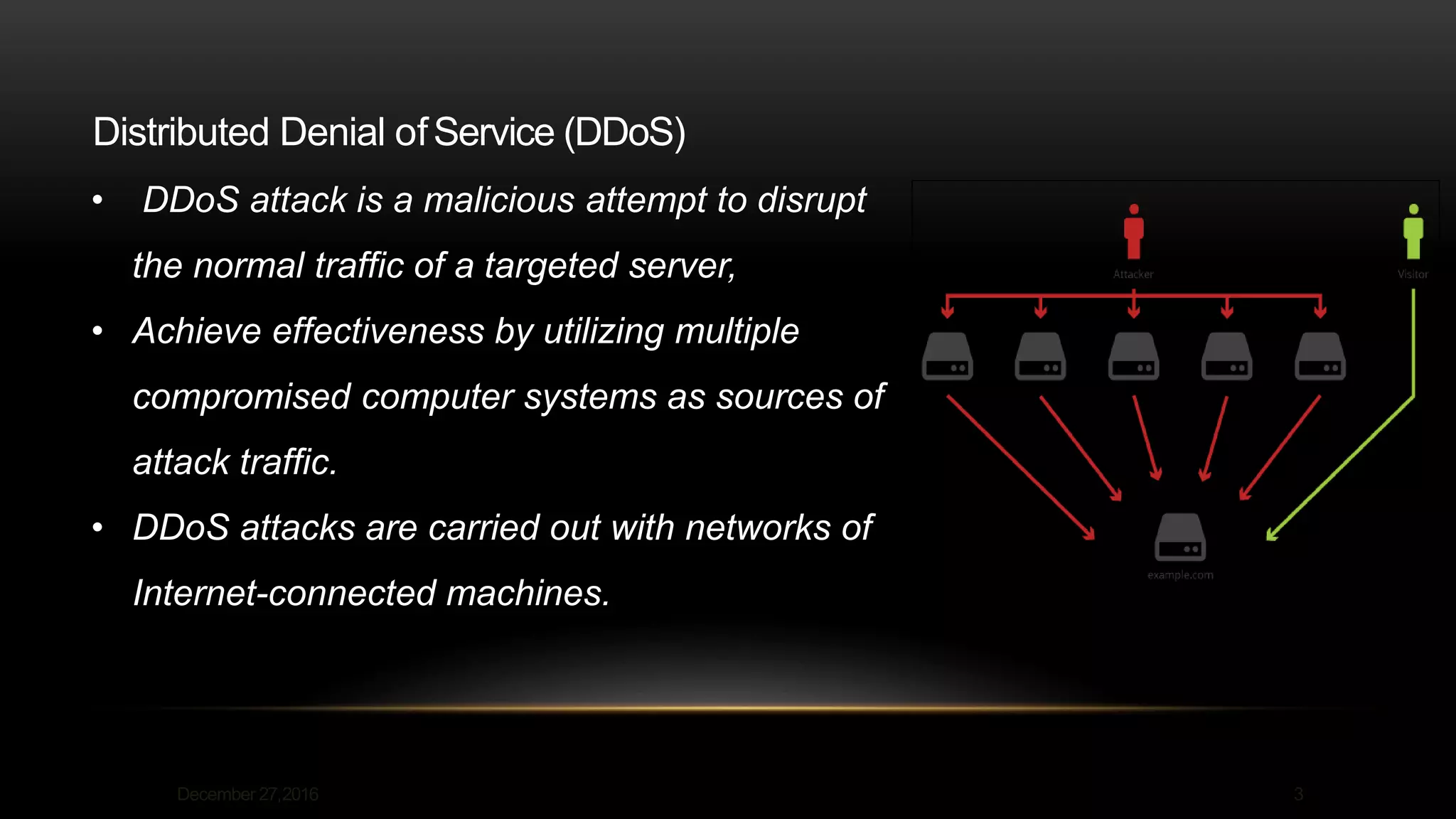
Distributed Denial ofService (DDoS)
• DDoS attack is a malicious attempt to disrupt
the normal traffic of a targeted server,
• Achieve effectiveness by utilizing multiple
compromised computer systems as sources of
attack traffic.
• DDoS attacks are carried out with networks of
Internet-connected machines.
December 27,2016 3
HOW DDOS ATTACK WORK
■ incoming traffic flooding the victim
originates from many different
sources – potentially hundreds of
thousands ormore.
■ effectively makes it impossible to
stop the attack simply by blocking
asingle IPaddress;
■ very difficult to distinguish
legitimate user traffic from attack
traffic when spread across so many
points oforigin.
December 27,2016 4
TYPES OF DOS ATTACKS
• Buffer overflow attacks – the most common DoS attack. The
concept is to send more traffic to a network address than the
programmers have built the system to handle.
• ICMP flood – leverages misconfigured network devices by sending
spoofed packets that ping every computer on the targeted network,
instead of just one specific machine. The network is then triggered
TYPESOFDDOSATTACKS
December 27,2016 6
■ Trafficattacks: Traffic flooding attacks send ahuge volume of TCP
,UDP and
ICPM packets to the target. Legitimate requests get lost and these attacks
may be accompanied by malware exploitation.
■ Bandwidth attacks: This DDoS attack overloads the target with massive
amounts of junk data. This results in a loss of network bandwidth and
equipment resources and can lead to acomplete denial of service.
■ Application attacks: Application-layer data messages can deplete
resources in the application layer, leaving the target's system services
unavailable.
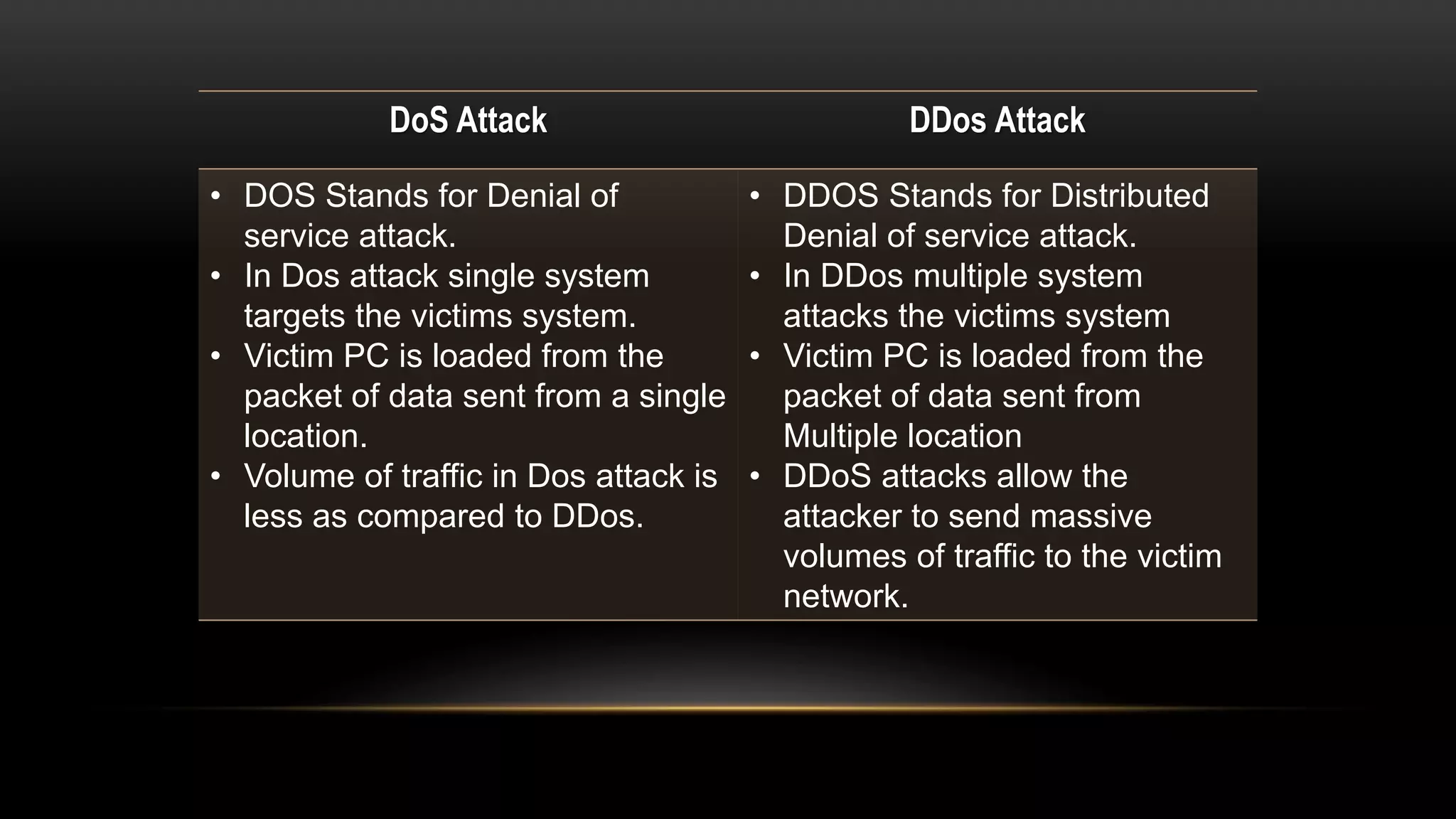
DoS Attack DDos Attack
• DOS Stands for Denial of
service attack.
• In Dos attack single system
targets the victims system.
• Victim PC is loaded from the
packet of data sent from a single
location.
• Volume of traffic in Dos attack is
less as compared to DDos.
• DDOS Stands for Distributed
Denial of service attack.
• In DDos multiple system
attacks the victims system
• Victim PC is loaded from the
packet of data sent from
Multiple location
• DDoS attacks allow the
attacker to send massive
volumes of traffic to the victim
network.
ATTACKER MOTIVATION
1.Hacktivism: Hacktivists use DoS attacks as a means to express their criticism
of everything, from governments and politicians, including “big business”
2. Cyber vandalism: These vandals are often bored teenagers looking for an
adrenaline rush, or seeking to vent their anger or frustration against an
institution or on a person.
3. Business competition: DoS and DDoS attacks are increasingly being used
as a competitive business tool.
4. Extortion: An increasingly popular motivation for DDoS attacks is extortion,
meaning a cybercriminal demands money in exchange for stopping (or not
carrying out) a crippling DDoS or DoS attack
ATTACK PREVENTION
MBER27,
9
 Buy More Bandwidth ensure that you have enough bandwidth to handle
spikes in traffic that may be caused by malicious activity.
 Build Redundancy Into Your Infrastructure For this strategy to be truly
effective, it’s necessary to ensure that the data centers are connected to
different networks.
 Configure Your Network Hardware Against DDoS Attacks: For example,
configuring your firewall or router to drop incoming ICMP packets or
block DNS responses from outside your network
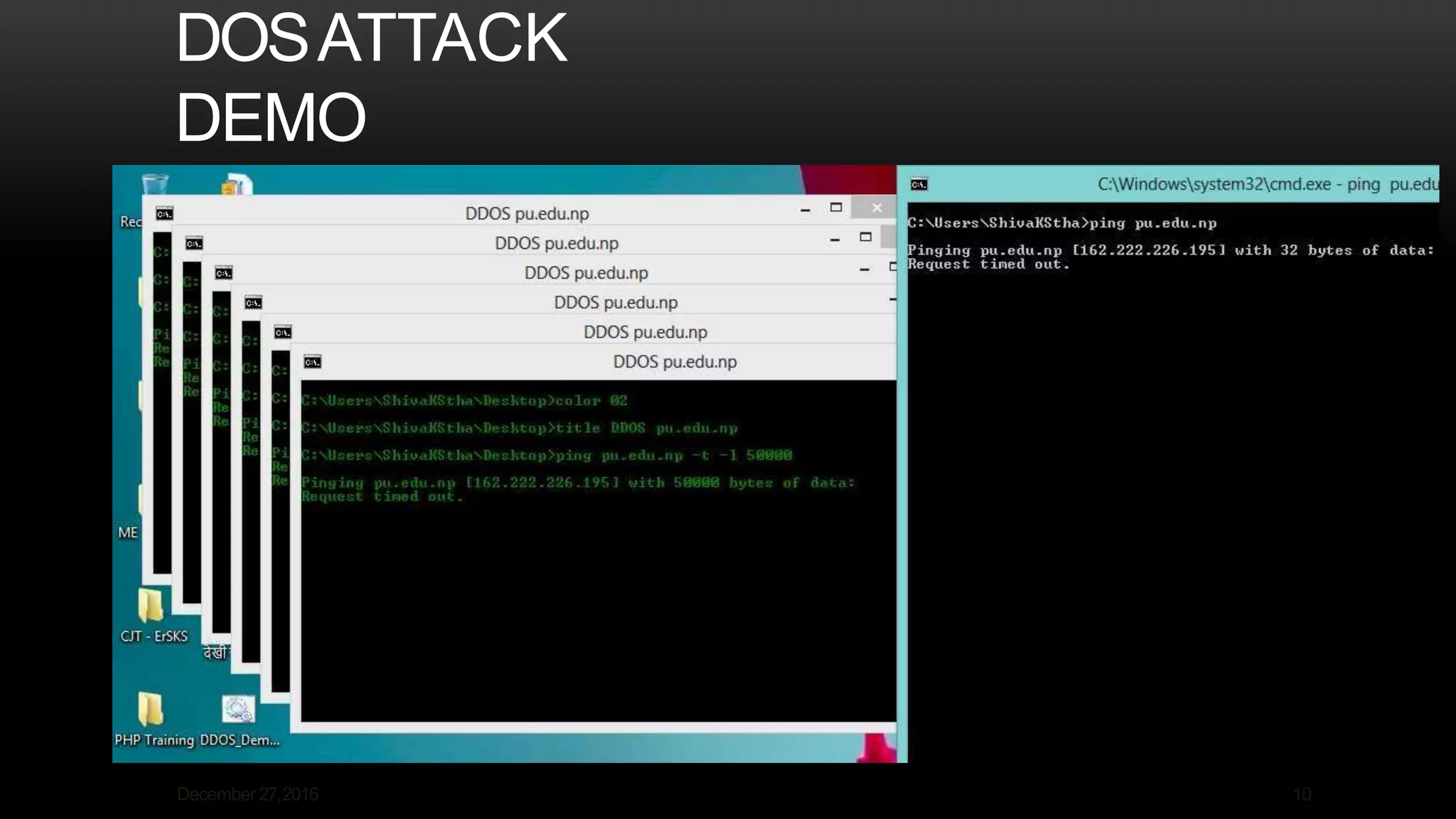
DOSATTACK
DEMO
December 27,2016 10
Dos n d dos

Dos n d dos

  • 1.
  • 2.
    INTRODUCTION: ■ Denial ofService(DoS) – Attack to disrupt the authorized useof networks, systems, orapplications – Primary focus is to oversaturate the capacity of targeted machine – perpetrator seeks to make a machine or network resource unavailable to its intended users December 27,2016 2
  • 3.
    Distributed Denial ofService(DDoS) • DDoS attack is a malicious attempt to disrupt the normal traffic of a targeted server, • Achieve effectiveness by utilizing multiple compromised computer systems as sources of attack traffic. • DDoS attacks are carried out with networks of Internet-connected machines. December 27,2016 3
  • 4.
    HOW DDOS ATTACKWORK ■ incoming traffic flooding the victim originates from many different sources – potentially hundreds of thousands ormore. ■ effectively makes it impossible to stop the attack simply by blocking asingle IPaddress; ■ very difficult to distinguish legitimate user traffic from attack traffic when spread across so many points oforigin. December 27,2016 4
  • 5.
    TYPES OF DOSATTACKS • Buffer overflow attacks – the most common DoS attack. The concept is to send more traffic to a network address than the programmers have built the system to handle. • ICMP flood – leverages misconfigured network devices by sending spoofed packets that ping every computer on the targeted network, instead of just one specific machine. The network is then triggered
  • 6.
    TYPESOFDDOSATTACKS December 27,2016 6 ■Trafficattacks: Traffic flooding attacks send ahuge volume of TCP ,UDP and ICPM packets to the target. Legitimate requests get lost and these attacks may be accompanied by malware exploitation. ■ Bandwidth attacks: This DDoS attack overloads the target with massive amounts of junk data. This results in a loss of network bandwidth and equipment resources and can lead to acomplete denial of service. ■ Application attacks: Application-layer data messages can deplete resources in the application layer, leaving the target's system services unavailable.
  • 7.
    DoS Attack DDosAttack • DOS Stands for Denial of service attack. • In Dos attack single system targets the victims system. • Victim PC is loaded from the packet of data sent from a single location. • Volume of traffic in Dos attack is less as compared to DDos. • DDOS Stands for Distributed Denial of service attack. • In DDos multiple system attacks the victims system • Victim PC is loaded from the packet of data sent from Multiple location • DDoS attacks allow the attacker to send massive volumes of traffic to the victim network.
  • 8.
    ATTACKER MOTIVATION 1.Hacktivism: Hacktivistsuse DoS attacks as a means to express their criticism of everything, from governments and politicians, including “big business” 2. Cyber vandalism: These vandals are often bored teenagers looking for an adrenaline rush, or seeking to vent their anger or frustration against an institution or on a person. 3. Business competition: DoS and DDoS attacks are increasingly being used as a competitive business tool. 4. Extortion: An increasingly popular motivation for DDoS attacks is extortion, meaning a cybercriminal demands money in exchange for stopping (or not carrying out) a crippling DDoS or DoS attack
  • 9.
    ATTACK PREVENTION MBER27, 9  BuyMore Bandwidth ensure that you have enough bandwidth to handle spikes in traffic that may be caused by malicious activity.  Build Redundancy Into Your Infrastructure For this strategy to be truly effective, it’s necessary to ensure that the data centers are connected to different networks.  Configure Your Network Hardware Against DDoS Attacks: For example, configuring your firewall or router to drop incoming ICMP packets or block DNS responses from outside your network
  • 10.