MODULE 4 ENUMERATION
Objective Overview of System Hacking Cycle Enumeration Techniques for Enumeration Establishing Null Session Enumerating User Accounts Null User Countermeasures SNMP Scan SNMP Enumeration MIB SNMP Util Example SNMP Enumeration Countermeasures Active Directory Enumeration AD Enumeration Countermeasures
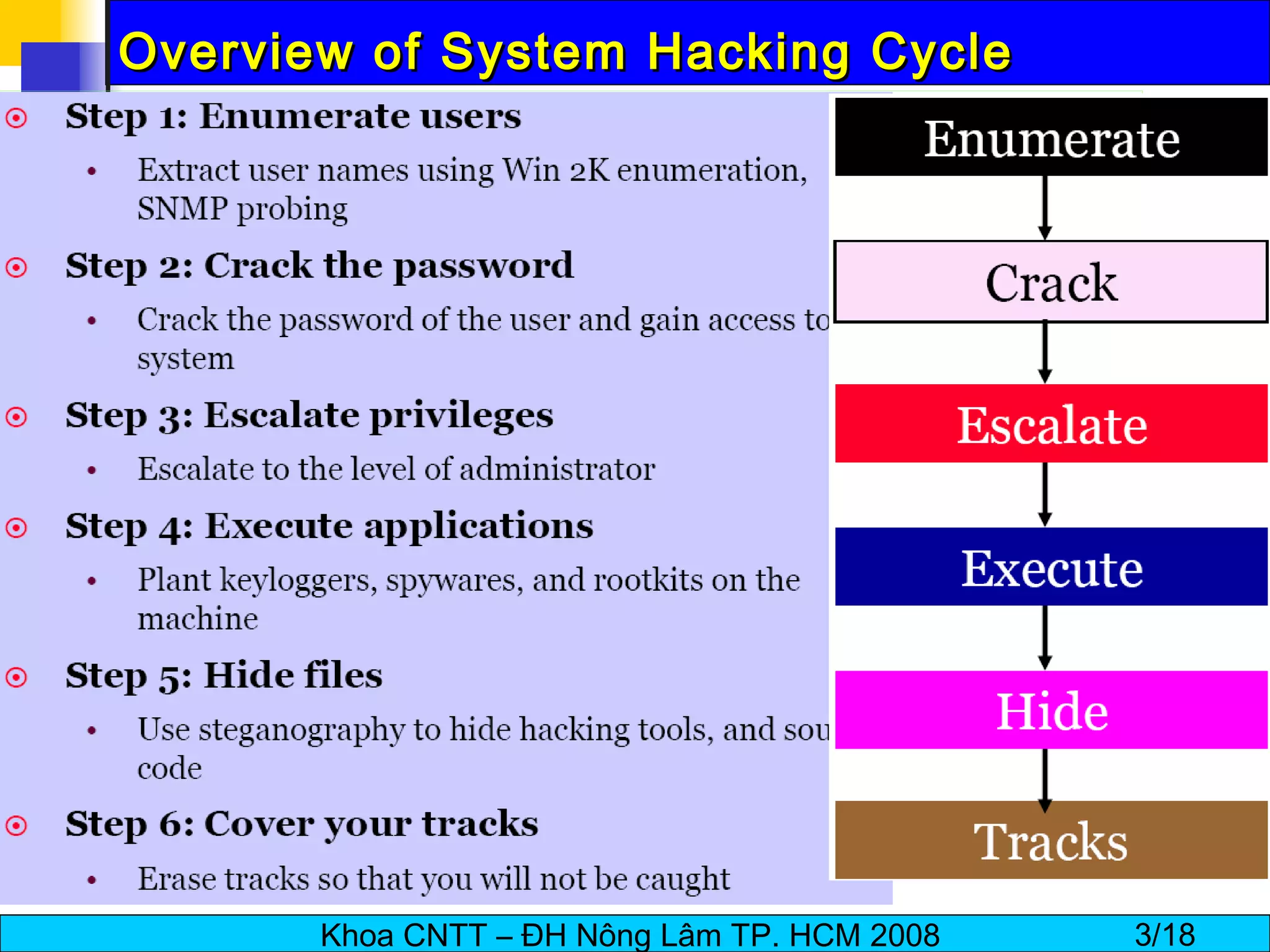
Overview of System Hacking Cycle
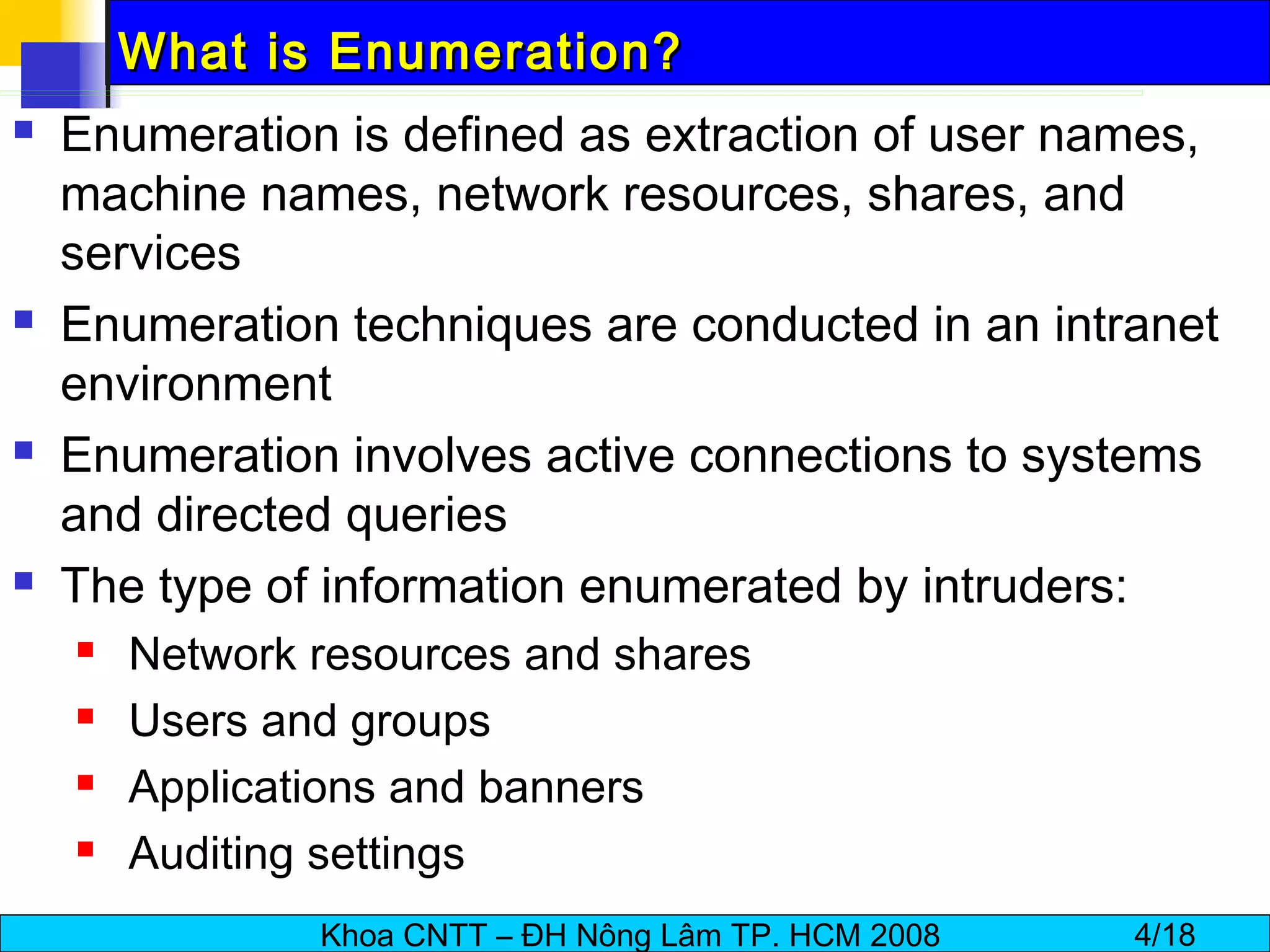
What is Enumeration? Enumeration is defined as extraction of user names, machine names, network resources, shares, and services Enumeration techniques are conducted in an intranet environment Enumeration involves active connections to systems and directed queries The type of information enumerated by intruders: Network resources and shares Users and groups Applications and banners Auditing settings
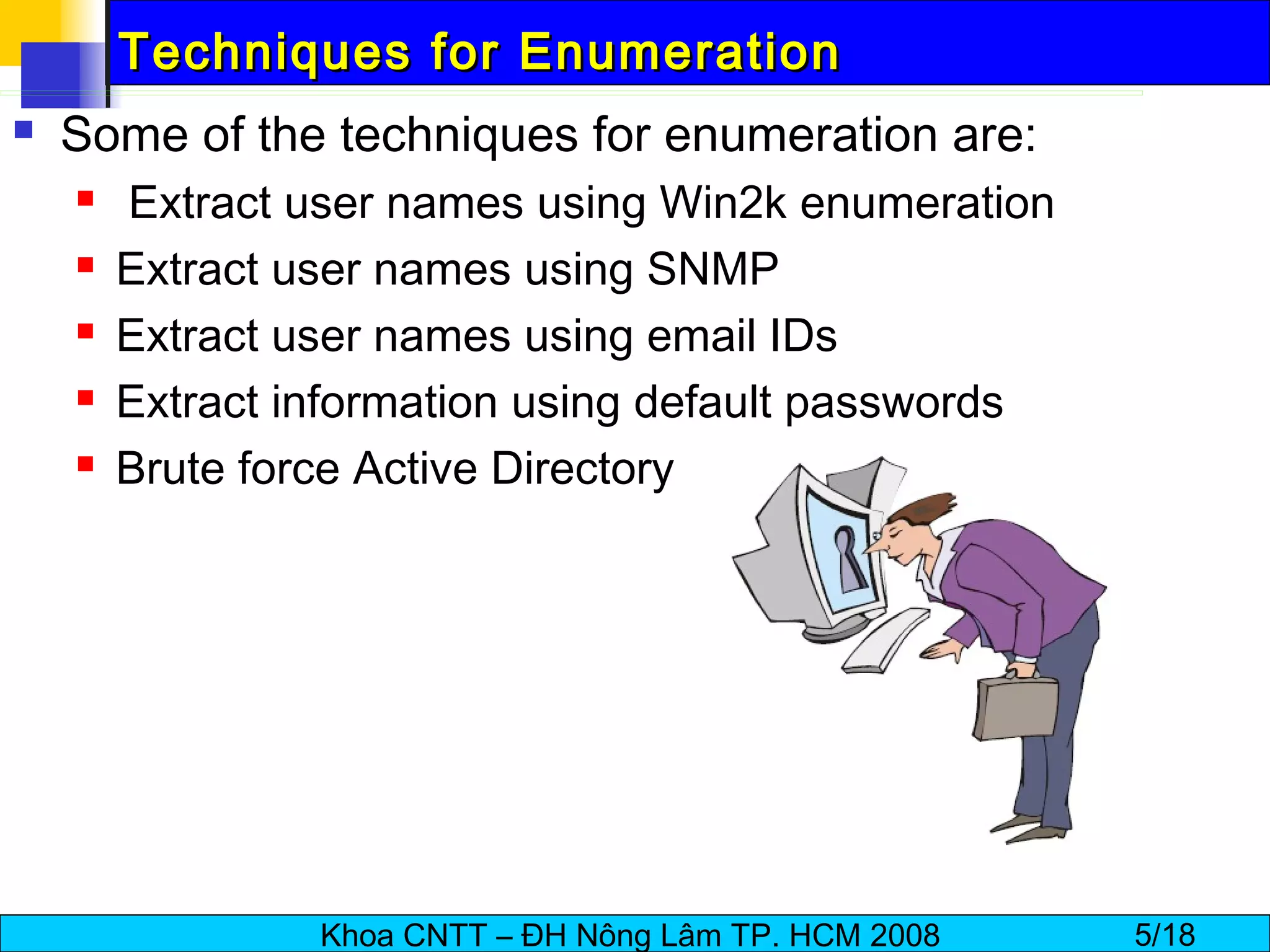
Techniques for Enumeration Some of the techniques for enumeration are: Extract user names using Win2k enumeration Extract user names using SNMP Extract user names using email IDs Extract information using default passwords Brute force Active Directory
Netbios Null Sessions The null session is often refereed to as the Holy Grail of Windows hacking. Null sessions take advantage of flaws in the CIFS/SMB (Common Internet File System/Server Messaging Block) You can establish a null session with a Windows (NT/2000/XP) host by logging on with a null user name and password Using these null connections allows you to gather the following information from the host: List of users and groups List of machines List of shares Users and host SIDs (Security Identifiers)
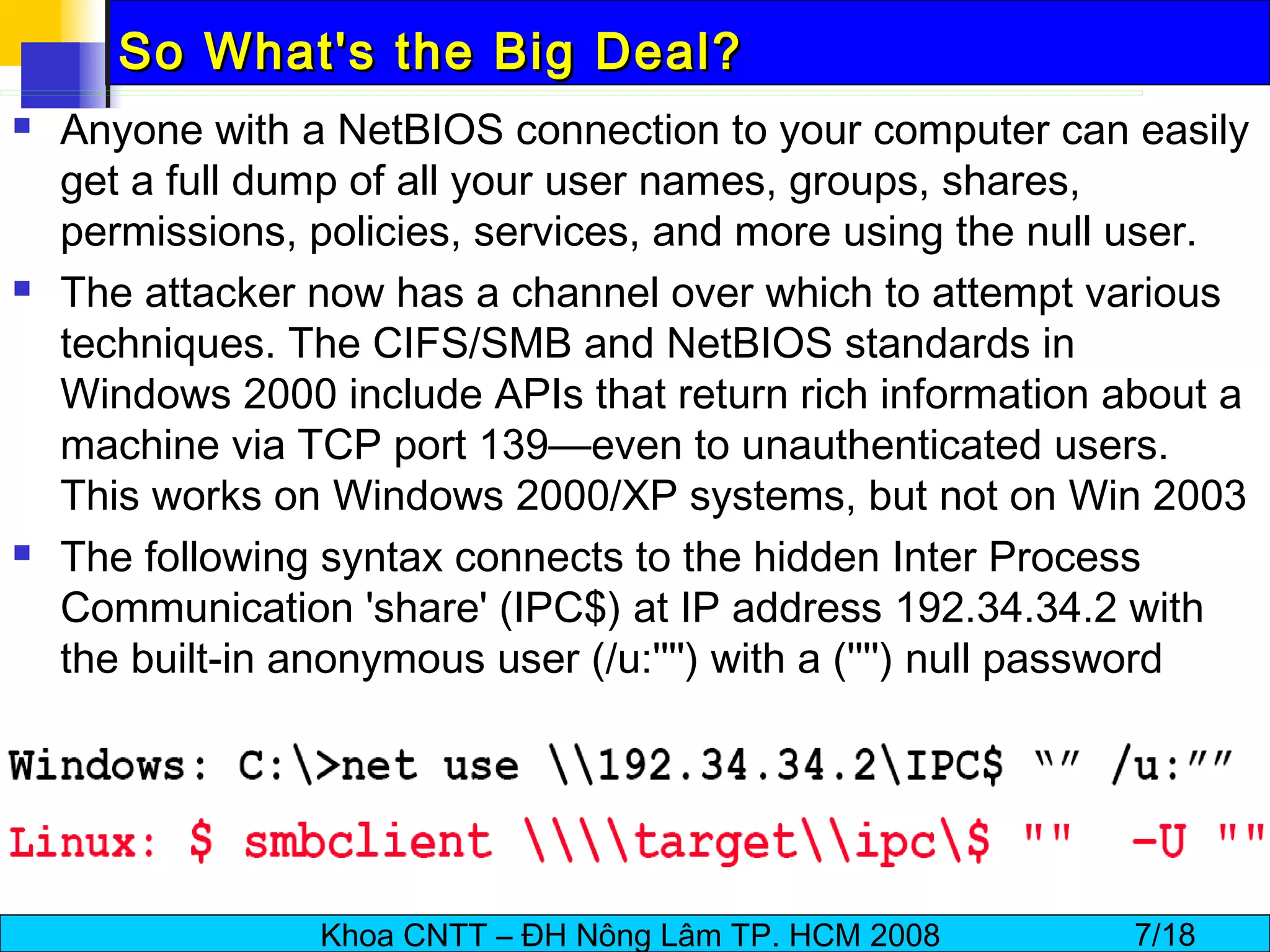
So What's the Big Deal? Anyone with a NetBIOS connection to your computer can easily get a full dump of all your user names, groups, shares, permissions, policies, services, and more using the null user. The attacker now has a channel over which to attempt various techniques. The CIFS/SMB and NetBIOS standards in Windows 2000 include APIs that return rich information about a machine via TCP port 139—even to unauthenticated users. This works on Windows 2000/XP systems, but not on Win 2003 The following syntax connects to the hidden Inter Process Communication 'share' (IPC$) at IP address 192.34.34.2 with the built-in anonymous user (/u:'''') with a ('''') null password
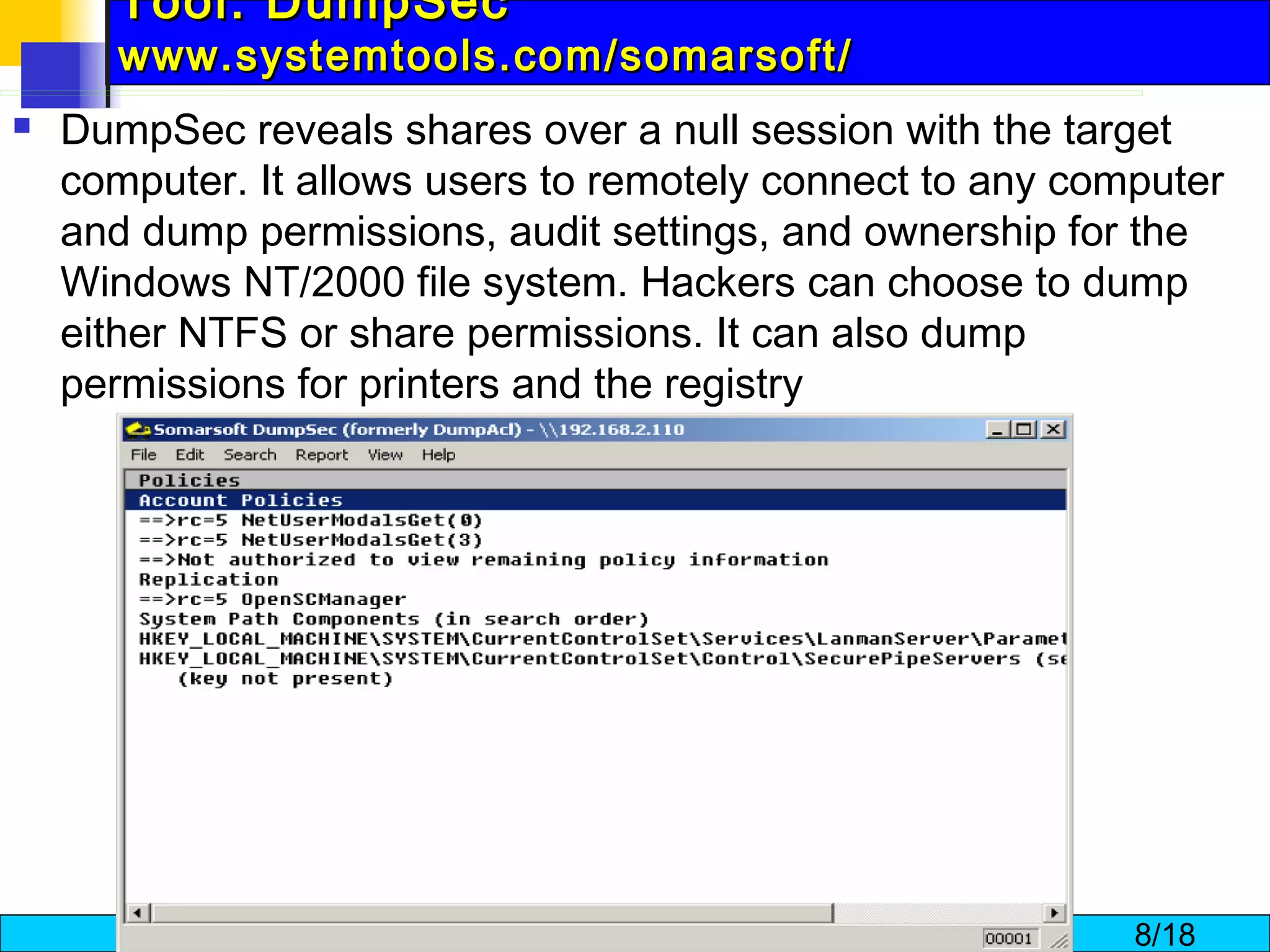
Tool: DumpSec  www.systemtools.com/somarsoft/ DumpSec reveals shares over a null session with the target computer. It allows users to remotely connect to any computer and dump permissions, audit settings, and ownership for the Windows NT/2000 file system. Hackers can choose to dump either NTFS or share permissions. It can also dump permissions for printers and the registry
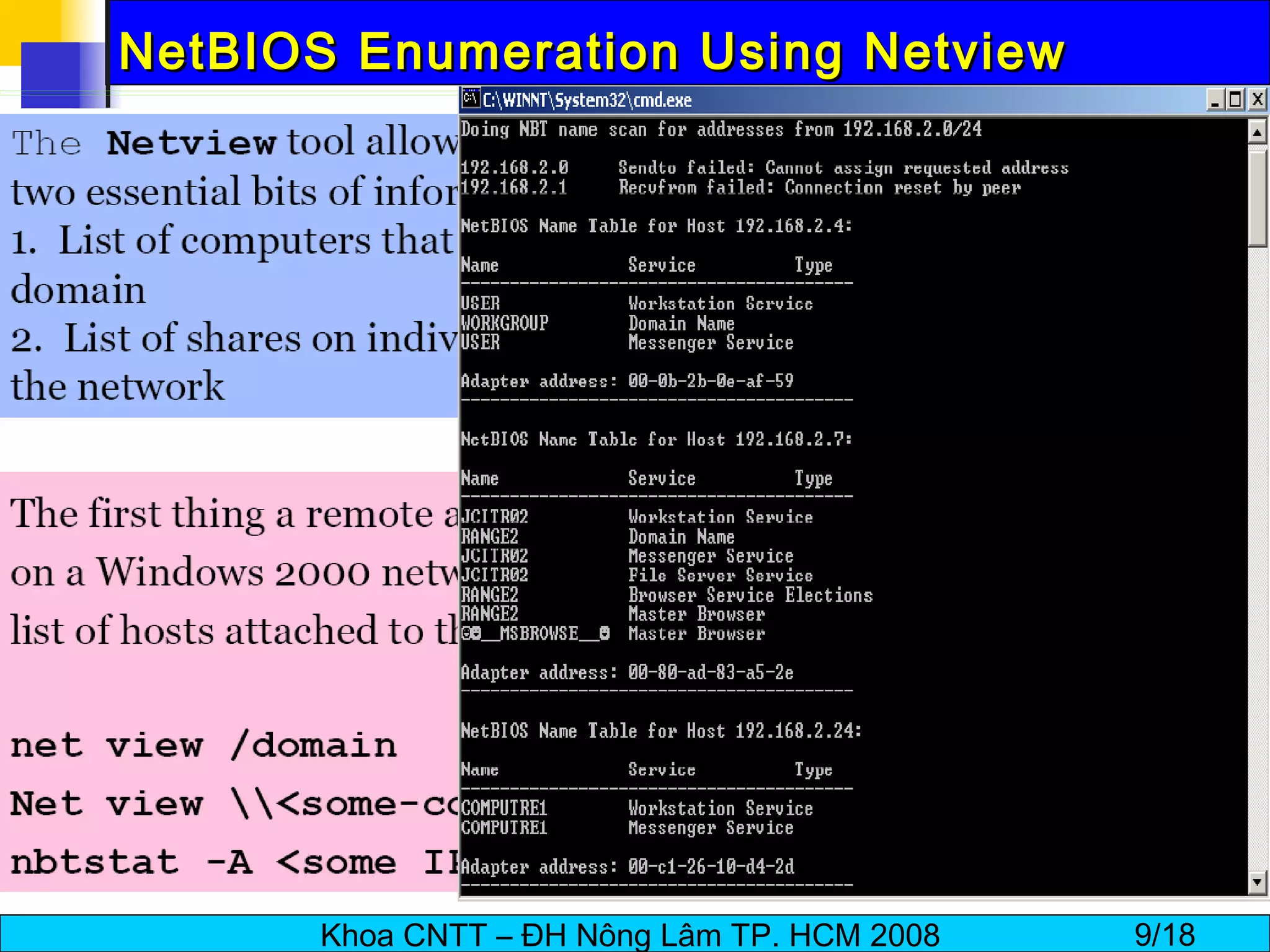
NetBIOS Enumeration Using Netview
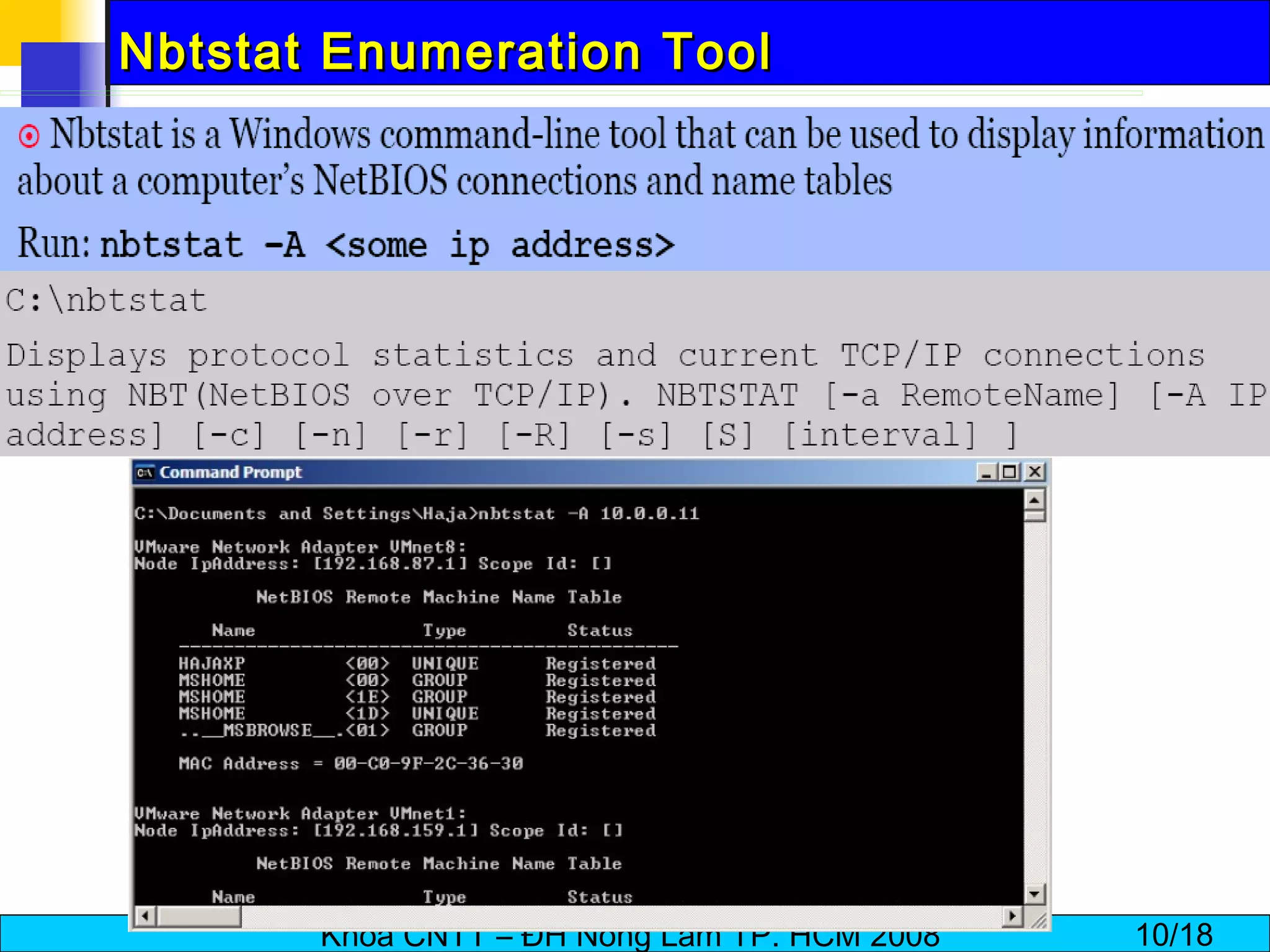
Nbtstat Enumeration Tool
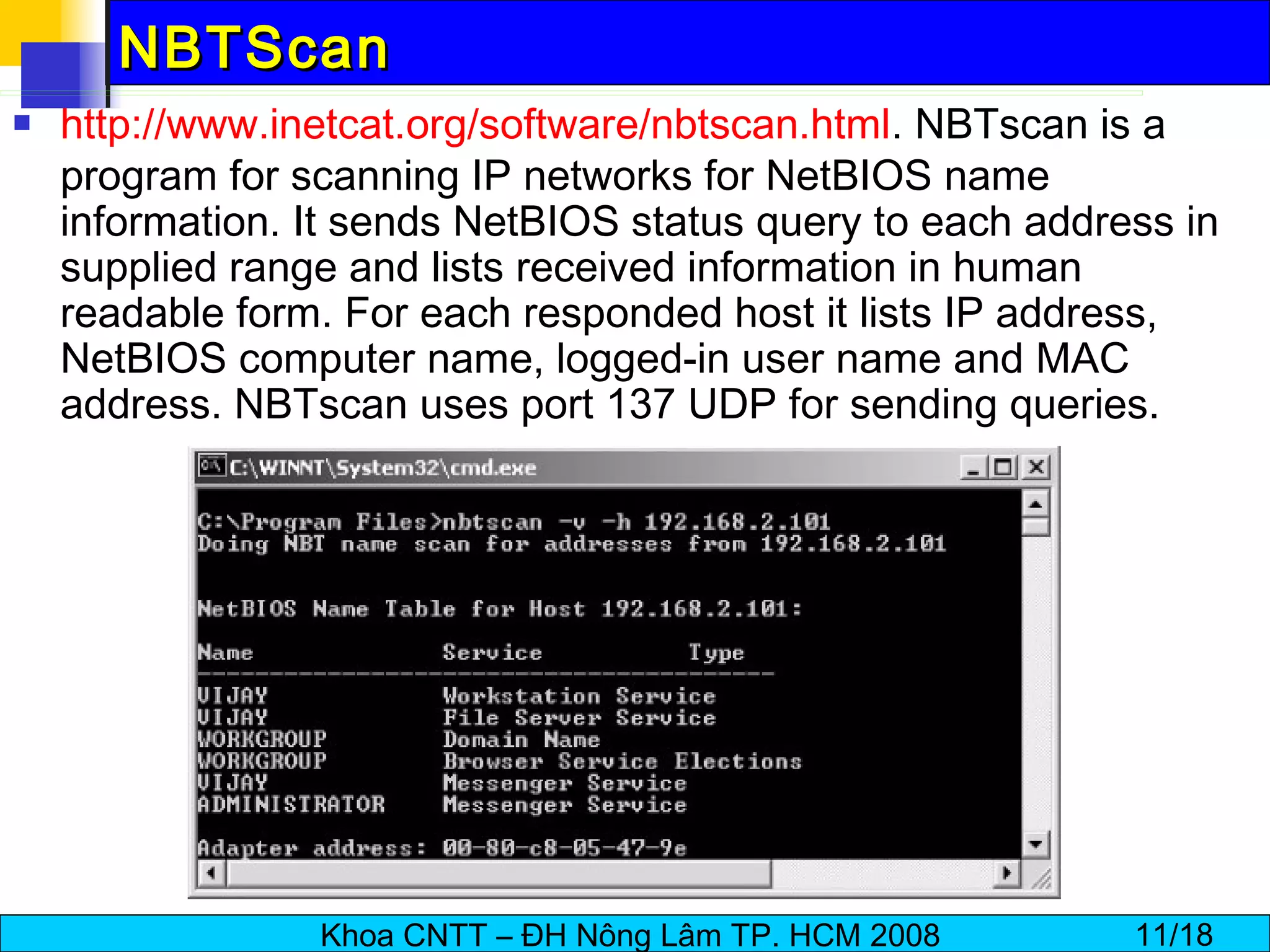
NBTScan http:// www.inetcat.org/software/nbtscan.html . NBTscan is a program for scanning IP networks for NetBIOS name information. It sends NetBIOS status query to each address in supplied range and lists received information in human readable form. For each responded host it lists IP address, NetBIOS computer name, logged-in user name and MAC address. NBTscan uses port 137 UDP for sending queries.
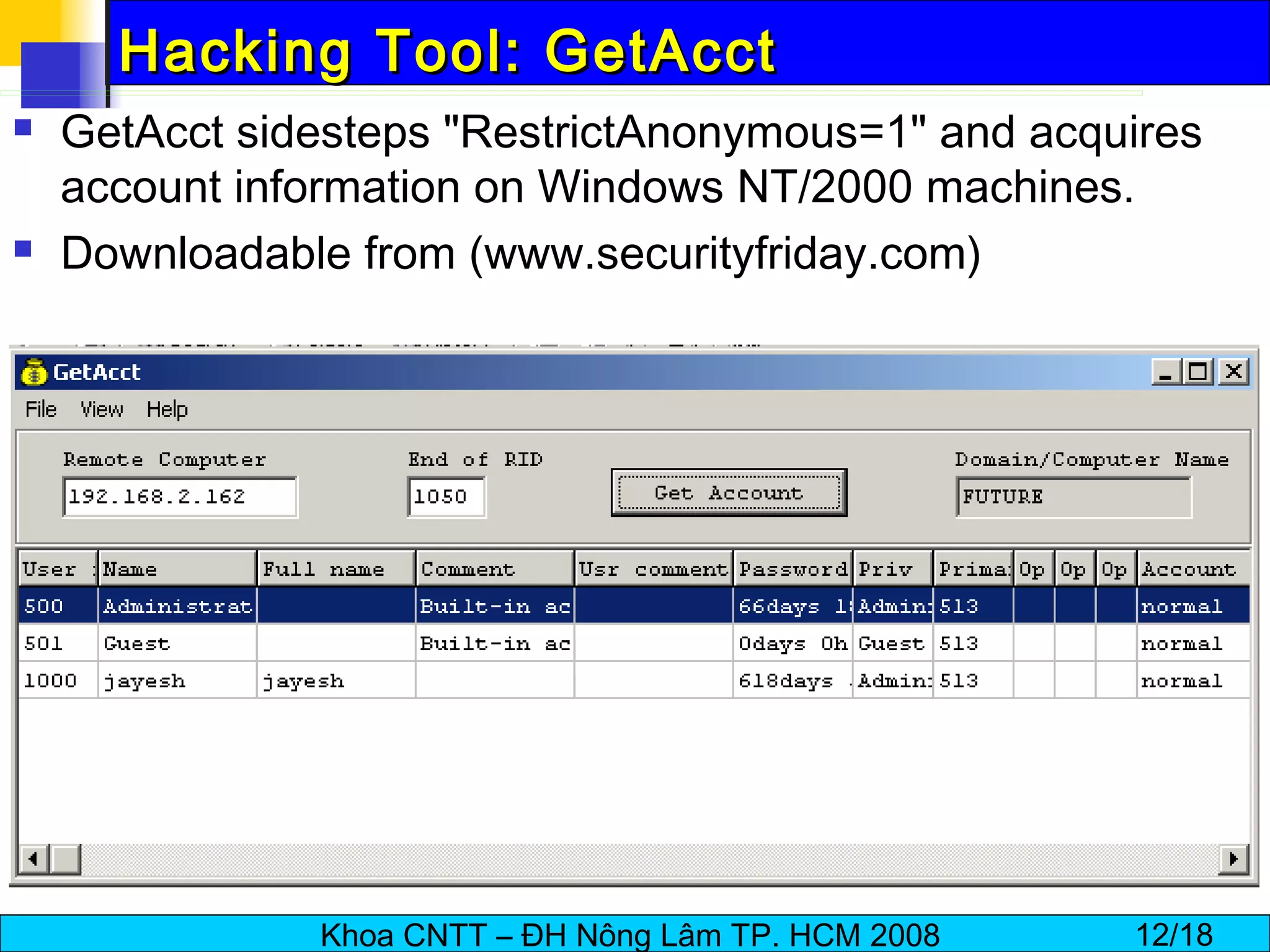
Hacking Tool: GetAcct GetAcct sidesteps "RestrictAnonymous=1" and acquires account information on Windows NT/2000 machines.  Downloadable from (www.securityfriday.com)
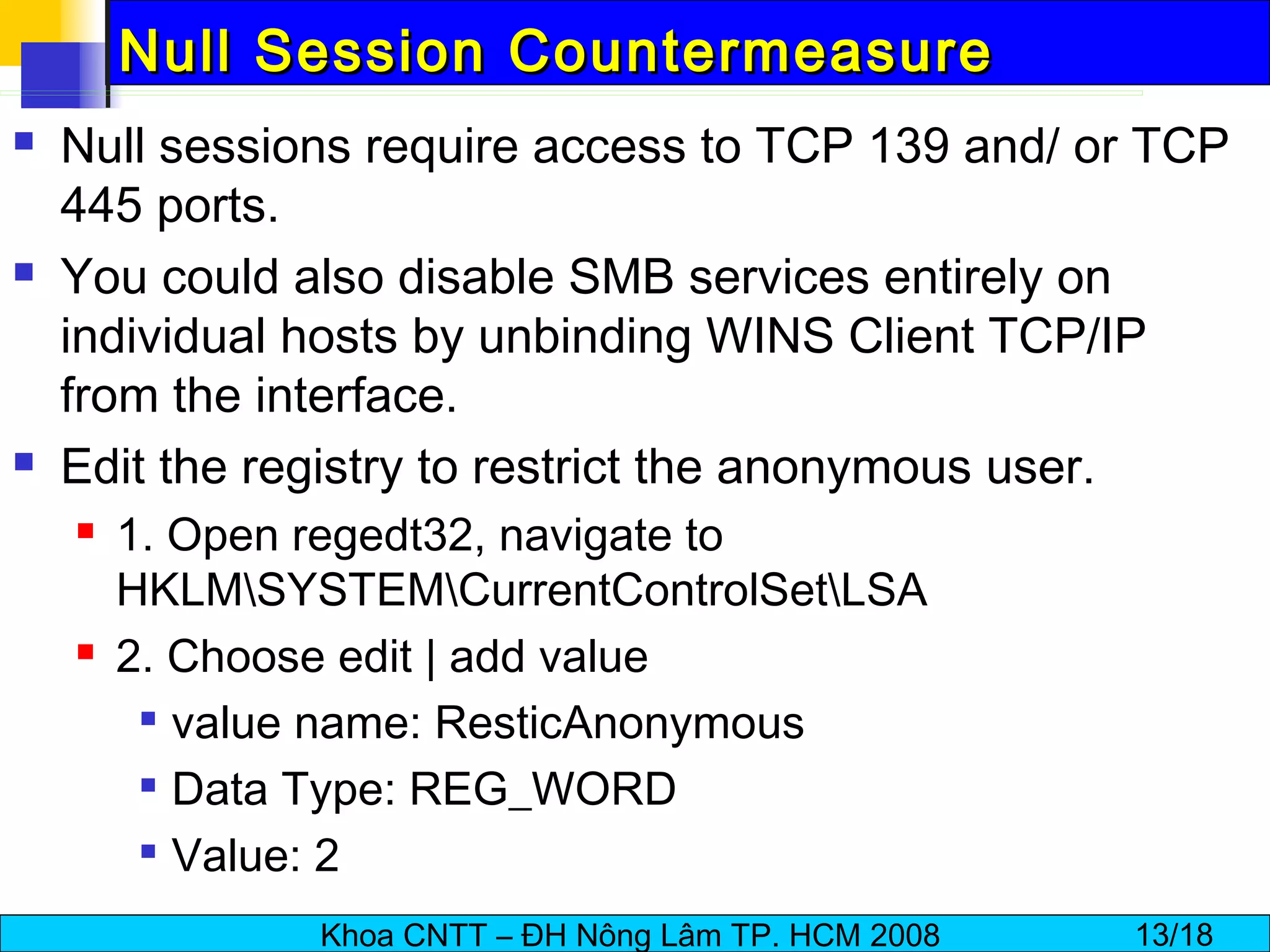
Null Session Countermeasure Null sessions require access to TCP 139 and/ or TCP 445 ports. You could also disable SMB services entirely on individual hosts by unbinding WINS Client TCP/IP from the interface. Edit the registry to restrict the anonymous user. 1. Open regedt32, navigate to HKLM\SYSTEM\CurrentControlSet\LSA 2. Choose edit | add value value name: ResticAnonymous Data Type: REG_WORD Value: 2
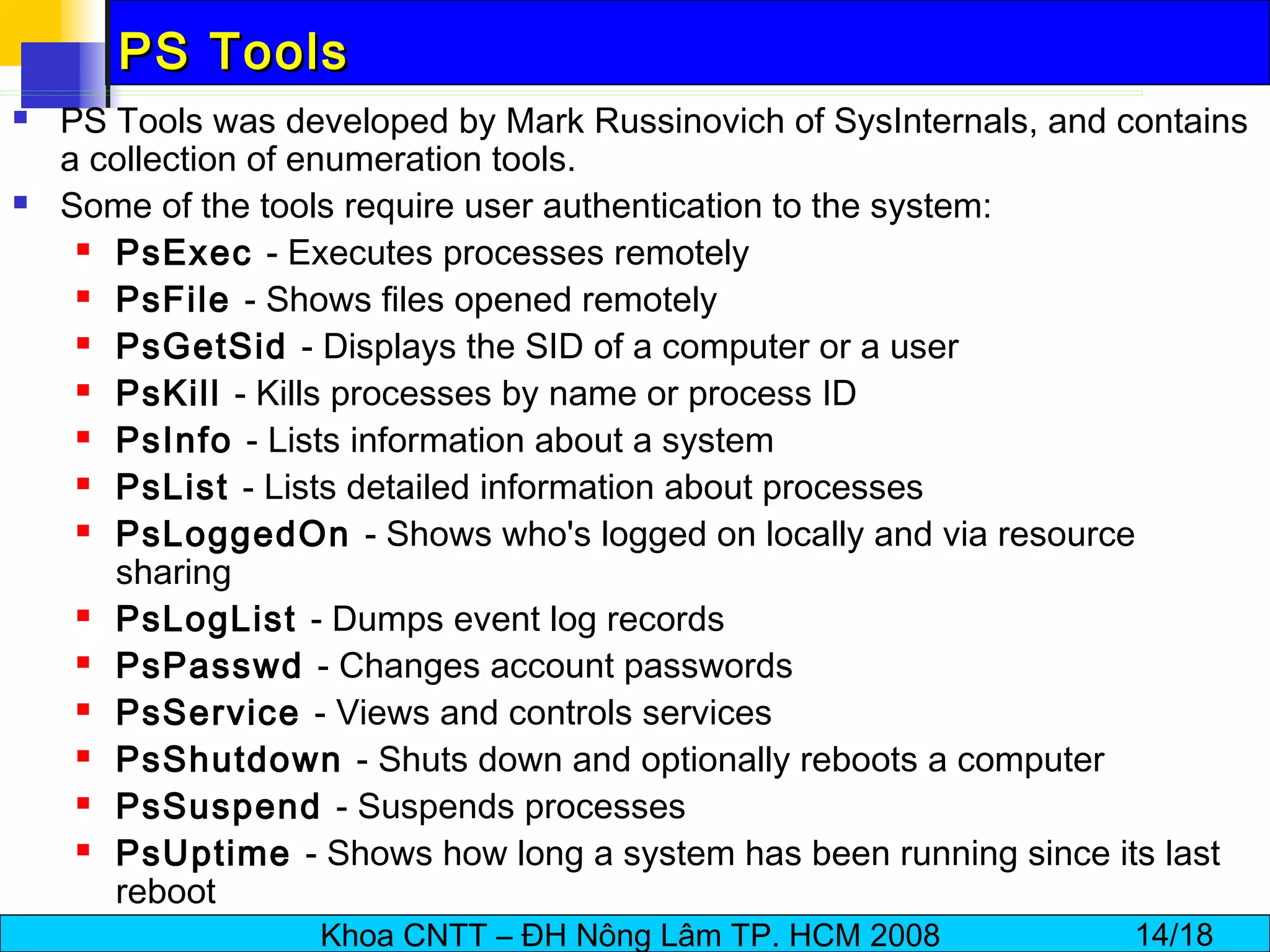
PS Tools PS Tools was developed by Mark Russinovich of SysInternals, and contains a collection of enumeration tools. Some of the tools require user authentication to the system: PsExec  - Executes processes remotely PsFile  - Shows files opened remotely PsGetSid  - Displays the SID of a computer or a user PsKill  - Kills processes by name or process ID PsInfo  - Lists information about a system PsList  - Lists detailed information about processes PsLoggedOn  - Shows who's logged on locally and via resource sharing PsLogList  - Dumps event log records PsPasswd  - Changes account passwords PsService  - Views and controls services PsShutdown  - Shuts down and optionally reboots a computer PsSuspend  - Suspends processes PsUptime  - Shows how long a system has been running since its last reboot
UNIX Enumeration Commands used to enumerate Unix network resources are as follows: showmount: –  Finds the shared directories on the machine –  [root $] showmount –e 19x.16x. xxx.xx Finger: –  Enumerates the user and host –  Enables you to view the user’s home directory, login time, idle times, office location, and the last time they both received or read mail –  [root$] finger –1 @target.hackme.com rpcinfo: –  Helps to enumerate Remote Procedure Call protocol –  RPC protocol allows applications to talk to one another over the network –  [root] rpcinfo –p 19x.16x.xxx.xx
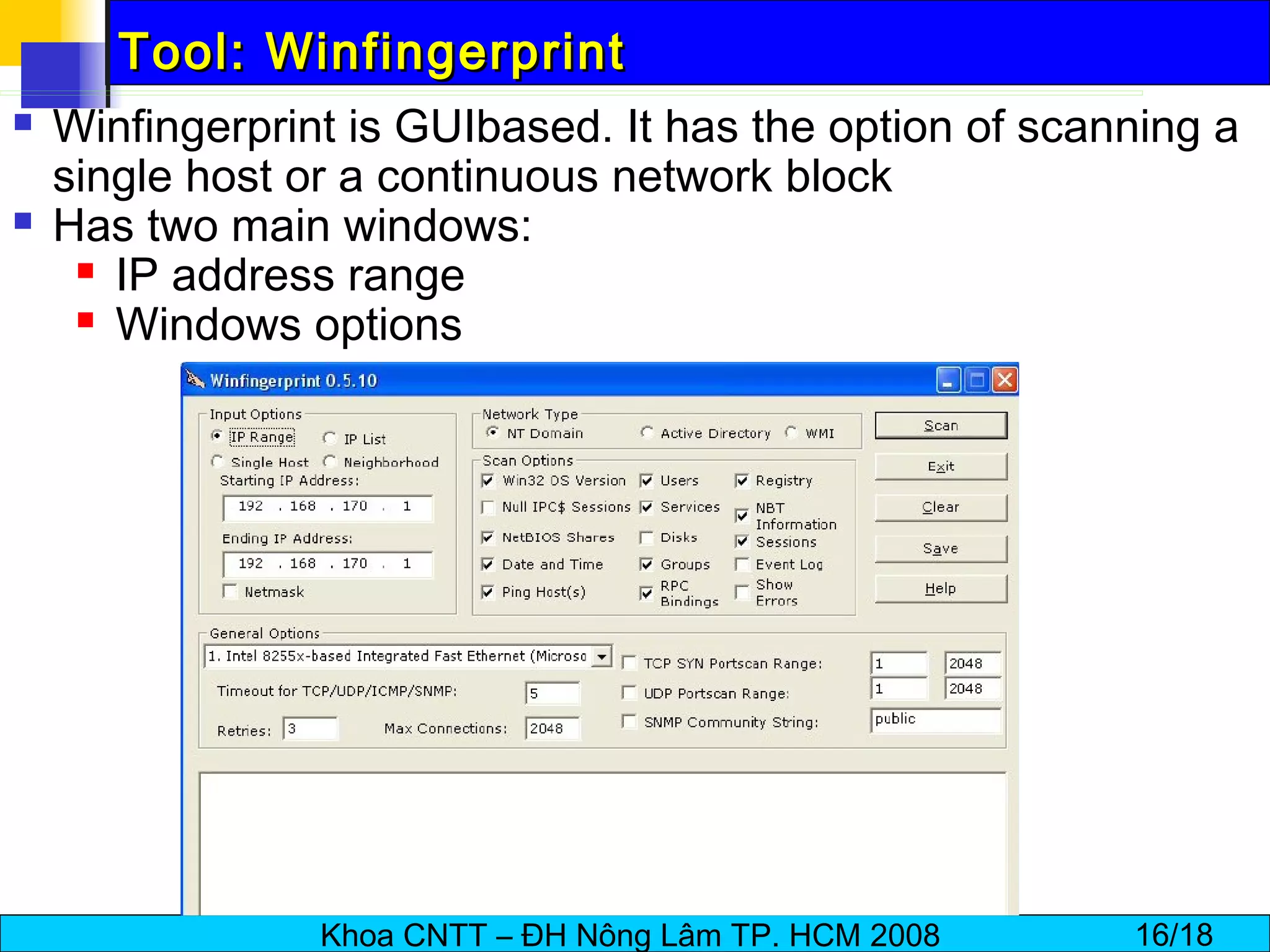
Tool: Winfingerprint Winfingerprint is GUIbased. It has the option of scanning a single host or a continuous network block Has two main windows: IP address range Windows options
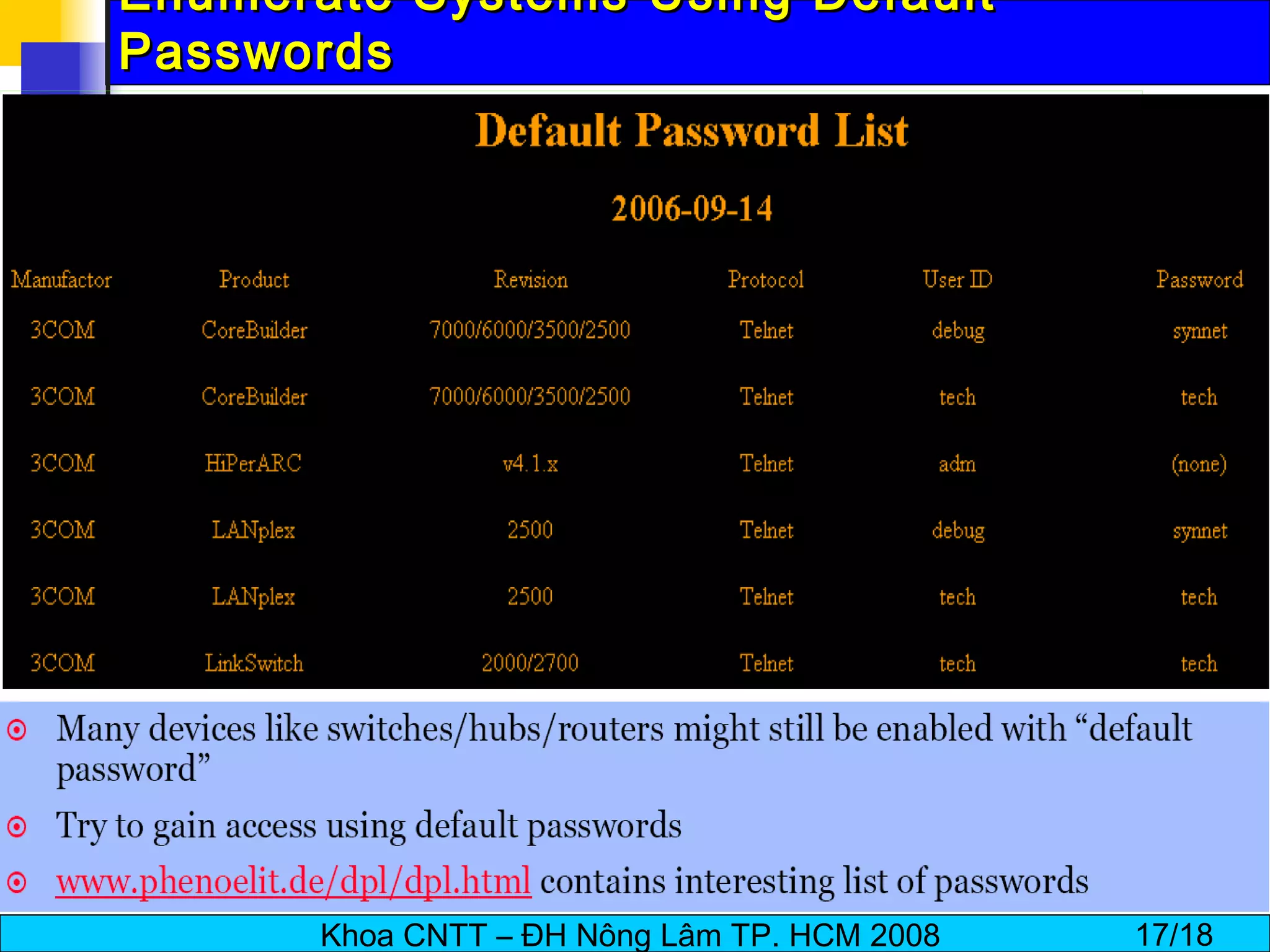
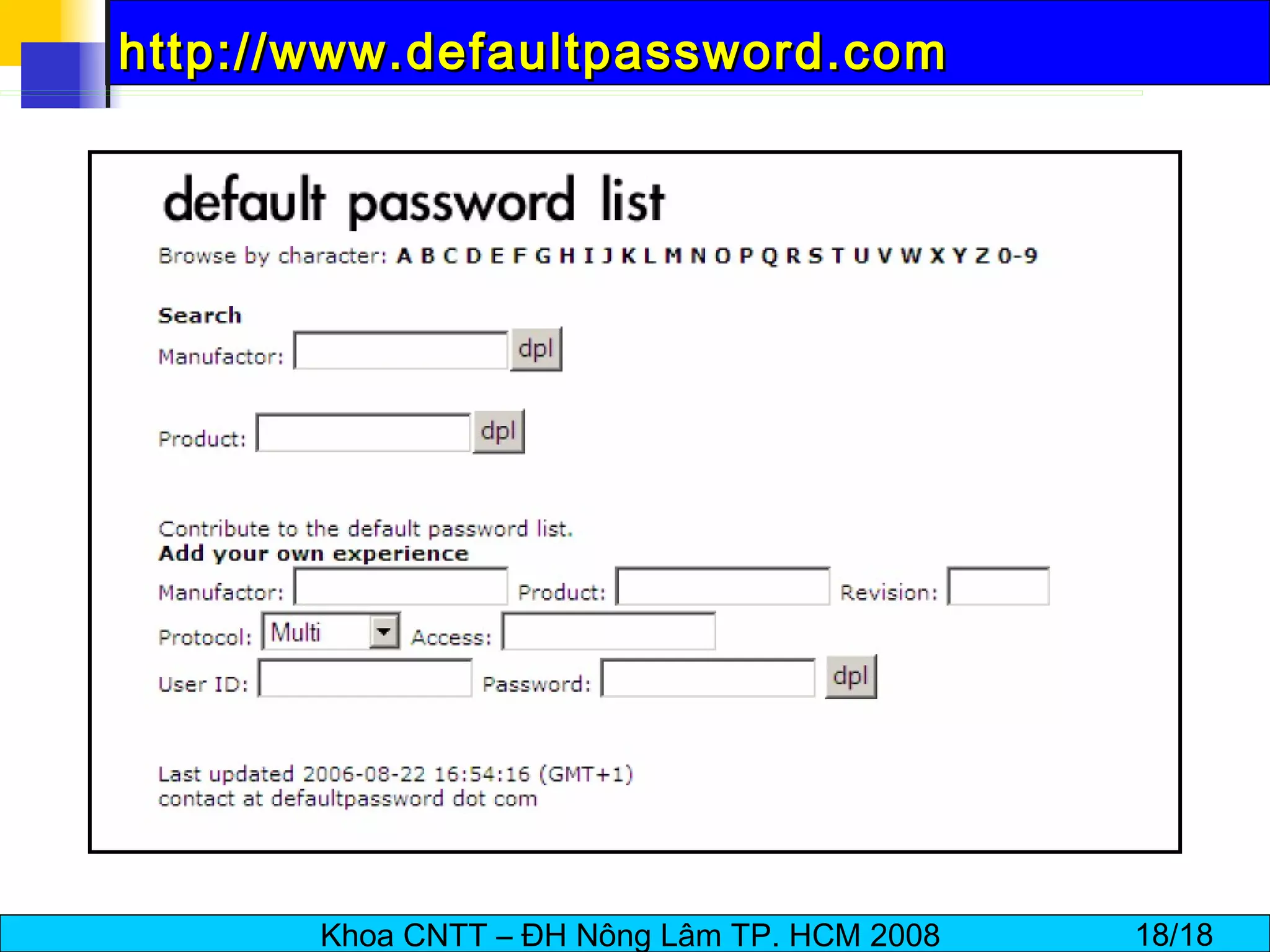
Enumerate Systems Using Default Passwords
http://www.defaultpassword.com

Module 4 Enumeration

  • 1.
  • 2.
    Objective Overview ofSystem Hacking Cycle Enumeration Techniques for Enumeration Establishing Null Session Enumerating User Accounts Null User Countermeasures SNMP Scan SNMP Enumeration MIB SNMP Util Example SNMP Enumeration Countermeasures Active Directory Enumeration AD Enumeration Countermeasures
  • 3.
    Overview of SystemHacking Cycle
  • 4.
    What is Enumeration?Enumeration is defined as extraction of user names, machine names, network resources, shares, and services Enumeration techniques are conducted in an intranet environment Enumeration involves active connections to systems and directed queries The type of information enumerated by intruders: Network resources and shares Users and groups Applications and banners Auditing settings
  • 5.
    Techniques for EnumerationSome of the techniques for enumeration are: Extract user names using Win2k enumeration Extract user names using SNMP Extract user names using email IDs Extract information using default passwords Brute force Active Directory
  • 6.
    Netbios Null SessionsThe null session is often refereed to as the Holy Grail of Windows hacking. Null sessions take advantage of flaws in the CIFS/SMB (Common Internet File System/Server Messaging Block) You can establish a null session with a Windows (NT/2000/XP) host by logging on with a null user name and password Using these null connections allows you to gather the following information from the host: List of users and groups List of machines List of shares Users and host SIDs (Security Identifiers)
  • 7.
    So What's theBig Deal? Anyone with a NetBIOS connection to your computer can easily get a full dump of all your user names, groups, shares, permissions, policies, services, and more using the null user. The attacker now has a channel over which to attempt various techniques. The CIFS/SMB and NetBIOS standards in Windows 2000 include APIs that return rich information about a machine via TCP port 139—even to unauthenticated users. This works on Windows 2000/XP systems, but not on Win 2003 The following syntax connects to the hidden Inter Process Communication 'share' (IPC$) at IP address 192.34.34.2 with the built-in anonymous user (/u:'''') with a ('''') null password
  • 8.
    Tool: DumpSec www.systemtools.com/somarsoft/ DumpSec reveals shares over a null session with the target computer. It allows users to remotely connect to any computer and dump permissions, audit settings, and ownership for the Windows NT/2000 file system. Hackers can choose to dump either NTFS or share permissions. It can also dump permissions for printers and the registry
  • 9.
  • 10.
  • 11.
    NBTScan http:// www.inetcat.org/software/nbtscan.html. NBTscan is a program for scanning IP networks for NetBIOS name information. It sends NetBIOS status query to each address in supplied range and lists received information in human readable form. For each responded host it lists IP address, NetBIOS computer name, logged-in user name and MAC address. NBTscan uses port 137 UDP for sending queries.
  • 12.
    Hacking Tool: GetAcctGetAcct sidesteps "RestrictAnonymous=1" and acquires account information on Windows NT/2000 machines. Downloadable from (www.securityfriday.com)
  • 13.
    Null Session CountermeasureNull sessions require access to TCP 139 and/ or TCP 445 ports. You could also disable SMB services entirely on individual hosts by unbinding WINS Client TCP/IP from the interface. Edit the registry to restrict the anonymous user. 1. Open regedt32, navigate to HKLM\SYSTEM\CurrentControlSet\LSA 2. Choose edit | add value value name: ResticAnonymous Data Type: REG_WORD Value: 2
  • 14.
    PS Tools PSTools was developed by Mark Russinovich of SysInternals, and contains a collection of enumeration tools. Some of the tools require user authentication to the system: PsExec - Executes processes remotely PsFile - Shows files opened remotely PsGetSid - Displays the SID of a computer or a user PsKill - Kills processes by name or process ID PsInfo - Lists information about a system PsList - Lists detailed information about processes PsLoggedOn - Shows who's logged on locally and via resource sharing PsLogList - Dumps event log records PsPasswd - Changes account passwords PsService - Views and controls services PsShutdown - Shuts down and optionally reboots a computer PsSuspend - Suspends processes PsUptime - Shows how long a system has been running since its last reboot
  • 15.
    UNIX Enumeration Commandsused to enumerate Unix network resources are as follows: showmount: – Finds the shared directories on the machine – [root $] showmount –e 19x.16x. xxx.xx Finger: – Enumerates the user and host – Enables you to view the user’s home directory, login time, idle times, office location, and the last time they both received or read mail – [root$] finger –1 @target.hackme.com rpcinfo: – Helps to enumerate Remote Procedure Call protocol – RPC protocol allows applications to talk to one another over the network – [root] rpcinfo –p 19x.16x.xxx.xx
  • 16.
    Tool: Winfingerprint Winfingerprintis GUIbased. It has the option of scanning a single host or a continuous network block Has two main windows: IP address range Windows options
  • 17.
    Enumerate Systems UsingDefault Passwords
  • 18.