
Cyber Security and Ethical Hacking
By Mehedi Hasan
Lecture 10:
DOS Attacks, Distributed DOS Attacks, Data Encryption, Data
Hiding and Steganography - Part i
DOS Attack
Each system connected to the internet has limited bandwidth available.
In a DOS attack, an attacker tries to choke or clog or overload all the
available bandwidth on the target system by bombarding it with infinite
or unlimited data.
As a result even legitimate or real customers and clients are no longer
able to connect to the target system, hence disrupting all services
provided by the victim.
Results in loss of revenue, disrupt in services, inconvenience, customer
dissatisfaction and many other problems.
DOS Attack
TYPES OF DOS ATTACKS
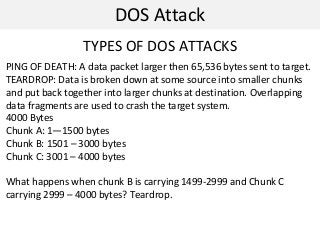
PING OF DEATH: A data packet larger then 65,536 bytes sent to target.
TEARDROP: Data is broken down at some source into smaller chunks
and put back together into larger chunks at destination. Overlapping
data fragments are used to crash the target system.
4000 Bytes
Chunk A: 1—1500 bytes
Chunk B: 1501 – 3000 bytes
Chunk C: 3001 – 4000 bytes
What happens when chunk B is carrying 1499-2999 and Chunk C
carrying 2999 – 4000 bytes? Teardrop.
DOS Attack
TYPES OF DOS ATTACKS
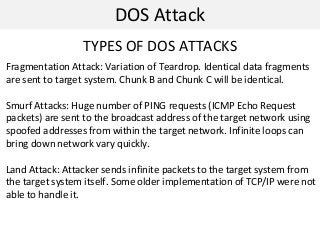
Fragmentation Attack: Variation of Teardrop. Identical data fragments
are sent to target system. Chunk B and Chunk C will be identical.
Smurf Attacks: Huge number of PING requests (ICMP Echo Request
packets) are sent to the broadcast address of the target network using
spoofed addresses from within the target network. Infinite loops can
bring down network vary quickly.
Land Attack: Attacker sends infinite packets to the target system from
the target system itself. Some older implementation of TCP/IP were not
able to handle it.
DOS Attack
TYPES OF DOS ATTACKS
Syn Flooding: Exploits the classic 3-way TCP/IP handshake. Attacker
create infinite instances of half open connections by sending infinite
connection requests from spoofed addresses. According to TCP/IP rules,
whenever a system receives a connection request (SYN packet), it must
keep track of that connection for least 75 seconds.
Step 1: Attacker sends SYN packet to target (Spoofing).
Step 2: Target sends SYN/ACK packet to spoofed.
Step 3: Attacker will never reply to the target.
Hence, the target is out of commission and cannot accept any new
connections until one of the old connections get limited out.
DOS Attack
TYPES OF DOS ATTACKS
Syn Flooding: Can lead to 3 different scenarios:
• The spoofed IP address does not exist.
• The Spoofed IP address exists.
• The spoofed IP address is a system within the victim network.
DOS Attack
TYPES OF DOS ATTACKS
Application Specific DOS Attacks: Instead of attacking the entire system,
it is possible for a criminal to DOS attack only specific applications on
the victim system. For example, the criminal can DOS atack only the
FTP, HTTP or SQL application by flooding any of them with infinite
requests, hence bringing them down.
DOS Attack
NPING
Command line packet generator
DOS Attack
Flood the victim with unlimited data
Colasoft Packet Builder
DOS Attack
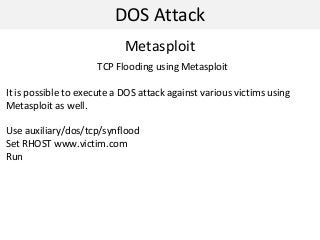
Metasploit
TCP Flooding using Metasploit
It is possible to execute a DOS attack against various victims using
Metasploit as well.
Use auxiliary/dos/tcp/synflood
Set RHOST www.victim.com
Run
DOS Attack
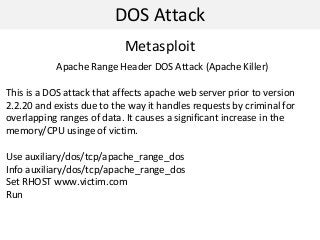
Metasploit
Apache Range Header DOS Attack (Apache Killer)
This is a DOS attack that affects apache web server prior to version
2.2.20 and exists due to the way it handles requests by criminal for
overlapping ranges of data. It causes a significant increase in the
memory/CPU usinge of victim.
Use auxiliary/dos/tcp/apache_range_dos
Info auxiliary/dos/tcp/apache_range_dos
Set RHOST www.victim.com
Run
DOS Attack
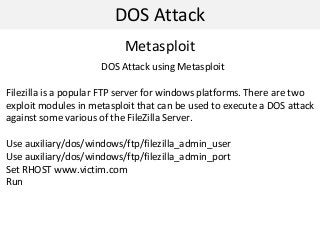
Metasploit
DOS Attack using Metasploit
Filezilla is a popular FTP server for windows platforms. There are two
exploit modules in metasploit that can be used to execute a DOS attack
against some various of the FileZilla Server.
Use auxiliary/dos/windows/ftp/filezilla_admin_user
Use auxiliary/dos/windows/ftp/filezilla_admin_port
Set RHOST www.victim.com
Run
DOS Attack
Distributed DOS Attacks
The objective behind a DOS attack is to flood the Target with as much
data as possible. A DOS attack can inflict limited damage, since there is
1 criminal attacker 1 target. This is where D-DOS attacks come in.
Distributed DOS attacks are multi-tiered, multi-layers sophisticated
modern day versions of DOS attacks, where the criminal first hacks into
and take control over a less sophisticated network (called zombies) and
then uses all system on that network to attack the target.
Distributed DOS atatck can be executed with the help of tools like Tribal
Flood Network (TFN), Trin00, Stacheldraht and others.
Can also be executed through viruses, worms and malware infections
DOS Attack
Cyber terrorism War
Case Study
Low Orbit lon Cannon (LOIC)
It is an open source network stress tool. But can also be used as a dDOS
attack application.
It tries to bring down a server by flooding the victim with infinite
number of TCP or UDP packets. If a lot of people run LOIC against the
same victim simultaneously then it becomes a distributed VOS Attack.
For example, the anonymous hacker group were using IRC channels and
online forums to inform all their supporters about which computer to
attack using LOIC on a specific day.
Http://cisko.fr/
DDOS Attack
DoSHTTP
DDOS Attack
PHP DOS Attacker
DDOS Attack
Botnets and Zombies
A bot is an application or script that can run specific tasks or commands
automatically, for example to execute DOS attacks against the victim. A
system infected with a bot and being controlled remotely by an attacker
is known as a Zombie. Bots or Zombies are controlled from the central
command and control server (C&C). A botnet is a network of computers
on the internet that are infected with some malware or Trojan or bot
and are misused for malicious purposes.
Zombies are recruited into Botnet networks through malware
download, clicking on infected link, P2P through hidden channels like
IRC, Twitter, IM or HTTP.
Such Botnets can be misused from executing DOS Attacks, Spam Click
Fraud and other malicious purposes.
Shark is a popular Botnet.
DDOS Attack
PLUGBOT
DDOS Attack
Guru Plug is a type of plug which allows normal computing in
a small space
DOS and DDOS Attack
Countermeasures
Separate or compartmentalize critical services.
Buy more bandwidth then normally required to count for sudden
attacks. Filter out USELESS/MALICIOUS traffic as early possible.
In case of a attack, disable non critical services and try to keep at least
critical services running.
Disable publicly accessible services.
Balance traffic load on a set of servers.
Regular monitoring and working closely with ISP will always help.
Use antivirus software to detect an remove any bot/trajan/dDOS tools
from your computer.
Analyze traffic patterns to detect source of attack and it by port or by IP
address.
Patch systems regularly. IPSec provides proper verification.
Use scanning tools to detect and remove DDOS tools.
DOS and DDOS Attack
Netflow Analyzer Bandwidth & Traffic Management Tools
http://www.manageengine.com/products/netflow/
Encryption
On the fly file and Disk encryption tools
TrueCrypt
DOS and DDOS Attack
Alternate Data streams or ADS is a feature in windows NTFS
(New technology File System) that contains metadata for
locating files by author or title.
Interestingly, adding additional metadata to a file’s ADS, will
not increase its size or change its functionality. This makes
data stored in the ADS of a file completely hidden. Hence, a
great place for criminals to hide malicious files like Trojan,
keyloggers and spyware.
Alternate Data Streams (ADS)
Data Hiding
How to hide some text inside the ADS of another Text file?
Let us create a text file named test.txt and write some sample
text this is a test file only inside it.
Alternate Data Streams (ADS) Manipulation
Let us now use a clone : to data inside the ADS of the test.txt
file.
Data Hiding
Detection of ADS Streams
Alternate Data Streams (ADS) Manipulation
Alternate stream view. http://www.nirsoft.net
Data Hiding
Steganography
Hide files inside pics, videos and music.
S-Tools
Data Hiding
Steganography
Hermetic : Hide inside a photo.
Data Hiding
Steganography
wbStego4
Hermetic : Hide inside a photo.
Thanks You

Cyber security & ethical hacking 10

  • 1.
    Cyber Security andEthical Hacking By Mehedi Hasan Lecture 10: DOS Attacks, Distributed DOS Attacks, Data Encryption, Data Hiding and Steganography - Part i
  • 2.
    DOS Attack Each systemconnected to the internet has limited bandwidth available. In a DOS attack, an attacker tries to choke or clog or overload all the available bandwidth on the target system by bombarding it with infinite or unlimited data. As a result even legitimate or real customers and clients are no longer able to connect to the target system, hence disrupting all services provided by the victim. Results in loss of revenue, disrupt in services, inconvenience, customer dissatisfaction and many other problems.
  • 3.
    DOS Attack TYPES OFDOS ATTACKS PING OF DEATH: A data packet larger then 65,536 bytes sent to target. TEARDROP: Data is broken down at some source into smaller chunks and put back together into larger chunks at destination. Overlapping data fragments are used to crash the target system. 4000 Bytes Chunk A: 1—1500 bytes Chunk B: 1501 – 3000 bytes Chunk C: 3001 – 4000 bytes What happens when chunk B is carrying 1499-2999 and Chunk C carrying 2999 – 4000 bytes? Teardrop.
  • 4.
    DOS Attack TYPES OFDOS ATTACKS Fragmentation Attack: Variation of Teardrop. Identical data fragments are sent to target system. Chunk B and Chunk C will be identical. Smurf Attacks: Huge number of PING requests (ICMP Echo Request packets) are sent to the broadcast address of the target network using spoofed addresses from within the target network. Infinite loops can bring down network vary quickly. Land Attack: Attacker sends infinite packets to the target system from the target system itself. Some older implementation of TCP/IP were not able to handle it.
  • 5.
    DOS Attack TYPES OFDOS ATTACKS Syn Flooding: Exploits the classic 3-way TCP/IP handshake. Attacker create infinite instances of half open connections by sending infinite connection requests from spoofed addresses. According to TCP/IP rules, whenever a system receives a connection request (SYN packet), it must keep track of that connection for least 75 seconds. Step 1: Attacker sends SYN packet to target (Spoofing). Step 2: Target sends SYN/ACK packet to spoofed. Step 3: Attacker will never reply to the target. Hence, the target is out of commission and cannot accept any new connections until one of the old connections get limited out.
  • 6.
    DOS Attack TYPES OFDOS ATTACKS Syn Flooding: Can lead to 3 different scenarios: • The spoofed IP address does not exist. • The Spoofed IP address exists. • The spoofed IP address is a system within the victim network.
  • 7.
    DOS Attack TYPES OFDOS ATTACKS Application Specific DOS Attacks: Instead of attacking the entire system, it is possible for a criminal to DOS attack only specific applications on the victim system. For example, the criminal can DOS atack only the FTP, HTTP or SQL application by flooding any of them with infinite requests, hence bringing them down.
  • 8.
  • 9.
    DOS Attack Flood thevictim with unlimited data Colasoft Packet Builder
  • 10.
    DOS Attack Metasploit TCP Floodingusing Metasploit It is possible to execute a DOS attack against various victims using Metasploit as well. Use auxiliary/dos/tcp/synflood Set RHOST www.victim.com Run
  • 11.
    DOS Attack Metasploit Apache RangeHeader DOS Attack (Apache Killer) This is a DOS attack that affects apache web server prior to version 2.2.20 and exists due to the way it handles requests by criminal for overlapping ranges of data. It causes a significant increase in the memory/CPU usinge of victim. Use auxiliary/dos/tcp/apache_range_dos Info auxiliary/dos/tcp/apache_range_dos Set RHOST www.victim.com Run
  • 12.
    DOS Attack Metasploit DOS Attackusing Metasploit Filezilla is a popular FTP server for windows platforms. There are two exploit modules in metasploit that can be used to execute a DOS attack against some various of the FileZilla Server. Use auxiliary/dos/windows/ftp/filezilla_admin_user Use auxiliary/dos/windows/ftp/filezilla_admin_port Set RHOST www.victim.com Run
  • 13.
    DOS Attack Distributed DOSAttacks The objective behind a DOS attack is to flood the Target with as much data as possible. A DOS attack can inflict limited damage, since there is 1 criminal attacker 1 target. This is where D-DOS attacks come in. Distributed DOS attacks are multi-tiered, multi-layers sophisticated modern day versions of DOS attacks, where the criminal first hacks into and take control over a less sophisticated network (called zombies) and then uses all system on that network to attack the target. Distributed DOS atatck can be executed with the help of tools like Tribal Flood Network (TFN), Trin00, Stacheldraht and others. Can also be executed through viruses, worms and malware infections
  • 14.
  • 15.
    Low Orbit lonCannon (LOIC) It is an open source network stress tool. But can also be used as a dDOS attack application. It tries to bring down a server by flooding the victim with infinite number of TCP or UDP packets. If a lot of people run LOIC against the same victim simultaneously then it becomes a distributed VOS Attack. For example, the anonymous hacker group were using IRC channels and online forums to inform all their supporters about which computer to attack using LOIC on a specific day. Http://cisko.fr/
  • 16.
  • 17.
  • 18.
    DDOS Attack Botnets andZombies A bot is an application or script that can run specific tasks or commands automatically, for example to execute DOS attacks against the victim. A system infected with a bot and being controlled remotely by an attacker is known as a Zombie. Bots or Zombies are controlled from the central command and control server (C&C). A botnet is a network of computers on the internet that are infected with some malware or Trojan or bot and are misused for malicious purposes. Zombies are recruited into Botnet networks through malware download, clicking on infected link, P2P through hidden channels like IRC, Twitter, IM or HTTP. Such Botnets can be misused from executing DOS Attacks, Spam Click Fraud and other malicious purposes. Shark is a popular Botnet.
  • 19.
  • 20.
    DDOS Attack Guru Plugis a type of plug which allows normal computing in a small space
  • 21.
    DOS and DDOSAttack Countermeasures Separate or compartmentalize critical services. Buy more bandwidth then normally required to count for sudden attacks. Filter out USELESS/MALICIOUS traffic as early possible. In case of a attack, disable non critical services and try to keep at least critical services running. Disable publicly accessible services. Balance traffic load on a set of servers. Regular monitoring and working closely with ISP will always help. Use antivirus software to detect an remove any bot/trajan/dDOS tools from your computer. Analyze traffic patterns to detect source of attack and it by port or by IP address. Patch systems regularly. IPSec provides proper verification. Use scanning tools to detect and remove DDOS tools.
  • 22.
    DOS and DDOSAttack Netflow Analyzer Bandwidth & Traffic Management Tools http://www.manageengine.com/products/netflow/
  • 23.
    Encryption On the flyfile and Disk encryption tools TrueCrypt
  • 24.
    DOS and DDOSAttack Alternate Data streams or ADS is a feature in windows NTFS (New technology File System) that contains metadata for locating files by author or title. Interestingly, adding additional metadata to a file’s ADS, will not increase its size or change its functionality. This makes data stored in the ADS of a file completely hidden. Hence, a great place for criminals to hide malicious files like Trojan, keyloggers and spyware. Alternate Data Streams (ADS)
  • 25.
    Data Hiding How tohide some text inside the ADS of another Text file? Let us create a text file named test.txt and write some sample text this is a test file only inside it. Alternate Data Streams (ADS) Manipulation Let us now use a clone : to data inside the ADS of the test.txt file.
  • 26.
    Data Hiding Detection ofADS Streams Alternate Data Streams (ADS) Manipulation Alternate stream view. http://www.nirsoft.net
  • 27.
    Data Hiding Steganography Hide filesinside pics, videos and music. S-Tools
  • 28.
  • 29.
  • 30.