Disclaimer: This tutorial is for educational purposes only and is
not intended to be put into practise unless you have authorised
access to the system you are trying to break into)
Denial of service or distributed denial service
of service attack is an attempt to make a
machine or network resource unavailable to
its intended users.
Basically sending more requests than a
capacity of web server. apache or IIS
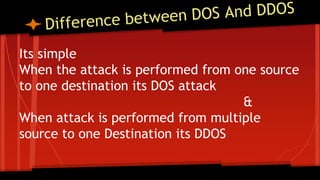
Its simple
When the attack is performed from one source
to one destination its DOS attack
&
When attack is performed from multiple
source to one Destination its DDOS
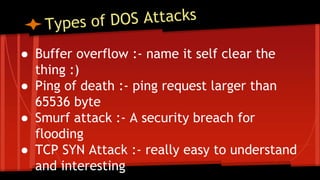
● Buffer overflow :- name it self clear the
thing :)
● Ping of death :- ping request larger than
65536 byte
● Smurf attack :- A security breach for
flooding
● TCP SYN Attack :- really easy to understand
and interesting
Buffers can only hold specific amount of data,
when that capacity has been reached data has
to flow somewhere else,typically into another
buffer which can corrupt the data that already
contained in a buffer
A type of DoS attack in which the attacker sends
a ping request that is larger than 65,536 bytes,
which is the maximum size that IP allows. While a
ping larger than 65,536 bytes is too large to fit in
one packet that can be transmitted, TCP/IP
allows a packet to be fragmented, essentially
splitting the packet into smaller segments that
are eventually reassembled.
Attacks took advantage of this flaw by
fragmenting packets that when received
would total more than the allowed number of
bytes and would effectively cause a buffer
overload on the operating system at the
receiving end, crashing the system.
Smurf attack
From Wikipedia, the free encyclopedia
The Smurf Attack is a distributed denial-of-service attack in which large numbers of Internet
Control Message Protocol (ICMP) packets with the intended victim's spoofed source IP are
broadcast to a coputer network using an IP Broadcast address. Most devices on a network will,
by default, respond to this by sending a reply to the source IP address. If the number of
machines on the network that receive and respond to these packets is very large, the victim's
computer will be flooded with traffic. This can slow down the victim's computer to the point
where it becomes impossible to work on.
This is really easy to understand,this attack
send the syn packet to server then wait for
syn/ack from server once it got syn/ack it
keeps server waiting for ack, This creates a
DOS or DDOS to server.
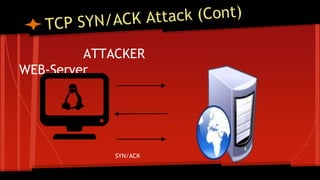
ATTACKER
WEB-Server
SYN
SYN/ACK
In next Lecture we will cover the following
points
● Prerequisite to DOS tools
● performing DOS Attacks
● AB(apache benchmark)
● Httperf
● slowhttptest
● Golden eye
@S3curityB3ast
https://www.breakthesec.com
https://www.youtube.com/user/hackerkaustu
bh

Denial of service attack

  • 1.
    Disclaimer: This tutorialis for educational purposes only and is not intended to be put into practise unless you have authorised access to the system you are trying to break into)
  • 2.
    Denial of serviceor distributed denial service of service attack is an attempt to make a machine or network resource unavailable to its intended users. Basically sending more requests than a capacity of web server. apache or IIS
  • 3.
    Its simple When theattack is performed from one source to one destination its DOS attack & When attack is performed from multiple source to one Destination its DDOS
  • 4.
    ● Buffer overflow:- name it self clear the thing :) ● Ping of death :- ping request larger than 65536 byte ● Smurf attack :- A security breach for flooding ● TCP SYN Attack :- really easy to understand and interesting
  • 5.
    Buffers can onlyhold specific amount of data, when that capacity has been reached data has to flow somewhere else,typically into another buffer which can corrupt the data that already contained in a buffer
  • 6.
    A type ofDoS attack in which the attacker sends a ping request that is larger than 65,536 bytes, which is the maximum size that IP allows. While a ping larger than 65,536 bytes is too large to fit in one packet that can be transmitted, TCP/IP allows a packet to be fragmented, essentially splitting the packet into smaller segments that are eventually reassembled.
  • 7.
    Attacks took advantageof this flaw by fragmenting packets that when received would total more than the allowed number of bytes and would effectively cause a buffer overload on the operating system at the receiving end, crashing the system.
  • 8.
    Smurf attack From Wikipedia,the free encyclopedia The Smurf Attack is a distributed denial-of-service attack in which large numbers of Internet Control Message Protocol (ICMP) packets with the intended victim's spoofed source IP are broadcast to a coputer network using an IP Broadcast address. Most devices on a network will, by default, respond to this by sending a reply to the source IP address. If the number of machines on the network that receive and respond to these packets is very large, the victim's computer will be flooded with traffic. This can slow down the victim's computer to the point where it becomes impossible to work on.
  • 9.
    This is reallyeasy to understand,this attack send the syn packet to server then wait for syn/ack from server once it got syn/ack it keeps server waiting for ack, This creates a DOS or DDOS to server.
  • 10.
  • 11.
    In next Lecturewe will cover the following points ● Prerequisite to DOS tools ● performing DOS Attacks ● AB(apache benchmark) ● Httperf ● slowhttptest ● Golden eye
  • 12.