Module 5, Topic 1 Examples

    Some Help from Mrs. M
Direct Variation
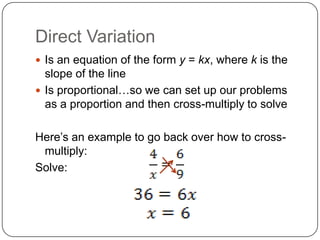
 Is an equation of the form y = kx, where k is the
  slope of the line
 Is proportional…so we can set up our problems
  as a proportion and then cross-multiply to solve

Here’s an example to go back over how to cross-
 multiply:
Solve:
Some Direct Variation Examples
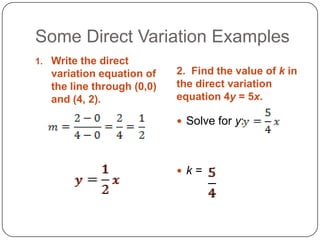
1. Write the direct
   variation equation of    2. Find the value of k in
   the line through (0,0)   the direct variation
   and (4, 2).              equation 4y = 5x.

                             Solve for y:


                             k=
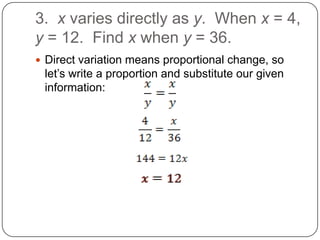
3. x varies directly as y. When x = 4,
y = 12. Find x when y = 36.
 Direct variation means proportional change, so
 let’s write a proportion and substitute our given
 information:
Some Other Examples
 http://quiz.uprm.edu/tutorials/direct_var/direct_var
 _right.xml

 http://www.freemathhelp.com/direct-variation.html

Module 5, topic 1 examples

  • 1.
    Module 5, Topic1 Examples Some Help from Mrs. M
  • 2.
    Direct Variation  Isan equation of the form y = kx, where k is the slope of the line  Is proportional…so we can set up our problems as a proportion and then cross-multiply to solve Here’s an example to go back over how to cross- multiply: Solve:
  • 3.
    Some Direct VariationExamples 1. Write the direct variation equation of 2. Find the value of k in the line through (0,0) the direct variation and (4, 2). equation 4y = 5x.  Solve for y:  k=
  • 4.
    3. x variesdirectly as y. When x = 4, y = 12. Find x when y = 36.  Direct variation means proportional change, so let’s write a proportion and substitute our given information:
  • 5.
    Some Other Examples http://quiz.uprm.edu/tutorials/direct_var/direct_var _right.xml  http://www.freemathhelp.com/direct-variation.html