Sequences and Series
A Variety of Problems for You to Practice
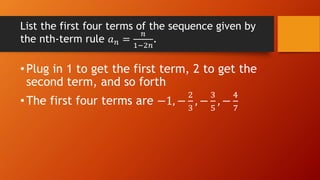
List the first four terms of the sequence given by
the nth-term rule 𝑎 𝑛 =
𝑛
1−2𝑛
.
•Plug in 1 to get the first term, 2 to get the
second term, and so forth
•The first four terms are −1, −
2
3
, −
3
5
, −
4
7
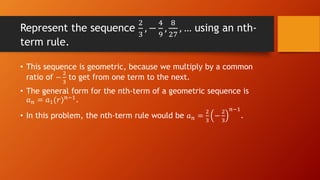
Represent the sequence
2
3
, −
4
9
,
8
27
, … using an nth-
term rule.
• This sequence is geometric, because we multiply by a common
ratio of −
2
3
to get from one term to the next.
• The general form for the nth-term of a geometric sequence is
𝑎 𝑛 = 𝑎1(𝑟) 𝑛−1.
• In this problem, the nth-term rule would be 𝑎 𝑛 =
2
3
−
2
3
𝑛−1
.
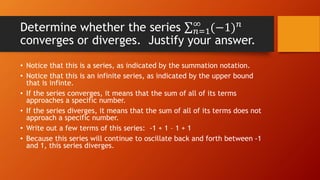
Determine whether the series 𝑛=1
∞
(−1) 𝑛
converges or diverges. Justify your answer.
• Notice that this is a series, as indicated by the summation notation.
• Notice that this is an infinite series, as indicated by the upper bound
that is infinte.
• If the series converges, it means that the sum of all of its terms
approaches a specific number.
• If the series diverges, it means that the sum of all of its terms does not
approach a specific number.
• Write out a few terms of this series: -1 + 1 – 1 + 1
• Because this series will continue to oscillate back and forth between -1
and 1, this series diverges.
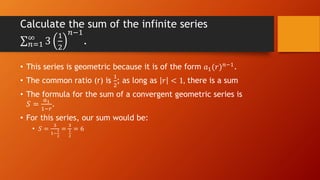
Calculate the sum of the infinite series
𝑛=1
∞
3
1
2
𝑛−1
.
• This series is geometric because it is of the form 𝑎1(𝑟) 𝑛−1.
• The common ratio (r) is
1
2
; as long as 𝑟 < 1, there is a sum
• The formula for the sum of a convergent geometric series is
𝑆 =
𝑎1
1−𝑟
.
• For this series, our sum would be:
• 𝑆 =
3
1−
1
2
=
3
1
2
= 6

Sequences and Series

  • 1.
    Sequences and Series AVariety of Problems for You to Practice
  • 2.
    List the firstfour terms of the sequence given by the nth-term rule 𝑎 𝑛 = 𝑛 1−2𝑛 . •Plug in 1 to get the first term, 2 to get the second term, and so forth •The first four terms are −1, − 2 3 , − 3 5 , − 4 7
  • 3.
    Represent the sequence 2 3 ,− 4 9 , 8 27 , … using an nth- term rule. • This sequence is geometric, because we multiply by a common ratio of − 2 3 to get from one term to the next. • The general form for the nth-term of a geometric sequence is 𝑎 𝑛 = 𝑎1(𝑟) 𝑛−1. • In this problem, the nth-term rule would be 𝑎 𝑛 = 2 3 − 2 3 𝑛−1 .
  • 4.
    Determine whether theseries 𝑛=1 ∞ (−1) 𝑛 converges or diverges. Justify your answer. • Notice that this is a series, as indicated by the summation notation. • Notice that this is an infinite series, as indicated by the upper bound that is infinte. • If the series converges, it means that the sum of all of its terms approaches a specific number. • If the series diverges, it means that the sum of all of its terms does not approach a specific number. • Write out a few terms of this series: -1 + 1 – 1 + 1 • Because this series will continue to oscillate back and forth between -1 and 1, this series diverges.
  • 5.
    Calculate the sumof the infinite series 𝑛=1 ∞ 3 1 2 𝑛−1 . • This series is geometric because it is of the form 𝑎1(𝑟) 𝑛−1. • The common ratio (r) is 1 2 ; as long as 𝑟 < 1, there is a sum • The formula for the sum of a convergent geometric series is 𝑆 = 𝑎1 1−𝑟 . • For this series, our sum would be: • 𝑆 = 3 1− 1 2 = 3 1 2 = 6