Direct Variation

   Section 4.6
    Page 253
• When x and y vary directly, there is a
  nonzero number a such that the following
  is true:
                y = ax
     a is the constant of variation
For example: y = 3x or y = -1/4x

non-example : y = 4x + 5
• y = ax    shows direct variation
            between x & y

• What else is true about this type of
  equation?

• YES = it goes through the origin!
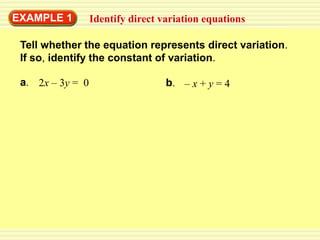
EXAMPLE 1         Identify direct variation equations

 Tell whether the equation represents direct variation.
 If so, identify the constant of variation.

 a. 2x – 3y = 0                    b. – x + y = 4
EXAMPLE 1          Identify direct variation equations

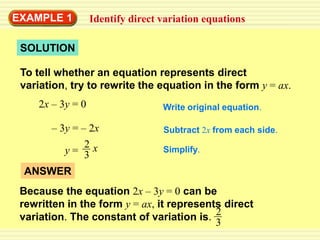
 SOLUTION

 To tell whether an equation represents direct
 variation, try to rewrite the equation in the form y = ax.
     2x – 3y = 0                   Write original equation.

       – 3y = – 2x                 Subtract 2x from each side.
               2x                  Simplify.
          y= 3
 ANSWER
 Because the equation 2x – 3y = 0 can be
 rewritten in the form y = ax, it represents direct
 variation. The constant of variation is. 2
                                           3
EXAMPLE 1      Identify direct variation equations


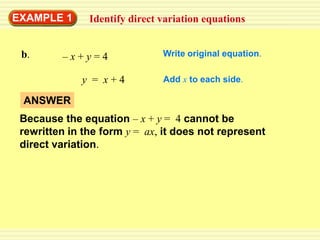
 b.      –x+y=4                Write original equation.

             y = x+4           Add x to each side.

 ANSWER
 Because the equation – x + y = 4 cannot be
 rewritten in the form y = ax, it does not represent
 direct variation.
EXAMPLE 2       Graph direct variation equations

 Graph the direct variation equation.
          2
 a. y =     x                b. y = – 3x
          3

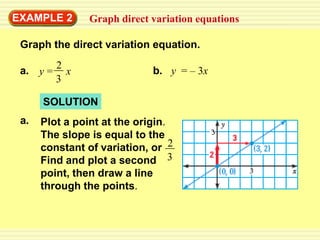
      SOLUTION
 a.   Plot a point at the origin.
      The slope is equal to the
      constant of variation, or 2
      Find and plot a second 3
      point, then draw a line
      through the points.
EXAMPLE 2       Graph direct variation equations


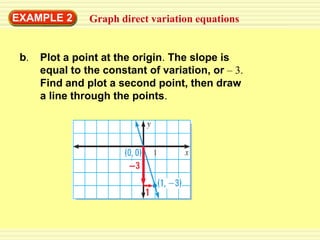
 b.   Plot a point at the origin. The slope is
      equal to the constant of variation, or – 3.
      Find and plot a second point, then draw
      a line through the points.
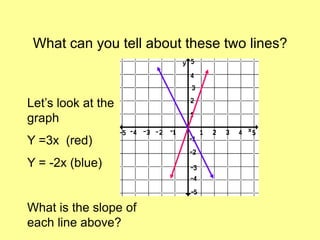
What can you tell about these two lines?


Let’s look at the
graph
Y =3x (red)
Y = -2x (blue)


What is the slope of
each line above?
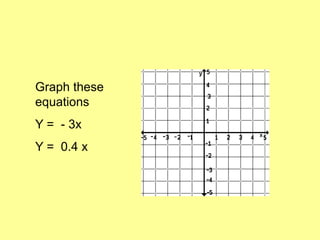
Graph these
equations
Y = - 3x
Y = 0.4 x
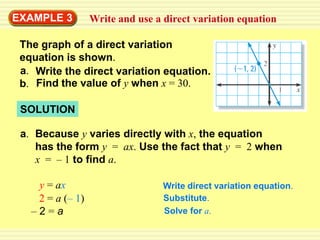
EXAMPLE 3         Write and use a direct variation equation

 The graph of a direct variation
 equation is shown.
 a. Write the direct variation equation.
 b. Find the value of y when x = 30.

 SOLUTION

 a. Because y varies directly with x, the equation
    has the form y = ax. Use the fact that y = 2 when
    x = – 1 to find a.

    y = ax                        Write direct variation equation.
    2 = a (– 1)                   Substitute.
   –2=a                           Solve for a.
• Assignment:

• P. 256 (#1-15, 19-20)
• You will need graph paper

4.6 model direct variation day 1

  • 1.
    Direct Variation Section 4.6 Page 253
  • 2.
    • When xand y vary directly, there is a nonzero number a such that the following is true: y = ax a is the constant of variation For example: y = 3x or y = -1/4x non-example : y = 4x + 5
  • 3.
    • y =ax shows direct variation between x & y • What else is true about this type of equation? • YES = it goes through the origin!
  • 4.
    EXAMPLE 1 Identify direct variation equations Tell whether the equation represents direct variation. If so, identify the constant of variation. a. 2x – 3y = 0 b. – x + y = 4
  • 5.
    EXAMPLE 1 Identify direct variation equations SOLUTION To tell whether an equation represents direct variation, try to rewrite the equation in the form y = ax. 2x – 3y = 0 Write original equation. – 3y = – 2x Subtract 2x from each side. 2x Simplify. y= 3 ANSWER Because the equation 2x – 3y = 0 can be rewritten in the form y = ax, it represents direct variation. The constant of variation is. 2 3
  • 6.
    EXAMPLE 1 Identify direct variation equations b. –x+y=4 Write original equation. y = x+4 Add x to each side. ANSWER Because the equation – x + y = 4 cannot be rewritten in the form y = ax, it does not represent direct variation.
  • 7.
    EXAMPLE 2 Graph direct variation equations Graph the direct variation equation. 2 a. y = x b. y = – 3x 3 SOLUTION a. Plot a point at the origin. The slope is equal to the constant of variation, or 2 Find and plot a second 3 point, then draw a line through the points.
  • 8.
    EXAMPLE 2 Graph direct variation equations b. Plot a point at the origin. The slope is equal to the constant of variation, or – 3. Find and plot a second point, then draw a line through the points.
  • 9.
    What can youtell about these two lines? Let’s look at the graph Y =3x (red) Y = -2x (blue) What is the slope of each line above?
  • 10.
  • 11.
    EXAMPLE 3 Write and use a direct variation equation The graph of a direct variation equation is shown. a. Write the direct variation equation. b. Find the value of y when x = 30. SOLUTION a. Because y varies directly with x, the equation has the form y = ax. Use the fact that y = 2 when x = – 1 to find a. y = ax Write direct variation equation. 2 = a (– 1) Substitute. –2=a Solve for a.
  • 12.
    • Assignment: • P.256 (#1-15, 19-20) • You will need graph paper