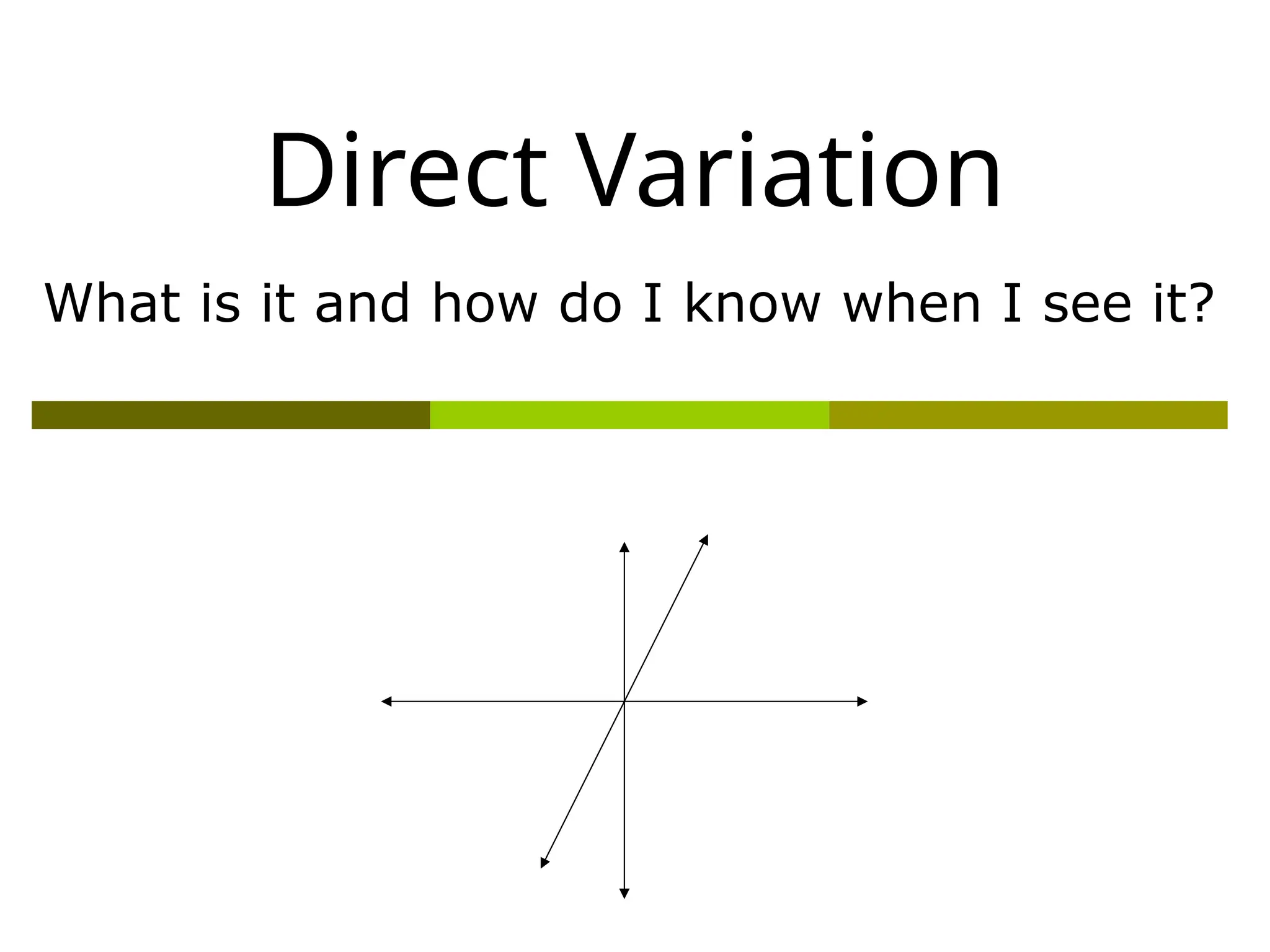
Direct Variation
What is it and how do I know when I see it?
Definition:
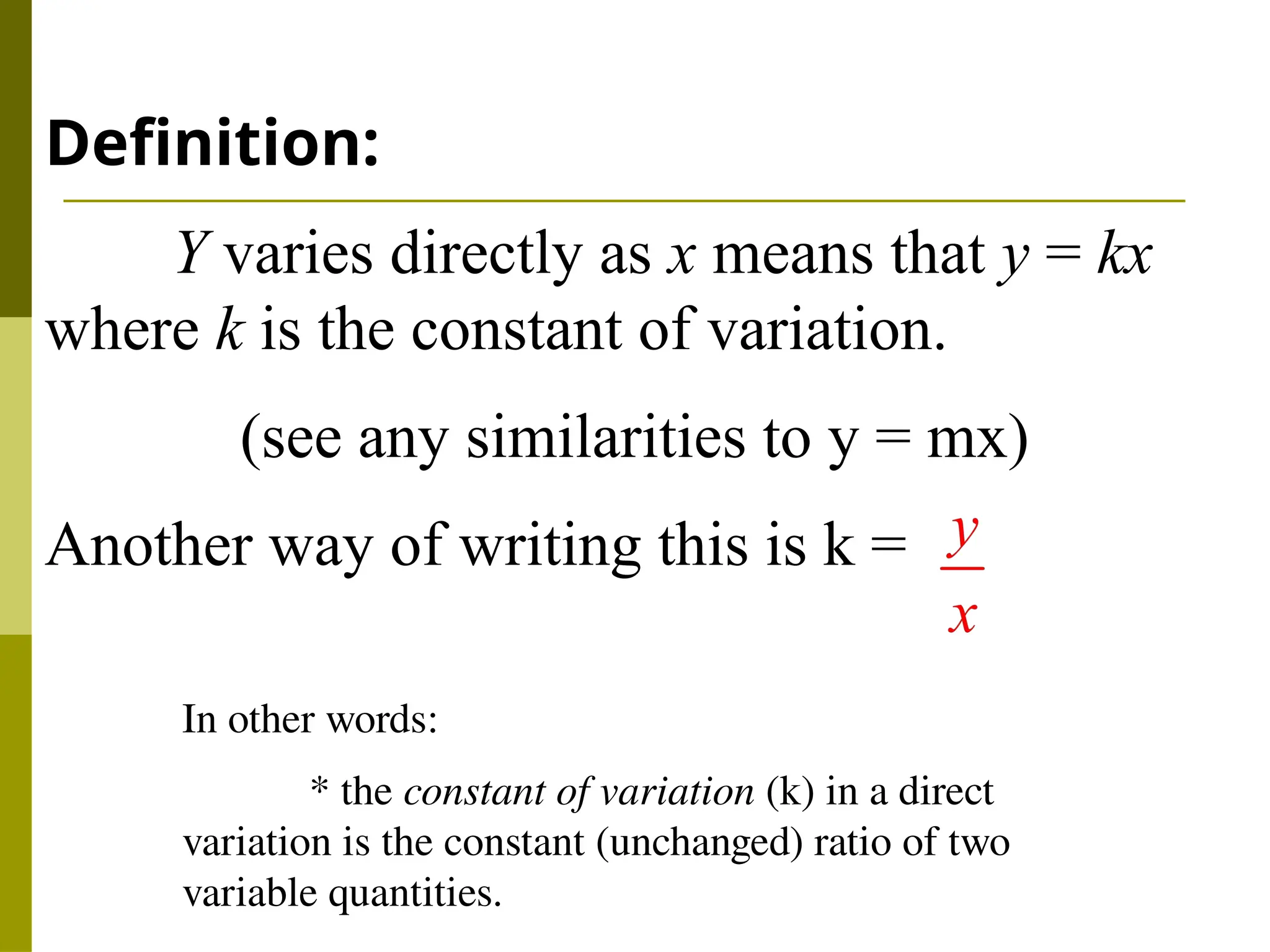
Y varies directly as x means that y = kx
where k is the constant of variation.
(see any similarities to y = mx)
Another way of writing this is k =
In other words:
* the constant of variation (k) in a direct
variation is the constant (unchanged) ratio of two
variable quantities.
Examples of Direct Variation:
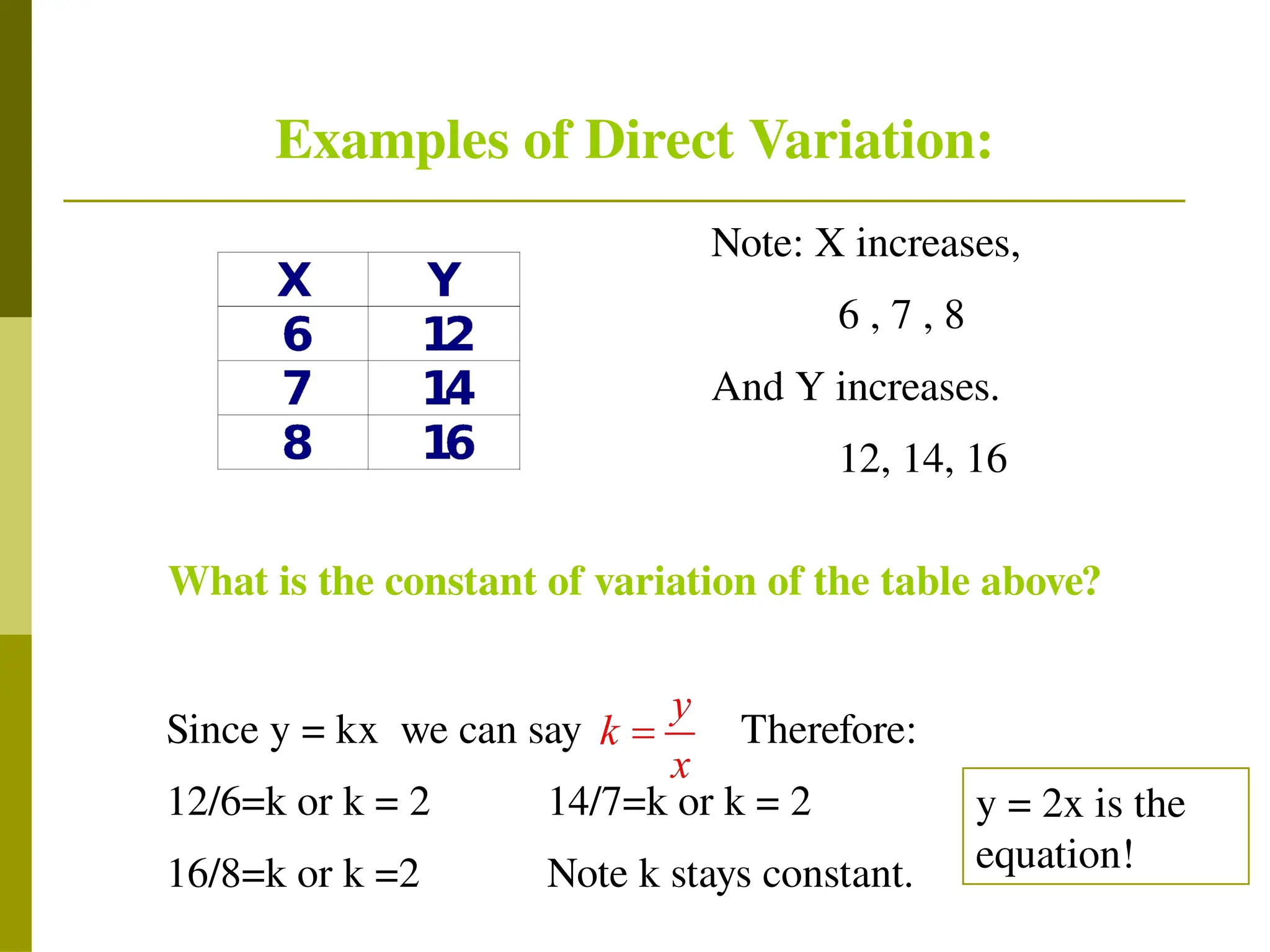
Note: X increases,
6 , 7 , 8
And Y increases.
12, 14, 16
What is the constant of variation of the table above?
Since y = kx we can say Therefore:
12/6=k or k = 2 14/7=k or k = 2
16/8=k or k =2 Note k stays constant.
y = 2x is the
equation!
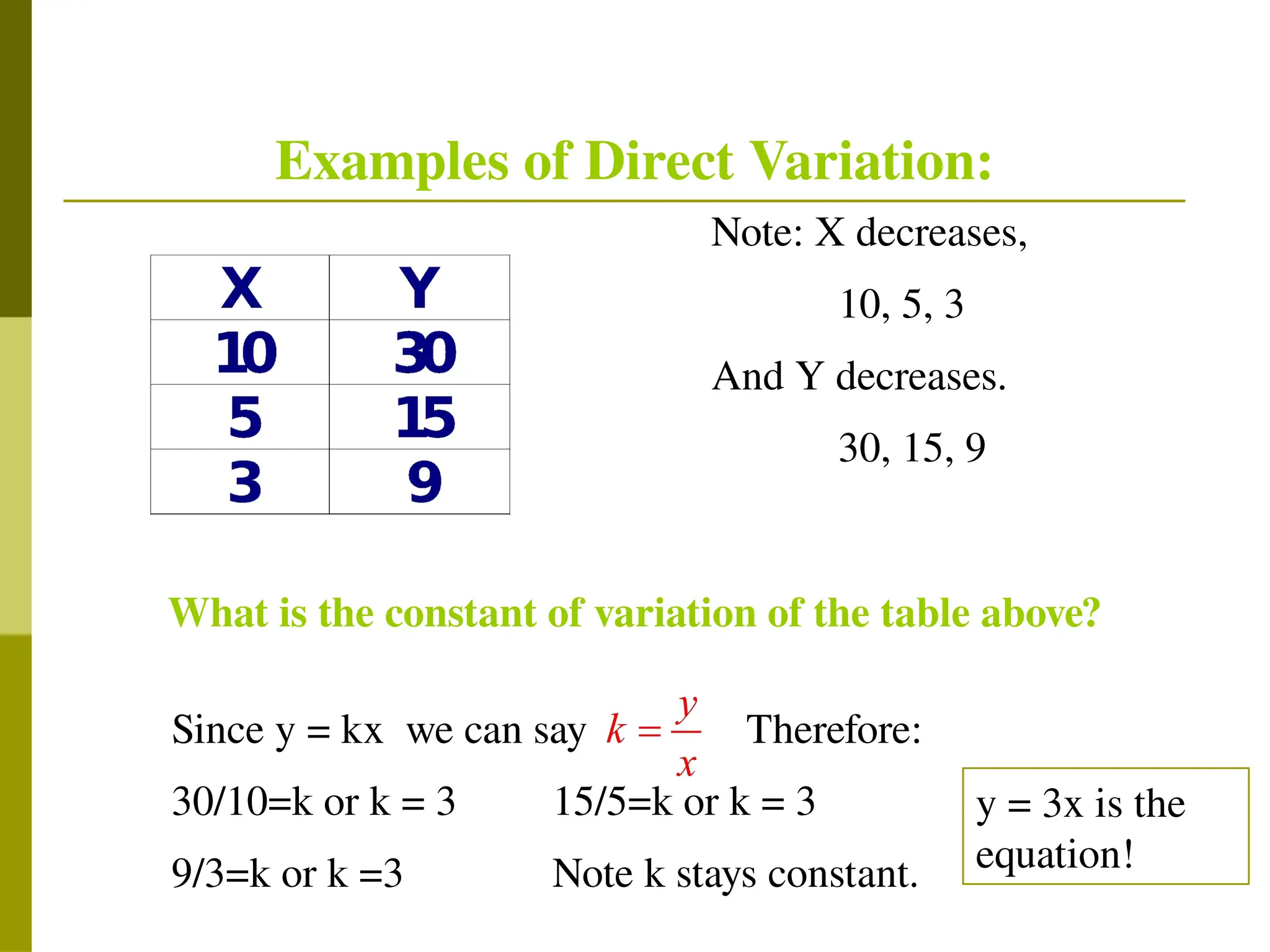
Note: X decreases,
10, 5, 3
And Y decreases.
30, 15, 9
What is the constant of variation of the table above?
Since y = kx we can say Therefore:
30/10=k or k = 3 15/5=k or k = 3
9/3=k or k =3 Note k stays constant.
y = 3x is the
equation!
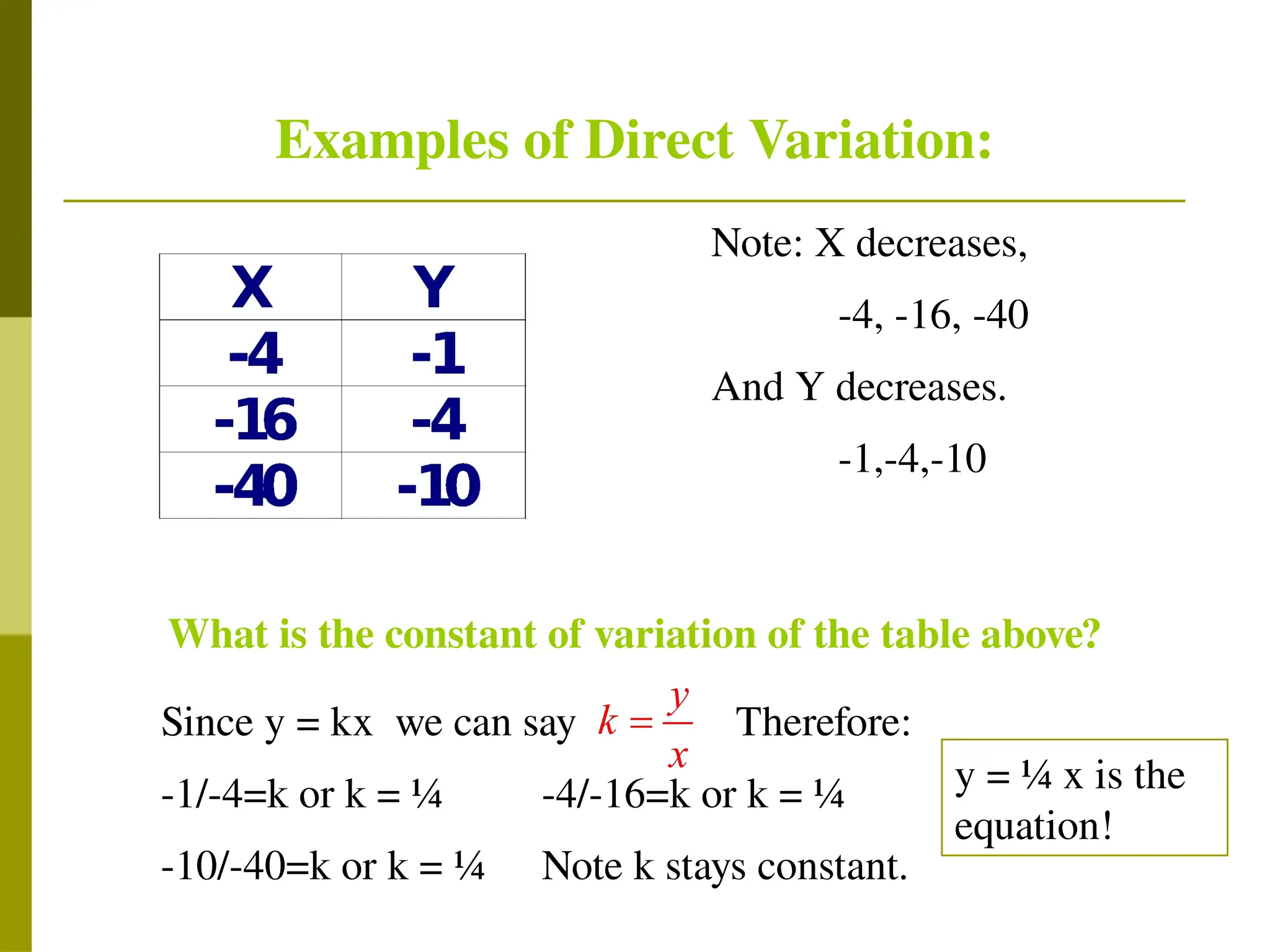
Examples of Direct Variation:
Note: X decreases,
-4, -16, -40
And Y decreases.
-1,-4,-10
What is the constant of variation of the table above?
Since y = kx we can say Therefore:
-1/-4=k or k = Âź -4/-16=k or k = Âź
-10/-40=k or k = Âź Note k stays constant.
y = Âź x is the
equation!
Examples of Direct Variation:
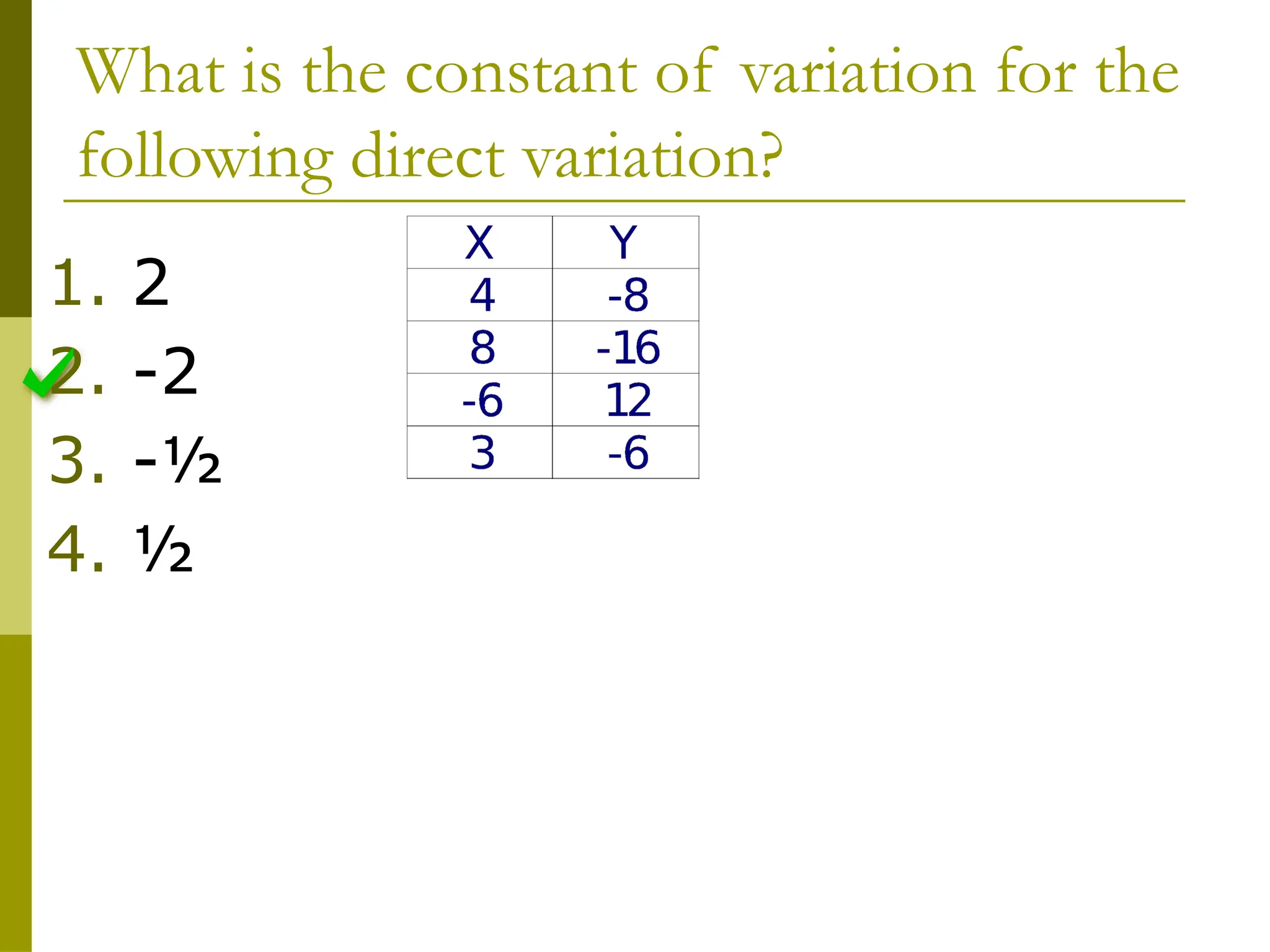
What is the constant of variation for the
following direct variation?
1. 2
2. -2
3. -½
4. ½
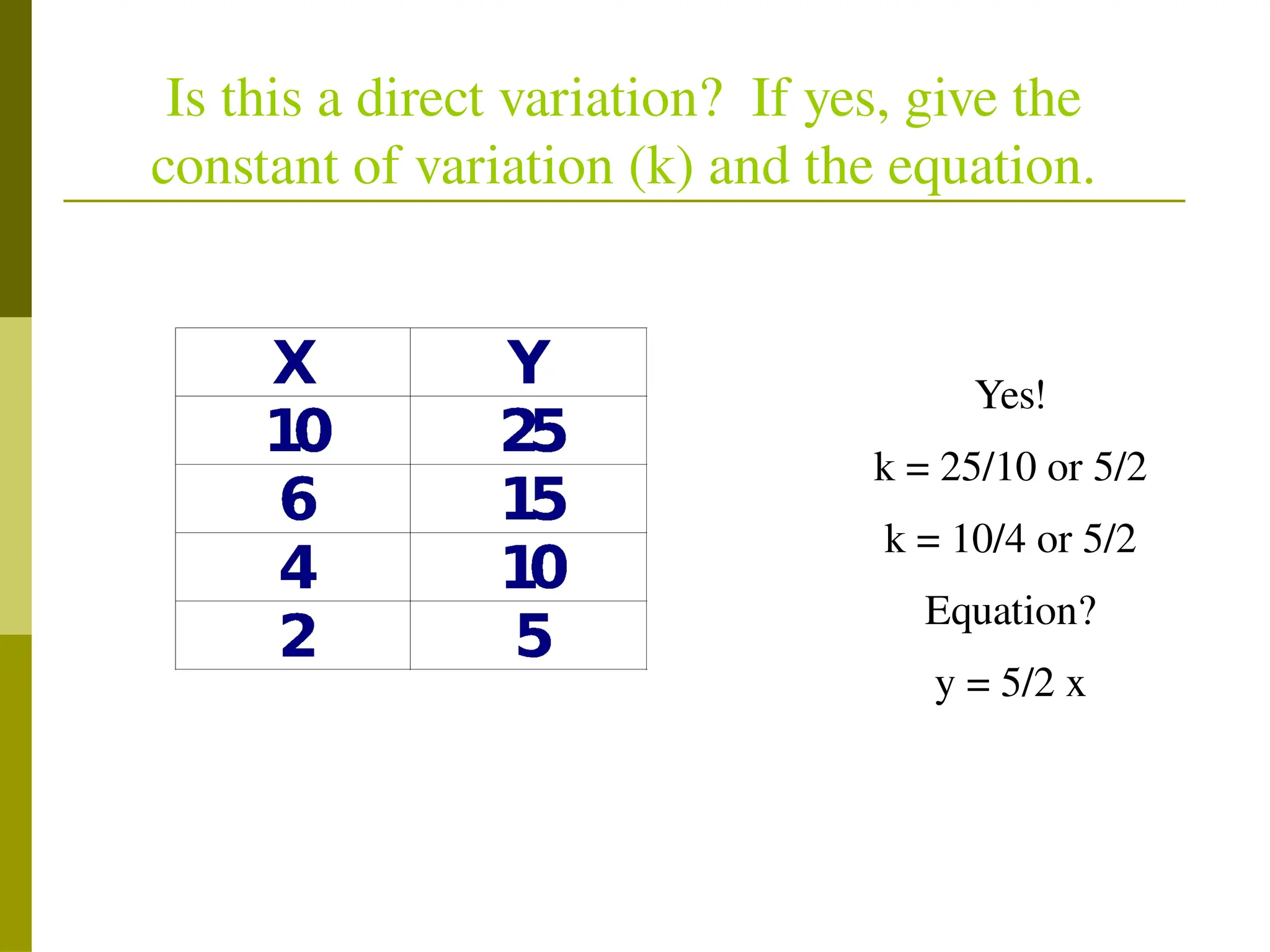
Yes!
k = 25/10 or 5/2
k = 10/4 or 5/2
Equation?
y = 5/2 x
Is this a direct variation? If yes, give the
constant of variation (k) and the equation.
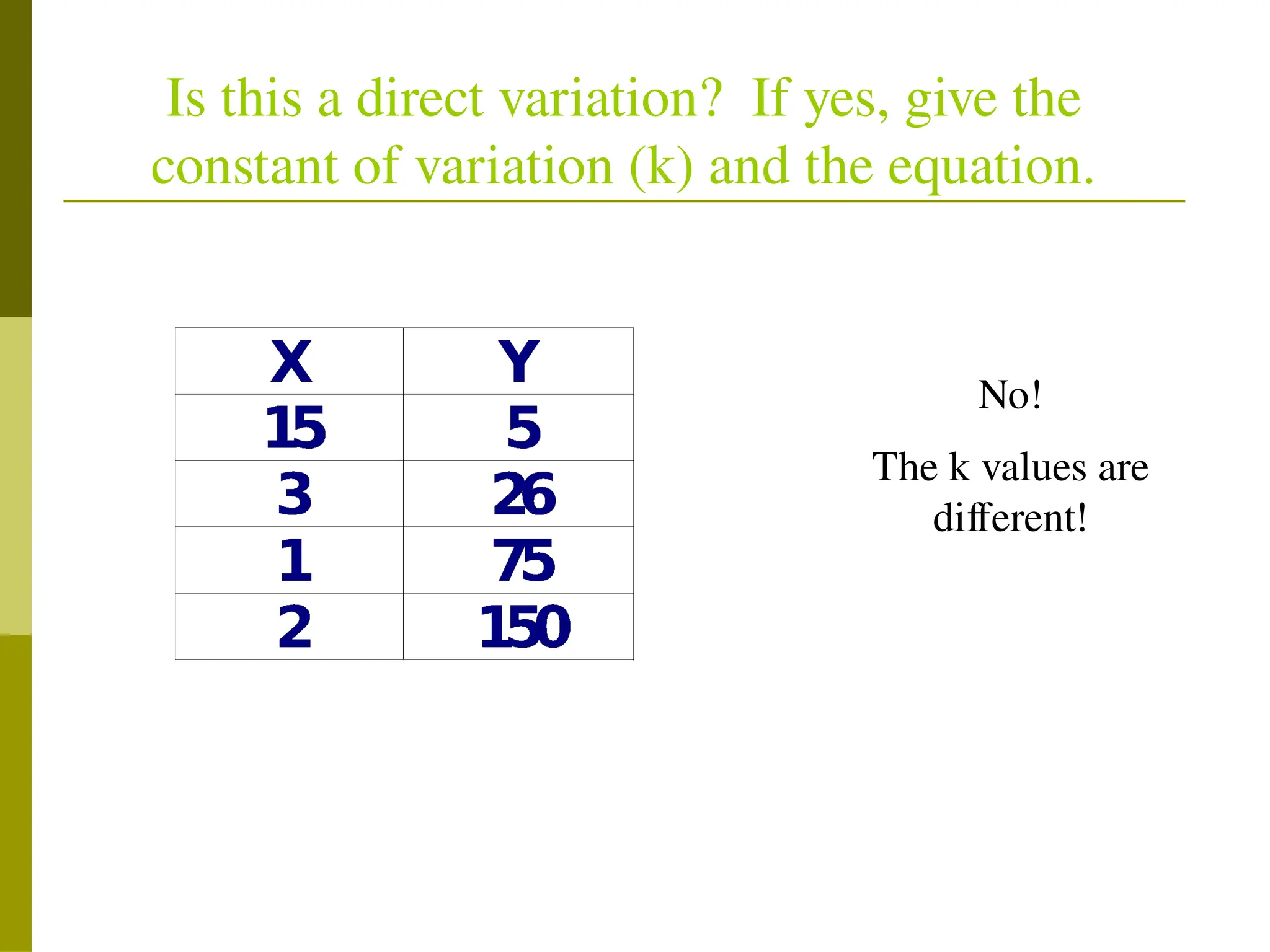
No!
The k values are
different!
Is this a direct variation? If yes, give the
constant of variation (k) and the equation.
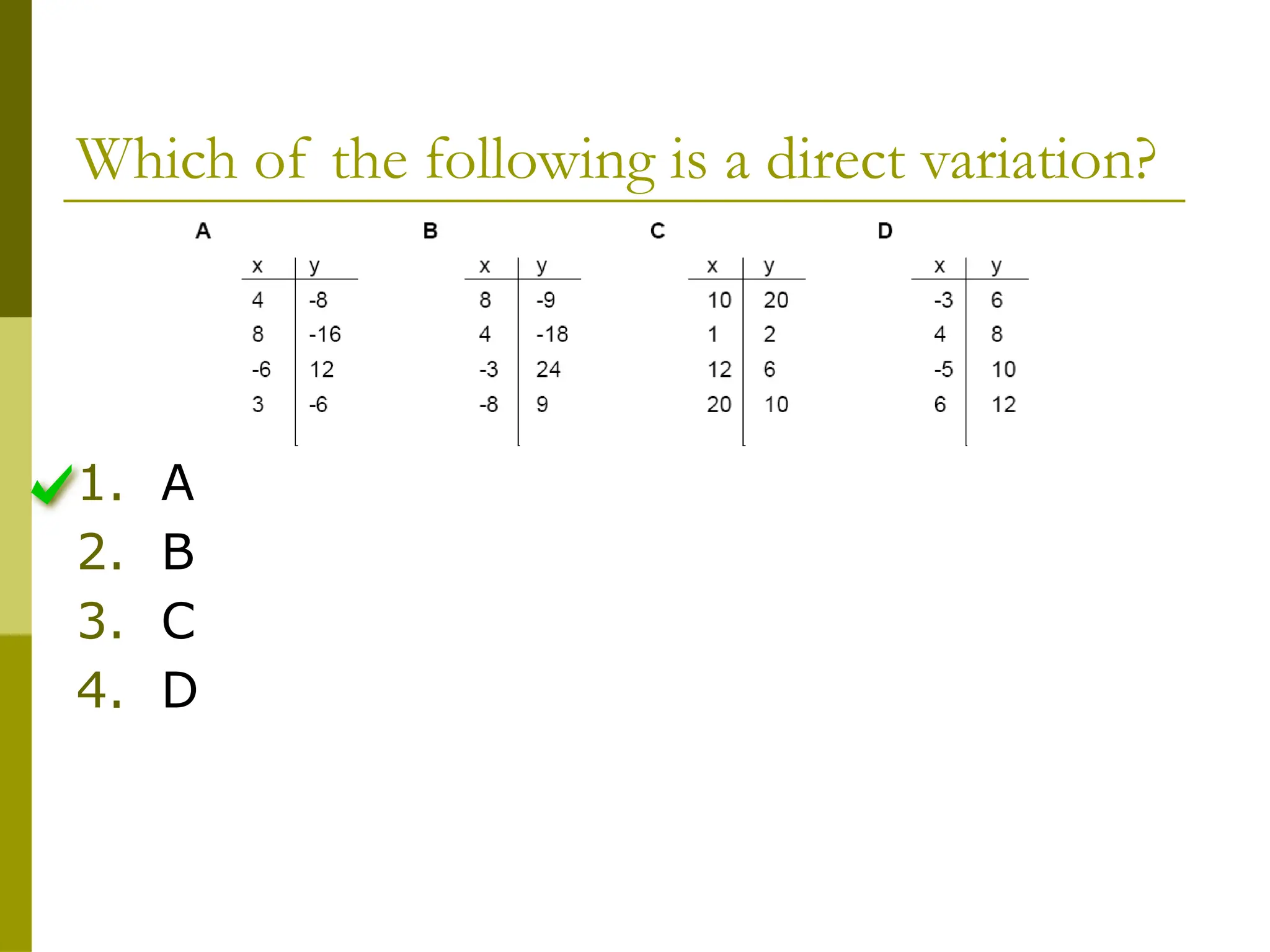
Which of the following is a direct variation?
1. A
2. B
3. C
4. D
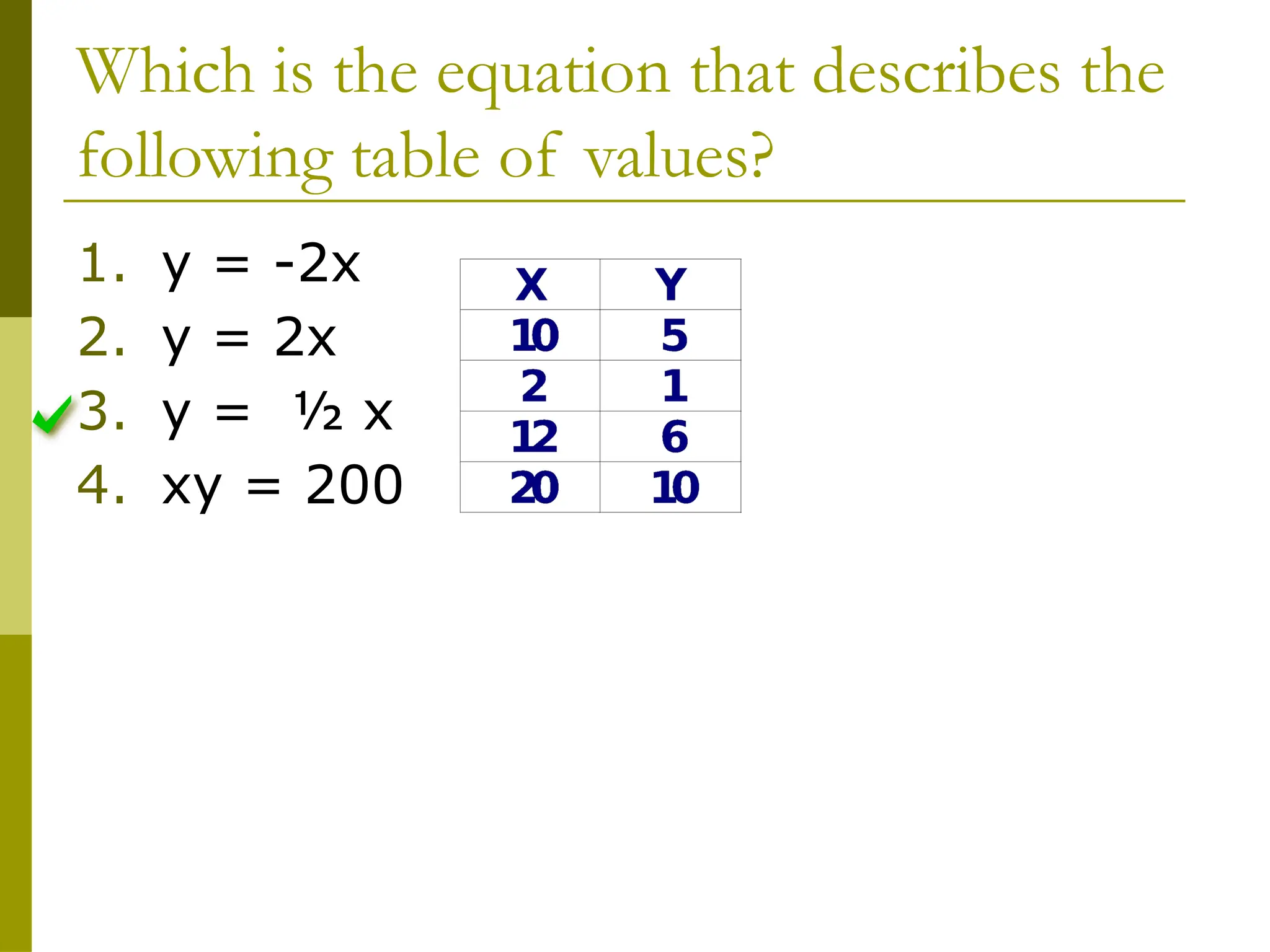
Which is the equation that describes the
following table of values?
1. y = -2x
2. y = 2x
3. y = ½ x
4. xy = 200
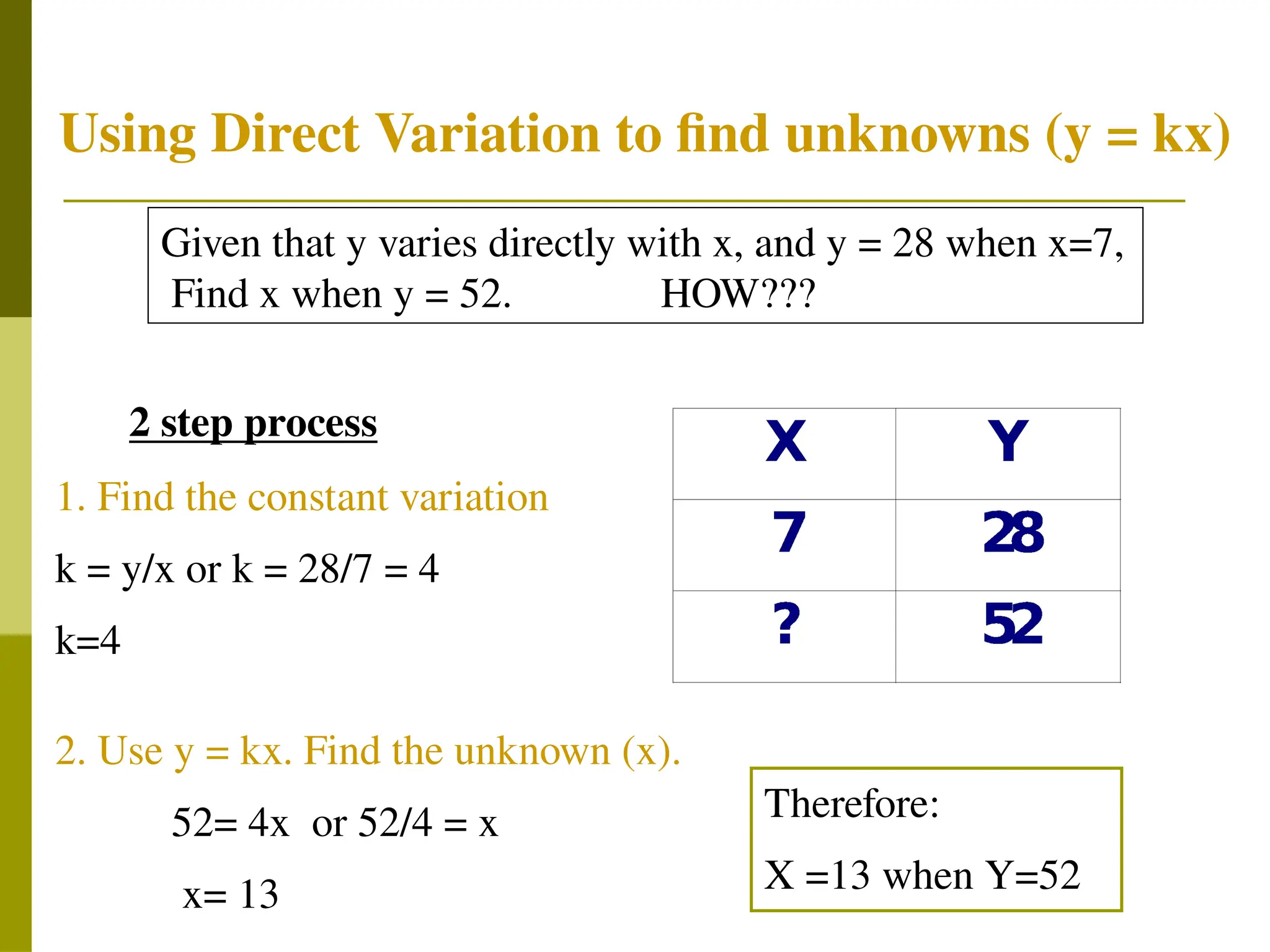
Using Direct Variation to find unknowns (y = kx)
Given that y varies directly with x, and y = 28 when x=7,
Find x when y = 52. HOW???
2 step process
1. Find the constant variation
k = y/x or k = 28/7 = 4
k=4
2. Use y = kx. Find the unknown (x).
52= 4x or 52/4 = x
x= 13
Therefore:
X =13 when Y=52
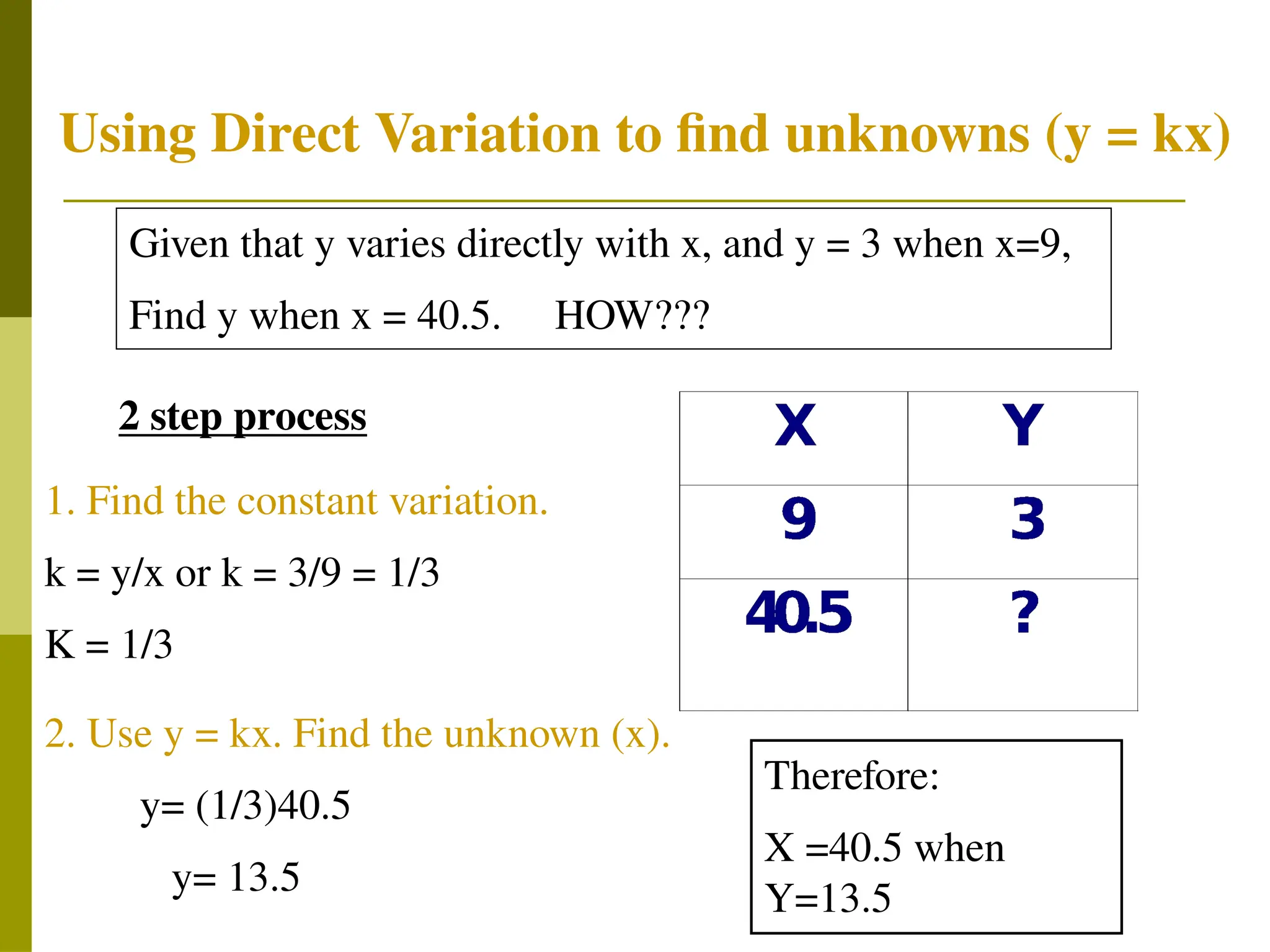
Given that y varies directly with x, and y = 3 when x=9,
Find y when x = 40.5. HOW???
2 step process
1. Find the constant variation.
k = y/x or k = 3/9 = 1/3
K = 1/3
2. Use y = kx. Find the unknown (x).
y= (1/3)40.5
y= 13.5
Therefore:
X =40.5 when
Y=13.5
Using Direct Variation to find unknowns (y = kx)
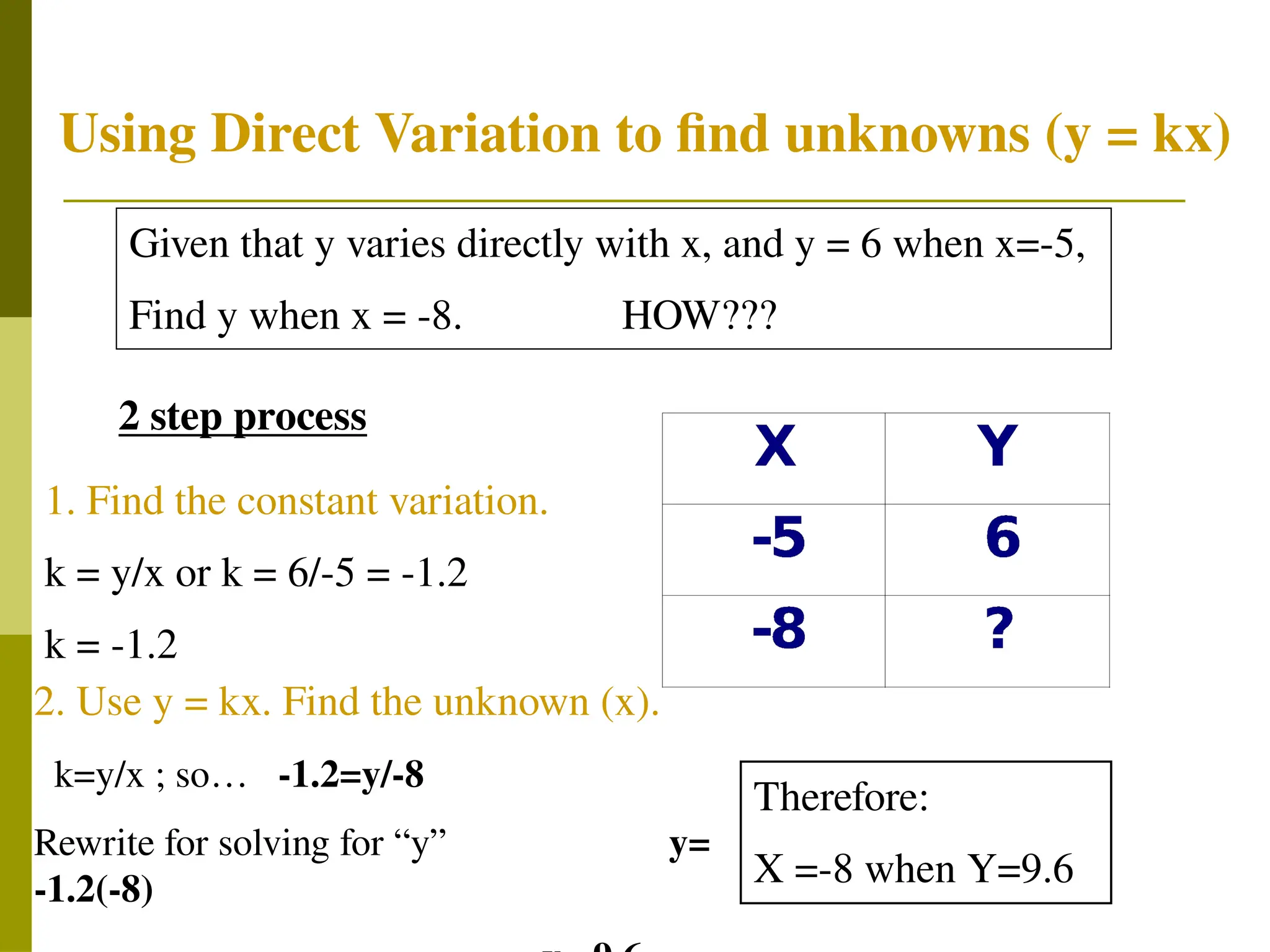
Given that y varies directly with x, and y = 6 when x=-5,
Find y when x = -8. HOW???
2 step process
1. Find the constant variation.
k = y/x or k = 6/-5 = -1.2
k = -1.2
2. Use y = kx. Find the unknown (x).
k=y/x ; so… -1.2=y/-8
Rewrite for solving for “y” y=
-1.2(-8)
Therefore:
X =-8 when Y=9.6
Using Direct Variation to find unknowns (y = kx)
Using Direct Variation to solve word problems
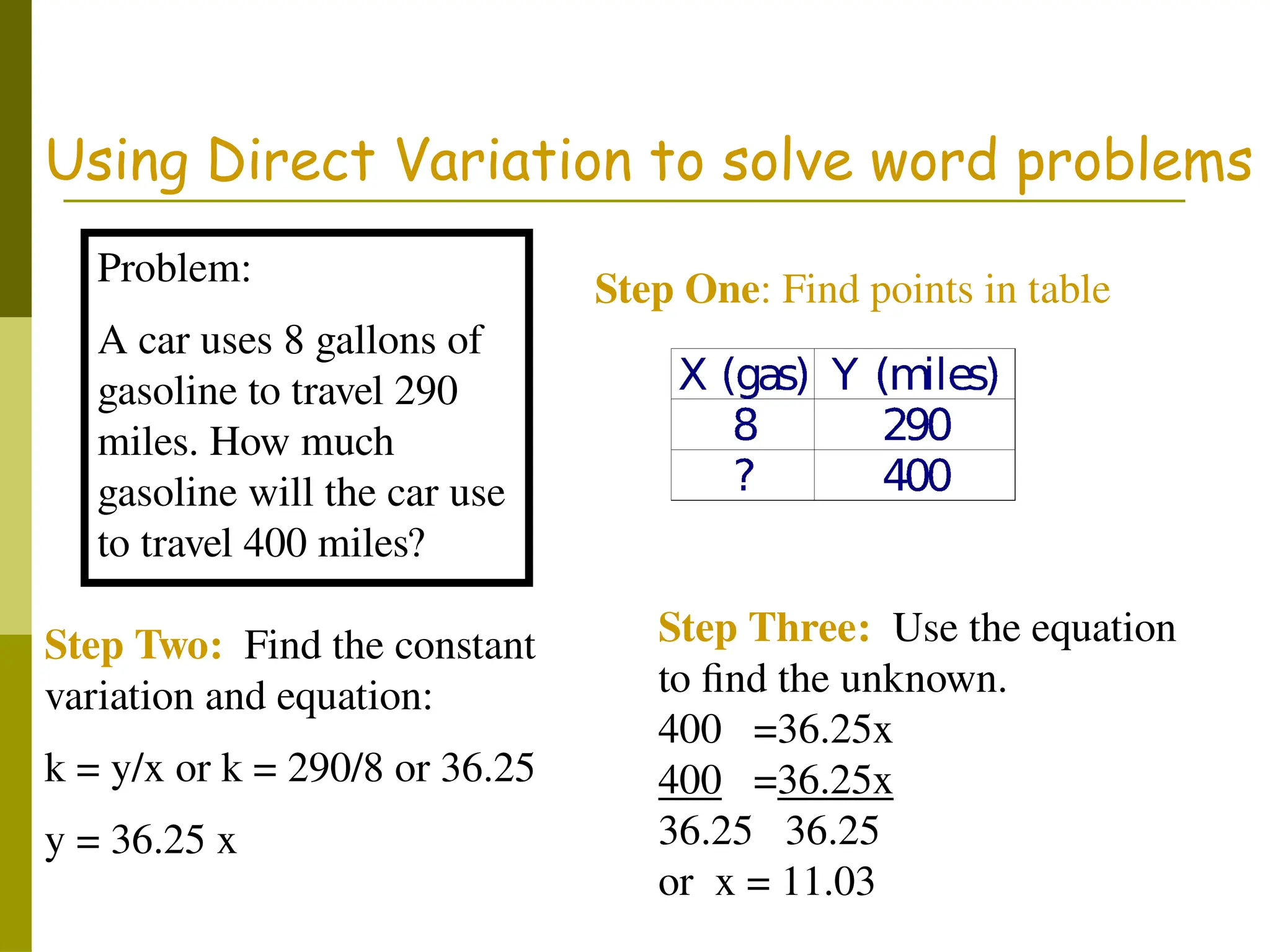
Problem:
A car uses 8 gallons of
gasoline to travel 290
miles. How much
gasoline will the car use
to travel 400 miles?
Step One: Find points in table
Step Two: Find the constant
variation and equation:
k = y/x or k = 290/8 or 36.25
y = 36.25 x
Step Three: Use the equation
to find the unknown.
400 =36.25x
400 =36.25x
36.25 36.25
or x = 11.03
Using Direct Variation to solve word problems
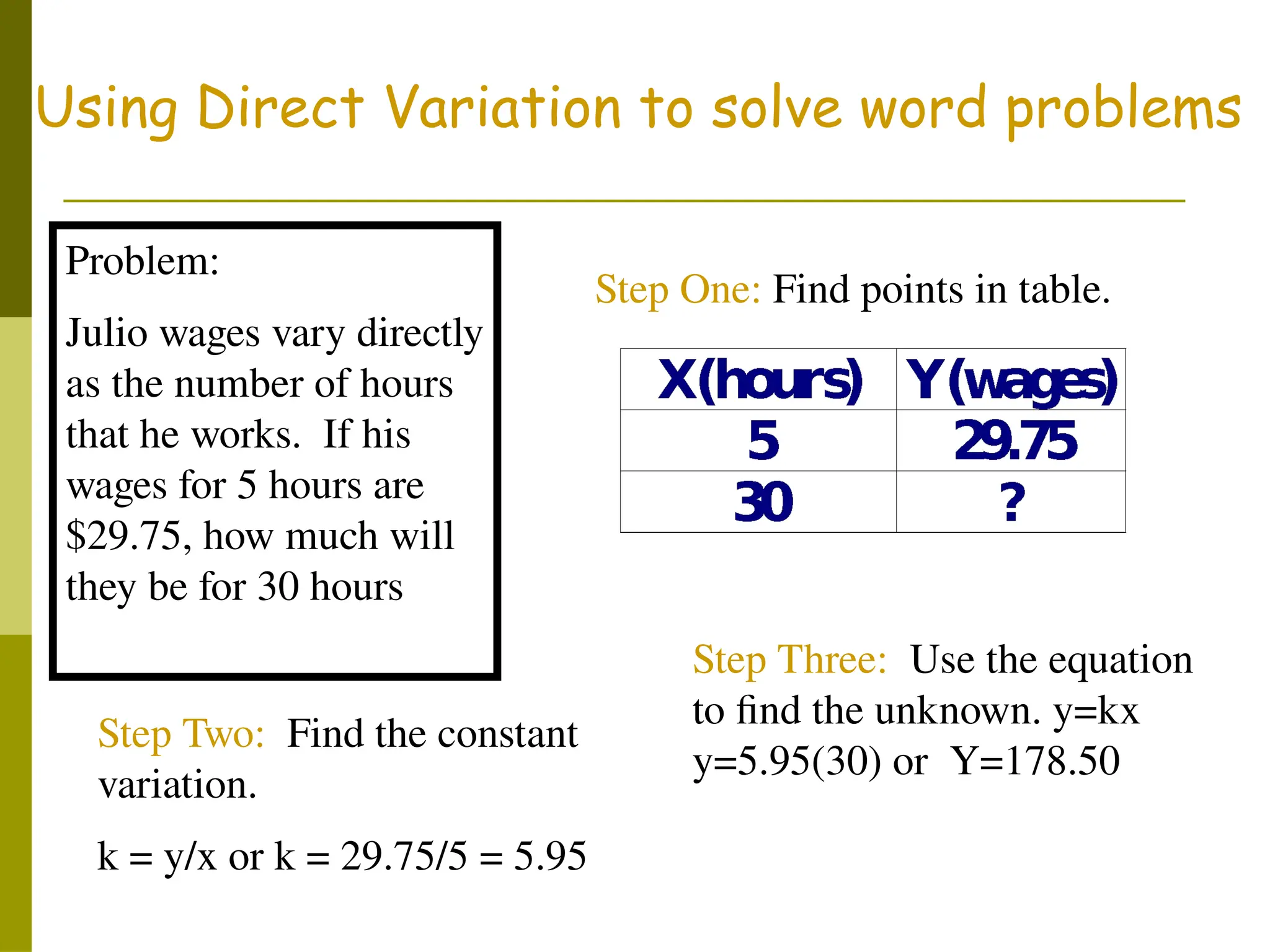
Problem:
Julio wages vary directly
as the number of hours
that he works. If his
wages for 5 hours are
$29.75, how much will
they be for 30 hours
Step One: Find points in table.
Step Two: Find the constant
variation.
k = y/x or k = 29.75/5 = 5.95
Step Three: Use the equation
to find the unknown. y=kx
y=5.95(30) or Y=178.50
Direct Variation and its graph
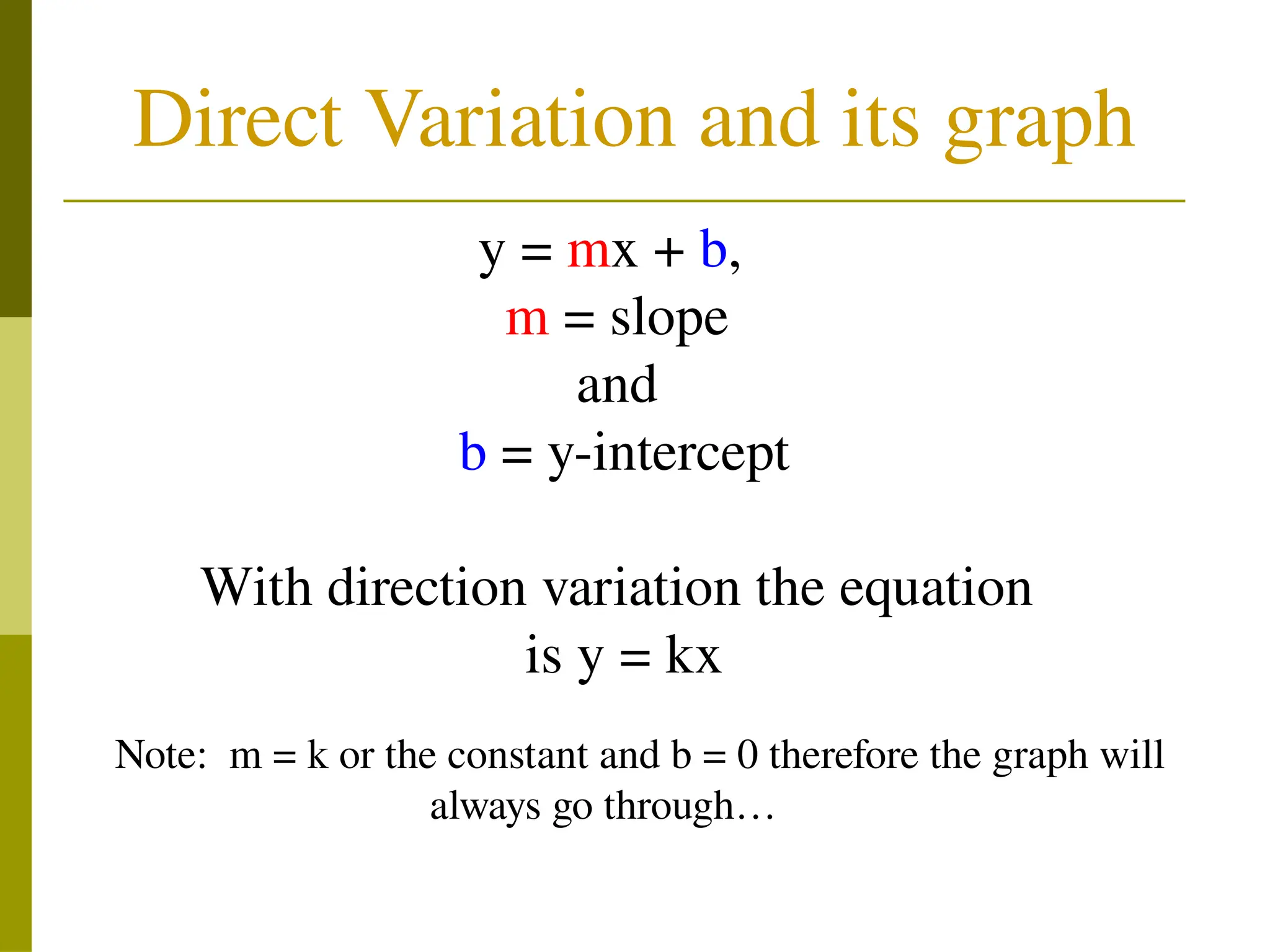
y = mx + b,
m = slope
and
b = y-intercept
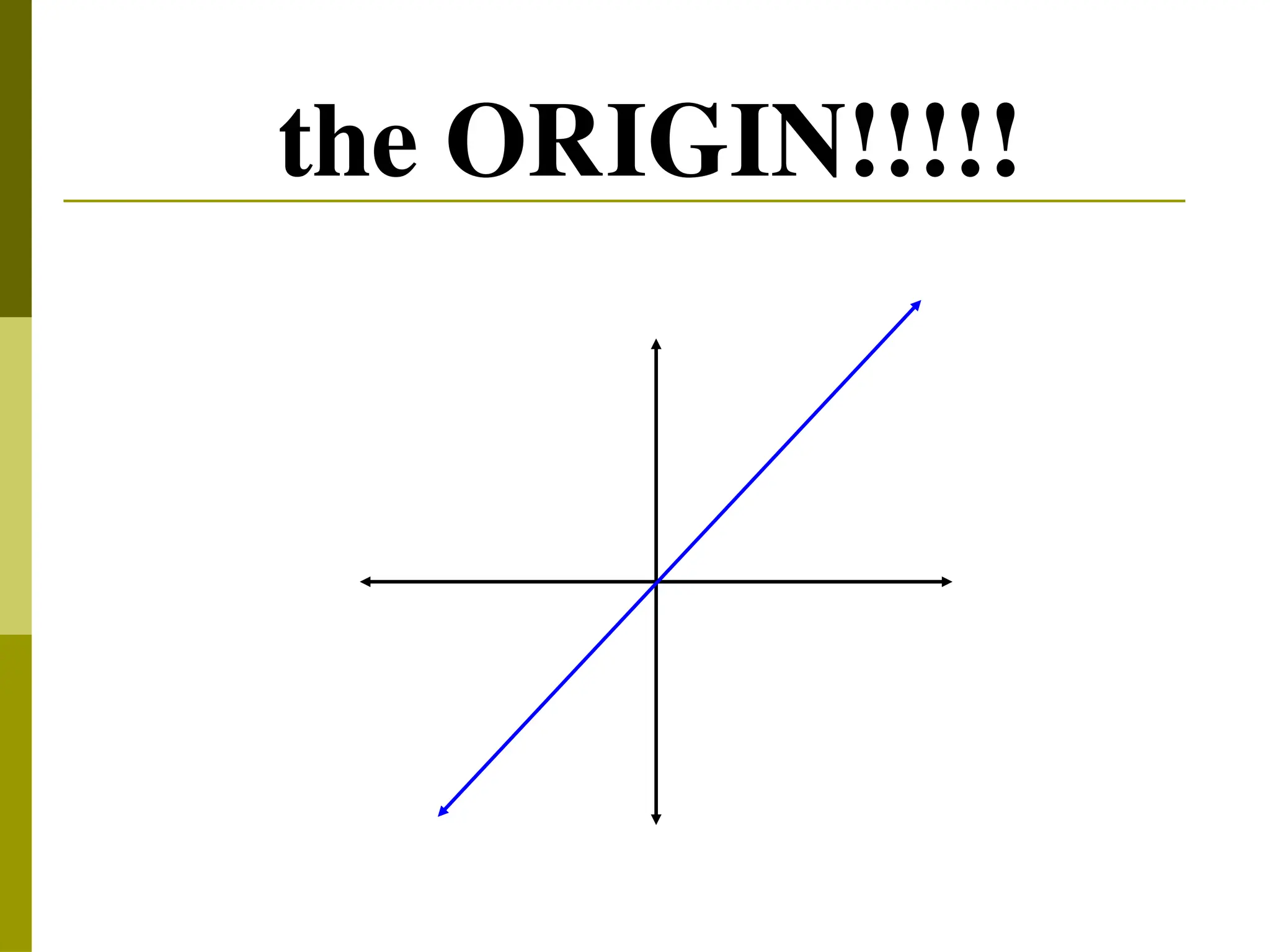
With direction variation the equation
is y = kx
Note: m = k or the constant and b = 0 therefore the graph will
always go through…
the ORIGIN!!!!!
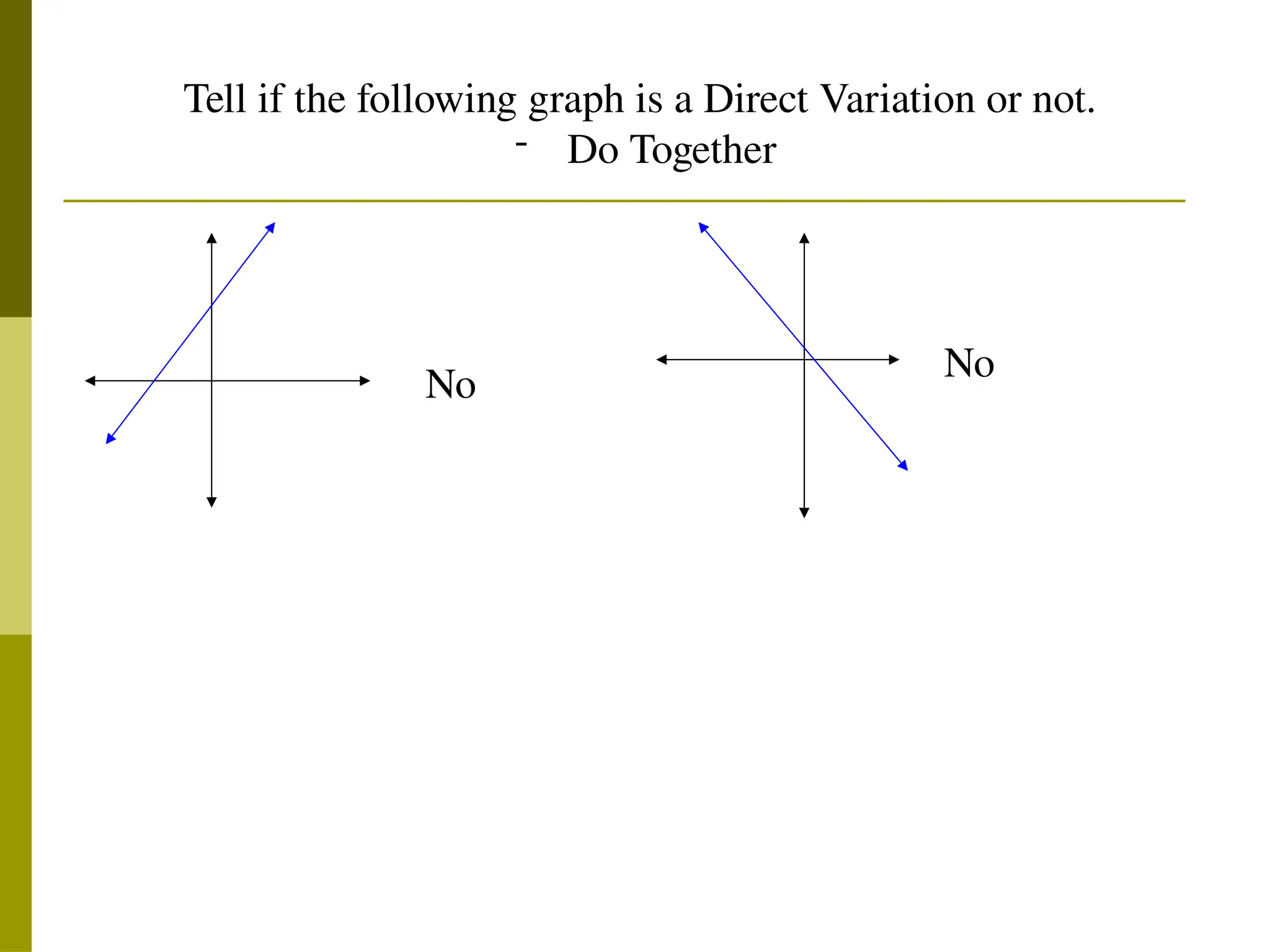
Tell if the following graph is a Direct Variation or not.
- Do Together
No
No
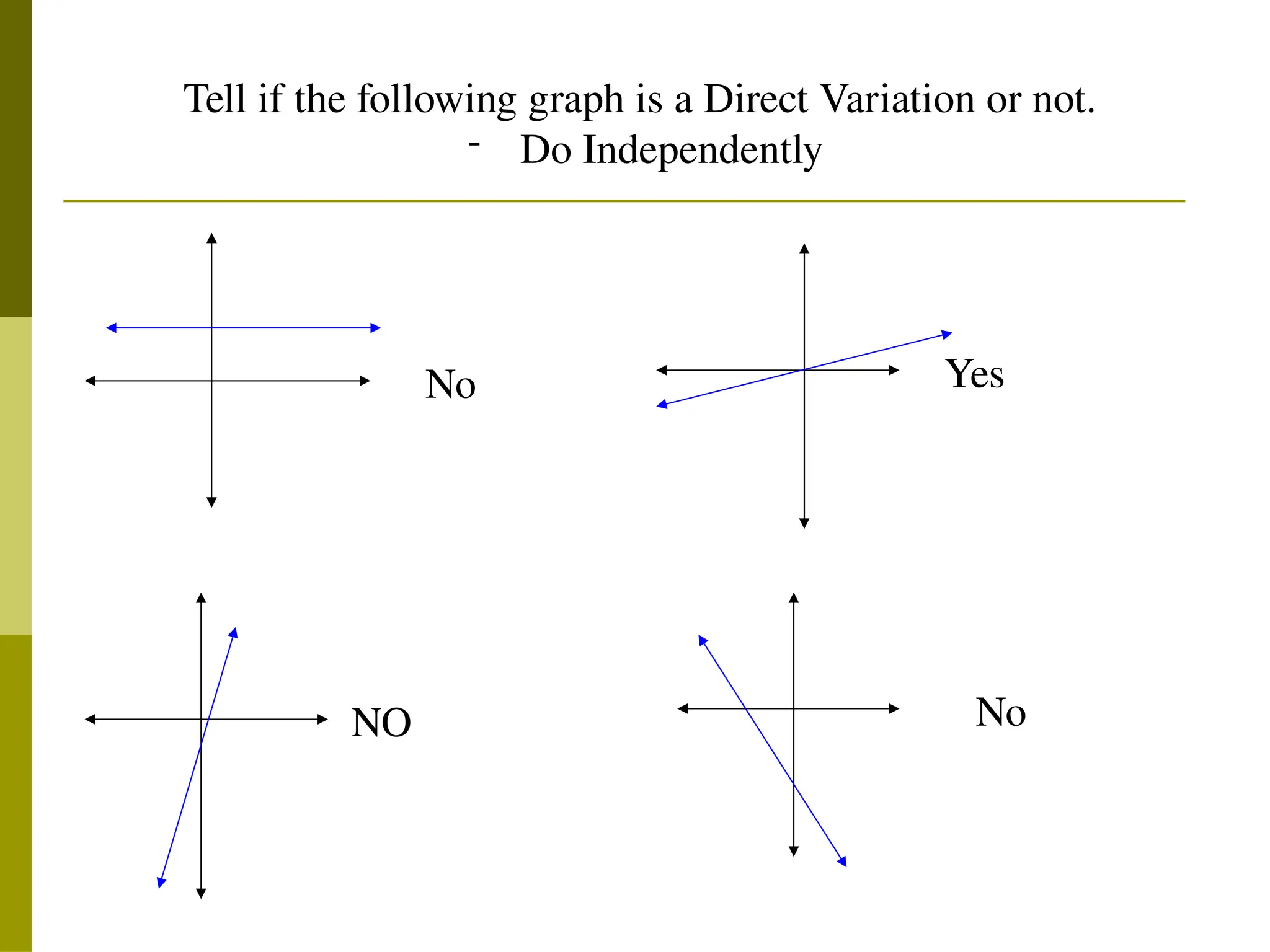
No Yes
NO No
Tell if the following graph is a Direct Variation or not.
- Do Independently

Direct Variation.ppt.pptx YYY

  • 1.
    Direct Variation What isit and how do I know when I see it?
  • 2.
    Definition: Y varies directlyas x means that y = kx where k is the constant of variation. (see any similarities to y = mx) Another way of writing this is k = In other words: * the constant of variation (k) in a direct variation is the constant (unchanged) ratio of two variable quantities.
  • 3.
    Examples of DirectVariation: Note: X increases, 6 , 7 , 8 And Y increases. 12, 14, 16 What is the constant of variation of the table above? Since y = kx we can say Therefore: 12/6=k or k = 2 14/7=k or k = 2 16/8=k or k =2 Note k stays constant. y = 2x is the equation!
  • 4.
    Note: X decreases, 10,5, 3 And Y decreases. 30, 15, 9 What is the constant of variation of the table above? Since y = kx we can say Therefore: 30/10=k or k = 3 15/5=k or k = 3 9/3=k or k =3 Note k stays constant. y = 3x is the equation! Examples of Direct Variation:
  • 5.
    Note: X decreases, -4,-16, -40 And Y decreases. -1,-4,-10 What is the constant of variation of the table above? Since y = kx we can say Therefore: -1/-4=k or k = Âź -4/-16=k or k = Âź -10/-40=k or k = Âź Note k stays constant. y = Âź x is the equation! Examples of Direct Variation:
  • 6.
    What is theconstant of variation for the following direct variation? 1. 2 2. -2 3. -½ 4. ½
  • 7.
    Yes! k = 25/10or 5/2 k = 10/4 or 5/2 Equation? y = 5/2 x Is this a direct variation? If yes, give the constant of variation (k) and the equation.
  • 8.
    No! The k valuesare different! Is this a direct variation? If yes, give the constant of variation (k) and the equation.
  • 9.
    Which of thefollowing is a direct variation? 1. A 2. B 3. C 4. D
  • 10.
    Which is theequation that describes the following table of values? 1. y = -2x 2. y = 2x 3. y = ½ x 4. xy = 200
  • 11.
    Using Direct Variationto find unknowns (y = kx) Given that y varies directly with x, and y = 28 when x=7, Find x when y = 52. HOW??? 2 step process 1. Find the constant variation k = y/x or k = 28/7 = 4 k=4 2. Use y = kx. Find the unknown (x). 52= 4x or 52/4 = x x= 13 Therefore: X =13 when Y=52
  • 12.
    Given that yvaries directly with x, and y = 3 when x=9, Find y when x = 40.5. HOW??? 2 step process 1. Find the constant variation. k = y/x or k = 3/9 = 1/3 K = 1/3 2. Use y = kx. Find the unknown (x). y= (1/3)40.5 y= 13.5 Therefore: X =40.5 when Y=13.5 Using Direct Variation to find unknowns (y = kx)
  • 13.
    Given that yvaries directly with x, and y = 6 when x=-5, Find y when x = -8. HOW??? 2 step process 1. Find the constant variation. k = y/x or k = 6/-5 = -1.2 k = -1.2 2. Use y = kx. Find the unknown (x). k=y/x ; so… -1.2=y/-8 Rewrite for solving for “y” y= -1.2(-8) Therefore: X =-8 when Y=9.6 Using Direct Variation to find unknowns (y = kx)
  • 14.
    Using Direct Variationto solve word problems Problem: A car uses 8 gallons of gasoline to travel 290 miles. How much gasoline will the car use to travel 400 miles? Step One: Find points in table Step Two: Find the constant variation and equation: k = y/x or k = 290/8 or 36.25 y = 36.25 x Step Three: Use the equation to find the unknown. 400 =36.25x 400 =36.25x 36.25 36.25 or x = 11.03
  • 15.
    Using Direct Variationto solve word problems Problem: Julio wages vary directly as the number of hours that he works. If his wages for 5 hours are $29.75, how much will they be for 30 hours Step One: Find points in table. Step Two: Find the constant variation. k = y/x or k = 29.75/5 = 5.95 Step Three: Use the equation to find the unknown. y=kx y=5.95(30) or Y=178.50
  • 16.
    Direct Variation andits graph y = mx + b, m = slope and b = y-intercept With direction variation the equation is y = kx Note: m = k or the constant and b = 0 therefore the graph will always go through…
  • 17.
  • 18.
    Tell if thefollowing graph is a Direct Variation or not. - Do Together No No
  • 19.
    No Yes NO No Tellif the following graph is a Direct Variation or not. - Do Independently