PARALLEL, PERPENDICULAR, OR
NEITHER
Practice Problems
REMEMBER THE CHARACTERISTICS:
Characteristic Parallel Lines Perpendicular Lines
Slope Same or Equal Opposite Reciprocals
Y-Intercepts Different Same or Different
PARALLEL, PERPENDICULAR, OR
NEITHER?
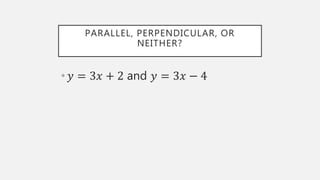
• 𝑦 = 3𝑥 + 2 and 𝑦 = 3𝑥 − 4
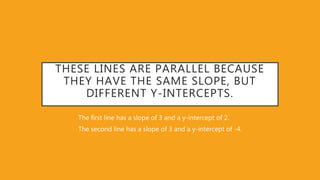
THESE LINES ARE PARALLEL BECAUSE
THEY HAVE THE SAME SLOPE, BUT
DIFFERENT Y-INTERCEPTS.
The first line has a slope of 3 and a y-intercept of 2.
The second line has a slope of 3 and a y-intercept of -4.
PARALLEL, PERPENDICULAR, OR
NEITHER?
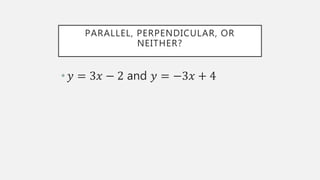
• 𝑦 = 3𝑥 − 2 and 𝑦 = −3𝑥 + 4
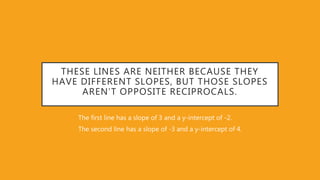
THESE LINES ARE NEITHER BECAUSE THEY
HAVE DIFFERENT SLOPES, BUT THOSE SLOPES
AREN’T OPPOSITE RECIPROCALS.
The first line has a slope of 3 and a y-intercept of -2.
The second line has a slope of -3 and a y-intercept of 4.
PARALLEL, PERPENDICULAR, OR
NEITHER?
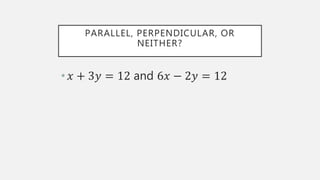
• 𝑥 + 3𝑦 = 12 and 6𝑥 − 2𝑦 = 12
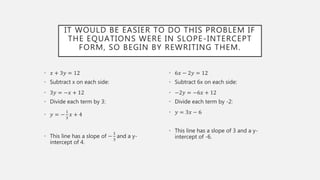
IT WOULD BE EASIER TO DO THIS PROBLEM IF
THE EQUATIONS WERE IN SLOPE-INTERCEPT
FORM, SO BEGIN BY REWRITING THEM.
• 𝑥 + 3𝑦 = 12
• Subtract x on each side:
• 3𝑦 = −𝑥 + 12
• Divide each term by 3:
• 𝑦 = −
1
3
𝑥 + 4
• This line has a slope of −
1
3
and a y-
intercept of 4.
• 6𝑥 − 2𝑦 = 12
• Subtract 6x on each side:
• −2𝑦 = −6𝑥 + 12
• Divide each term by -2:
• 𝑦 = 3𝑥 − 6
• This line has a slope of 3 and a y-
intercept of -6.
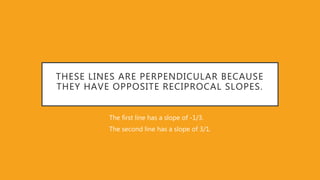
THESE LINES ARE PERPENDICULAR BECAUSE
THEY HAVE OPPOSITE RECIPROCAL SLOPES.
The first line has a slope of -1/3.
The second line has a slope of 3/1.

Parallel, Perpendicular, or Neither?

  • 1.
  • 2.
    REMEMBER THE CHARACTERISTICS: CharacteristicParallel Lines Perpendicular Lines Slope Same or Equal Opposite Reciprocals Y-Intercepts Different Same or Different
  • 3.
    PARALLEL, PERPENDICULAR, OR NEITHER? •𝑦 = 3𝑥 + 2 and 𝑦 = 3𝑥 − 4
  • 4.
    THESE LINES AREPARALLEL BECAUSE THEY HAVE THE SAME SLOPE, BUT DIFFERENT Y-INTERCEPTS. The first line has a slope of 3 and a y-intercept of 2. The second line has a slope of 3 and a y-intercept of -4.
  • 5.
    PARALLEL, PERPENDICULAR, OR NEITHER? •𝑦 = 3𝑥 − 2 and 𝑦 = −3𝑥 + 4
  • 6.
    THESE LINES ARENEITHER BECAUSE THEY HAVE DIFFERENT SLOPES, BUT THOSE SLOPES AREN’T OPPOSITE RECIPROCALS. The first line has a slope of 3 and a y-intercept of -2. The second line has a slope of -3 and a y-intercept of 4.
  • 7.
    PARALLEL, PERPENDICULAR, OR NEITHER? •𝑥 + 3𝑦 = 12 and 6𝑥 − 2𝑦 = 12
  • 8.
    IT WOULD BEEASIER TO DO THIS PROBLEM IF THE EQUATIONS WERE IN SLOPE-INTERCEPT FORM, SO BEGIN BY REWRITING THEM. • 𝑥 + 3𝑦 = 12 • Subtract x on each side: • 3𝑦 = −𝑥 + 12 • Divide each term by 3: • 𝑦 = − 1 3 𝑥 + 4 • This line has a slope of − 1 3 and a y- intercept of 4. • 6𝑥 − 2𝑦 = 12 • Subtract 6x on each side: • −2𝑦 = −6𝑥 + 12 • Divide each term by -2: • 𝑦 = 3𝑥 − 6 • This line has a slope of 3 and a y- intercept of -6.
  • 9.
    THESE LINES AREPERPENDICULAR BECAUSE THEY HAVE OPPOSITE RECIPROCAL SLOPES. The first line has a slope of -1/3. The second line has a slope of 3/1.