Differential
Equations
History of Differential Equations
Definition & Types of Differential Equation
Order & Degree of Differential Equations
History of Differential Equations:
According to some Historians of Mathematics, the
study of differential equations began in 1675, when
Gottfried Leibniz (1646-1716) wrote the equation:
𝑥𝑑𝑥 =
𝑥2
2
History of Differential Equations:
The search for general methods of integrating
differential equations began when Isaac Newton
(1642-1727) classified first order differential
equations into three classes:
I.
𝑑𝑦
𝑑𝑥
= 𝑓 𝑥
II.
𝑑𝑦
𝑑𝑥
= 𝑓(𝑥, 𝑦)
III. 𝑥
𝜕𝑢
𝜕𝑥
+ 𝑦
𝜕𝑢
𝜕𝑦
= 𝑢
Differential Equations & their
Classification:
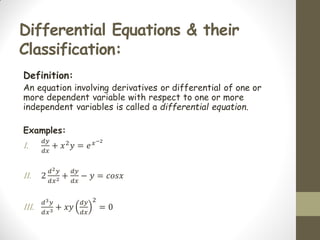
Definition:
An equation involving derivatives or differential of one or
more dependent variable with respect to one or more
independent variables is called a differential equation.
Examples:
I.
𝑑𝑦
𝑑𝑥
+ 𝑥2 𝑦 = 𝑒 𝑥−2
II. 2
𝑑2 𝑦
𝑑𝑥2 +
𝑑𝑦
𝑑𝑥
− 𝑦 = 𝑐𝑜𝑠𝑥
III.
𝑑3 𝑦
𝑑𝑥3 + 𝑥𝑦
𝑑𝑦
𝑑𝑥
2
= 0
Differential Equations &
their Classification:
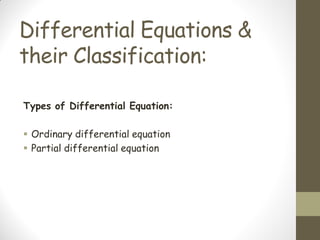
Types of Differential Equation:
 Ordinary differential equation
 Partial differential equation
Ordinary Differential
Equation:
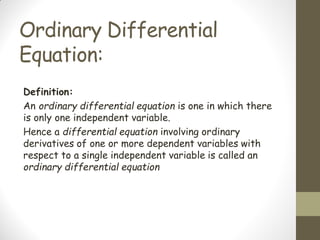
Definition:
An ordinary differential equation is one in which there
is only one independent variable.
Hence a differential equation involving ordinary
derivatives of one or more dependent variables with
respect to a single independent variable is called an
ordinary differential equation
Ordinary Differential
Equation:
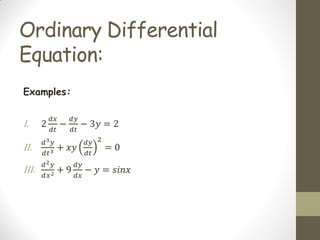
Examples:
I. 2
𝑑𝑥
𝑑𝑡
−
𝑑𝑦
𝑑𝑡
− 3𝑦 = 2
II.
𝑑3 𝑦
𝑑𝑡3 + 𝑥𝑦
𝑑𝑦
𝑑𝑡
2
= 0
III.
𝑑2 𝑦
𝑑𝑥2 + 9
𝑑𝑦
𝑑𝑥
− 𝑦 = 𝑠𝑖𝑛𝑥
Partial Differential
Equation:
Definition:
A differential equation involving partial derivatives of
one or more dependent variable with respect to one or
more independent variables is called a partial
differential equation.
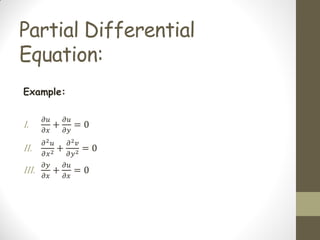
Partial Differential
Equation:
Example:
I.
𝜕𝑢
𝜕𝑥
+
𝜕𝑢
𝜕𝑦
= 0
II.
𝜕2 𝑢
𝜕𝑥2 +
𝜕2 𝑣
𝜕𝑦2 = 0
III.
𝜕𝑦
𝜕𝑥
+
𝜕𝑢
𝜕𝑥
= 0
Order of Differential
Equation:
Definition:
The order of a differential equation is the order of the
highest derivative appearing in the equation.
Examples:
I.
𝑑3 𝑦
𝑑𝑡3 + 𝑥𝑦
𝑑𝑦
𝑑𝑡
2
= 0
is of order 3 and it is ordinary differential equation.
I.
𝜕𝑢
𝜕𝑥
2
+
𝜕𝑢
𝜕𝑦
= 𝑐𝑜𝑠𝑥
is of order 1 and it is partial differential equation.
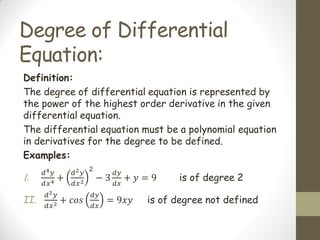
Degree of Differential
Equation:
Definition:
The degree of differential equation is represented by
the power of the highest order derivative in the given
differential equation.
The differential equation must be a polynomial equation
in derivatives for the degree to be defined.
Examples:
I.
𝑑4 𝑦
𝑑𝑥4 +
𝑑2 𝑦
𝑑𝑥2
2
− 3
𝑑𝑦
𝑑𝑥
+ 𝑦 = 9 is of degree 2
II.
𝑑2 𝑦
𝑑𝑥2 + 𝑐𝑜𝑠
𝑑𝑦
𝑑𝑥
= 9𝑥𝑦 is of degree not defined

Differential equations,pdf

  • 1.
    Differential Equations History of DifferentialEquations Definition & Types of Differential Equation Order & Degree of Differential Equations
  • 2.
    History of DifferentialEquations: According to some Historians of Mathematics, the study of differential equations began in 1675, when Gottfried Leibniz (1646-1716) wrote the equation: 𝑥𝑑𝑥 = 𝑥2 2
  • 3.
    History of DifferentialEquations: The search for general methods of integrating differential equations began when Isaac Newton (1642-1727) classified first order differential equations into three classes: I. 𝑑𝑦 𝑑𝑥 = 𝑓 𝑥 II. 𝑑𝑦 𝑑𝑥 = 𝑓(𝑥, 𝑦) III. 𝑥 𝜕𝑢 𝜕𝑥 + 𝑦 𝜕𝑢 𝜕𝑦 = 𝑢
  • 4.
    Differential Equations &their Classification: Definition: An equation involving derivatives or differential of one or more dependent variable with respect to one or more independent variables is called a differential equation. Examples: I. 𝑑𝑦 𝑑𝑥 + 𝑥2 𝑦 = 𝑒 𝑥−2 II. 2 𝑑2 𝑦 𝑑𝑥2 + 𝑑𝑦 𝑑𝑥 − 𝑦 = 𝑐𝑜𝑠𝑥 III. 𝑑3 𝑦 𝑑𝑥3 + 𝑥𝑦 𝑑𝑦 𝑑𝑥 2 = 0
  • 5.
    Differential Equations & theirClassification: Types of Differential Equation:  Ordinary differential equation  Partial differential equation
  • 6.
    Ordinary Differential Equation: Definition: An ordinarydifferential equation is one in which there is only one independent variable. Hence a differential equation involving ordinary derivatives of one or more dependent variables with respect to a single independent variable is called an ordinary differential equation
  • 7.
    Ordinary Differential Equation: Examples: I. 2 𝑑𝑥 𝑑𝑡 − 𝑑𝑦 𝑑𝑡 −3𝑦 = 2 II. 𝑑3 𝑦 𝑑𝑡3 + 𝑥𝑦 𝑑𝑦 𝑑𝑡 2 = 0 III. 𝑑2 𝑦 𝑑𝑥2 + 9 𝑑𝑦 𝑑𝑥 − 𝑦 = 𝑠𝑖𝑛𝑥
  • 8.
    Partial Differential Equation: Definition: A differentialequation involving partial derivatives of one or more dependent variable with respect to one or more independent variables is called a partial differential equation.
  • 9.
    Partial Differential Equation: Example: I. 𝜕𝑢 𝜕𝑥 + 𝜕𝑢 𝜕𝑦 = 0 II. 𝜕2𝑢 𝜕𝑥2 + 𝜕2 𝑣 𝜕𝑦2 = 0 III. 𝜕𝑦 𝜕𝑥 + 𝜕𝑢 𝜕𝑥 = 0
  • 10.
    Order of Differential Equation: Definition: Theorder of a differential equation is the order of the highest derivative appearing in the equation. Examples: I. 𝑑3 𝑦 𝑑𝑡3 + 𝑥𝑦 𝑑𝑦 𝑑𝑡 2 = 0 is of order 3 and it is ordinary differential equation. I. 𝜕𝑢 𝜕𝑥 2 + 𝜕𝑢 𝜕𝑦 = 𝑐𝑜𝑠𝑥 is of order 1 and it is partial differential equation.
  • 11.
    Degree of Differential Equation: Definition: Thedegree of differential equation is represented by the power of the highest order derivative in the given differential equation. The differential equation must be a polynomial equation in derivatives for the degree to be defined. Examples: I. 𝑑4 𝑦 𝑑𝑥4 + 𝑑2 𝑦 𝑑𝑥2 2 − 3 𝑑𝑦 𝑑𝑥 + 𝑦 = 9 is of degree 2 II. 𝑑2 𝑦 𝑑𝑥2 + 𝑐𝑜𝑠 𝑑𝑦 𝑑𝑥 = 9𝑥𝑦 is of degree not defined