Dr. Thirunahari Ugandhar
Associate Professor of Botany
Department of Botany
Kakatiya Govt. College (A), Hanamkonda
Multiple Allelism – Definition and Explanation
• Definition:
Multiple allelism refers to the presence of more
than two alternative forms (alleles) of a gene
that occupy the same locus (position) on a
homologous pair of chromosomes, although only
two alleles can be present in a diploid individual
(one on each chromosome).
Example in Humans:
ABO blood group system is a classic
example.
• Gene I has three alleles:
• IAI^AIA – produces A antigen
• IBI^BIB – produces B antigen
• iii – does not produce any antigen
• These combine to form four blood types: A, B, AB,
and O.
Genotypic Combinations:
With three alleles, the possible
combinations are:
• IAIAI^A I^AIAIA, IAiI^A iIAi, IBIBI^B I^BIBIB, IBiI^B
iIBi, IAIBI^A I^BIAIB, iii iii
Failure of Dominance – Definition and Explanation
• Definition:
Failure of dominance refers to a genetic condition
where the dominant allele does not completely
mask the effect of the recessive allele in a
heterozygous individual. As a result, the phenotype is
an intermediate or a blend between the dominant
and recessive traits.
Key Concepts:
1.Also Known As:
1.. Incomplete dominance or partial dominance.
2.Contrast to Complete Dominance:
1. In complete dominance, the dominant allele completely
overrides the effect of the recessive allele (e.g., tall ×
dwarf tall).
→
2. In failure of dominance, neither allele is completely
dominant, and both contribute to the phenotype.
Example:
Snapdragon Flower Color (Antirrhinum majus):
• Red flower (RR) × White flower (rr) Pink flower (Rr)
→
• Phenotype of F1 generation is intermediate,
showing incomplete dominance, not red
(dominant) or white (recessive).
Genotypic and Phenotypic Ratios in F2 Generation:
• Cross: Rr × Rr
• Genotype Ratio: 1 RR: 2 Rr: 1 rr
• Phenotype Ratio: 1 Red: 2 Pink: 1 White
Failure of dominance shows that dominance is not
always complete. It provides important evidence
that inheritance patterns can be more complex than
simple Mendelian laws.
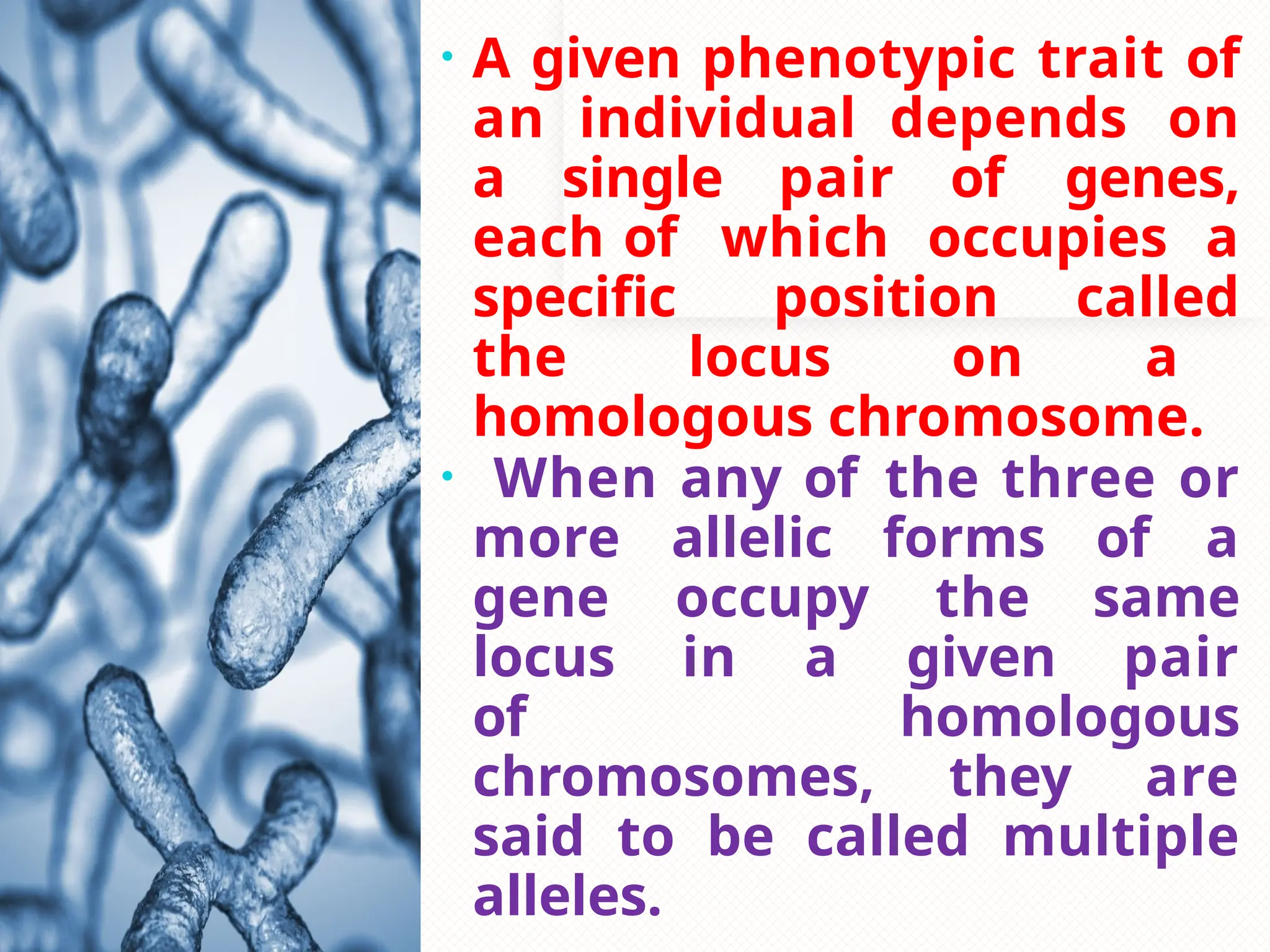
• A given phenotypic trait of
an individual depends on
a single pair of genes,
each of which occupies a
specific position called
the locus on a
homologous chromosome.
• When any of the three or
more allelic forms of a
gene occupy the same
locus in a given pair
of homologous
chromosomes, they are
said to be called multiple
alleles.
Characteristics of multiple
alleles
• Multiple alleles of a series always
occupy the same locus in the
homologous chromosome.
Therefore, no crossing over occurs
within the alleles of a series.
• Multiple alleles are always
responsible for the same character.
• The wild-type alleles of a series
exhibit dominant character,
whereas mutant types will
influence dominance or an
intermediate phenotypic effect.
• When any two of the mutant
multiple alleles are crossed, the
phenotype is always mutant type
and not the wild type
Wild type
Mutant type
Amorphs
Hypomorphs
Neomorphs
Isoalleles
Unstable alleles
Self-sterility in Nicotiana
• In plants, multiple alleles have
been reported in association
with self-sterility or self-
incompatibility.
• Self-sterility means that the
pollen from a plant is unable to
germinate on its stigma and will
not be able to bring about
fertilization in the ovules of the
same plant.
• East (1925) observed multiple
alleles in Nicotiana which are
responsible for self-
incompatibility or self-sterility.
• The gene for self-incompatibility
can be designated as S, which
has allelic series S1, S2, S3, S4 and
S5
• The cross-fertilizing tobacco plants
were not always homozygous as S1S1
or S2S2, but all plants were
heterozygous as S1S2, S3S4, S5S6.
• When crosses were made between
different S1S2 plants, the pollen tube
did not develop normally. But
effective pollen tube development
was observed when crossing was
made with other than S1S2 for
example S3S4.
• When crosses were made
between seed parents
with S1S2 and pollen
parents with S2S3, two
kinds of pollen tubes were
distinguished.
• Pollen grains carrying S2
were not effective, but the
pollen grains carrying S3
were capable of
fertilization.
• Thus, from the cross
S1S2XS3S4, all the pollens
were effective and four
kinds of progeny resulted:
S1S3, S1S4, S2S3 and S2S4.
Coat colour in rabbit
As an example, let's
consider a gene that
specifies coat color in
rabbits, called the C gene.
The C gene comes in four
common alleles: C, cch, ch
and c:A CC, rabbit has black
or brown fur A cchech,
⚫
rabbit has chinchilla
coloration (grayish fur).A
chch rabbit has Himalayan
(color-point) patterning,
with a white body and dark
ears, face, feet, and tailA cc
⚫ Multiple alleles makes for many possible dominance relationships. In
this case, the black C allele is completely dominant to all the others; the
chinchilla c^{ch}cchc, start superscript, c, h, end superscript allele is
incompletely dominant to the Himalayan c^hchc, start superscript, h, end
superscript and albino ccc alleles; and the Himalayan c^hchc, start
superscript, h, end superscript allele is completely dominant to the
albino ccc allele.
⚫ Rabbit breeders figured out these relationships by crossing different
rabbits of different genotypes and observing the phenotypes of the
heterozygous kits (baby bunnies).
Human Blood Type
⚫An excellent example of multiple allele
inheritance is human blood type. Blood type
exists as four possible phenotypes: A, B, AB, &
O.There are 3 alleles for the gene that
determines blood type.
⚫The alleles are as follows:
ALLELE
IA
⚫IB
⚫I
CODES
FOR
Type "A"
Blood
Type "B"
Blood Type
⚫Notice that, according to the symbols used in
the table above, that the allele for "O" (i) is
recessive to the alleles for "A" & "B".
⚫With three alleles we have a higher
number of possible combinations in
creating a genotype.
⚫ GENOTYPE
S
IAIA
Iai
RESULTING
PHENOTYPES
Type
A
Type
A
IBIB
Ibi
Type B
Type
B
⚫
IAIB Type
AB
⚫ii Type
O
Extensions to Mendelian
Genetics
 Gene Interactions
Gene Interactions – Extensions
to Mendelian Genetics
22
• 2 different genes can also act together to modify
a phenotype:
• 2 genes 1 phenotype (Additive Gene Action)
Complementation (complementary gene action)
• Epistasis (recessive and dominant)
Just as
different
alleles of 1
gene can
interact in
complex
ways,
Redundancy
Multifactorial Inheritance
23
Vast majority of traits are determined by multiple factors:
• genetic as well as environmental.
Gene interactions between two or more genes
• Example: Lentil Seed color.
F1 all same, F2: 4 different phenotypes
F2 phenotypic ratio is 9:3:3:1
• (same as F2 dihybrids in Mendel’s original crosses).
Difference:
• in original crosses: 2 independent traits/phenotypes=2 independent
genes;
• Seed color and seed shape
• here: multiple phenotypes of 1 trait=2 independent genes
• Seed color only.
You can tell this
genotype is
caused by more
than one gene :
•because there
are 4 phenotypes
not 3 in F2
•1 gene F2
would have 3
phenotypes
1:2:1 ratio
(Additive Gene
Action)
F2 phenotypes
– Tan:
– Gray:
A_bb
aaB_
– Green:
aabb
Dominance Relationships:
• Tan is dominant to green
• Gray is dominant to green
• Brown is dominant to gray, green and tan.
• Tan and Gray are incompletely dominant, giving rise
to brown.
Genotypic classes:
• Brown: A_B_
6
Complementary Gene
Action
The must have a dominant allele in both genes to result
in the purple flower phenotype
Each genotypic class may not always dictate a unique phenotype
A pair of genes can often work together to create a specific phenotype. We call this
complementary interaction.
With this type of interaction we see 2 different phenotypes instead of the 4 seen in
2 genes 1 phenotype
Two or more genotypic classes may display an identical phenotype.
• – Example: Two lines of pure breeding white flowered pea plants falling
into different genotypic classes: AAbb & aaBB
27
28
Epistasis
29
One gene’s allele masks the phenotype of the
other gene’s alleles.
Four genotypic classes produce fewer than four
phenotypes.
Different types of epistasis:
Recessive epistasis: when the recessive allele of
one gene masks the effects of either allele of the
second gene.
Dominant epistasis: when the dominant allele of
one gene masks the effects of either allele of the
second gene.
Recessiv
e
Epistasis
30
Phenotypic ratios are
9:3:4 in F2.
Example 2: ABO blood
groups: Bombay
phenotype.
Example 1: Coat color of
Labrador retriever
X
P
F1
Coat-Color Inheritance in
Labrador Retrievers
blac
k
11
golde
n
blac
k
Recessive Epistasis:
a recessive mutation in one gene masks the phenotypic effects of
another
F1
X
F2
Appears like
incomplete
dominance
because some of
the progeny look
like neither parent,
but the ratio is
wrong.
9 : 3 : 4 12
13
(9 B-E-: 3 bbE-: 3 B-ee: 1 bbee)
x
F2
BE
Be
bE
be
AACC AACc AacCC AacCc
AACc AAcc AacCc Aaccc
AacCC AacCc acacCC acacCc
AACc Aaccc acacCc acaccc
BbEe
BbEe
BE Be bE be
BBEE BBEe BbEE BbEe
BBEe
BbEE BbEe
BbEe
BBee Bbe
e
bbEe
bbEE
BbEe Bbee bbEe bbee
9 black: 3 brown: 4 golden
Dihybrid
Cross:
14
Molecular Explanation
Pigment production (B) and subsequent incorporation (E)
into the hair shaft are controlled by two separate genes. To
be black, both genes must function. Mutations in B (b) lead
to brown pigment. Mutations in E (e) lead to no pigment in
coat.
gene B
gene E
3
4
9
15
Recessive Epistasis
alleles of another
Two genes involved in coat color determination.
Gene B determines whether black (B) or brown (bb) pigment is produced.
Gene E determines if pigment is deposited in hair
• – golden retrievers (ee) make either black (B-) or brown (bb) pigment (look at noses)… but not in fur
The recessive allele is epistatic to (stands over) other genes when homozygous -- hence the
name “recessive epistasis”
Phenotypes do not segregate according to Mendelian ratios (the phenotypic ratios are
modified Mendelian ratios).
epistasis - (Greek, to stand upon or stop) the differential phenotypic expression of a genotype
at one locus caused by the genotype at another, non allelic, locus. A mutation that exerts its
expression by canceling the expression of the
Dominant Epistasis
• caused by the dominant allele of one
gene, masking the action of either allele
of the other gene.
• Ratio is 12:3:1 instaed f 9:3:3:1
• Example: Summer Squash
18
Petal color in
snapdragons
-
if Mendel had
used snap
dragons for his
experiments,
he wouldn’t
be famous!
X
F1
F2 15/16 red; 1/16
white
P
AABB
A-B-
aab
b
Redundancy:
Duplicate Genes
AACC AACc AacCC
AACc AAcc AacCc
AacCC AacCc acacCC
AACc Aaccc acacCc
acaccc
AB Ab aB ab
AABB AABb AaBB AaBb
AABb AAbb AaBb Aabb
AaBB AaBb aaBB aaBb
AaBb Aabb aaBb aabb
A-B- A-B-
X
AB
Ab
aB
ab
15/16 A-B-
red;
1/16 aabb
• If one gene is involved in the
trait, then the monohybrid
phenotypic ratio is:
• 3:1 or 1:2:1 or 2:1
• If two genes are involved in the
trait, then the dihybrid
phenotypic ratio is:
• 9:3:3:1 or some permutation
(9:4:3 or 9:7 or 12:3:1)
Hints for figuring out gene
interactions:
Look at the F2 phenotypic
ratios!!
21
Hints for figuring out gene
interactions:
• 2 Genes 1 Phenotype (Additive Gene Action): You can tell
this genotype is caused by more than one gene because
there are 4 phenotypes not 3 in F2 (9:3:3:1)
– 1 gene F2 would have 3 phenotypes 1:2:1 ratio
• Complementary Gene Action: one good copy of each
gene is needed for expression of the final phenotype
– 9:7 ratio
• Epistasis: one gene can mask the effect of another
gene
– 9:3:4 ratio for recessive epistasis
– 12:3:1 ratio for dominant epistasis
• Duplicate genes: only double mutant has mutant
phenotype
– 15:1 ratio
2
variations on Mendelian
inheritance
Gene
interaction
Additive
Complementary
Recessive
Epistasis
Dominant
Epistasis
One dominant a lele
from either of twogenes
needed for phenotype
9 3 3 1 15:1
Duplicate
Genes
Inheritanc
e pattern
A-/B- A-/bb aa/B- aabb ratio
Each genotype
results in a unique
phenotype
9 3 3 1 9:3:3:1
At least one
dominant alele
from each of two
genes needed for
phenotype
9 3 3 1 9:7
Homozyous recessive
genotype atone locus
masks expression at
second locus
9 3 3 1 9:3:4
Dominant allele at one
locus masks
expression at second
locus
9 3 3 1 12:3:1
2
23
true breeding brown dogs X true breeding white
dogs F1 = all white
F2 = 118
white
32 black
10 brown
 Find the genotypes of the dogs in each
class: What is the ratio?
12
3
1
How many
genes?
2
What is the ratio of white to colored dogs? 12:4 =
3:1
This means that white is dominant to colored so let’s
call one gene: W= white w=colored
Sample
Problem
24
What is the ratio of black to brown
dogs?
3 : 1
So black must be dominant to brown. So we will call
the second gene: B=black and b=brown
What class of dogs are the double recessive
homozygotes and what is their genotype?
Brown - wwbb
What is the genotype of the black
dogs? Must be wwB-
What are the genotypes of the white
dogs?
W_ B_ and W_bb  This is an example of
dominant
epistasis
(white).
F2 = 118 white
32 black
10 brown
Same Genotype may produce
different Phenotypes
• Penetrance: Genotype does not necessarily define
phenotype. The proportion of individuals with a given genotype
express the phenotype determines penetrance.
• 100% penetrance = all individuals show phenotype.
• 50% penetrance = half the individuals show phenotype.
– Example: retinoblastoma: only 75% individuals affected.
• Expressivity: the degree or intensity with which a particular
genotype is expressed in a phenotype in a given individual.
– Retinoblastoma: some have both eyes affected,
some only one.
Modifier Effects
46
Modifying environment: The
environment may influence the effect
of a genotype on the phenotype.
E.G.: Siamese cats: temperature dependent
color of coat. Color shows up only in
extremities, where the temp is lower (enzyme
for pigment formation is active only at lower
temp.)
Modifier Genes: they have a subtle,
secondary effect which alters the
phenotypes produced by the primary
genes.
E.G. Tail length in mice. The mutant allele t
causes a shortening of the tail. Not all short
tails are of the same length: another gene
affects the actual length. (Variable
expressivity).
Modifying environment:
The environmental influence
of a genotype on the
phenotype= phenocopy

Multiple Allelism Dr. Thirunahari Ugandhar.pptx

  • 1.
    Dr. Thirunahari Ugandhar AssociateProfessor of Botany Department of Botany Kakatiya Govt. College (A), Hanamkonda
  • 3.
    Multiple Allelism –Definition and Explanation • Definition: Multiple allelism refers to the presence of more than two alternative forms (alleles) of a gene that occupy the same locus (position) on a homologous pair of chromosomes, although only two alleles can be present in a diploid individual (one on each chromosome).
  • 4.
    Example in Humans: ABOblood group system is a classic example. • Gene I has three alleles: • IAI^AIA – produces A antigen • IBI^BIB – produces B antigen • iii – does not produce any antigen • These combine to form four blood types: A, B, AB, and O. Genotypic Combinations: With three alleles, the possible combinations are: • IAIAI^A I^AIAIA, IAiI^A iIAi, IBIBI^B I^BIBIB, IBiI^B iIBi, IAIBI^A I^BIAIB, iii iii
  • 5.
    Failure of Dominance– Definition and Explanation • Definition: Failure of dominance refers to a genetic condition where the dominant allele does not completely mask the effect of the recessive allele in a heterozygous individual. As a result, the phenotype is an intermediate or a blend between the dominant and recessive traits. Key Concepts: 1.Also Known As: 1.. Incomplete dominance or partial dominance. 2.Contrast to Complete Dominance: 1. In complete dominance, the dominant allele completely overrides the effect of the recessive allele (e.g., tall × dwarf tall). → 2. In failure of dominance, neither allele is completely dominant, and both contribute to the phenotype.
  • 6.
    Example: Snapdragon Flower Color(Antirrhinum majus): • Red flower (RR) × White flower (rr) Pink flower (Rr) → • Phenotype of F1 generation is intermediate, showing incomplete dominance, not red (dominant) or white (recessive). Genotypic and Phenotypic Ratios in F2 Generation: • Cross: Rr × Rr • Genotype Ratio: 1 RR: 2 Rr: 1 rr • Phenotype Ratio: 1 Red: 2 Pink: 1 White Failure of dominance shows that dominance is not always complete. It provides important evidence that inheritance patterns can be more complex than simple Mendelian laws.
  • 9.
    • A givenphenotypic trait of an individual depends on a single pair of genes, each of which occupies a specific position called the locus on a homologous chromosome. • When any of the three or more allelic forms of a gene occupy the same locus in a given pair of homologous chromosomes, they are said to be called multiple alleles.
  • 10.
    Characteristics of multiple alleles •Multiple alleles of a series always occupy the same locus in the homologous chromosome. Therefore, no crossing over occurs within the alleles of a series. • Multiple alleles are always responsible for the same character. • The wild-type alleles of a series exhibit dominant character, whereas mutant types will influence dominance or an intermediate phenotypic effect. • When any two of the mutant multiple alleles are crossed, the phenotype is always mutant type and not the wild type
  • 11.
  • 12.
    Self-sterility in Nicotiana •In plants, multiple alleles have been reported in association with self-sterility or self- incompatibility. • Self-sterility means that the pollen from a plant is unable to germinate on its stigma and will not be able to bring about fertilization in the ovules of the same plant. • East (1925) observed multiple alleles in Nicotiana which are responsible for self- incompatibility or self-sterility. • The gene for self-incompatibility can be designated as S, which has allelic series S1, S2, S3, S4 and S5
  • 14.
    • The cross-fertilizingtobacco plants were not always homozygous as S1S1 or S2S2, but all plants were heterozygous as S1S2, S3S4, S5S6. • When crosses were made between different S1S2 plants, the pollen tube did not develop normally. But effective pollen tube development was observed when crossing was made with other than S1S2 for example S3S4.
  • 16.
    • When crosseswere made between seed parents with S1S2 and pollen parents with S2S3, two kinds of pollen tubes were distinguished. • Pollen grains carrying S2 were not effective, but the pollen grains carrying S3 were capable of fertilization. • Thus, from the cross S1S2XS3S4, all the pollens were effective and four kinds of progeny resulted: S1S3, S1S4, S2S3 and S2S4.
  • 17.
    Coat colour inrabbit As an example, let's consider a gene that specifies coat color in rabbits, called the C gene. The C gene comes in four common alleles: C, cch, ch and c:A CC, rabbit has black or brown fur A cchech, ⚫ rabbit has chinchilla coloration (grayish fur).A chch rabbit has Himalayan (color-point) patterning, with a white body and dark ears, face, feet, and tailA cc
  • 18.
    ⚫ Multiple allelesmakes for many possible dominance relationships. In this case, the black C allele is completely dominant to all the others; the chinchilla c^{ch}cchc, start superscript, c, h, end superscript allele is incompletely dominant to the Himalayan c^hchc, start superscript, h, end superscript and albino ccc alleles; and the Himalayan c^hchc, start superscript, h, end superscript allele is completely dominant to the albino ccc allele. ⚫ Rabbit breeders figured out these relationships by crossing different rabbits of different genotypes and observing the phenotypes of the heterozygous kits (baby bunnies).
  • 19.
    Human Blood Type ⚫Anexcellent example of multiple allele inheritance is human blood type. Blood type exists as four possible phenotypes: A, B, AB, & O.There are 3 alleles for the gene that determines blood type. ⚫The alleles are as follows: ALLELE IA ⚫IB ⚫I CODES FOR Type "A" Blood Type "B" Blood Type
  • 20.
    ⚫Notice that, accordingto the symbols used in the table above, that the allele for "O" (i) is recessive to the alleles for "A" & "B". ⚫With three alleles we have a higher number of possible combinations in creating a genotype. ⚫ GENOTYPE S IAIA Iai RESULTING PHENOTYPES Type A Type A IBIB Ibi Type B Type B ⚫ IAIB Type AB ⚫ii Type O
  • 21.
  • 22.
    Gene Interactions –Extensions to Mendelian Genetics 22 • 2 different genes can also act together to modify a phenotype: • 2 genes 1 phenotype (Additive Gene Action) Complementation (complementary gene action) • Epistasis (recessive and dominant) Just as different alleles of 1 gene can interact in complex ways, Redundancy
  • 23.
    Multifactorial Inheritance 23 Vast majorityof traits are determined by multiple factors: • genetic as well as environmental. Gene interactions between two or more genes • Example: Lentil Seed color. F1 all same, F2: 4 different phenotypes F2 phenotypic ratio is 9:3:3:1 • (same as F2 dihybrids in Mendel’s original crosses). Difference: • in original crosses: 2 independent traits/phenotypes=2 independent genes; • Seed color and seed shape • here: multiple phenotypes of 1 trait=2 independent genes • Seed color only.
  • 24.
    You can tellthis genotype is caused by more than one gene : •because there are 4 phenotypes not 3 in F2 •1 gene F2 would have 3 phenotypes 1:2:1 ratio (Additive Gene Action)
  • 25.
    F2 phenotypes – Tan: –Gray: A_bb aaB_ – Green: aabb Dominance Relationships: • Tan is dominant to green • Gray is dominant to green • Brown is dominant to gray, green and tan. • Tan and Gray are incompletely dominant, giving rise to brown. Genotypic classes: • Brown: A_B_
  • 26.
    6 Complementary Gene Action The musthave a dominant allele in both genes to result in the purple flower phenotype Each genotypic class may not always dictate a unique phenotype A pair of genes can often work together to create a specific phenotype. We call this complementary interaction. With this type of interaction we see 2 different phenotypes instead of the 4 seen in 2 genes 1 phenotype Two or more genotypic classes may display an identical phenotype. • – Example: Two lines of pure breeding white flowered pea plants falling into different genotypic classes: AAbb & aaBB
  • 27.
  • 28.
  • 29.
    Epistasis 29 One gene’s allelemasks the phenotype of the other gene’s alleles. Four genotypic classes produce fewer than four phenotypes. Different types of epistasis: Recessive epistasis: when the recessive allele of one gene masks the effects of either allele of the second gene. Dominant epistasis: when the dominant allele of one gene masks the effects of either allele of the second gene.
  • 30.
    Recessiv e Epistasis 30 Phenotypic ratios are 9:3:4in F2. Example 2: ABO blood groups: Bombay phenotype. Example 1: Coat color of Labrador retriever
  • 31.
    X P F1 Coat-Color Inheritance in LabradorRetrievers blac k 11 golde n blac k
  • 32.
    Recessive Epistasis: a recessivemutation in one gene masks the phenotypic effects of another F1 X F2 Appears like incomplete dominance because some of the progeny look like neither parent, but the ratio is wrong. 9 : 3 : 4 12
  • 33.
    13 (9 B-E-: 3bbE-: 3 B-ee: 1 bbee) x F2 BE Be bE be AACC AACc AacCC AacCc AACc AAcc AacCc Aaccc AacCC AacCc acacCC acacCc AACc Aaccc acacCc acaccc BbEe BbEe BE Be bE be BBEE BBEe BbEE BbEe BBEe BbEE BbEe BbEe BBee Bbe e bbEe bbEE BbEe Bbee bbEe bbee 9 black: 3 brown: 4 golden Dihybrid Cross:
  • 34.
    14 Molecular Explanation Pigment production(B) and subsequent incorporation (E) into the hair shaft are controlled by two separate genes. To be black, both genes must function. Mutations in B (b) lead to brown pigment. Mutations in E (e) lead to no pigment in coat. gene B gene E 3 4 9
  • 35.
    15 Recessive Epistasis alleles ofanother Two genes involved in coat color determination. Gene B determines whether black (B) or brown (bb) pigment is produced. Gene E determines if pigment is deposited in hair • – golden retrievers (ee) make either black (B-) or brown (bb) pigment (look at noses)… but not in fur The recessive allele is epistatic to (stands over) other genes when homozygous -- hence the name “recessive epistasis” Phenotypes do not segregate according to Mendelian ratios (the phenotypic ratios are modified Mendelian ratios). epistasis - (Greek, to stand upon or stop) the differential phenotypic expression of a genotype at one locus caused by the genotype at another, non allelic, locus. A mutation that exerts its expression by canceling the expression of the
  • 36.
    Dominant Epistasis • causedby the dominant allele of one gene, masking the action of either allele of the other gene. • Ratio is 12:3:1 instaed f 9:3:3:1 • Example: Summer Squash
  • 38.
    18 Petal color in snapdragons - ifMendel had used snap dragons for his experiments, he wouldn’t be famous! X F1 F2 15/16 red; 1/16 white P AABB A-B- aab b Redundancy: Duplicate Genes
  • 39.
    AACC AACc AacCC AACcAAcc AacCc AacCC AacCc acacCC AACc Aaccc acacCc acaccc AB Ab aB ab AABB AABb AaBB AaBb AABb AAbb AaBb Aabb AaBB AaBb aaBB aaBb AaBb Aabb aaBb aabb A-B- A-B- X AB Ab aB ab 15/16 A-B- red; 1/16 aabb
  • 40.
    • If onegene is involved in the trait, then the monohybrid phenotypic ratio is: • 3:1 or 1:2:1 or 2:1 • If two genes are involved in the trait, then the dihybrid phenotypic ratio is: • 9:3:3:1 or some permutation (9:4:3 or 9:7 or 12:3:1) Hints for figuring out gene interactions: Look at the F2 phenotypic ratios!!
  • 41.
    21 Hints for figuringout gene interactions: • 2 Genes 1 Phenotype (Additive Gene Action): You can tell this genotype is caused by more than one gene because there are 4 phenotypes not 3 in F2 (9:3:3:1) – 1 gene F2 would have 3 phenotypes 1:2:1 ratio • Complementary Gene Action: one good copy of each gene is needed for expression of the final phenotype – 9:7 ratio • Epistasis: one gene can mask the effect of another gene – 9:3:4 ratio for recessive epistasis – 12:3:1 ratio for dominant epistasis • Duplicate genes: only double mutant has mutant phenotype – 15:1 ratio
  • 42.
    2 variations on Mendelian inheritance Gene interaction Additive Complementary Recessive Epistasis Dominant Epistasis Onedominant a lele from either of twogenes needed for phenotype 9 3 3 1 15:1 Duplicate Genes Inheritanc e pattern A-/B- A-/bb aa/B- aabb ratio Each genotype results in a unique phenotype 9 3 3 1 9:3:3:1 At least one dominant alele from each of two genes needed for phenotype 9 3 3 1 9:7 Homozyous recessive genotype atone locus masks expression at second locus 9 3 3 1 9:3:4 Dominant allele at one locus masks expression at second locus 9 3 3 1 12:3:1 2
  • 43.
    23 true breeding browndogs X true breeding white dogs F1 = all white F2 = 118 white 32 black 10 brown  Find the genotypes of the dogs in each class: What is the ratio? 12 3 1 How many genes? 2 What is the ratio of white to colored dogs? 12:4 = 3:1 This means that white is dominant to colored so let’s call one gene: W= white w=colored Sample Problem
  • 44.
    24 What is theratio of black to brown dogs? 3 : 1 So black must be dominant to brown. So we will call the second gene: B=black and b=brown What class of dogs are the double recessive homozygotes and what is their genotype? Brown - wwbb What is the genotype of the black dogs? Must be wwB- What are the genotypes of the white dogs? W_ B_ and W_bb  This is an example of dominant epistasis (white). F2 = 118 white 32 black 10 brown
  • 45.
    Same Genotype mayproduce different Phenotypes • Penetrance: Genotype does not necessarily define phenotype. The proportion of individuals with a given genotype express the phenotype determines penetrance. • 100% penetrance = all individuals show phenotype. • 50% penetrance = half the individuals show phenotype. – Example: retinoblastoma: only 75% individuals affected. • Expressivity: the degree or intensity with which a particular genotype is expressed in a phenotype in a given individual. – Retinoblastoma: some have both eyes affected, some only one.
  • 46.
    Modifier Effects 46 Modifying environment:The environment may influence the effect of a genotype on the phenotype. E.G.: Siamese cats: temperature dependent color of coat. Color shows up only in extremities, where the temp is lower (enzyme for pigment formation is active only at lower temp.) Modifier Genes: they have a subtle, secondary effect which alters the phenotypes produced by the primary genes. E.G. Tail length in mice. The mutant allele t causes a shortening of the tail. Not all short tails are of the same length: another gene affects the actual length. (Variable expressivity).
  • 47.
    Modifying environment: The environmentalinfluence of a genotype on the phenotype= phenocopy