MASTER SEMINAR
o n
Presented by-
Chiranjeev
M.Sc. (Ag.)
Dept. of GPB
MENDEL’S LAW , GENE
INTERACTIONS AND
IT’S IMPORTANCE IN
CROP IMPROVEMENT
Chairperson
Dr. L.K.Gangwar
Department of Genetics & Plant Breeding
COLLEGE OF AGRICULTURE
SARDAR VALLABHBHAI PATEL UNIVERSITY
OF AGRICULTURE AND TECHNOLOGY
MEERUT - 250110
INTRODUCTION
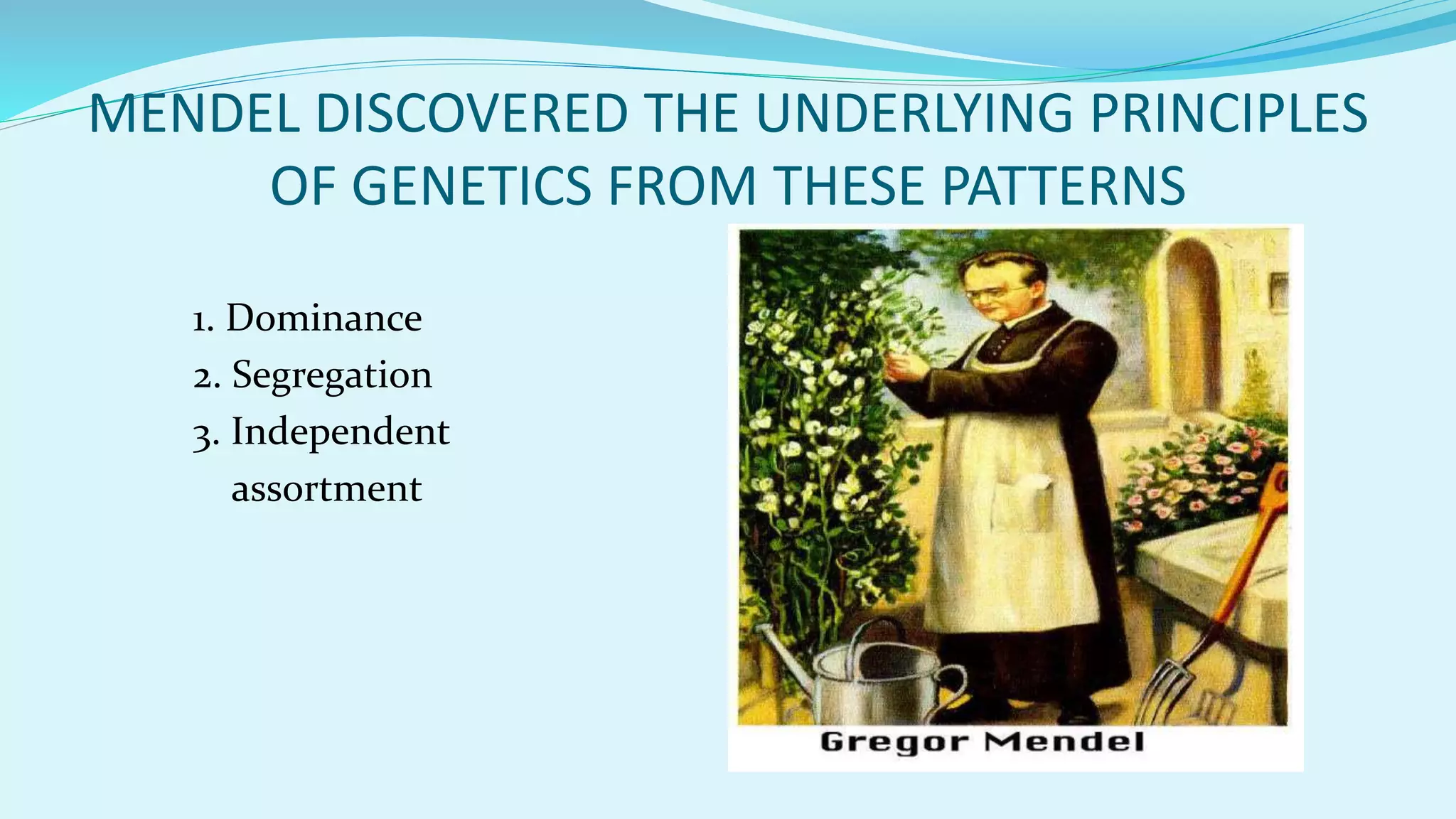
1822 - 1884
Gregor Johan Mendel is the father of
genetics.
Experimented with pea plants
He thought that ‘heritable factors’
(genes) retained their individuality
generation after generation
Principles of genetics were
developed in the mid 19th century
Experimented with pea plants, by
crossing various strains and observed
the characteristics of their Offspring.
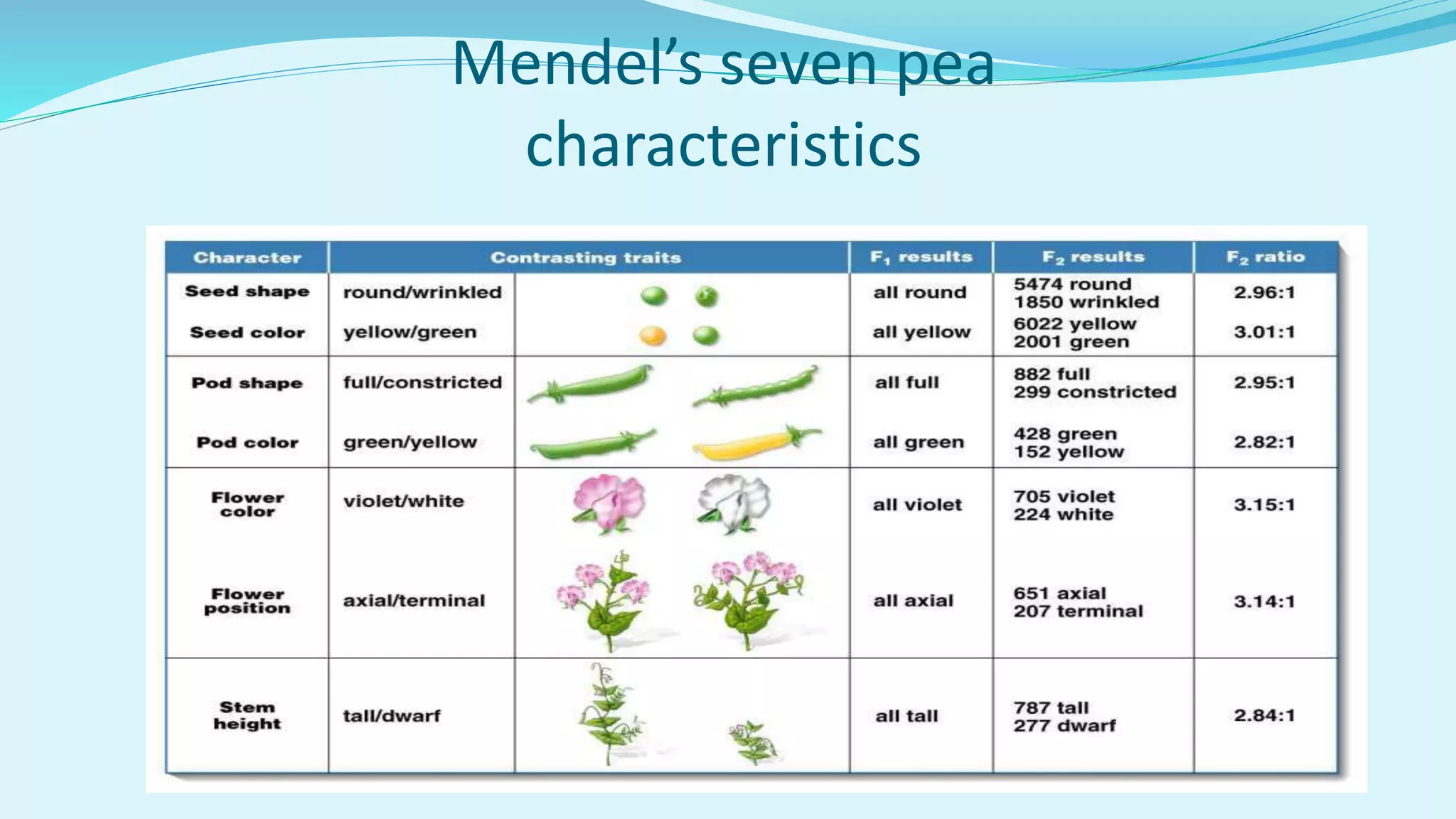
 Mendel studied inheritance of seven traits in pea
plants and first used the term dominance and
recessiveness
 Proposed similar but separate inheritable
characters, one from each parent, later to be
called genes.
INHERITANCE
 Parents and offspring often share same observable traits.
 Mendelian inheritance (or Mendelian genetics or
Mendelism) is the transmission of hereditary
characteristics from parent organisms to their offspring; it
underlies much of genetics.
 They were initially derived from the work of Gregor
Johann Mendel published in 1865 and 1866 which was "re-
discovered" in 1900, by Avery, Macleod and Mc carty .
THE UNITS OF INHERITANCE ARE ALLELES OF GENES
Traits are controlled by alleles – alternate forms of a gene
 Found on homologous chromosomes at a particular gene
locus
The dominant allele masks the expression of the other
allele - the recessive allele
Genotype refers to the alleles an individual receives at
fertilization
 Homozygous - an organism has two identical alleles at a gene
locus
 Heterozygous - an organism has two different alleles at a gene
locus
Phenotype - the physical appearance of the individual.
Mendel’s seven pea
characteristics
MENDEL DISCOVERED THE UNDERLYING PRINCIPLES
OF GENETICS FROM THESE PATTERNS
1. Dominance
2. Segregation
3. Independent
assortment
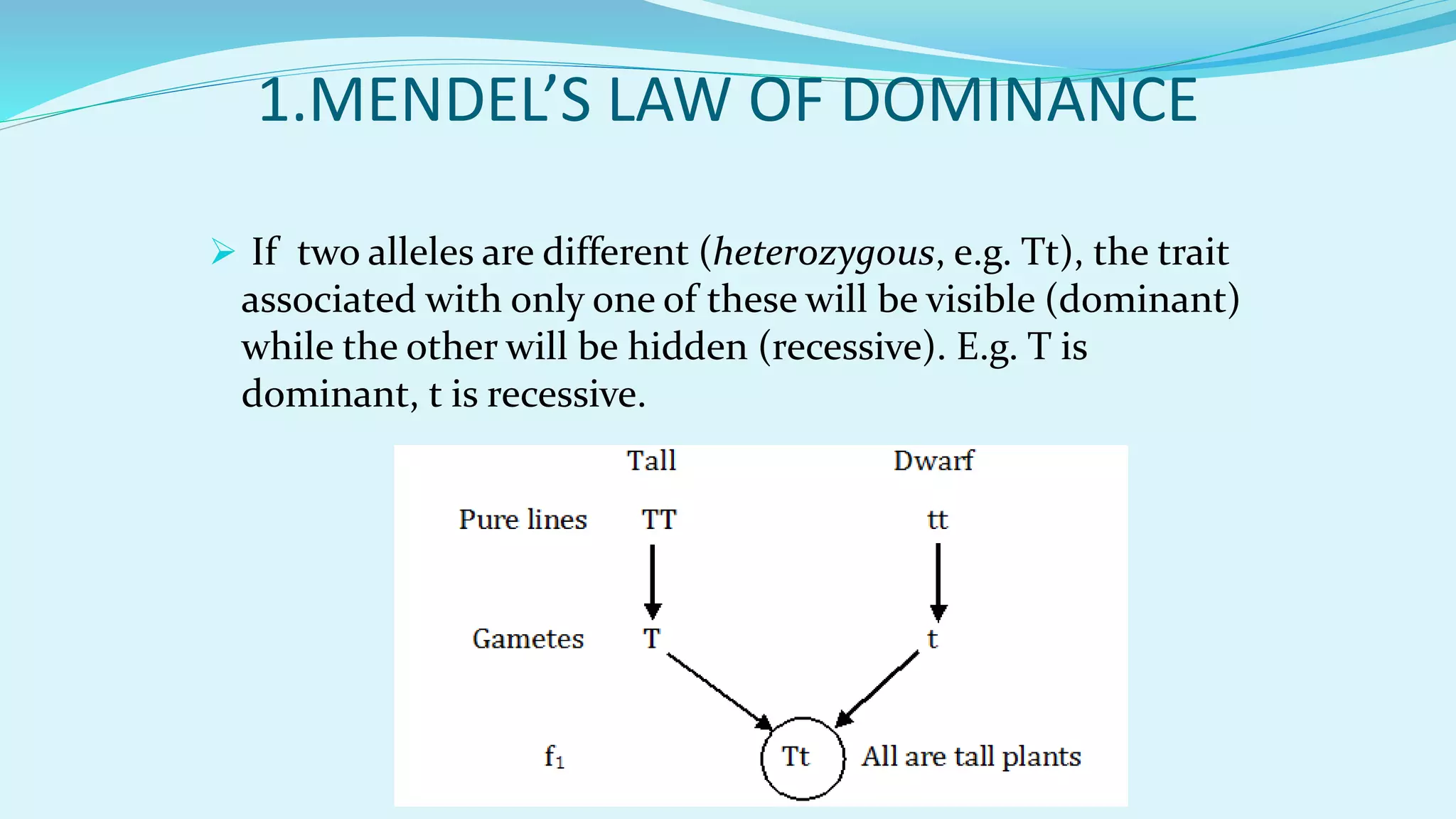
1.MENDEL’S LAW OF DOMINANCE
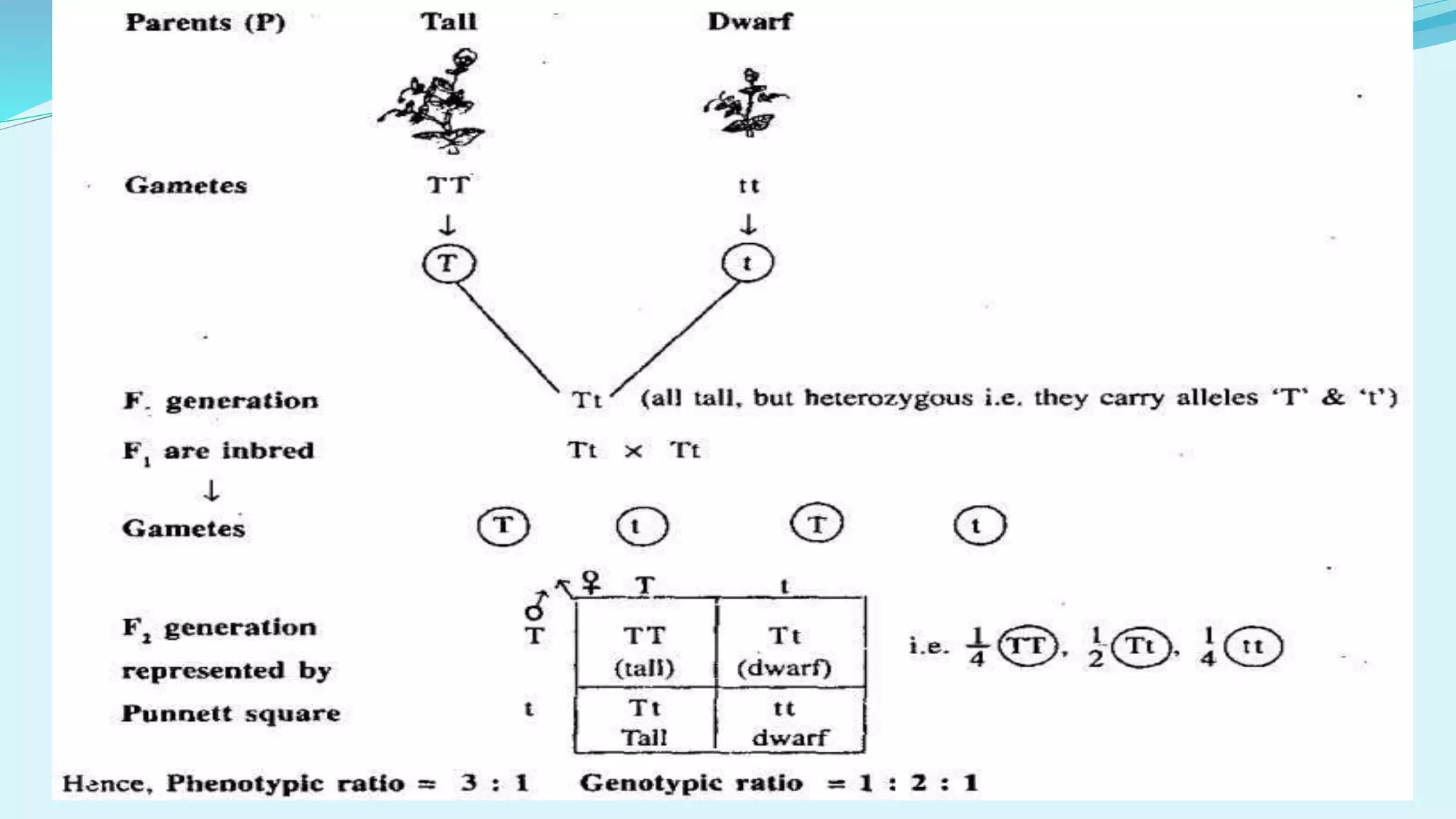
 If two alleles are different (heterozygous, e.g. Tt), the trait
associated with only one of these will be visible (dominant)
while the other will be hidden (recessive). E.g. T is
dominant, t is recessive.
CONTD..
 Law of dominance : In a hybrid union, the allele which
expresses itself phenotypically is the dominant allele while
the other allele which fails to express itself phenotypically is
the recessive allele. The hybrid individual shows phenotype
of the dominant character.
The law of dominance is often described as Mendel’s first
law of inheritance.
2.MENDEL’S LAW OF SEGREGATION
A normal (somatic) cell has two variants (alleles) for a
Mendelian trait.
A gamete (sperm, egg, pollen, ovule) contains one allele,
randomly chosen from the two somatic alleles.
E.g. if you have one allele for brown eyes (B) and one for
blue eyes (b), somatic cells have Bb and each gamete will
carry one of B or b chosen randomly.
Law of segregation – the separation of alleles into
separate gametes.
The law of segregation states:
 Each individual has two factors for each trait
 The factors segregate (separate) during the formation of
the gametes
 Each gamete contains only one factor from each pair of
factors
 Fertilization gives each new individual two factors for each
trait
3.LAW OF INDEPENDENT ASSORTMENT
 "When a dihybrid (or a polyhybrid ) forms gametes,
 (i) each gamete receives one allele from each allelic pair
and
 (ii) the assortment of the alleles of different traits during the
gamete formation is totally independent of their original
combinations in the parents.
 In other words, each allele of any one pair is free to
combine with any allele from each of the remaining
pairs during the formation ofthe gametes
 This is known as the Law of Independent Assortment of
characters.
 It is also referred to as Mendel’s third law of heredity.
Gene Interaction
Introduction
 Defination- The phenomenon of two or more genes affecting the
expression of each other in various ways in the development of a single
character of an organism is known as gene interaction.
 Most of the characters of living organisms are controlled/ influenced/
governed by a collaboration of several different genes.
 Mendel and other workers assumed that characters are governed by
single genes but later it was discovered that many characters are
governed by two or more genes.
 In gene interaction, expression of one gene depends on expression
(presence or absence) of another gene.
Cont….
Such genes affect the development of concerned characters
in various ways; this lead to the modification of the typical
dihybrid ratio (9:3:3:1) or trihybrid (27:9:9:9:3:3:3:1).
In gene interaction, expression of one gene depends on
expression (presence or absence) of another gene.
Types of Gene Interactions
• Gene interactions can be classified as
A. Allelic/ non epistatic gene interaction/ - This type of interaction
gives the classical ratio of 3:1 or 9:3:3:1.
B. Non-allelic/ epistatic gene interaction- In this type of gene
interaction genes located on same or different chromosome interact
with each other for their expression.
Discovery of non allelic gene interaction has been made after Mendel
and can be best understood by studying phenotypic trait of gene.
Epistatic and Hypostatic gene
Epistatic gene When a gene or locus which suppress or mask the
phenotypic expression of another gene at another locus such gene is know
as epistatic gene.
Epistatic is Greek term and meaning is standing up.
Hypostatic gene The gene or locus which was suppressed by a epistatic
gene was called hypostatic gene.
Types of Epistasis Gene Interaction
The types are:
1. Recessive Epistasis or Supplementary gene interaction
2. Dominant Epistasis or Simple epistasis
3. Dominant [Inhibitory] Epistasis or Inhibitory gene interaction
4. Duplicate Recessive Epistasis or Complementary epistasis
5. Duplicate Dominant Epistasis or Duplicate gene interaction
6. Polymeric Gene Action
Recessive Epistasis [9:3:4 Ratio]
 When recessive alleles at one locus mask the expression of both (dominant and
recessive) alleles at another locus, it is known as recessive epistasis.
 This type of gene interaction is also known as supplementary gene
interaction. A good example of such gene interaction is found for grain colour in
maize. There are three colours of grain in maize, viz., purple, red and white.
Purple colour develops in the presence of two dominant genes (R and P),
Red colour in the presence of a dominant gene R, and
White in homozygous recessive condition (rrpp).
A cross between purple (RRPP) and white (rrpp) grain colour strains of
maize produced plants with purple colour in F1.
Inter-mating of these F1 plants produced progeny with purple, red and white
grains in F2 in the ratio of 9 : 3 : 4 (Fig. 8.2).
Here allele r is recessive to R, but epistatic to alleles P and
p.
In F2, all plants with R-P-(9/16) will have purple grains and
those with R-pp genotypes (3/16) have red grain colour.
The epistatic allele r in homozygous condition will produce
plants with white grains from rrP-(3/16) and rrpp (1/16)
genotypes.
Thus the normal segregation ratio of 9:3:3:1 is modified to
9:3:4 in F2 generation. Such type of gene interaction is also
found for colour in mice, bulb colour in onion and for
certain characters in many other organisms.
2.Dominant Epistasis [12 : 3 : 1 Ratio]
When a dominant allele at one locus can mask the expression of both alleles
(dominant and recessive) at another locus, it is known as dominant epistasis.
In other words, the expression of one dominant or recessive allele is masked by
another dominant gene. This is also referred to as simple or epistatic gene
interaction.
An example of dominant epistasis is found for fruit colour in summer squash.
There are three types of fruit colours in this cucumber, viz., white, yellow and green.
 White colour is controlled by dominant gene W
 Yellow colour by dominant gene G
 Green colour by both recessive genes wwgg and
 White is dominant over both yellow and green.
A cross between plants having white and yellow fruits produced F1with white fruits.
Inter-mating of F1 plants produced plants with white, yellow and green coloured fruits in
F2 in 12 : 3 : 1 ratio (Fig. 8.3). This can be explained as follows.
Here, W is dominant to w and epistatic to alleles G and g.
Hence it will mask the expression of G/g alleles.
Therefore, in F2,
 plants with W-G-(9/16) and W-gg (3/16) genotypes will produce
white fruits;
 plants with wwG-(3/16) will produce yellow fruits and
 plant with wwgg (1/16) genotype will produce green fruits.
Thus the normal dihybrid ratio 9:3:3:1 is modified to 12:3:1 ratio in
F2 generation.
3. Dominant [Inhibitory] Epistasis [13:3 Ratio]
In this type of epistasis, a dominant allele at one locus can mask the
expression of both (dominant and recessive) alleles at second locus.
This is also known as inhibitory gene interaction.
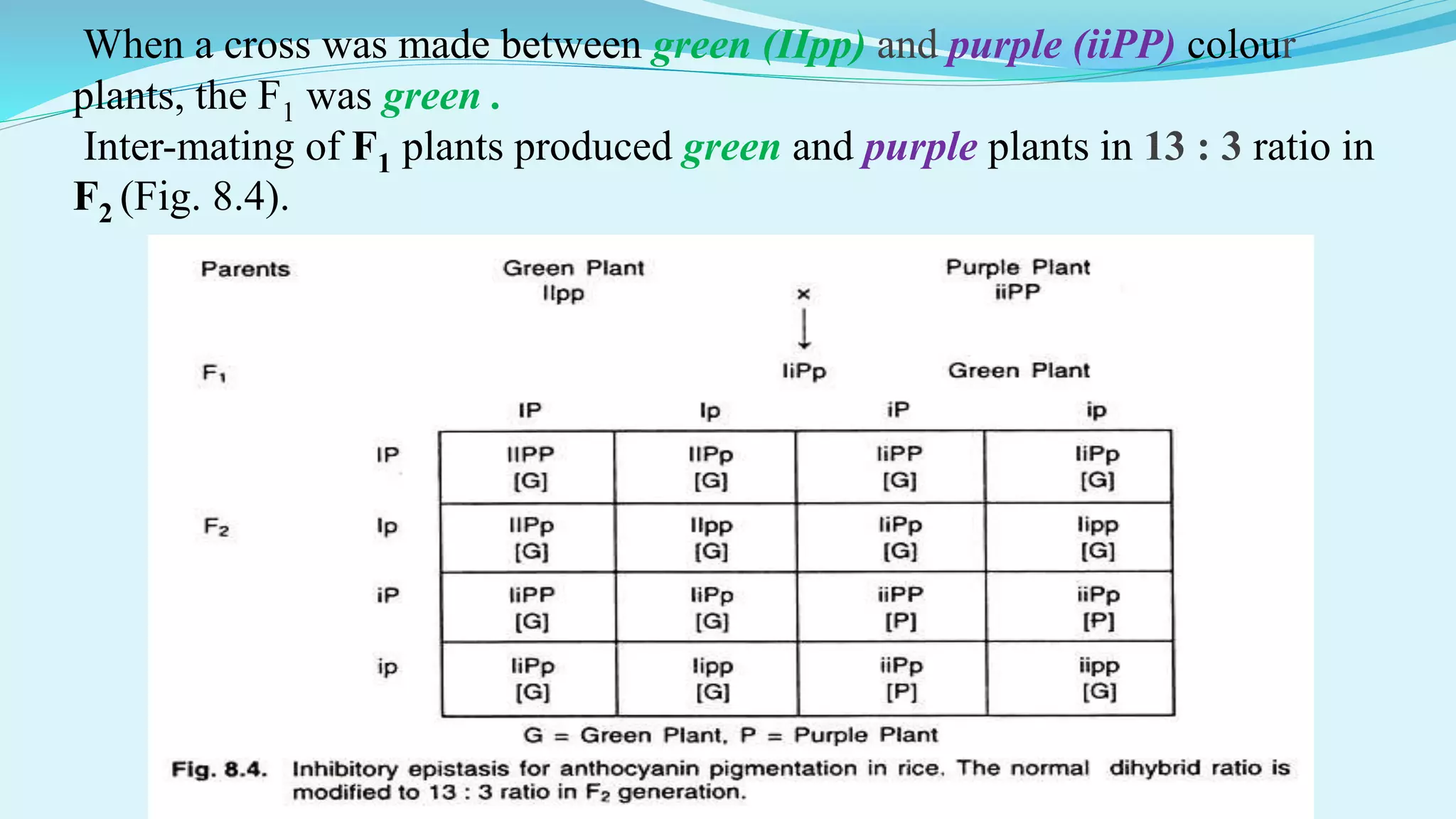
An example of this type of gene interaction is found for anthocyanin
pigmentation in rice.
The green colour of plants is governed by the gene I which is
dominant over purple colour.
The purple colour is controlled by a dominant gene P.
When a cross was made between green (IIpp) and purple (iiPP) colour
plants, the F1 was green .
Inter-mating of F1 plants produced green and purple plants in 13 : 3 ratio in
F2 (Fig. 8.4).
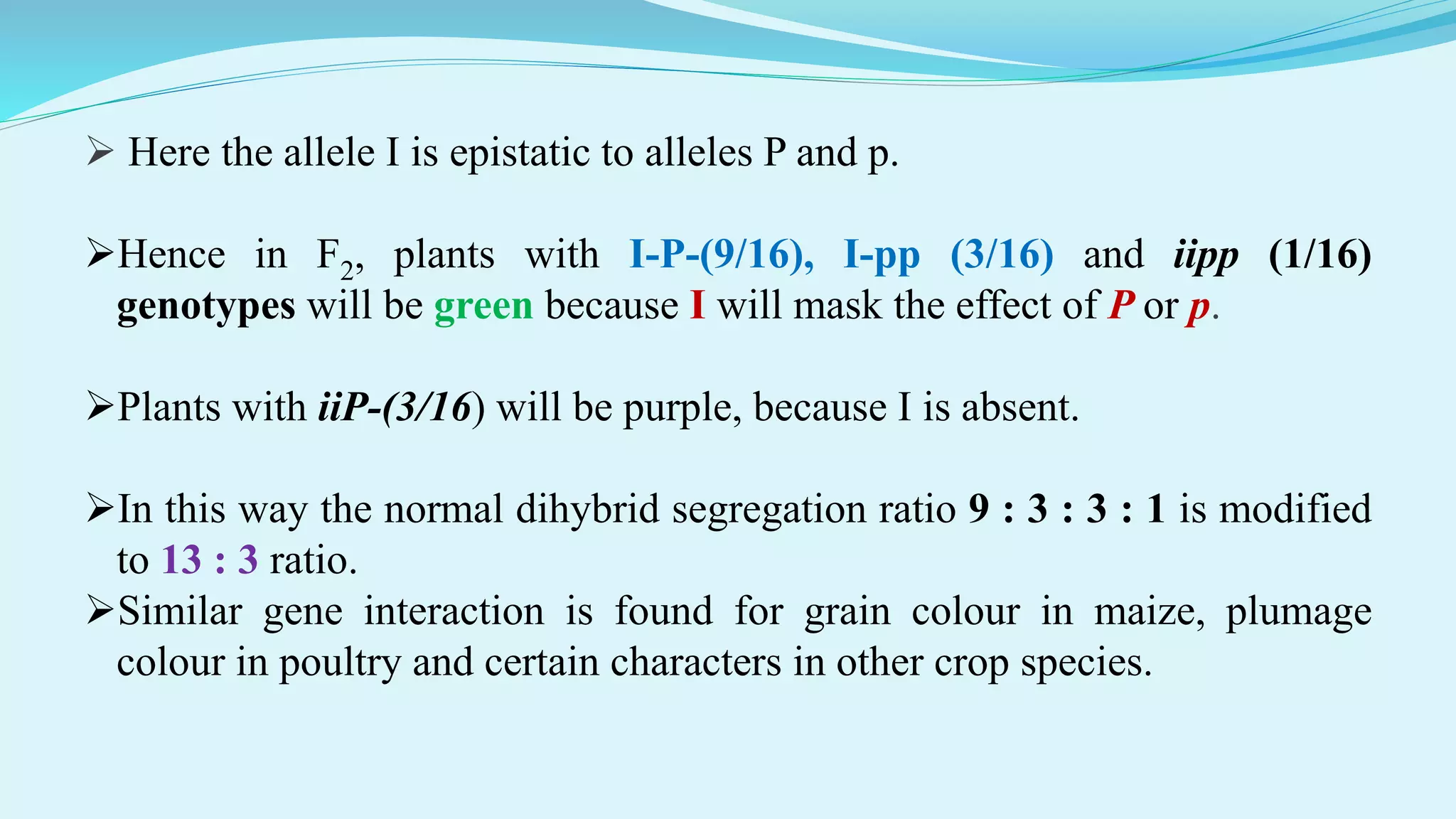
 Here the allele I is epistatic to alleles P and p.
Hence in F2, plants with I-P-(9/16), I-pp (3/16) and iipp (1/16)
genotypes will be green because I will mask the effect of P or p.
Plants with iiP-(3/16) will be purple, because I is absent.
In this way the normal dihybrid segregation ratio 9 : 3 : 3 : 1 is modified
to 13 : 3 ratio.
Similar gene interaction is found for grain colour in maize, plumage
colour in poultry and certain characters in other crop species.
4. Duplicate Recessive Epistasis [9:7]
When recessive alleles at either of the two loci can mask the expression of dominant
alleles at the two loci, it is called duplicate recessive epistasis.
This is also known as complementary gene interaction.
The best example of duplicate recessive epistasis is found for flower colour in sweet
pea.
The purple colour of flower in sweet pea is governed by two dominant genes say A
and B.
When these genes are in separate individuals (AAbb or aaBB) or recessive (aabb)
they produce white flower.
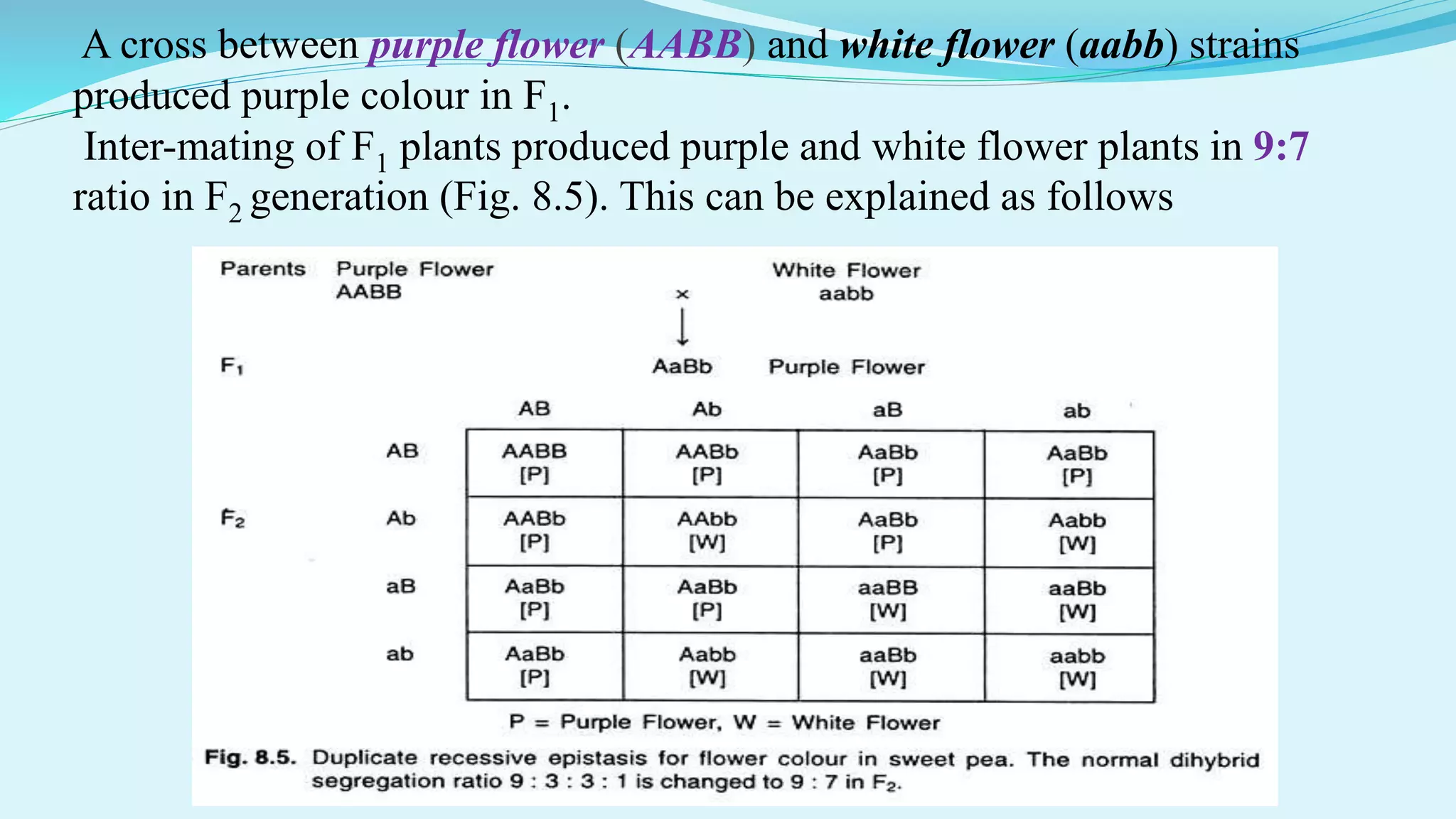
A cross between purple flower (AABB) and white flower (aabb) strains
produced purple colour in F1.
Inter-mating of F1 plants produced purple and white flower plants in 9:7
ratio in F2 generation (Fig. 8.5). This can be explained as follows
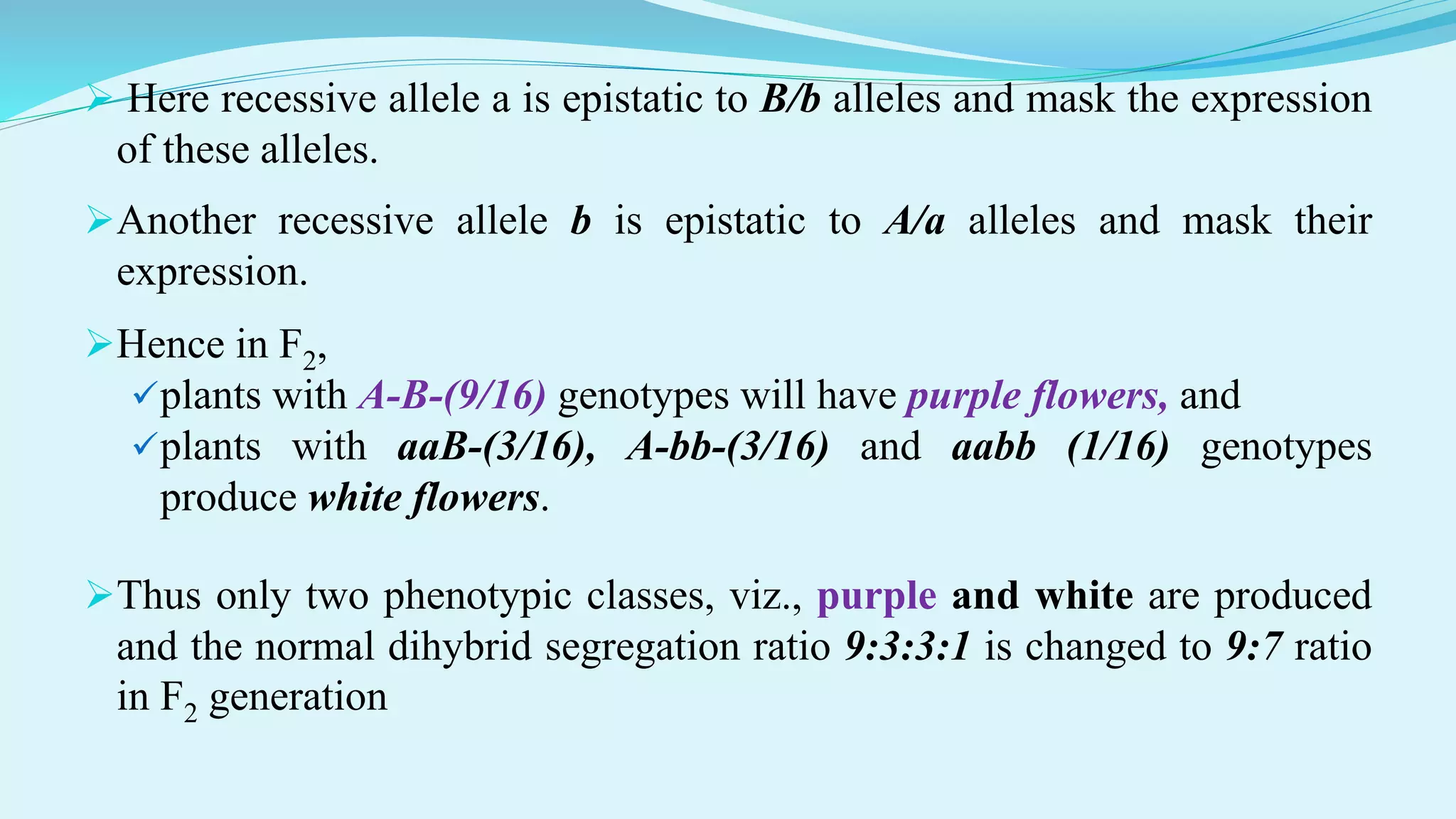
 Here recessive allele a is epistatic to B/b alleles and mask the expression
of these alleles.
Another recessive allele b is epistatic to A/a alleles and mask their
expression.
Hence in F2,
plants with A-B-(9/16) genotypes will have purple flowers, and
plants with aaB-(3/16), A-bb-(3/16) and aabb (1/16) genotypes
produce white flowers.
Thus only two phenotypic classes, viz., purple and white are produced
and the normal dihybrid segregation ratio 9:3:3:1 is changed to 9:7 ratio
in F2 generation
5. Duplicate Dominant Epistasis [15:1 Ratio]
When a dominant allele at either of two loci can mask the expression of
recessive alleles at the two loci, it is known as duplicate dominant epistasis.
This is also called duplicate gene action. A good example of duplicate
dominant epistasis is awn character in rice.
 Development of awn in rice is controlled by two dominant duplicate genes (A
and B).
Presence of any of these two alleles can produce awn.
The awnless condition develops only when both these genes are in
homozygous recessive (aabb).
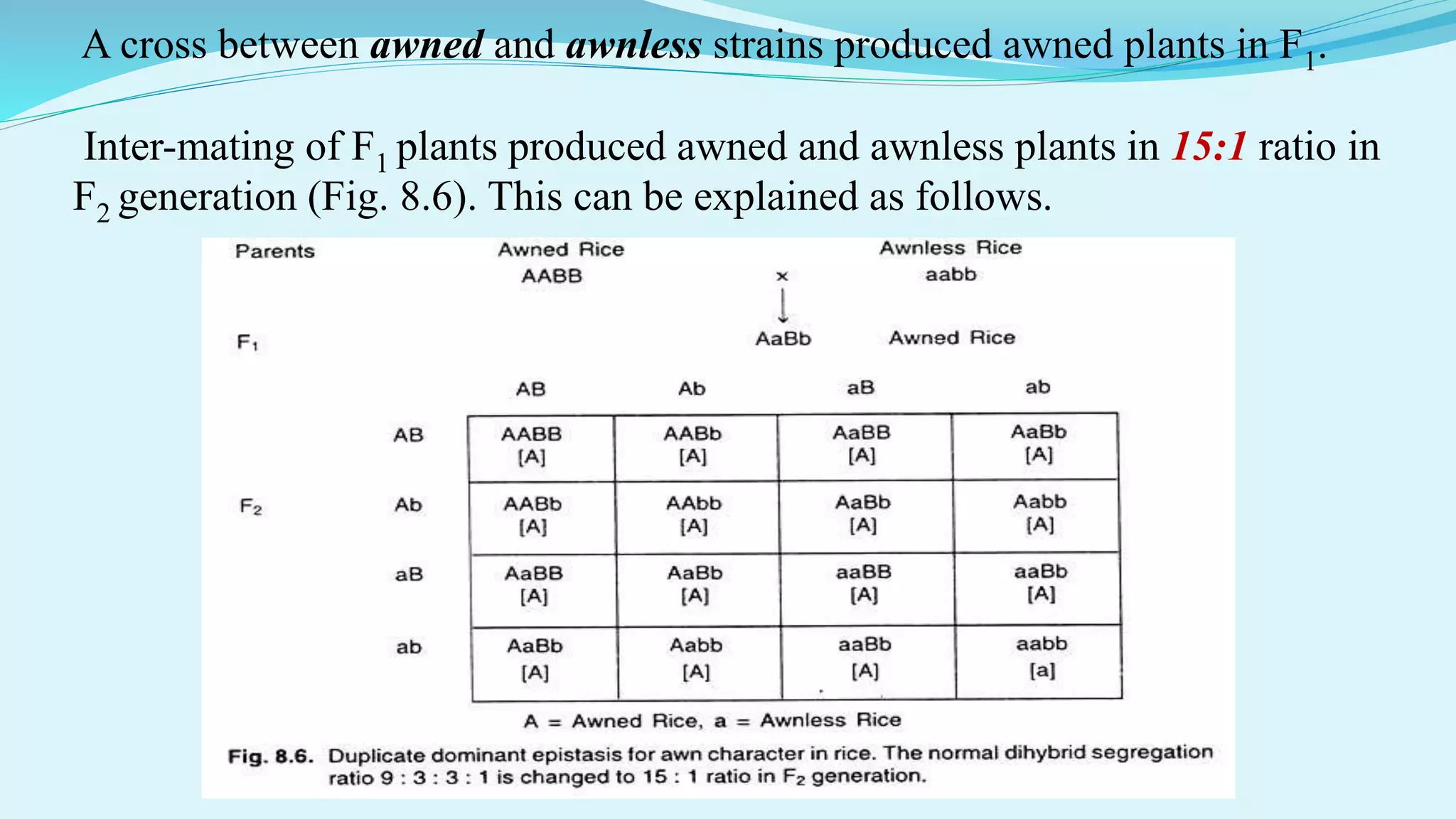
A cross between awned and awnless strains produced awned plants in F1.
Inter-mating of F1 plants produced awned and awnless plants in 15:1 ratio in
F2 generation (Fig. 8.6). This can be explained as follows.
The allele A is epistatic to B/b alleles and all plants having allele A will
develop awn.
Another dominant allele B is epistatic to alleles A/a. Individuals with this allele
also will develop awn character.
Hence in F2,
plants with A-B-(9/16), A-bb-(3/16) and aaB-(3/16) genotypes will develop
awn.
The awnless condition will develop only in double recessive (aabb) genotype
(1/16).
In this way only two classes of plants are developed and the normal dihybrid
segregation ratio 9:3:3:1 is modified to 15:1 ratio in F2.
Similar gene action is found for nodulation in peanut and non-floating
character in rice
6. Polymeric Gene Interaction [9:6:1 Ratio]
Two dominant alleles have similar effect when they are separate, but
produce enhanced effect when they come together. Such gene interaction
is known as polymeric gene interaction.
The joint effect of two alleles appears to be additive or cumulative, but
each of the two genes show complete dominance, hence they cannot be
considered as additive genes.
In case of additive effect, genes show lack of dominance.
A cross between disc shape (AABB) and long shape (aabb) strains
produced disc shape fruits in F1.
Inter-mating of F1 plants produced plants with disc, spherical and long
shape fruits in 9:6:1 ratio in F2 (Fig. 8.7). This can be explained as follow
Here,
• plants with A—B—(9/16) genotypes produce disc shape fruits,
• plant with A-bb-(3/16) and aaB-(3/16) genotypes produce spherical
fruits, and
• plants with aabb (1/16) genotype produce long fruits.
Thus in F2, normal dihybrid segregation ratio 9:3:3:1 is modified to 9:6:1
ratio.
THANK YOU

Chiranjeev Patel

  • 2.
    MASTER SEMINAR o n Presentedby- Chiranjeev M.Sc. (Ag.) Dept. of GPB MENDEL’S LAW , GENE INTERACTIONS AND IT’S IMPORTANCE IN CROP IMPROVEMENT Chairperson Dr. L.K.Gangwar Department of Genetics & Plant Breeding COLLEGE OF AGRICULTURE SARDAR VALLABHBHAI PATEL UNIVERSITY OF AGRICULTURE AND TECHNOLOGY MEERUT - 250110
  • 3.
    INTRODUCTION 1822 - 1884 GregorJohan Mendel is the father of genetics. Experimented with pea plants He thought that ‘heritable factors’ (genes) retained their individuality generation after generation Principles of genetics were developed in the mid 19th century Experimented with pea plants, by crossing various strains and observed the characteristics of their Offspring.
  • 4.
     Mendel studiedinheritance of seven traits in pea plants and first used the term dominance and recessiveness  Proposed similar but separate inheritable characters, one from each parent, later to be called genes.
  • 5.
    INHERITANCE  Parents andoffspring often share same observable traits.  Mendelian inheritance (or Mendelian genetics or Mendelism) is the transmission of hereditary characteristics from parent organisms to their offspring; it underlies much of genetics.  They were initially derived from the work of Gregor Johann Mendel published in 1865 and 1866 which was "re- discovered" in 1900, by Avery, Macleod and Mc carty .
  • 6.
    THE UNITS OFINHERITANCE ARE ALLELES OF GENES Traits are controlled by alleles – alternate forms of a gene  Found on homologous chromosomes at a particular gene locus The dominant allele masks the expression of the other allele - the recessive allele Genotype refers to the alleles an individual receives at fertilization  Homozygous - an organism has two identical alleles at a gene locus  Heterozygous - an organism has two different alleles at a gene locus Phenotype - the physical appearance of the individual.
  • 7.
  • 8.
    MENDEL DISCOVERED THEUNDERLYING PRINCIPLES OF GENETICS FROM THESE PATTERNS 1. Dominance 2. Segregation 3. Independent assortment
  • 9.
    1.MENDEL’S LAW OFDOMINANCE  If two alleles are different (heterozygous, e.g. Tt), the trait associated with only one of these will be visible (dominant) while the other will be hidden (recessive). E.g. T is dominant, t is recessive.
  • 10.
    CONTD..  Law ofdominance : In a hybrid union, the allele which expresses itself phenotypically is the dominant allele while the other allele which fails to express itself phenotypically is the recessive allele. The hybrid individual shows phenotype of the dominant character. The law of dominance is often described as Mendel’s first law of inheritance.
  • 11.
    2.MENDEL’S LAW OFSEGREGATION A normal (somatic) cell has two variants (alleles) for a Mendelian trait. A gamete (sperm, egg, pollen, ovule) contains one allele, randomly chosen from the two somatic alleles. E.g. if you have one allele for brown eyes (B) and one for blue eyes (b), somatic cells have Bb and each gamete will carry one of B or b chosen randomly. Law of segregation – the separation of alleles into separate gametes.
  • 12.
    The law ofsegregation states:  Each individual has two factors for each trait  The factors segregate (separate) during the formation of the gametes  Each gamete contains only one factor from each pair of factors  Fertilization gives each new individual two factors for each trait
  • 14.
    3.LAW OF INDEPENDENTASSORTMENT  "When a dihybrid (or a polyhybrid ) forms gametes,  (i) each gamete receives one allele from each allelic pair and  (ii) the assortment of the alleles of different traits during the gamete formation is totally independent of their original combinations in the parents.  In other words, each allele of any one pair is free to combine with any allele from each of the remaining pairs during the formation ofthe gametes  This is known as the Law of Independent Assortment of characters.  It is also referred to as Mendel’s third law of heredity.
  • 16.
  • 17.
    Introduction  Defination- Thephenomenon of two or more genes affecting the expression of each other in various ways in the development of a single character of an organism is known as gene interaction.  Most of the characters of living organisms are controlled/ influenced/ governed by a collaboration of several different genes.  Mendel and other workers assumed that characters are governed by single genes but later it was discovered that many characters are governed by two or more genes.  In gene interaction, expression of one gene depends on expression (presence or absence) of another gene.
  • 18.
    Cont…. Such genes affectthe development of concerned characters in various ways; this lead to the modification of the typical dihybrid ratio (9:3:3:1) or trihybrid (27:9:9:9:3:3:3:1). In gene interaction, expression of one gene depends on expression (presence or absence) of another gene.
  • 19.
    Types of GeneInteractions • Gene interactions can be classified as A. Allelic/ non epistatic gene interaction/ - This type of interaction gives the classical ratio of 3:1 or 9:3:3:1. B. Non-allelic/ epistatic gene interaction- In this type of gene interaction genes located on same or different chromosome interact with each other for their expression. Discovery of non allelic gene interaction has been made after Mendel and can be best understood by studying phenotypic trait of gene.
  • 20.
    Epistatic and Hypostaticgene Epistatic gene When a gene or locus which suppress or mask the phenotypic expression of another gene at another locus such gene is know as epistatic gene. Epistatic is Greek term and meaning is standing up. Hypostatic gene The gene or locus which was suppressed by a epistatic gene was called hypostatic gene.
  • 21.
    Types of EpistasisGene Interaction The types are: 1. Recessive Epistasis or Supplementary gene interaction 2. Dominant Epistasis or Simple epistasis 3. Dominant [Inhibitory] Epistasis or Inhibitory gene interaction 4. Duplicate Recessive Epistasis or Complementary epistasis 5. Duplicate Dominant Epistasis or Duplicate gene interaction 6. Polymeric Gene Action
  • 22.
    Recessive Epistasis [9:3:4Ratio]  When recessive alleles at one locus mask the expression of both (dominant and recessive) alleles at another locus, it is known as recessive epistasis.  This type of gene interaction is also known as supplementary gene interaction. A good example of such gene interaction is found for grain colour in maize. There are three colours of grain in maize, viz., purple, red and white. Purple colour develops in the presence of two dominant genes (R and P), Red colour in the presence of a dominant gene R, and White in homozygous recessive condition (rrpp).
  • 23.
    A cross betweenpurple (RRPP) and white (rrpp) grain colour strains of maize produced plants with purple colour in F1. Inter-mating of these F1 plants produced progeny with purple, red and white grains in F2 in the ratio of 9 : 3 : 4 (Fig. 8.2).
  • 24.
    Here allele ris recessive to R, but epistatic to alleles P and p. In F2, all plants with R-P-(9/16) will have purple grains and those with R-pp genotypes (3/16) have red grain colour. The epistatic allele r in homozygous condition will produce plants with white grains from rrP-(3/16) and rrpp (1/16) genotypes. Thus the normal segregation ratio of 9:3:3:1 is modified to 9:3:4 in F2 generation. Such type of gene interaction is also found for colour in mice, bulb colour in onion and for certain characters in many other organisms.
  • 25.
    2.Dominant Epistasis [12: 3 : 1 Ratio] When a dominant allele at one locus can mask the expression of both alleles (dominant and recessive) at another locus, it is known as dominant epistasis. In other words, the expression of one dominant or recessive allele is masked by another dominant gene. This is also referred to as simple or epistatic gene interaction. An example of dominant epistasis is found for fruit colour in summer squash. There are three types of fruit colours in this cucumber, viz., white, yellow and green.  White colour is controlled by dominant gene W  Yellow colour by dominant gene G  Green colour by both recessive genes wwgg and  White is dominant over both yellow and green.
  • 26.
    A cross betweenplants having white and yellow fruits produced F1with white fruits. Inter-mating of F1 plants produced plants with white, yellow and green coloured fruits in F2 in 12 : 3 : 1 ratio (Fig. 8.3). This can be explained as follows.
  • 27.
    Here, W isdominant to w and epistatic to alleles G and g. Hence it will mask the expression of G/g alleles. Therefore, in F2,  plants with W-G-(9/16) and W-gg (3/16) genotypes will produce white fruits;  plants with wwG-(3/16) will produce yellow fruits and  plant with wwgg (1/16) genotype will produce green fruits. Thus the normal dihybrid ratio 9:3:3:1 is modified to 12:3:1 ratio in F2 generation.
  • 28.
    3. Dominant [Inhibitory]Epistasis [13:3 Ratio] In this type of epistasis, a dominant allele at one locus can mask the expression of both (dominant and recessive) alleles at second locus. This is also known as inhibitory gene interaction. An example of this type of gene interaction is found for anthocyanin pigmentation in rice. The green colour of plants is governed by the gene I which is dominant over purple colour. The purple colour is controlled by a dominant gene P.
  • 29.
    When a crosswas made between green (IIpp) and purple (iiPP) colour plants, the F1 was green . Inter-mating of F1 plants produced green and purple plants in 13 : 3 ratio in F2 (Fig. 8.4).
  • 30.
     Here theallele I is epistatic to alleles P and p. Hence in F2, plants with I-P-(9/16), I-pp (3/16) and iipp (1/16) genotypes will be green because I will mask the effect of P or p. Plants with iiP-(3/16) will be purple, because I is absent. In this way the normal dihybrid segregation ratio 9 : 3 : 3 : 1 is modified to 13 : 3 ratio. Similar gene interaction is found for grain colour in maize, plumage colour in poultry and certain characters in other crop species.
  • 31.
    4. Duplicate RecessiveEpistasis [9:7] When recessive alleles at either of the two loci can mask the expression of dominant alleles at the two loci, it is called duplicate recessive epistasis. This is also known as complementary gene interaction. The best example of duplicate recessive epistasis is found for flower colour in sweet pea. The purple colour of flower in sweet pea is governed by two dominant genes say A and B. When these genes are in separate individuals (AAbb or aaBB) or recessive (aabb) they produce white flower.
  • 32.
    A cross betweenpurple flower (AABB) and white flower (aabb) strains produced purple colour in F1. Inter-mating of F1 plants produced purple and white flower plants in 9:7 ratio in F2 generation (Fig. 8.5). This can be explained as follows
  • 33.
     Here recessiveallele a is epistatic to B/b alleles and mask the expression of these alleles. Another recessive allele b is epistatic to A/a alleles and mask their expression. Hence in F2, plants with A-B-(9/16) genotypes will have purple flowers, and plants with aaB-(3/16), A-bb-(3/16) and aabb (1/16) genotypes produce white flowers. Thus only two phenotypic classes, viz., purple and white are produced and the normal dihybrid segregation ratio 9:3:3:1 is changed to 9:7 ratio in F2 generation
  • 34.
    5. Duplicate DominantEpistasis [15:1 Ratio] When a dominant allele at either of two loci can mask the expression of recessive alleles at the two loci, it is known as duplicate dominant epistasis. This is also called duplicate gene action. A good example of duplicate dominant epistasis is awn character in rice.  Development of awn in rice is controlled by two dominant duplicate genes (A and B). Presence of any of these two alleles can produce awn. The awnless condition develops only when both these genes are in homozygous recessive (aabb).
  • 35.
    A cross betweenawned and awnless strains produced awned plants in F1. Inter-mating of F1 plants produced awned and awnless plants in 15:1 ratio in F2 generation (Fig. 8.6). This can be explained as follows.
  • 36.
    The allele Ais epistatic to B/b alleles and all plants having allele A will develop awn. Another dominant allele B is epistatic to alleles A/a. Individuals with this allele also will develop awn character. Hence in F2, plants with A-B-(9/16), A-bb-(3/16) and aaB-(3/16) genotypes will develop awn. The awnless condition will develop only in double recessive (aabb) genotype (1/16). In this way only two classes of plants are developed and the normal dihybrid segregation ratio 9:3:3:1 is modified to 15:1 ratio in F2. Similar gene action is found for nodulation in peanut and non-floating character in rice
  • 37.
    6. Polymeric GeneInteraction [9:6:1 Ratio] Two dominant alleles have similar effect when they are separate, but produce enhanced effect when they come together. Such gene interaction is known as polymeric gene interaction. The joint effect of two alleles appears to be additive or cumulative, but each of the two genes show complete dominance, hence they cannot be considered as additive genes. In case of additive effect, genes show lack of dominance.
  • 38.
    A cross betweendisc shape (AABB) and long shape (aabb) strains produced disc shape fruits in F1. Inter-mating of F1 plants produced plants with disc, spherical and long shape fruits in 9:6:1 ratio in F2 (Fig. 8.7). This can be explained as follow
  • 39.
    Here, • plants withA—B—(9/16) genotypes produce disc shape fruits, • plant with A-bb-(3/16) and aaB-(3/16) genotypes produce spherical fruits, and • plants with aabb (1/16) genotype produce long fruits. Thus in F2, normal dihybrid segregation ratio 9:3:3:1 is modified to 9:6:1 ratio.
  • 40.