NON-
MENDELLIAN
PATTERNS OF
INHERITANCE
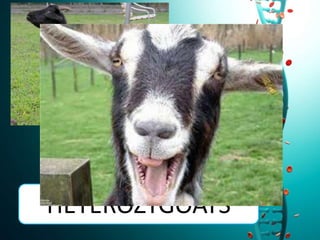
HETEROZYGOATS
According to Mendel’s
law, phenotypical
characteristics are
determined by pairs of
factors (alleles) that
separate independently
in gametes.
Lack of Dominance
A genetic condition in
which the heterozygous
individual has a different
phenotype from the
homozygous individual.
Multiple Alleles
The phenomenon in
which the same gene has
more than two different
alleles
Pleiotropy
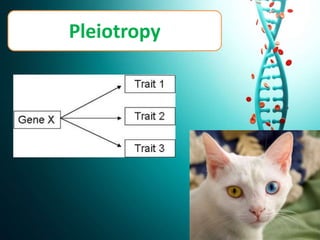
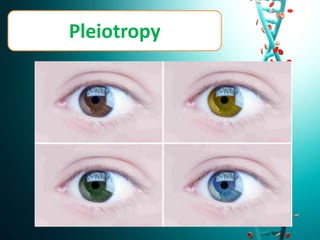
Pleiotropy (or pliotropy)
is the phenomenon in which
a single gene conditions
several different phenotypical
traits.
Pleiotropy
Pleiotropy
Lethal Genes
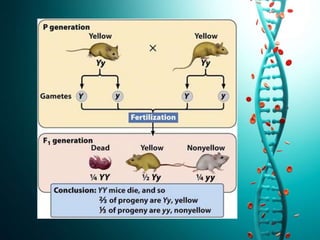
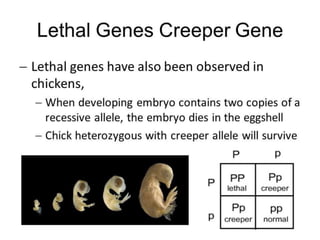
Lethal genes are genes
with at least one allele that,
when present in the
genotype of an individual,
cause death.
Sex-linked Inheritance
A type of non-Mendelian
inheritance because it opposes
Mendel’s first law, which
postulates that each trait is
always conditioned by two
factors (alleles).
Sex-linked Inheritance
Sex-linked traits are
genetic characteristics
determined by genes, which
are located on sex
chromosomes.
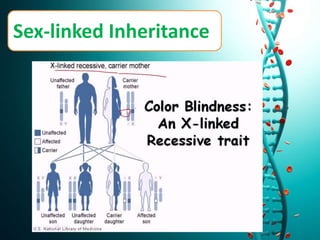
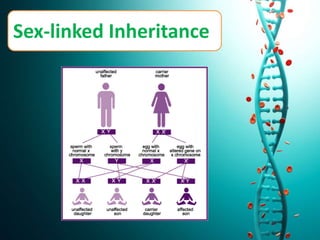
Sex-linked Inheritance
Gene Interactions
Gene interactions are the
phenomenon in which a
given phenotypic trait is
conditioned by two or more
genes
Gene Interactions
The three main types of gene
interaction are: complementary
genes, epistasis and polygenic
inheritance (or quantitative
inheritance).
Complementary Genes
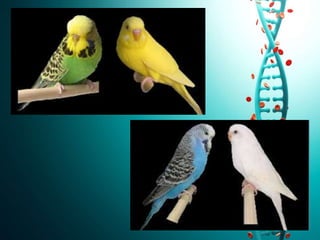
Complementary genes
are different genes that act
together to determine a
given phenotypic trait.
Epistasis
Gene interaction in
which a gene (the epistatic
gene) can disallow the
phenotypical manifestation
of another gene (the
hypostatic gene).
Epistasis
In dominant epistasis, the
inhibitor allele is the dominant allele
(for example, I) of the epistatic gene
and, as result, inhibition occurs in
dominant homozygosity (II) or in
heterozygosity (Ii).
Epistasis
In recessive epistasis, the
inhibitor allele is the recessive allele
of the epistatic gene (i) and, as a
result, inhibition occurs only in
recessive homozygosity (ii).
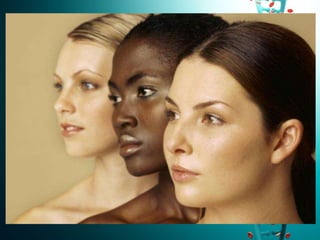
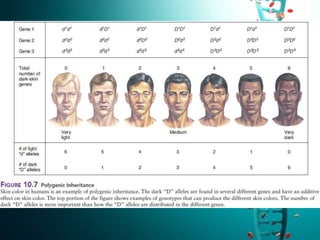
Polygenic Inheritance
Gene interaction in which a given
trait is conditioned by several different
genes with alleles that may or may not
contribute to increasing the intensity
of the phenotype.
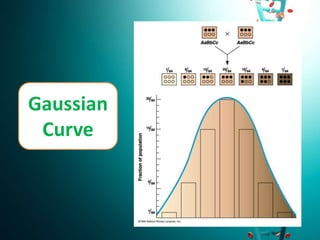
Gaussian
Curve
Pedigree Analysis
Hemophilia is a recessive, sex-linked
disorder which causes an inability to clot
when bleeding. Ray and Elaine Smith
were married in 1970. Neither Ray nor
Elaine had hemophilia. They had two
daughters and then a son. Both
daughters, Alicia and Candace, had
normal clotting abilities and never had
any children of their own.
Pedigree Analysis
The son, Mike, had hemophilia and
married Beth, who did not. They had two
children of their own, first Gregory and
then Victoria. Surprisingly, Victoria had
hemophilia but Gregory did not. Draw
the pedigree that traces hemophilia in
the Smith family, shade in the
circles/squares of the individuals with
the blood disorder.
Pedigree Analysis
a.) Why is it surprising that Victoria had
hemophilia but Gregory did not?
b.) If Victoria has children, what do you
automatically know about her…
Daughters? Sons?
Very Short Quiz! 
Briefly explain the following terms:
1. Incomplete Dominance
2. Codominance
3. Lethal Genes
4. Gene Interaction
5. Pedigree Analysis

Non-Mendellian genetics