ALLELIC GENE
INTERACTION
GENE INTERACTION
• Gene interaction is the influence
of allelic or non-allelic genes on normal
phenotypic expression of the trait.
• In other words, cases where
two genes of the same allelic pair
or genes of two or more
different allelic pairs influence one
another is called gene interaction.
TYPES OF GENE INTERACTION
2 Types
• Inter-allelic or allelic or non-epistatic gene
interaction (Intragenic interaction) – This gives
the classical ratio of 3:1 or 9:3:3:1
• Intra-allelic or non-allelic or epistatic gene
interaction (Intergenic interaction) -- Here,
genes located on same or different chromosomes
interact with each other for their expression
Inter-allelic or allelic gene interaction
(Intragenic interaction)
• Two alleles present on the same gene locus
on the two homologous chromosome of a
gene interact together for phenotypic
expression
• This interaction modifies the Mendelian
monohybrid, phenotypic F ratio i:e 3:1 to
1:2:1.
• The examples of this interaction are:
• Incomplete dominance
• Co-dominance and
• Multiple alleles
ALLELES
• Alleles are alternative forms of a gene,
• Responsible for differences in phenotypic
expression of a given trait (e.g., brown eyes
versus green eyes).
• A gene for which at least two alleles exist is
said to be polymorphic.
• Instances in which a particular gene may exist
in three or more allelic forms are known as
multiple allele conditions
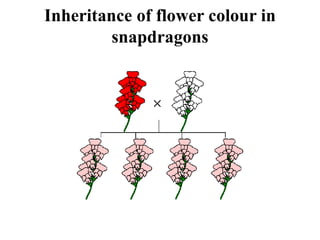
Incomplete dominance
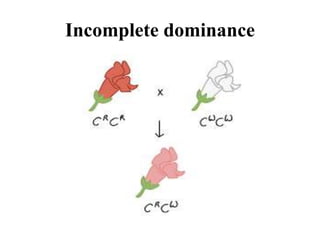
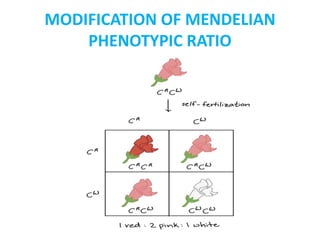
• A condition when neither allele is completely
dominant over the other
• Therefore, results in a new phenotype.
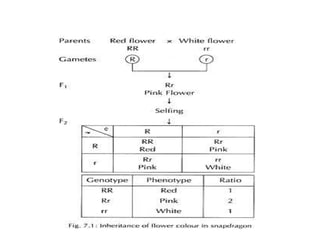
• It is recognized by the heterozygotes expressing
an intermediate phenotype relative to the
parental phenotypes.
• It helps to account for some of the variations that
make nature so amazing and that make people
and animals unique.
Inheritance of flower colour in
snapdragons
Incomplete dominance
MODIFICATION OF MENDELIAN
PHENOTYPIC RATIO
More Examples of Incomplete
dominance
• If a red tulip and a white tulip are cross
pollinated the result is a pink tulip
• An Andalusian fowl produced from a black and
a white parent is blue.
• A black sheep and a white sheep mate and have
a grey sheep.
• Sickle cell disease is the result of incomplete
dominance as those who carry the disease have
50% normal and 50% abnormal haemoglobin.
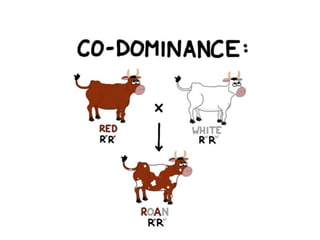
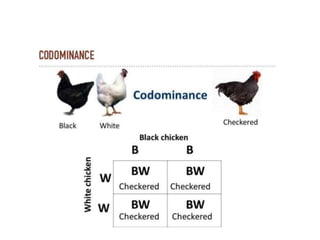
Codominance
• Occurs when rather than expressing an
intermediate phenotype, the heterozygotes
express both homozygous phenotypes.
• An example is in human ABO blood types
• Since neither A nor B is dominant over the other
and they are both dominant over O they are said
to be codominant.
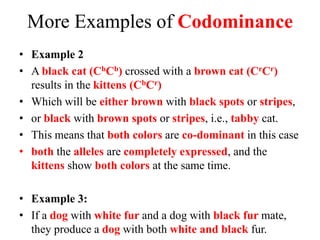
More Examples of Codominance
• Example 2
• A black cat (CbCb) crossed with a brown cat (CrCr)
results in the kittens (CbCr)
• Which will be either brown with black spots or stripes,
• or black with brown spots or stripes, i.e., tabby cat.
• This means that both colors are co-dominant in this case
• both the alleles are completely expressed, and the
kittens show both colors at the same time.
• Example 3:
• If a dog with white fur and a dog with black fur mate,
they produce a dog with both white and black fur.
LETHAL GENES
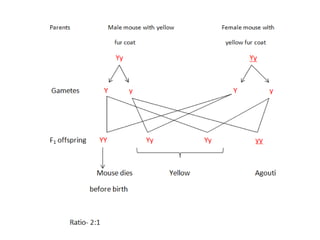
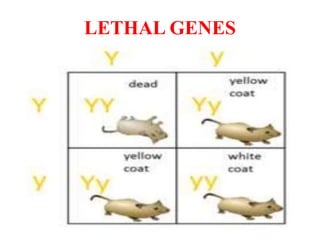
• Lethal alleles (also referred to as lethal
genes or lethals) are alleles that cause the
death of the organism that carries them.
• They are usually a result of mutations
in genes that are essential for growth or
development.
• first discovered by Lucien Cuénot while
studying the inheritance of coat colour gene in
mice.
LETHAL GENES
LETHAL GENES
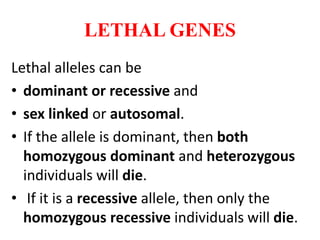
Lethal alleles can be
• dominant or recessive and
• sex linked or autosomal.
• If the allele is dominant, then both
homozygous dominant and heterozygous
individuals will die.
• If it is a recessive allele, then only the
homozygous recessive individuals will die.
LETHAL GENES
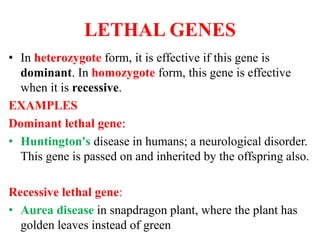
• In heterozygote form, it is effective if this gene is
dominant. In homozygote form, this gene is effective
when it is recessive.
EXAMPLES
Dominant lethal gene:
• Huntington's disease in humans; a neurological disorder.
This gene is passed on and inherited by the offspring also.
Recessive lethal gene:
• Aurea disease in snapdragon plant, where the plant has
golden leaves instead of green
Other examples of Lethal genes
• In humans is achondroplasia, a genetic
condition which causes dwarfism. Affected
individuals are all heterozygotes, as the
accumulation of two mutant alleles is lethal
and results in the ovum not forming.
• In cats, is the Manx cat. Manx cats, if
homozygotic, will not survive. Heterozygotic
Manx cats have characteristically short tails.
MULTIPLE ALLELES
• Many genes have more than two alleles
• Even though any one diploid individual can
only have at most two alleles for any gene.
• Multiple alleles result from different mutations
of the same gene.
ABO BLOOD GROUPS IN HUMANS
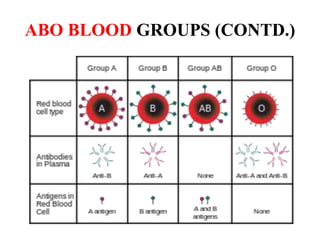
• Determined by 3 alleles A, B, and O.
• Represented by IA, IB and i alleles respectively
• Where "I" which stands for “immunoglobin”.
• A and B are codominants which are both dominant over
O.
• Any individual has one of six possible genotypes:
AA, AO, BB, BO, AB, and OO.
• These produce one of four possible phenotypes: Type A,
Type B, Type AB and Type O.
ABO BLOOD GROUPS (CONTD.)
• The only possible genotype for a type O person
is OO.
• Type A people have either AA or AO genotypes.
• Type B people have either BB or BO genotypes.
• Type AB have only the AB (heterozygous)
genotype.
ABO BLOOD GROUPS (CONTD.)
IMPORTANCE OF ABO BLOOD
GROUP
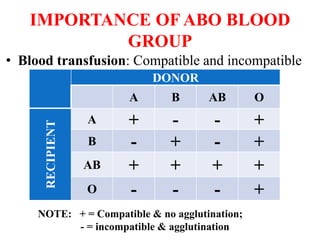
• Blood transfusion: Compatible and incompatible
DONOR
A B AB O
RECIPIENT
A + - - +
B - + - +
AB + + + +
O - - - +
NOTE: + = Compatible & no agglutination;
- = incompatible & agglutination
IMPORTANCE (Contd.)
• Paternity dispute resolution e.g., a type AB
man cannot be the father of a type O infant
• Forensic science e.g.in crime detection
N.B: Both forensic science and impossibility
of paternity are now being replaced by
genetic fingerprinting, which provides
greater certainty.
MORE EXAMPLES OF MULTIPLE
ALLELES
• Coat colour in rabbits determined by four
alleles.
• Eye colour influenced by more than one gene,
including OCA2 and HERC2.
THANKS FOR
YOUR
ATTENTION AND
GOD BLESS

Allelic Gene Interaction.pptx

  • 1.
  • 2.
    GENE INTERACTION • Geneinteraction is the influence of allelic or non-allelic genes on normal phenotypic expression of the trait. • In other words, cases where two genes of the same allelic pair or genes of two or more different allelic pairs influence one another is called gene interaction.
  • 3.
    TYPES OF GENEINTERACTION 2 Types • Inter-allelic or allelic or non-epistatic gene interaction (Intragenic interaction) – This gives the classical ratio of 3:1 or 9:3:3:1 • Intra-allelic or non-allelic or epistatic gene interaction (Intergenic interaction) -- Here, genes located on same or different chromosomes interact with each other for their expression
  • 4.
    Inter-allelic or allelicgene interaction (Intragenic interaction) • Two alleles present on the same gene locus on the two homologous chromosome of a gene interact together for phenotypic expression • This interaction modifies the Mendelian monohybrid, phenotypic F ratio i:e 3:1 to 1:2:1. • The examples of this interaction are: • Incomplete dominance • Co-dominance and • Multiple alleles
  • 5.
    ALLELES • Alleles arealternative forms of a gene, • Responsible for differences in phenotypic expression of a given trait (e.g., brown eyes versus green eyes). • A gene for which at least two alleles exist is said to be polymorphic. • Instances in which a particular gene may exist in three or more allelic forms are known as multiple allele conditions
  • 6.
    Incomplete dominance • Acondition when neither allele is completely dominant over the other • Therefore, results in a new phenotype. • It is recognized by the heterozygotes expressing an intermediate phenotype relative to the parental phenotypes. • It helps to account for some of the variations that make nature so amazing and that make people and animals unique.
  • 7.
    Inheritance of flowercolour in snapdragons
  • 8.
  • 9.
  • 11.
    More Examples ofIncomplete dominance • If a red tulip and a white tulip are cross pollinated the result is a pink tulip • An Andalusian fowl produced from a black and a white parent is blue. • A black sheep and a white sheep mate and have a grey sheep. • Sickle cell disease is the result of incomplete dominance as those who carry the disease have 50% normal and 50% abnormal haemoglobin.
  • 12.
    Codominance • Occurs whenrather than expressing an intermediate phenotype, the heterozygotes express both homozygous phenotypes. • An example is in human ABO blood types • Since neither A nor B is dominant over the other and they are both dominant over O they are said to be codominant.
  • 15.
    More Examples ofCodominance • Example 2 • A black cat (CbCb) crossed with a brown cat (CrCr) results in the kittens (CbCr) • Which will be either brown with black spots or stripes, • or black with brown spots or stripes, i.e., tabby cat. • This means that both colors are co-dominant in this case • both the alleles are completely expressed, and the kittens show both colors at the same time. • Example 3: • If a dog with white fur and a dog with black fur mate, they produce a dog with both white and black fur.
  • 16.
    LETHAL GENES • Lethalalleles (also referred to as lethal genes or lethals) are alleles that cause the death of the organism that carries them. • They are usually a result of mutations in genes that are essential for growth or development. • first discovered by Lucien Cuénot while studying the inheritance of coat colour gene in mice.
  • 18.
  • 19.
    LETHAL GENES Lethal allelescan be • dominant or recessive and • sex linked or autosomal. • If the allele is dominant, then both homozygous dominant and heterozygous individuals will die. • If it is a recessive allele, then only the homozygous recessive individuals will die.
  • 20.
    LETHAL GENES • Inheterozygote form, it is effective if this gene is dominant. In homozygote form, this gene is effective when it is recessive. EXAMPLES Dominant lethal gene: • Huntington's disease in humans; a neurological disorder. This gene is passed on and inherited by the offspring also. Recessive lethal gene: • Aurea disease in snapdragon plant, where the plant has golden leaves instead of green
  • 21.
    Other examples ofLethal genes • In humans is achondroplasia, a genetic condition which causes dwarfism. Affected individuals are all heterozygotes, as the accumulation of two mutant alleles is lethal and results in the ovum not forming. • In cats, is the Manx cat. Manx cats, if homozygotic, will not survive. Heterozygotic Manx cats have characteristically short tails.
  • 22.
    MULTIPLE ALLELES • Manygenes have more than two alleles • Even though any one diploid individual can only have at most two alleles for any gene. • Multiple alleles result from different mutations of the same gene.
  • 23.
    ABO BLOOD GROUPSIN HUMANS • Determined by 3 alleles A, B, and O. • Represented by IA, IB and i alleles respectively • Where "I" which stands for “immunoglobin”. • A and B are codominants which are both dominant over O. • Any individual has one of six possible genotypes: AA, AO, BB, BO, AB, and OO. • These produce one of four possible phenotypes: Type A, Type B, Type AB and Type O.
  • 24.
    ABO BLOOD GROUPS(CONTD.) • The only possible genotype for a type O person is OO. • Type A people have either AA or AO genotypes. • Type B people have either BB or BO genotypes. • Type AB have only the AB (heterozygous) genotype.
  • 25.
  • 26.
    IMPORTANCE OF ABOBLOOD GROUP • Blood transfusion: Compatible and incompatible DONOR A B AB O RECIPIENT A + - - + B - + - + AB + + + + O - - - + NOTE: + = Compatible & no agglutination; - = incompatible & agglutination
  • 27.
    IMPORTANCE (Contd.) • Paternitydispute resolution e.g., a type AB man cannot be the father of a type O infant • Forensic science e.g.in crime detection N.B: Both forensic science and impossibility of paternity are now being replaced by genetic fingerprinting, which provides greater certainty.
  • 28.
    MORE EXAMPLES OFMULTIPLE ALLELES • Coat colour in rabbits determined by four alleles. • Eye colour influenced by more than one gene, including OCA2 and HERC2.
  • 29.