Advance Surveying
Aerial Photogrammetry
Prof. Rajguru R.S.
Civil Engineering Department
(rajgururajeshcivil@sanjivani.org.in)
Sanjivani College of Engineering,
Kopargaon,MH,India
Lecture Outline
 Definition
 Objectives
 Classification: quantitative and qualitative
photogrammetry Application
 Comparison of map and aerial photograph
 Vertical, Tilted and Oblique photograph
 Definition of Aerial Photogrammetry:
Aerial Photogrammetry is advance technique of
obtaining the information about object or area
without coming into the physical contact with the
object or area under investigation.
Photo=Picture
Grammetry =Measurement
Photogrammetry= Photo-measurement
 Objectives:
• To prepare the maps
• To make the reconnaissance survey
• To collect the military intelligence
• To interpret the geology and soil data
• To make survey of remote area
• To make survey of buildings
• To conduct environmental assessment
• To conduct Power line inspection
• To conduct forest survey
• Movie production
 Classification:
Sr. No. Terrestrial photogrammetry Aerial photogrammetry
1
2 Photographs are taken by photo
theodolite mounted at stationary
and elevated position.
Cameras fit to an aeroplane that flies
take pictures
3 Terrestrial photogrammetry
comparatively needs much less
investment and technical skill to
carry out.
Aerial photogrammetry requires a
high-end infra support:
4 To map a small piece of land. To map a large piece of land.
5 Maps are compiled from the
photographs
Accessories required for
interpretation & plotting the maps
 Comparison of map and aerial photograph:
Sr. No. Map Aerial photogrammetry
1
2 It is an orthogonal Projection. It is a central Projection
3 A map is a geometrically correct. An aerial photograph is a geometrically
incorrect.
4 The scale of the map is uniform The scale of the photograph is not
uniform
5 Enlargement/reduction of the maps
involves redrawing it
Enlargement/reduction does not change
the contents of the photographs
6 Map reading is common and more
familiar to users
Photograph needs a special technique to
read the photo-views
7 Plotting of map is economical Plotting of map is uneconomical
8 Map Prepared by conventional
method
Aerial Photograph preparation is highly
skill job
9 Time consuming method Time saving method
 Types of Photographs: Vertical , Tilted & Oblique
Types of aerial photographs on the basis of orientation of
camera axis:
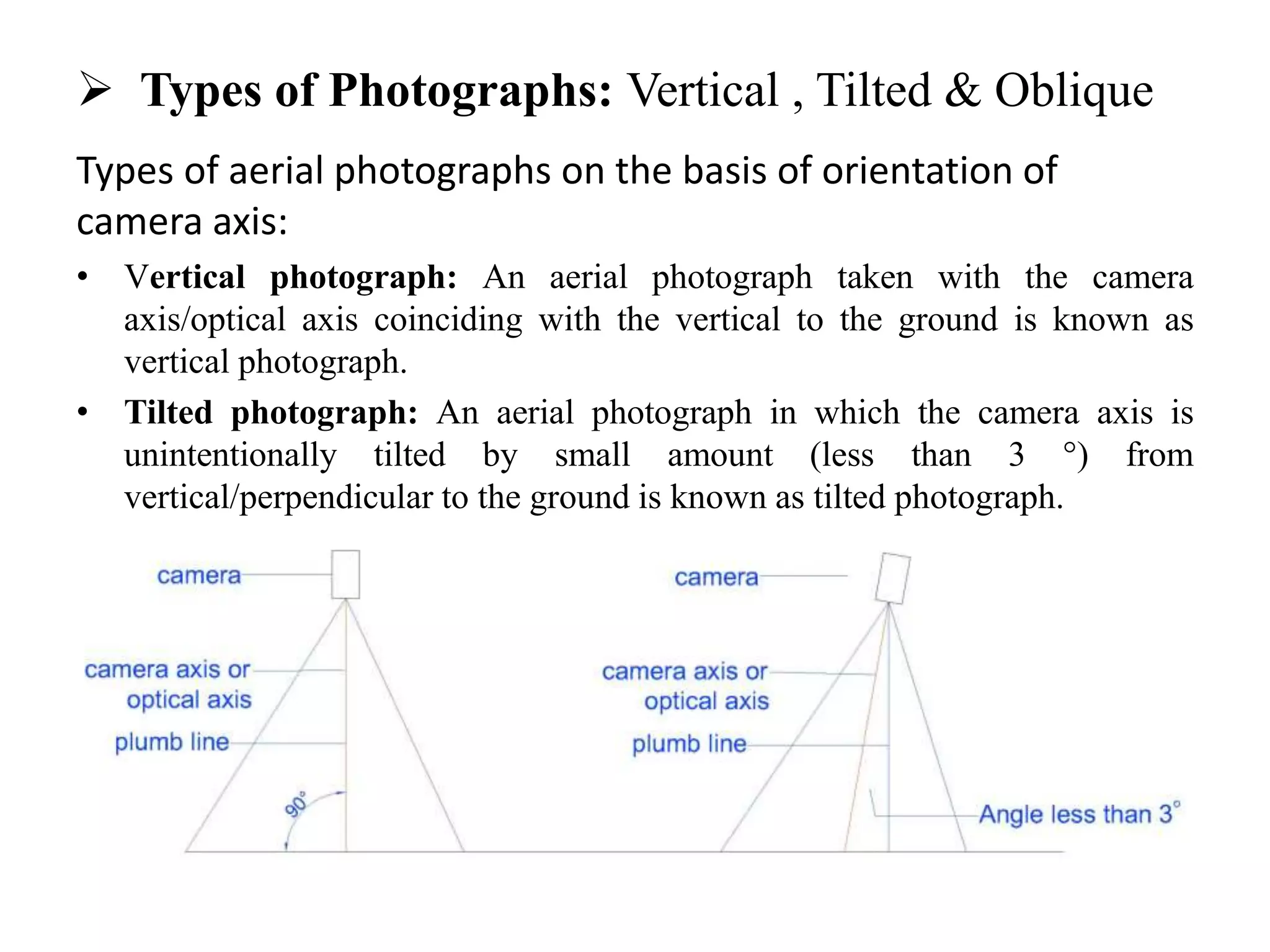
• Vertical photograph: An aerial photograph taken with the camera
axis/optical axis coinciding with the vertical to the ground is known as
vertical photograph.
• Tilted photograph: An aerial photograph in which the camera axis is
unintentionally tilted by small amount (less than 3 °) from
vertical/perpendicular to the ground is known as tilted photograph.
• Oblique photograph:
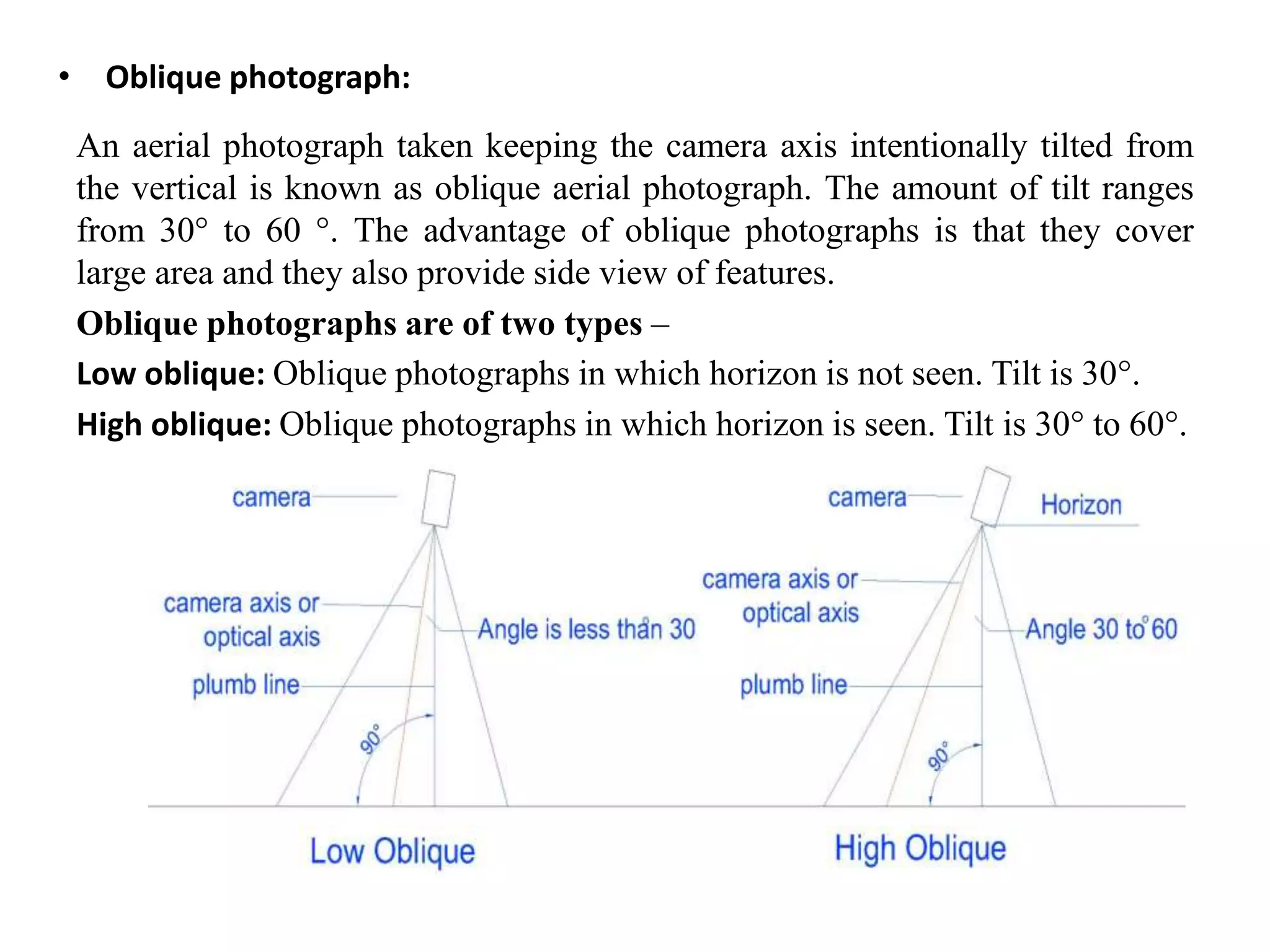
An aerial photograph taken keeping the camera axis intentionally tilted from
the vertical is known as oblique aerial photograph. The amount of tilt ranges
from 30° to 60 °. The advantage of oblique photographs is that they cover
large area and they also provide side view of features.
Oblique photographs are of two types –
Low oblique: Oblique photographs in which horizon is not seen. Tilt is 30°.
High oblique: Oblique photographs in which horizon is seen. Tilt is 30° to 60°.
Thank you

Aerial Photogrammetry 01

  • 1.
    Advance Surveying Aerial Photogrammetry Prof.Rajguru R.S. Civil Engineering Department (rajgururajeshcivil@sanjivani.org.in) Sanjivani College of Engineering, Kopargaon,MH,India
  • 2.
    Lecture Outline  Definition Objectives  Classification: quantitative and qualitative photogrammetry Application  Comparison of map and aerial photograph  Vertical, Tilted and Oblique photograph
  • 3.
     Definition ofAerial Photogrammetry: Aerial Photogrammetry is advance technique of obtaining the information about object or area without coming into the physical contact with the object or area under investigation. Photo=Picture Grammetry =Measurement Photogrammetry= Photo-measurement
  • 4.
     Objectives: • Toprepare the maps • To make the reconnaissance survey • To collect the military intelligence • To interpret the geology and soil data • To make survey of remote area • To make survey of buildings • To conduct environmental assessment • To conduct Power line inspection • To conduct forest survey • Movie production
  • 5.
     Classification: Sr. No.Terrestrial photogrammetry Aerial photogrammetry 1 2 Photographs are taken by photo theodolite mounted at stationary and elevated position. Cameras fit to an aeroplane that flies take pictures 3 Terrestrial photogrammetry comparatively needs much less investment and technical skill to carry out. Aerial photogrammetry requires a high-end infra support: 4 To map a small piece of land. To map a large piece of land. 5 Maps are compiled from the photographs Accessories required for interpretation & plotting the maps
  • 6.
     Comparison ofmap and aerial photograph: Sr. No. Map Aerial photogrammetry 1 2 It is an orthogonal Projection. It is a central Projection 3 A map is a geometrically correct. An aerial photograph is a geometrically incorrect. 4 The scale of the map is uniform The scale of the photograph is not uniform 5 Enlargement/reduction of the maps involves redrawing it Enlargement/reduction does not change the contents of the photographs 6 Map reading is common and more familiar to users Photograph needs a special technique to read the photo-views 7 Plotting of map is economical Plotting of map is uneconomical 8 Map Prepared by conventional method Aerial Photograph preparation is highly skill job 9 Time consuming method Time saving method
  • 7.
     Types ofPhotographs: Vertical , Tilted & Oblique Types of aerial photographs on the basis of orientation of camera axis: • Vertical photograph: An aerial photograph taken with the camera axis/optical axis coinciding with the vertical to the ground is known as vertical photograph. • Tilted photograph: An aerial photograph in which the camera axis is unintentionally tilted by small amount (less than 3 °) from vertical/perpendicular to the ground is known as tilted photograph.
  • 8.
    • Oblique photograph: Anaerial photograph taken keeping the camera axis intentionally tilted from the vertical is known as oblique aerial photograph. The amount of tilt ranges from 30° to 60 °. The advantage of oblique photographs is that they cover large area and they also provide side view of features. Oblique photographs are of two types – Low oblique: Oblique photographs in which horizon is not seen. Tilt is 30°. High oblique: Oblique photographs in which horizon is seen. Tilt is 30° to 60°.
  • 9.