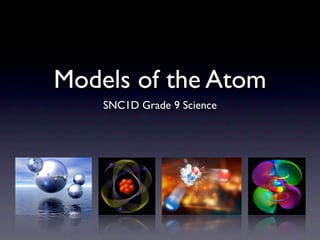
Models of the Atom
    SNC1D Grade 9 Science
Dalton Model
      •   Modern atomic theory
          began to take shape in the
          early 1800s

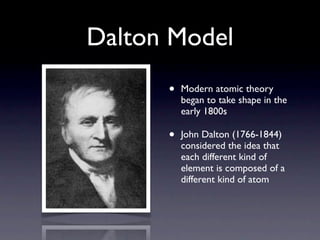
      •   John Dalton (1766-1844)
          considered the idea that
          each different kind of
          element is composed of a
          different kind of atom
Dalton Model
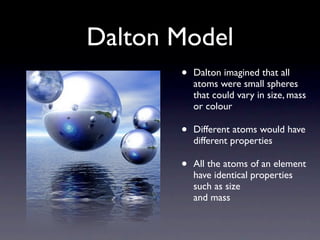
       •   Dalton imagined that all
           atoms were small spheres
           that could vary in size, mass
           or colour

       •   Different atoms would have
           different properties

       •   All the atoms of an element
           have identical properties
           such as size
           and mass
Thomson Model

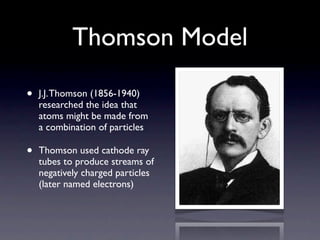
•   J.J. Thomson (1856-1940)
    researched the idea that
    atoms might be made from
    a combination of particles

•   Thomson used cathode ray
    tubes to produce streams of
    negatively charged particles
    (later named electrons)
Thomson Model
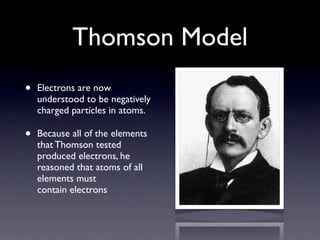
•   Electrons are now
    understood to be negatively
    charged particles in atoms.

•   Because all of the elements
    that Thomson tested
    produced electrons, he
    reasoned that atoms of all
    elements must
    contain electrons
Thomson Model
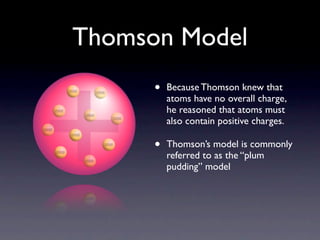
      •   Because Thomson knew that
          atoms have no overall charge,
          he reasoned that atoms must
          also contain positive charges.

      •   Thomson’s model is commonly
          referred to as the “plum
          pudding” model
Rutherford Model

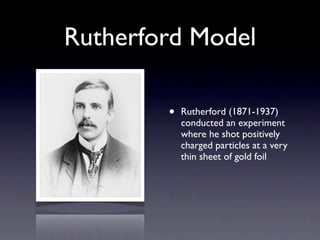
        •   Rutherford (1871-1937)
            conducted an experiment
            where he shot positively
            charged particles at a very
            thin sheet of gold foil
Rutherford Model
Rutherford Model
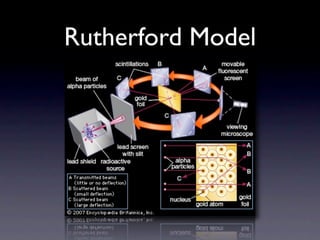
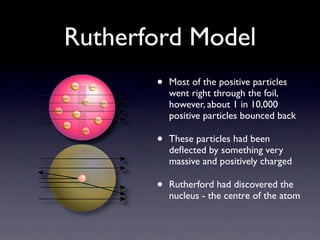
       •   Most of the positive particles
           went right through the foil,
           however, about 1 in 10,000
           positive particles bounced back

       •   These particles had been
           deflected by something very
           massive and positively charged

       •   Rutherford had discovered the
           nucleus - the centre of the atom
Rutherford Model

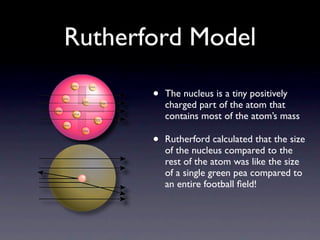
       •   The nucleus is a tiny positively
           charged part of the atom that
           contains most of the atom’s mass

       •   Rutherford calculated that the size
           of the nucleus compared to the
           rest of the atom was like the size
           of a single green pea compared to
           an entire football field!
Rutherford Model

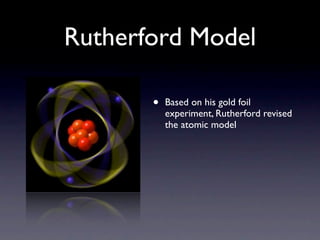
       •   Based on his gold foil
           experiment, Rutherford revised
           the atomic model
Chadwick Model
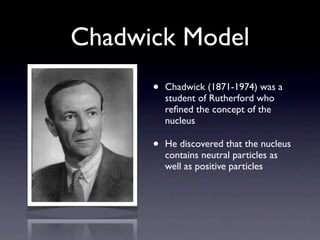
      •   Chadwick (1871-1974) was a
          student of Rutherford who
          refined the concept of the
          nucleus

      •   He discovered that the nucleus
          contains neutral particles as
          well as positive particles
Chadwick Model
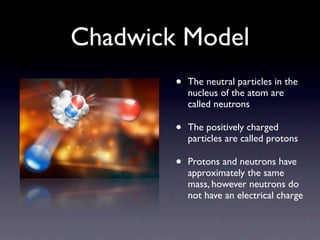
        •   The neutral particles in the
            nucleus of the atom are
            called neutrons

        •   The positively charged
            particles are called protons

        •   Protons and neutrons have
            approximately the same
            mass, however neutrons do
            not have an electrical charge
Bohr Model

     •   Bohr (1885-1962)
         transformed the model of
         the atom into one that is
         commonly used today

     •   His model shows how
         electrons are arranged
         in different elements
Bohr Model
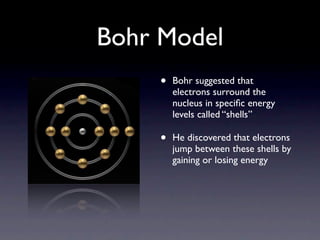
     •   Bohr suggested that
         electrons surround the
         nucleus in specific energy
         levels called “shells”

     •   He discovered that electrons
         jump between these shells by
         gaining or losing energy
Bohr Model
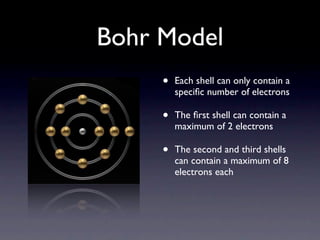
     •   Each shell can only contain a
         specific number of electrons

     •   The first shell can contain a
         maximum of 2 electrons

     •   The second and third shells
         can contain a maximum of 8
         electrons each
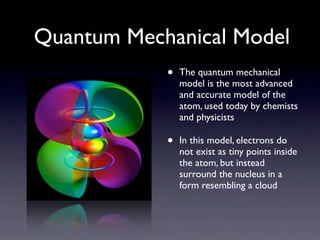
Quantum Mechanical Model
            •   The quantum mechanical
                model is the most advanced
                and accurate model of the
                atom, used today by chemists
                and physicists

            •   In this model, electrons do
                not exist as tiny points inside
                the atom, but instead
                surround the nucleus in a
                form resembling a cloud
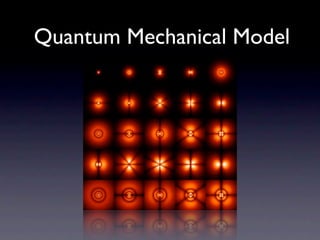
Quantum Mechanical Model

Models of the Atom

  • 1.
    Models of theAtom SNC1D Grade 9 Science
  • 2.
    Dalton Model • Modern atomic theory began to take shape in the early 1800s • John Dalton (1766-1844) considered the idea that each different kind of element is composed of a different kind of atom
  • 3.
    Dalton Model • Dalton imagined that all atoms were small spheres that could vary in size, mass or colour • Different atoms would have different properties • All the atoms of an element have identical properties such as size and mass
  • 4.
    Thomson Model • J.J. Thomson (1856-1940) researched the idea that atoms might be made from a combination of particles • Thomson used cathode ray tubes to produce streams of negatively charged particles (later named electrons)
  • 5.
    Thomson Model • Electrons are now understood to be negatively charged particles in atoms. • Because all of the elements that Thomson tested produced electrons, he reasoned that atoms of all elements must contain electrons
  • 6.
    Thomson Model • Because Thomson knew that atoms have no overall charge, he reasoned that atoms must also contain positive charges. • Thomson’s model is commonly referred to as the “plum pudding” model
  • 7.
    Rutherford Model • Rutherford (1871-1937) conducted an experiment where he shot positively charged particles at a very thin sheet of gold foil
  • 8.
  • 9.
    Rutherford Model • Most of the positive particles went right through the foil, however, about 1 in 10,000 positive particles bounced back • These particles had been deflected by something very massive and positively charged • Rutherford had discovered the nucleus - the centre of the atom
  • 10.
    Rutherford Model • The nucleus is a tiny positively charged part of the atom that contains most of the atom’s mass • Rutherford calculated that the size of the nucleus compared to the rest of the atom was like the size of a single green pea compared to an entire football field!
  • 11.
    Rutherford Model • Based on his gold foil experiment, Rutherford revised the atomic model
  • 12.
    Chadwick Model • Chadwick (1871-1974) was a student of Rutherford who refined the concept of the nucleus • He discovered that the nucleus contains neutral particles as well as positive particles
  • 13.
    Chadwick Model • The neutral particles in the nucleus of the atom are called neutrons • The positively charged particles are called protons • Protons and neutrons have approximately the same mass, however neutrons do not have an electrical charge
  • 14.
    Bohr Model • Bohr (1885-1962) transformed the model of the atom into one that is commonly used today • His model shows how electrons are arranged in different elements
  • 15.
    Bohr Model • Bohr suggested that electrons surround the nucleus in specific energy levels called “shells” • He discovered that electrons jump between these shells by gaining or losing energy
  • 16.
    Bohr Model • Each shell can only contain a specific number of electrons • The first shell can contain a maximum of 2 electrons • The second and third shells can contain a maximum of 8 electrons each
  • 17.
    Quantum Mechanical Model • The quantum mechanical model is the most advanced and accurate model of the atom, used today by chemists and physicists • In this model, electrons do not exist as tiny points inside the atom, but instead surround the nucleus in a form resembling a cloud
  • 18.