ATOMIC THEORY Building blocks of matter
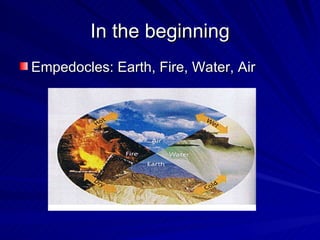
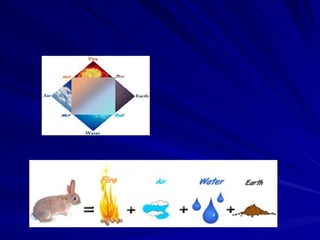
In the beginning Empedocles: Earth, Fire, Water, Air
 
DEMOCRITUS IN 400 BC,DEMOCRITUS SAID: ALL MATTER IS MADE UP OF  TINY PARTICLES CALLED “ATOMOS” & empty space Atoms are solid, homogeneous, indestructible and indivisible Different kinds of atoms have different shapes and sizes Different props. of matter due to size, shape and movement of atoms Apparent changes in matter is result of changes of atom groupings
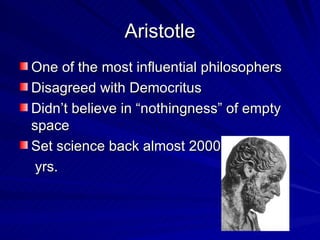
Aristotle One of the most influential philosophers Disagreed with Democritus Didn’t believe in “nothingness” of empty space Set science back almost 2000  yrs.
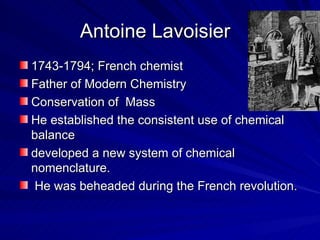
Antoine Lavoisier 1743-1794; French chemist Father of Modern Chemistry Conservation of  Mass He established the consistent use of chemical balance developed a new system of chemical nomenclature. He was beheaded during the French revolution.
Joseph Proust 1754 -1826; French chemist Law of definite proportions Compound always combines in the same whole-number ratio regardless of the size or source of the sample
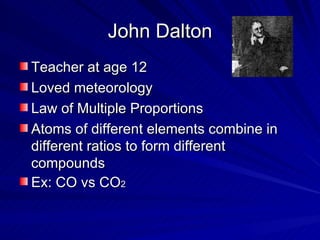
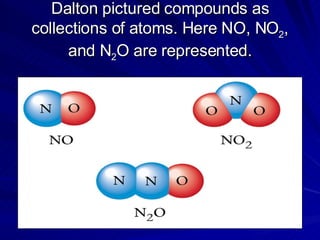
John Dalton Teacher at age 12 Loved meteorology Law of Multiple Proportions Atoms of different elements combine in different ratios to form different compounds Ex: CO vs CO 2
Dalton pictured compounds as collections of atoms. Here NO, NO 2 , and N 2 O are represented.
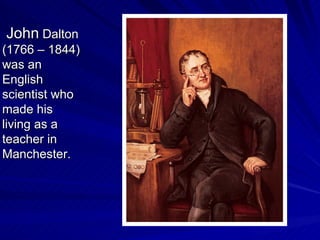
John  Dalton (1766 – 1844) was an English scientist who made his living as a teacher in Manchester.
Dalton’s atomic theory 1808 JOHN DALTON  /  ATOMIC THEORY 1. All matter is made up of atoms 2.  Atoms of the same element are alike. 3. Atoms of different elements are different. 4. Compounds have a definite composition by weight and combine in small whole number ratios. 5.  Atoms cannot be subdivided.
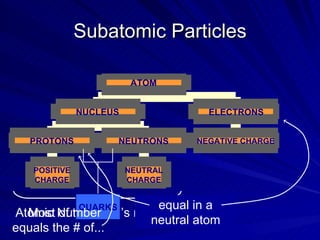
Subatomic Particles NUCLEUS ELECTRONS PROTONS NEUTRONS NEGATIVE CHARGE POSITIVE CHARGE NEUTRAL CHARGE ATOM Most of the atom’s mass. QUARKS Atomic Number equals the # of... equal in a neutral atom
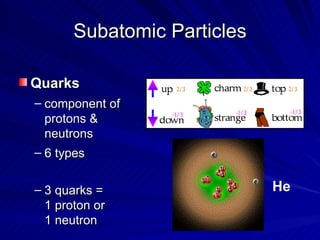
Subatomic Particles Quarks component of protons & neutrons 6 types 3 quarks =  1 proton or  1 neutron He
PARTICLES OF THE ATOM ELECTRON- JJ THOMPSON/1897 Mass/ Millikan PROTON AND NUCLEUS- RUTHERFORD/ 1911 ELECTRON SHELLS/  BOHR/ 1913 NEUTRON-CHADWICK / 1932
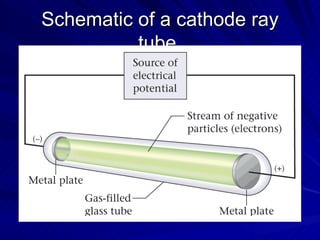
Are Atoms Really Unbreakable? J.J. Thomson investigated a beam called a  cathode ray determined that ray was made of tiny negatively charged particles --  electrons measurements led him to conclude that these electrons were smaller than a hydrogen atom if electrons are smaller than atoms, they must be pieces of atoms if atoms have pieces, they must be breakable Thomson also found that atoms of different elements all produced these same electrons
Schematic of a cathode ray tube.
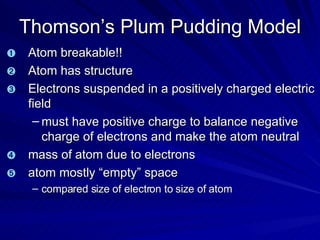
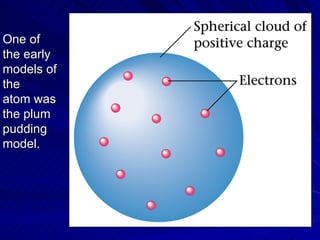
Thomson’s Plum Pudding Model Atom breakable!! Atom has structure Electrons suspended in a positively charged electric field must have positive charge to balance negative charge of electrons and make the atom neutral mass of atom due to electrons atom mostly “empty” space compared size of electron to size of atom
One of the early models of the  atom was the plum pudding model.
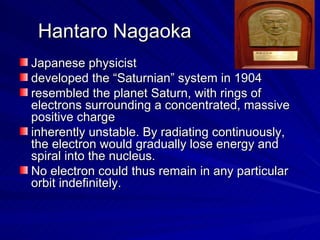
Hantaro Nagaoka Japanese physicist developed the “Saturnian” system in 1904  resembled the planet Saturn, with rings of electrons surrounding a concentrated, massive positive charge  inherently unstable. By radiating continuously, the electron would gradually lose energy and spiral into the nucleus.  No electron could thus remain in any particular orbit indefinitely.
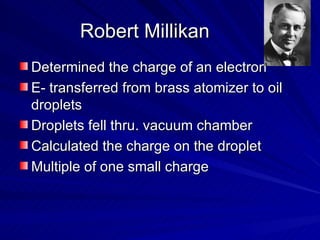
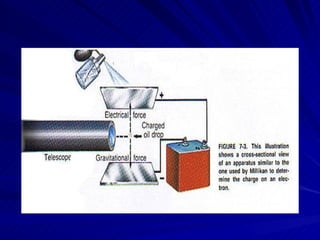
Robert Millikan Determined the charge of an electron E- transferred from brass atomizer to oil droplets  Droplets fell thru. vacuum chamber Calculated the charge on the droplet Multiple of one small charge
 
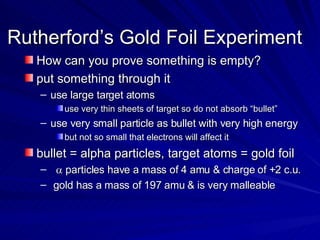
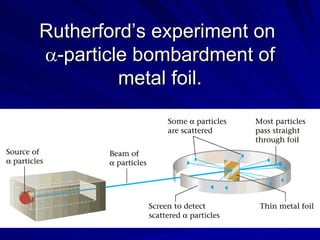
Rutherford’s Gold Foil Experiment How can you prove something is empty? put something through it use large target atoms use very thin sheets of target so do not absorb “bullet” use very small particle as bullet with very high energy  but not so small that electrons will affect it bullet = alpha particles, target atoms = gold foil    particles have a mass of 4 amu & charge of +2 c.u. gold has a mass of 197 amu & is very malleable
Rutherford’s experiment on   -particle bombardment of metal foil.
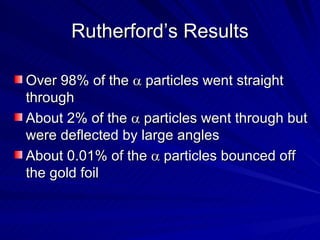
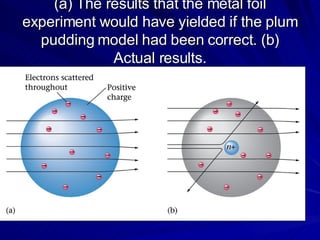
Rutherford’s Results Over 98% of the    particles went straight through About 2% of the    particles went through but were deflected by large angles About 0.01% of the    particles bounced off the gold foil
(a) The results that the metal foil experiment would have yielded if the plum pudding model had been correct. (b) Actual results.
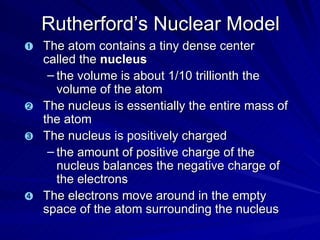
Rutherford’s Nuclear Model The atom contains a tiny dense center called the  nucleus the volume is about 1/10 trillionth the volume of the atom The nucleus is essentially the entire mass of the atom The nucleus is positively charged  the amount of positive charge of the nucleus balances the negative charge of the electrons The electrons move around in the empty space of the atom surrounding the nucleus
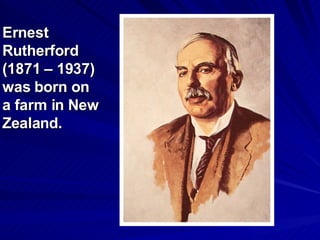
Ernest Rutherford (1871 – 1937)  was born on a farm in New Zealand.
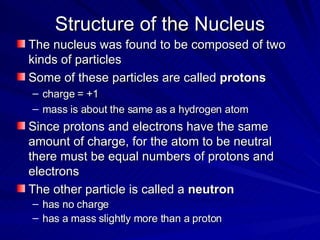
Structure of the Nucleus The nucleus was found to be composed of two kinds of particles Some of these particles are called  protons charge = +1 mass is about the same as a hydrogen atom Since protons and electrons have the same amount of charge, for the atom to be neutral there must be equal numbers of protons and electrons The other particle is called a  neutron has no charge has a mass slightly more than a proton
Bohr Model e -  exist only in orbits with specific amounts of energy called energy levels Therefore… e -  can only gain or lose certain amounts of energy ( quanta ) only certain photons are produced
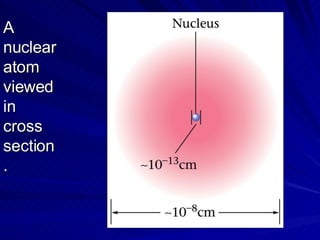
The Modern Atom We know atoms are composed of three main pieces - protons, neutrons and electrons The nucleus contains protons and neutrons The nucleus is only about 10 -13  cm in diameter The electrons move outside the nucleus with an average distance of about 10 -8  cm therefore the radius of the atom is about 10 5  times larger than the radius of the nucleus
A nuclear atom viewed  in cross section.
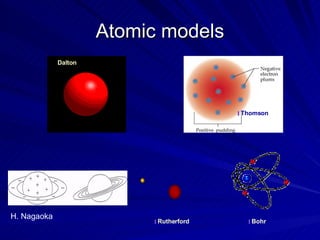
Atomic models Dalton Thomson Rutherford Bohr H. Nagaoka

Atomic Theory Reg

  • 1.
    ATOMIC THEORY Buildingblocks of matter
  • 2.
    In the beginningEmpedocles: Earth, Fire, Water, Air
  • 3.
  • 4.
    DEMOCRITUS IN 400BC,DEMOCRITUS SAID: ALL MATTER IS MADE UP OF TINY PARTICLES CALLED “ATOMOS” & empty space Atoms are solid, homogeneous, indestructible and indivisible Different kinds of atoms have different shapes and sizes Different props. of matter due to size, shape and movement of atoms Apparent changes in matter is result of changes of atom groupings
  • 5.
    Aristotle One ofthe most influential philosophers Disagreed with Democritus Didn’t believe in “nothingness” of empty space Set science back almost 2000 yrs.
  • 6.
    Antoine Lavoisier 1743-1794;French chemist Father of Modern Chemistry Conservation of Mass He established the consistent use of chemical balance developed a new system of chemical nomenclature. He was beheaded during the French revolution.
  • 7.
    Joseph Proust 1754-1826; French chemist Law of definite proportions Compound always combines in the same whole-number ratio regardless of the size or source of the sample
  • 8.
    John Dalton Teacherat age 12 Loved meteorology Law of Multiple Proportions Atoms of different elements combine in different ratios to form different compounds Ex: CO vs CO 2
  • 9.
    Dalton pictured compoundsas collections of atoms. Here NO, NO 2 , and N 2 O are represented.
  • 10.
    John Dalton(1766 – 1844) was an English scientist who made his living as a teacher in Manchester.
  • 11.
    Dalton’s atomic theory1808 JOHN DALTON / ATOMIC THEORY 1. All matter is made up of atoms 2. Atoms of the same element are alike. 3. Atoms of different elements are different. 4. Compounds have a definite composition by weight and combine in small whole number ratios. 5. Atoms cannot be subdivided.
  • 12.
    Subatomic Particles NUCLEUSELECTRONS PROTONS NEUTRONS NEGATIVE CHARGE POSITIVE CHARGE NEUTRAL CHARGE ATOM Most of the atom’s mass. QUARKS Atomic Number equals the # of... equal in a neutral atom
  • 13.
    Subatomic Particles Quarkscomponent of protons & neutrons 6 types 3 quarks = 1 proton or 1 neutron He
  • 14.
    PARTICLES OF THEATOM ELECTRON- JJ THOMPSON/1897 Mass/ Millikan PROTON AND NUCLEUS- RUTHERFORD/ 1911 ELECTRON SHELLS/ BOHR/ 1913 NEUTRON-CHADWICK / 1932
  • 15.
    Are Atoms ReallyUnbreakable? J.J. Thomson investigated a beam called a cathode ray determined that ray was made of tiny negatively charged particles -- electrons measurements led him to conclude that these electrons were smaller than a hydrogen atom if electrons are smaller than atoms, they must be pieces of atoms if atoms have pieces, they must be breakable Thomson also found that atoms of different elements all produced these same electrons
  • 16.
    Schematic of acathode ray tube.
  • 17.
    Thomson’s Plum PuddingModel Atom breakable!! Atom has structure Electrons suspended in a positively charged electric field must have positive charge to balance negative charge of electrons and make the atom neutral mass of atom due to electrons atom mostly “empty” space compared size of electron to size of atom
  • 18.
    One of theearly models of the atom was the plum pudding model.
  • 19.
    Hantaro Nagaoka Japanesephysicist developed the “Saturnian” system in 1904 resembled the planet Saturn, with rings of electrons surrounding a concentrated, massive positive charge inherently unstable. By radiating continuously, the electron would gradually lose energy and spiral into the nucleus. No electron could thus remain in any particular orbit indefinitely.
  • 20.
    Robert Millikan Determinedthe charge of an electron E- transferred from brass atomizer to oil droplets Droplets fell thru. vacuum chamber Calculated the charge on the droplet Multiple of one small charge
  • 21.
  • 22.
    Rutherford’s Gold FoilExperiment How can you prove something is empty? put something through it use large target atoms use very thin sheets of target so do not absorb “bullet” use very small particle as bullet with very high energy but not so small that electrons will affect it bullet = alpha particles, target atoms = gold foil  particles have a mass of 4 amu & charge of +2 c.u. gold has a mass of 197 amu & is very malleable
  • 23.
    Rutherford’s experiment on  -particle bombardment of metal foil.
  • 24.
    Rutherford’s Results Over98% of the  particles went straight through About 2% of the  particles went through but were deflected by large angles About 0.01% of the  particles bounced off the gold foil
  • 25.
    (a) The resultsthat the metal foil experiment would have yielded if the plum pudding model had been correct. (b) Actual results.
  • 26.
    Rutherford’s Nuclear ModelThe atom contains a tiny dense center called the nucleus the volume is about 1/10 trillionth the volume of the atom The nucleus is essentially the entire mass of the atom The nucleus is positively charged the amount of positive charge of the nucleus balances the negative charge of the electrons The electrons move around in the empty space of the atom surrounding the nucleus
  • 27.
    Ernest Rutherford (1871– 1937) was born on a farm in New Zealand.
  • 28.
    Structure of theNucleus The nucleus was found to be composed of two kinds of particles Some of these particles are called protons charge = +1 mass is about the same as a hydrogen atom Since protons and electrons have the same amount of charge, for the atom to be neutral there must be equal numbers of protons and electrons The other particle is called a neutron has no charge has a mass slightly more than a proton
  • 29.
    Bohr Model e- exist only in orbits with specific amounts of energy called energy levels Therefore… e - can only gain or lose certain amounts of energy ( quanta ) only certain photons are produced
  • 30.
    The Modern AtomWe know atoms are composed of three main pieces - protons, neutrons and electrons The nucleus contains protons and neutrons The nucleus is only about 10 -13 cm in diameter The electrons move outside the nucleus with an average distance of about 10 -8 cm therefore the radius of the atom is about 10 5 times larger than the radius of the nucleus
  • 31.
    A nuclear atomviewed in cross section.
  • 32.
    Atomic models DaltonThomson Rutherford Bohr H. Nagaoka