






GHG Sources and human activities
Recall that the most important contributor to the  natural  greenhouse effect is  water vapour .
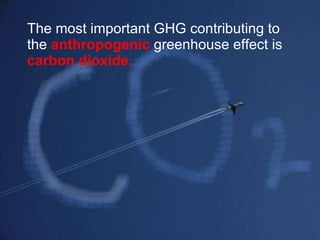
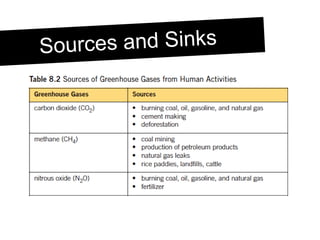
The most important GHG contributing to the  anthropogenic  greenhouse effect is  carbon dioxide.
Any process that  releases  carbon dioxide into the atmosphere is called a carbon  source .
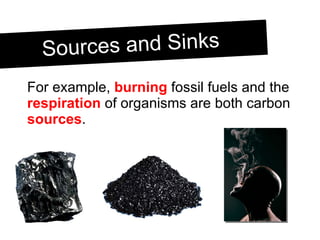
For example,  burning  fossil fuels and the  respiration  of organisms are both carbon  sources . Sources and Sinks
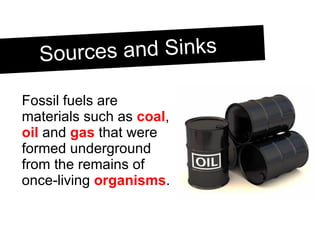
Fossil fuels are materials such as  coal ,  oil  and  gas  that were formed underground from the remains of once-living  organisms . Sources and Sinks
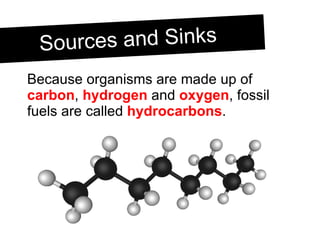
Because organisms are made up of  carbon ,  hydrogen  and  oxygen , fossil fuels are called  hydrocarbons . Sources and Sinks
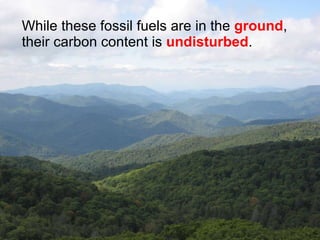
While these fossil fuels are in the  ground , their carbon content is  undisturbed .
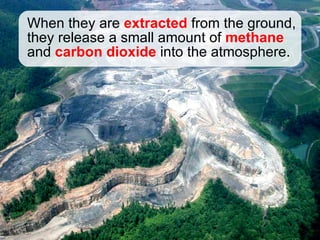
When they are  extracted  from the ground, they release a small amount of  methane  and  carbon dioxide  into the atmosphere.
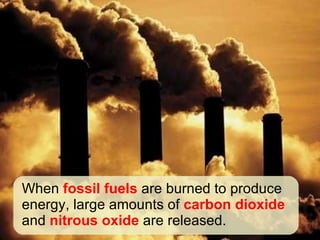
When  fossil fuels  are burned to produce energy, large amounts of  carbon dioxide  and  nitrous oxide  are released.
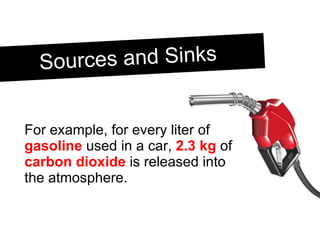
For example, for every liter of  gasoline  used in a car,  2.3 kg  of  carbon dioxide  is released into the atmosphere. Sources and Sinks
Sources and Sinks
Sources and Sinks
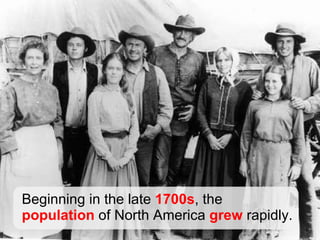
Beginning in the late  1700s , the  population  of North America  grew  rapidly.
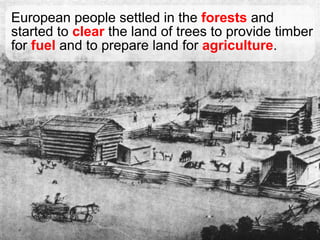
European people settled in the  forests  and started to  clear  the land of trees to provide timber for  fuel  and to prepare land for  agriculture .
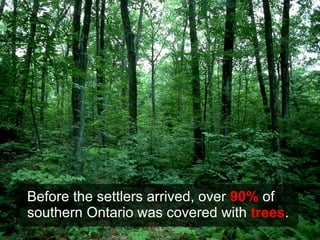
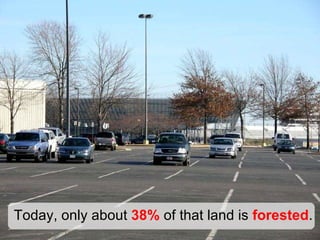
Before the settlers arrived, over  90%  of southern Ontario was covered with  trees .
Today, only about  38%  of that land is  forested .
Deforestation Forests play an important role in  removing  carbon dioxide from the air through the process of  photosynthesis .
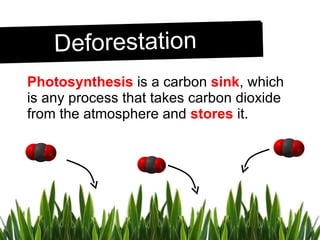
Photosynthesis  is a carbon  sink , which is any process that takes carbon dioxide from the atmosphere and  stores  it. Deforestation
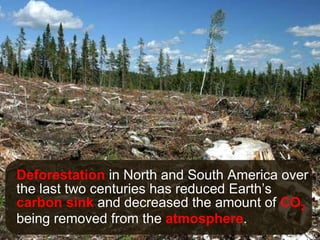
Deforestation  in North and South America over the last two centuries has reduced Earth’s  carbon sink  and decreased the amount of  CO 2  being removed from the  atmosphere .
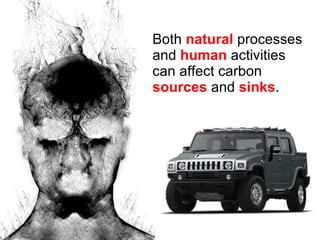
Both  natural  processes and  human  activities can affect carbon  sources  and  sinks .
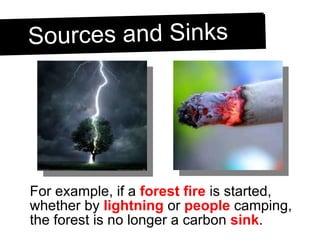
For example, if a  forest fire  is started, whether by  lightning  or  people  camping, the forest is no longer a carbon  sink . Sources and Sinks
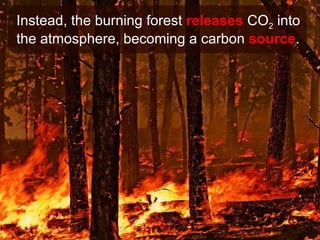
Instead, the burning forest  releases  CO 2  into the atmosphere, becoming a carbon  source .
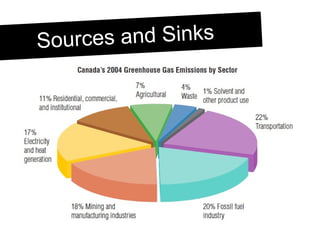
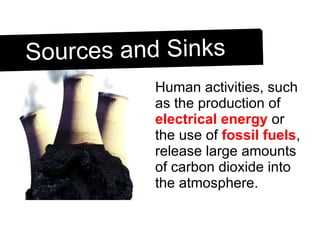
Human activities, such as the production of  electrical energy  or the use of  fossil fuels , release large amounts of carbon dioxide into the atmosphere. Sources and Sinks
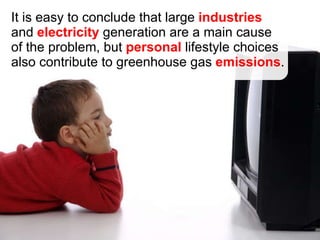
Sources and Sinks It is easy to conclude that large  industries  and  electricity  generation are a main cause of the problem, but  personal  lifestyle choices also contribute to greenhouse gas  emissions .
Consider the amount of  garbage  generated by your household or school… Sources and Sinks
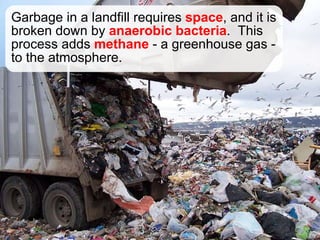
Garbage in a landfill requires  space , and it is broken down by  anaerobic bacteria .  This process adds  methane  - a greenhouse gas - to the atmosphere.
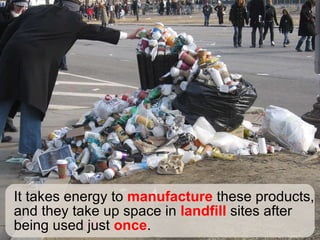
As well, North Americans purchase many  disposable  products. Sources and Sinks
It takes energy to  manufacture  these products, and they take up space in  landfill  sites after being used just  once .
North Americans  consume  much more than people in many other countries.
Also consider the amount of  electricity  you use at home…
… or the number of  lights  left on in office buildings at night.
Think about how far  trucks  must travel to deliver the  goods  we want.
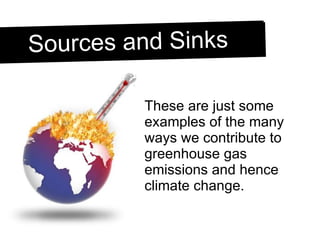
These are just some examples of the many ways we contribute to greenhouse gas emissions and hence climate change. Sources and Sinks
www.storyofstuff.com

GHG Sources & Human Activities

  • 1.
    GHG Sources andhuman activities
  • 2.
    Recall that themost important contributor to the natural greenhouse effect is water vapour .
  • 3.
    The most importantGHG contributing to the anthropogenic greenhouse effect is carbon dioxide.
  • 4.
    Any process that releases carbon dioxide into the atmosphere is called a carbon source .
  • 5.
    For example, burning fossil fuels and the respiration of organisms are both carbon sources . Sources and Sinks
  • 6.
    Fossil fuels arematerials such as coal , oil and gas that were formed underground from the remains of once-living organisms . Sources and Sinks
  • 7.
    Because organisms aremade up of carbon , hydrogen and oxygen , fossil fuels are called hydrocarbons . Sources and Sinks
  • 8.
    While these fossilfuels are in the ground , their carbon content is undisturbed .
  • 9.
    When they are extracted from the ground, they release a small amount of methane and carbon dioxide into the atmosphere.
  • 10.
    When fossilfuels are burned to produce energy, large amounts of carbon dioxide and nitrous oxide are released.
  • 11.
    For example, forevery liter of gasoline used in a car, 2.3 kg of carbon dioxide is released into the atmosphere. Sources and Sinks
  • 12.
  • 13.
  • 14.
    Beginning in thelate 1700s , the population of North America grew rapidly.
  • 15.
    European people settledin the forests and started to clear the land of trees to provide timber for fuel and to prepare land for agriculture .
  • 16.
    Before the settlersarrived, over 90% of southern Ontario was covered with trees .
  • 17.
    Today, only about 38% of that land is forested .
  • 18.
    Deforestation Forests playan important role in removing carbon dioxide from the air through the process of photosynthesis .
  • 19.
    Photosynthesis isa carbon sink , which is any process that takes carbon dioxide from the atmosphere and stores it. Deforestation
  • 20.
    Deforestation inNorth and South America over the last two centuries has reduced Earth’s carbon sink and decreased the amount of CO 2 being removed from the atmosphere .
  • 21.
    Both natural processes and human activities can affect carbon sources and sinks .
  • 22.
    For example, ifa forest fire is started, whether by lightning or people camping, the forest is no longer a carbon sink . Sources and Sinks
  • 23.
    Instead, the burningforest releases CO 2 into the atmosphere, becoming a carbon source .
  • 24.
    Human activities, suchas the production of electrical energy or the use of fossil fuels , release large amounts of carbon dioxide into the atmosphere. Sources and Sinks
  • 25.
    Sources and SinksIt is easy to conclude that large industries and electricity generation are a main cause of the problem, but personal lifestyle choices also contribute to greenhouse gas emissions .
  • 26.
    Consider the amountof garbage generated by your household or school… Sources and Sinks
  • 27.
    Garbage in alandfill requires space , and it is broken down by anaerobic bacteria . This process adds methane - a greenhouse gas - to the atmosphere.
  • 28.
    As well, NorthAmericans purchase many disposable products. Sources and Sinks
  • 29.
    It takes energyto manufacture these products, and they take up space in landfill sites after being used just once .
  • 30.
    North Americans consume much more than people in many other countries.
  • 31.
    Also consider theamount of electricity you use at home…
  • 32.
    … or thenumber of lights left on in office buildings at night.
  • 33.
    Think about howfar trucks must travel to deliver the goods we want.
  • 34.
    These are justsome examples of the many ways we contribute to greenhouse gas emissions and hence climate change. Sources and Sinks
  • 35.