Model Predictive Control for Integrating Processes Lou Heavner – Consultant, APC
Presenter Lou Heavner
Introduction Historically, APC project engineers and consultants have tried to keep level control outside of the MPC solution.  Level control and control of other integrating processes are poorly understood by many control engineers.  This presentation will attempt to answer the following questions: Can you control level with MPC? How do you control level with MPC? When should you control level with MPC?
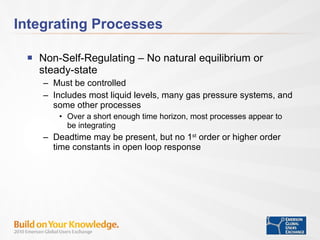
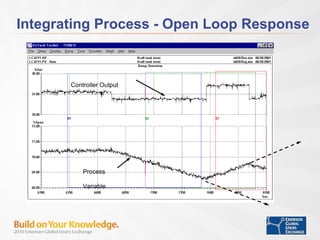
Integrating Processes Non-Self-Regulating – No natural equilibrium or steady-state Must be controlled Includes most liquid levels, many gas pressure systems, and some other processes Over a short enough time horizon, most processes appear to be integrating Deadtime may be present, but no 1 st  order or higher order time constants in open loop response
Integrating Process - Open Loop Response Controller Output Process Variable
Process Examples Hopper w/ Loss-in-Weight Feeder and Conveyor Large Deadtime Dynamic Distillation Column Bottom Level and Reflux Accumulator Level Multi-variable Interaction Evaporator Level Multi-variable Interaction Large Deadtime Dynamic Oil & Gas Production Separator Level Multi-variable Interaction Slug Control
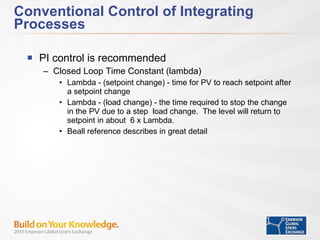
Conventional Control of Integrating Processes PI control is recommended Closed Loop Time Constant (lambda) Lambda - (setpoint change) - time for PV to reach setpoint after a setpoint change Lambda - (load change) - the time required to stop the change in the PV due to a step  load change.  The level will return to setpoint in about  6 x Lambda. Beall reference describes in great detail
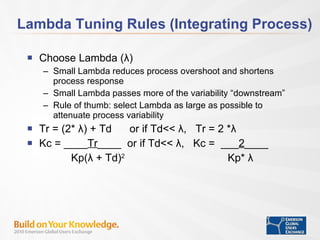
Lambda Tuning Rules (Integrating Process) Choose Lambda (λ) Small Lambda reduces process overshoot and shortens process response Small Lambda passes more of the variability “downstream” Rule of thumb: select Lambda as large as possible to attenuate process variability Tr = (2* λ) + Td  or if Td<< λ,  Tr = 2 *λ Kc = ____ Tr ____  or if Td<< λ,  Kc =  ___ 2 ____   Kp(λ + Td) 2    Kp* λ
Model Predictive Control Handles difficult process dynamics, reduces variability and protects constraints Easy, Fast, Implementation  Fully embedded, no integration required Configuration Operator Displays Historian Scaleable, Practical Model Predictive Control PredictPro LP Optimization Large Problems (80x40)
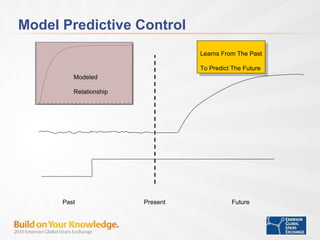
Model Predictive Control Learns From The Past To Predict The Future Past Present Future Modeled Relationship
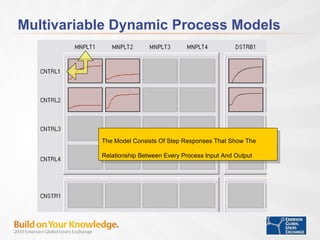
Multivariable Dynamic Process Models The Model Consists Of Step Responses That Show The Relationship Between Every Process Input And Output
Model Predictive Control of Integrating Processes Factors considered: Feedback mechanism Model Correction Factor Rotation Factor TSS selection MPC Controller “Tuning” POM POE  Multivariable Interaction Deadtime
Prediction Error Model Correction Factor & Rotation Factor Consider a prediction vector P whose elements are indexed by j. That is j= 0 to 119 since in MPC-PRO the prediction horizon is 120 elements long. The equation for the update of the prediction vector is: P(j) = P(j) + {(1 – R) + j*R}*F   Where R is the ROTATION FACTOR and F is the filtered shift measured as the error (i.e. the difference between the first element of the last prediction vector and the feedback measurement) multiplied by the MODEL CORRECTION FACTOR   Parameter Names & Default Values Predict Pro: ROTATION_FACTOR[x] = 0.05 Predict: ROT_FACTOR[x] = 0.001 MOD_CORR_FACTOR[x] = 0.75 v10.0+ or 0.4 in earlier versions [x] is the number of the process output Tunable w/o download
MPC Tuning Time to Steady-State (TSS) Defines Prediction Horizon Sets Controller execution speed Requires Download Penalty on Move (POM) Slows the control action of MVs (Process Inputs) Makes the controller more robust Powerful, but requires a download to change Penalty on Error (POE) Works on Process Outputs Fine tuning and usually not altered Requires Download
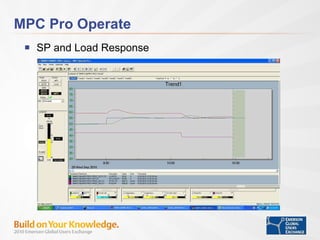
MPC Pro Operate SP and Load Response
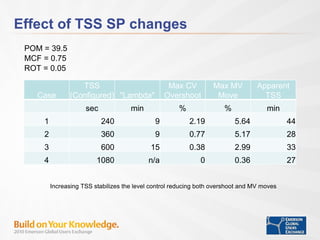
Effect of TSS SP changes Increasing TSS stabilizes the level control reducing both overshoot and MV moves Case TSS (Configured) &quot;Lambda&quot; Max CV Overshoot Max MV Move Apparent TSS sec min % % min 1 240 9 2.19 5.64 44 2 360 9 0.77 5.17 28 3 600 15 0.38 2.99 33 4 1080 n/a 0 0.36 27 POM = 39.5 MCF = 0.75 ROT = 0.05
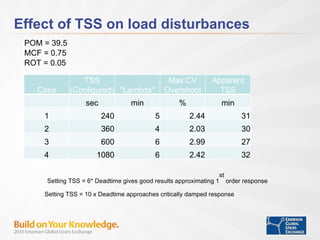
Effect of TSS on load disturbances Setting TSS = 6* Deadtime gives good results approximating 1 st  order response  Setting TSS = 10 x Deadtime approaches critically damped response Case TSS (Configured) &quot;Lambda&quot; Max CV Overshoot Apparent TSS sec min % min 1 240 5 2.44 31 2 360 4 2.03 30 3 600 6 2.99 27 4 1080 6 2.42 32 POM = 39.5 MCF = 0.75 ROT = 0.05
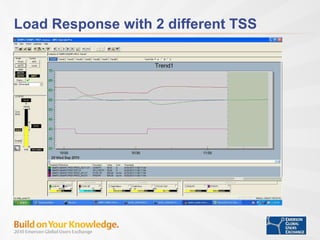
Load Response with 2 different TSS
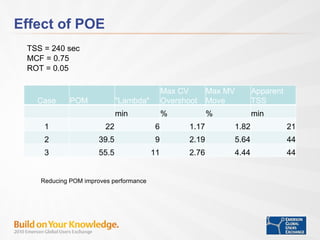
Effect of POE Reducing POM improves performance TSS = 240 sec MCF = 0.75 ROT = 0.05 Case POM &quot;Lambda&quot; Max CV Overshoot Max MV Move Apparent TSS min % % min 1 22 6 1.17 1.82 21 2 39.5 9 2.19 5.64 44 3 55.5 11 2.76 4.44 44
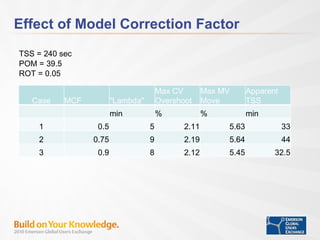
Effect of Model Correction Factor TSS = 240 sec POM = 39.5 ROT = 0.05 Case MCF &quot;Lambda&quot; Max CV Overshoot Max MV Move Apparent TSS min % % min 1 0.5 5 2.11 5.63 33 2 0.75 9 2.19 5.64 44 3 0.9 8 2.12 5.45 32.5
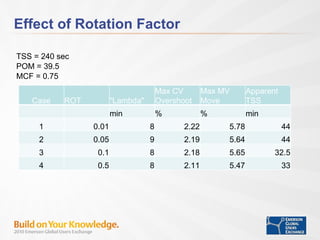
Effect of Rotation Factor Case ROT &quot;Lambda&quot; Max CV Overshoot Max MV Move Apparent TSS min % % min 1 0.01 8 2.22 5.78 44 2 0.05 9 2.19 5.64 44 3 0.1 8 2.18 5.65 32.5 4 0.5 8 2.11 5.47 33 TSS = 240 sec POM = 39.5 MCF = 0.75
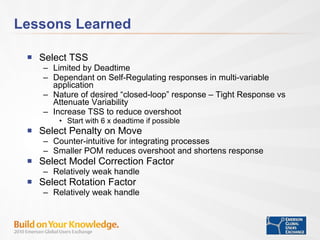
Lessons Learned Select TSS Limited by Deadtime Dependant on Self-Regulating responses in multi-variable application Nature of desired “closed-loop” response – Tight Response vs Attenuate Variability Increase TSS to reduce overshoot Start with 6 x deadtime if possible Select Penalty on Move Counter-intuitive for integrating processes Smaller POM reduces overshoot and shortens response Select Model Correction Factor Relatively weak handle Select Rotation Factor Relatively weak handle
Where To Get More Information Author: [email_address] (512) 834-7262 References: Beall, James F., Base Process Control Diagnostics and Optimization, Internal Emerson document, 2002. Consulting services Contact your local sales office

Model Predictive Control For Integrating Processes

  • 1.
    Model Predictive Controlfor Integrating Processes Lou Heavner – Consultant, APC
  • 2.
  • 3.
    Introduction Historically, APCproject engineers and consultants have tried to keep level control outside of the MPC solution. Level control and control of other integrating processes are poorly understood by many control engineers. This presentation will attempt to answer the following questions: Can you control level with MPC? How do you control level with MPC? When should you control level with MPC?
  • 4.
    Integrating Processes Non-Self-Regulating– No natural equilibrium or steady-state Must be controlled Includes most liquid levels, many gas pressure systems, and some other processes Over a short enough time horizon, most processes appear to be integrating Deadtime may be present, but no 1 st order or higher order time constants in open loop response
  • 5.
    Integrating Process -Open Loop Response Controller Output Process Variable
  • 6.
    Process Examples Hopperw/ Loss-in-Weight Feeder and Conveyor Large Deadtime Dynamic Distillation Column Bottom Level and Reflux Accumulator Level Multi-variable Interaction Evaporator Level Multi-variable Interaction Large Deadtime Dynamic Oil & Gas Production Separator Level Multi-variable Interaction Slug Control
  • 7.
    Conventional Control ofIntegrating Processes PI control is recommended Closed Loop Time Constant (lambda) Lambda - (setpoint change) - time for PV to reach setpoint after a setpoint change Lambda - (load change) - the time required to stop the change in the PV due to a step load change. The level will return to setpoint in about 6 x Lambda. Beall reference describes in great detail
  • 8.
    Lambda Tuning Rules(Integrating Process) Choose Lambda (λ) Small Lambda reduces process overshoot and shortens process response Small Lambda passes more of the variability “downstream” Rule of thumb: select Lambda as large as possible to attenuate process variability Tr = (2* λ) + Td or if Td<< λ, Tr = 2 *λ Kc = ____ Tr ____ or if Td<< λ, Kc = ___ 2 ____ Kp(λ + Td) 2 Kp* λ
  • 9.
    Model Predictive ControlHandles difficult process dynamics, reduces variability and protects constraints Easy, Fast, Implementation Fully embedded, no integration required Configuration Operator Displays Historian Scaleable, Practical Model Predictive Control PredictPro LP Optimization Large Problems (80x40)
  • 10.
    Model Predictive ControlLearns From The Past To Predict The Future Past Present Future Modeled Relationship
  • 11.
    Multivariable Dynamic ProcessModels The Model Consists Of Step Responses That Show The Relationship Between Every Process Input And Output
  • 12.
    Model Predictive Controlof Integrating Processes Factors considered: Feedback mechanism Model Correction Factor Rotation Factor TSS selection MPC Controller “Tuning” POM POE Multivariable Interaction Deadtime
  • 13.
    Prediction Error ModelCorrection Factor & Rotation Factor Consider a prediction vector P whose elements are indexed by j. That is j= 0 to 119 since in MPC-PRO the prediction horizon is 120 elements long. The equation for the update of the prediction vector is: P(j) = P(j) + {(1 – R) + j*R}*F   Where R is the ROTATION FACTOR and F is the filtered shift measured as the error (i.e. the difference between the first element of the last prediction vector and the feedback measurement) multiplied by the MODEL CORRECTION FACTOR   Parameter Names & Default Values Predict Pro: ROTATION_FACTOR[x] = 0.05 Predict: ROT_FACTOR[x] = 0.001 MOD_CORR_FACTOR[x] = 0.75 v10.0+ or 0.4 in earlier versions [x] is the number of the process output Tunable w/o download
  • 14.
    MPC Tuning Timeto Steady-State (TSS) Defines Prediction Horizon Sets Controller execution speed Requires Download Penalty on Move (POM) Slows the control action of MVs (Process Inputs) Makes the controller more robust Powerful, but requires a download to change Penalty on Error (POE) Works on Process Outputs Fine tuning and usually not altered Requires Download
  • 15.
    MPC Pro OperateSP and Load Response
  • 16.
    Effect of TSSSP changes Increasing TSS stabilizes the level control reducing both overshoot and MV moves Case TSS (Configured) &quot;Lambda&quot; Max CV Overshoot Max MV Move Apparent TSS sec min % % min 1 240 9 2.19 5.64 44 2 360 9 0.77 5.17 28 3 600 15 0.38 2.99 33 4 1080 n/a 0 0.36 27 POM = 39.5 MCF = 0.75 ROT = 0.05
  • 17.
    Effect of TSSon load disturbances Setting TSS = 6* Deadtime gives good results approximating 1 st order response Setting TSS = 10 x Deadtime approaches critically damped response Case TSS (Configured) &quot;Lambda&quot; Max CV Overshoot Apparent TSS sec min % min 1 240 5 2.44 31 2 360 4 2.03 30 3 600 6 2.99 27 4 1080 6 2.42 32 POM = 39.5 MCF = 0.75 ROT = 0.05
  • 18.
    Load Response with2 different TSS
  • 19.
    Effect of POEReducing POM improves performance TSS = 240 sec MCF = 0.75 ROT = 0.05 Case POM &quot;Lambda&quot; Max CV Overshoot Max MV Move Apparent TSS min % % min 1 22 6 1.17 1.82 21 2 39.5 9 2.19 5.64 44 3 55.5 11 2.76 4.44 44
  • 20.
    Effect of ModelCorrection Factor TSS = 240 sec POM = 39.5 ROT = 0.05 Case MCF &quot;Lambda&quot; Max CV Overshoot Max MV Move Apparent TSS min % % min 1 0.5 5 2.11 5.63 33 2 0.75 9 2.19 5.64 44 3 0.9 8 2.12 5.45 32.5
  • 21.
    Effect of RotationFactor Case ROT &quot;Lambda&quot; Max CV Overshoot Max MV Move Apparent TSS min % % min 1 0.01 8 2.22 5.78 44 2 0.05 9 2.19 5.64 44 3 0.1 8 2.18 5.65 32.5 4 0.5 8 2.11 5.47 33 TSS = 240 sec POM = 39.5 MCF = 0.75
  • 22.
    Lessons Learned SelectTSS Limited by Deadtime Dependant on Self-Regulating responses in multi-variable application Nature of desired “closed-loop” response – Tight Response vs Attenuate Variability Increase TSS to reduce overshoot Start with 6 x deadtime if possible Select Penalty on Move Counter-intuitive for integrating processes Smaller POM reduces overshoot and shortens response Select Model Correction Factor Relatively weak handle Select Rotation Factor Relatively weak handle
  • 23.
    Where To GetMore Information Author: [email_address] (512) 834-7262 References: Beall, James F., Base Process Control Diagnostics and Optimization, Internal Emerson document, 2002. Consulting services Contact your local sales office

Editor's Notes

  • #11 Main Points: A basic concept of Model Predictive Control is that the control predicts future process behavior based on past process input changes. MPC predicts future behavior based on step response models.
  • #12 Main Points: For multivariable control problems, a matrix of control models is used to calculate the response of each controlled and constraint variable based on changes to manipulated variables or measured disturbance variables. This is where the term Dynamic Matrix Control come from. Transition: Once you have defined your manipulated variables and control variables, its easy to configure DeltaV Predict using standard DeltaV Control Studio.