Advanced Process Control and Continuous Processing in
Pharmaceutical Manufacturing: What Can We Learn from
Other Industries
Paul Brodbeck/Control Associates Inc.
 What is Process Control?
 How?
 Why?
 Benefits?
 Why Advanced Process Control?
 Advanced Controls
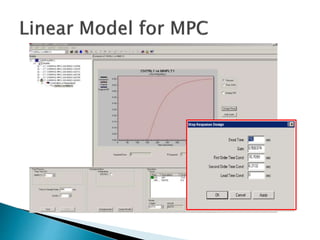
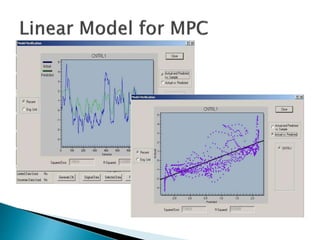
◦ MPC
◦ Kalman Filter
◦ Neural Networks
◦ LP Optimization
 Controlling process variable to a desired SP.
◦ Reactor Temperature
◦ Heat Exchanger Flow Rate
◦ Boiler Pressure
◦ OTC Tablet (API) Concentration.
◦ Dryer Moisture Content
◦ House Temperature
◦ Car Speed
◦ Distillation Column Production Rate
 Controller
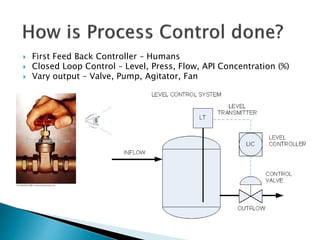
 First Feed Back Controller – Humans
 Closed Loop Control – Level, Press, Flow, API Concentration (%)
 Vary output – Valve, Pump, Agitator, Fan
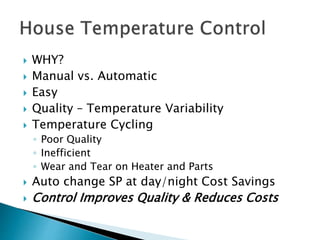
 WHY?
 Manual vs. Automatic
 Easy
 Quality – Temperature Variability
 Temperature Cycling
◦ Poor Quality
◦ Inefficient
◦ Wear and Tear on Heater and Parts
 Auto change SP at day/night Cost Savings
 Control Improves Quality & Reduces Costs
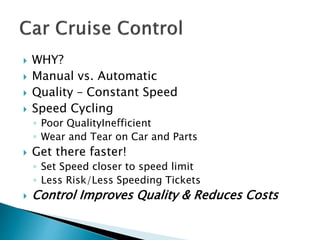
 WHY?
 Manual vs. Automatic
 Quality – Constant Speed
 Speed Cycling
◦ Poor QualityInefficient
◦ Wear and Tear on Car and Parts
 Get there faster!
◦ Set Speed closer to speed limit
◦ Less Risk/Less Speeding Tickets
 Control Improves Quality & Reduces Costs
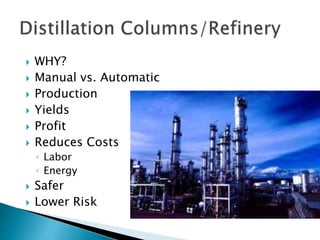
 WHY?
 Manual vs. Automatic
 Production
 Yields
 Profit
 Reduces Costs
◦ Labor
◦ Energy
 Safer
 Lower Risk
 Improves Quality
 Reduces Costs
 Increases Production
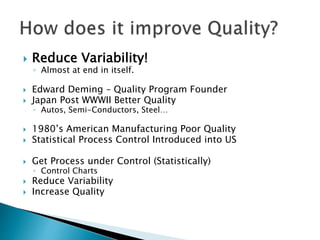
 Reduce Variability!
◦ Almost at end in itself.
 Edward Deming – Quality Program Founder
 Japan Post WWWII Better Quality
◦ Autos, Semi-Conductors, Steel…
 1980’s American Manufacturing Poor Quality
 Statistical Process Control Introduced into US
 Get Process under Control (Statistically)
◦ Control Charts
 Reduce Variability
 Increase Quality
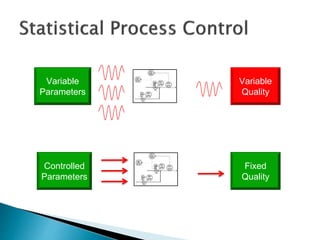
Variable
Parameters
Variable
Quality
Controlled
Parameters
Fixed
Quality
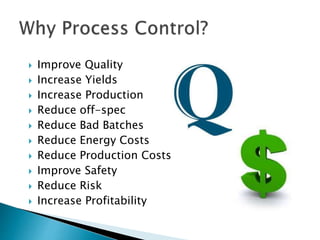
 Improve Quality
 Increase Yields
 Increase Production
 Reduce off-spec
 Reduce Bad Batches
 Reduce Energy Costs
 Reduce Production Costs
 Improve Safety
 Reduce Risk
 Increase Profitability
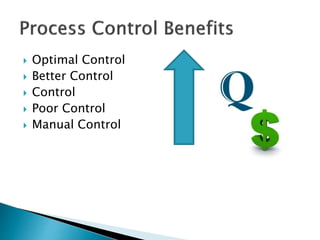
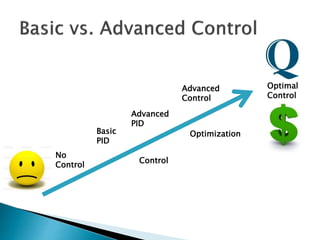
 Optimal Control
 Better Control
 Control
 Poor Control
 Manual Control
Basic
PID
Advanced
PID
Advanced
Control
No
Control
Optimal
Control
Optimization
Control
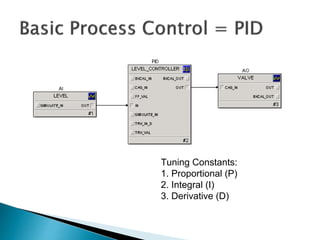
Tuning Constants:
1. Proportional (P)
2. Integral (I)
3. Derivative (D)
Applications
 Car Cruise Control
 Home Heating/AC,
 Distillation Columns
 Chemical Reactors
 Bioreactors
 Crystallization
 Chromatography
Industries
 Chemical
 Pharmaceutical
 Petroleum
 Automotive
 Robots
 Aerospace
 Boilers
 Missile Guidance
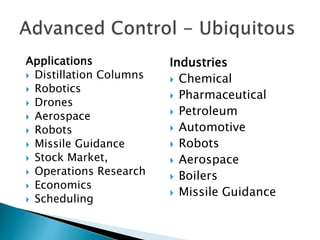
Applications
 Distillation Columns
 Robotics
 Drones
 Aerospace
 Robots
 Missile Guidance
 Stock Market,
 Operations Research
 Economics
 Scheduling
Industries
 Chemical
 Pharmaceutical
 Petroleum
 Automotive
 Robots
 Aerospace
 Boilers
 Missile Guidance
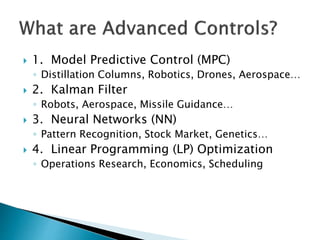
 1. Model Predictive Control (MPC)
◦ Distillation Columns, Robotics, Drones, Aerospace…
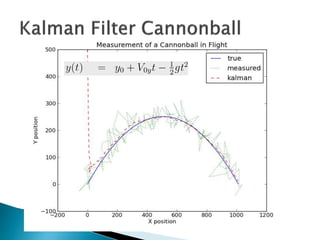
 2. Kalman Filter
◦ Robots, Aerospace, Missile Guidance…
 3. Neural Networks (NN)
◦ Pattern Recognition, Stock Market, Genetics…
 4. Linear Programming (LP) Optimization
◦ Operations Research, Economics, Scheduling
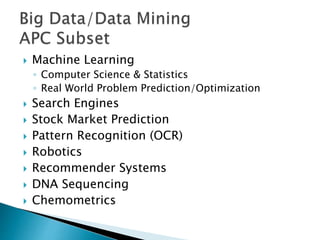
 Machine Learning
◦ Computer Science & Statistics
◦ Real World Problem Prediction/Optimization
 Search Engines
 Stock Market Prediction
 Pattern Recognition (OCR)
 Robotics
 Recommender Systems
 DNA Sequencing
 Chemometrics
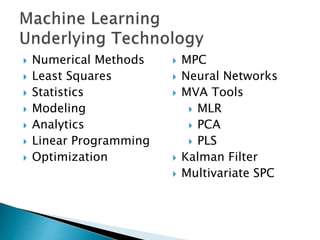
 Numerical Methods
 Least Squares
 Statistics
 Modeling
 Analytics
 Linear Programming
 Optimization
 MPC
 Neural Networks
 MVA Tools
 MLR
 PCA
 PLS
 Kalman Filter
 Multivariate SPC
 Optimal Control
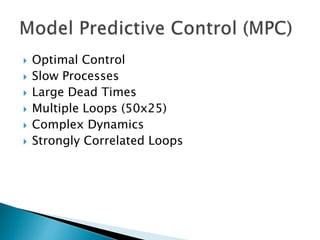
 Slow Processes
 Large Dead Times
 Multiple Loops (50x25)
 Complex Dynamics
 Strongly Correlated Loops
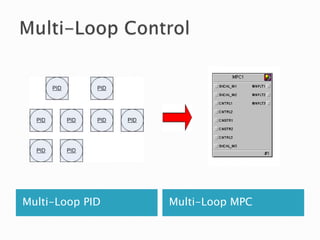
Multi-Loop PID Multi-Loop MPC
          
22 2
1 1 1 1 1 1
1 1
y u u
n n nP M M
y set u u
j j j j j j j j
i j i j i j
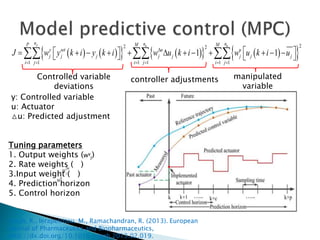
J w y k i y k i w u k i w u k i u
     
                  
y: Controlled variable
u: Actuator
△u: Predicted adjustment
manipulated
variable
deviations
Controlled variable
deviations
controller adjustments
Singh, R., Ierapetritou, M., Ramachandran, R. (2013). European
Journal of Pharmaceutics and Biopharmaceutics,
http://dx.doi.org/10.1016/j.ejpb.2013.02.019.
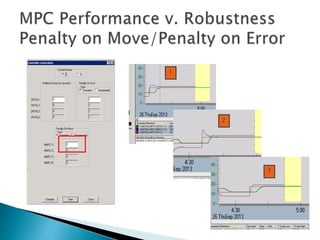
Tuning parameters
1. Output weights (wy
j)
2. Rate weights ( )
3.Input weight ( )
4. Prediction horizon
5. Control horizon
u
jw
u
jw
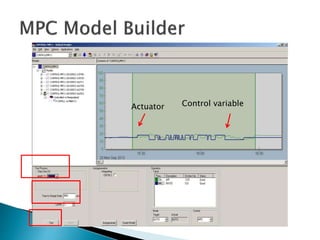
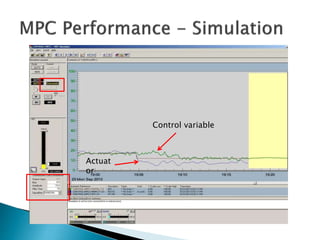
Actuator Control variable
Actuat
or
Control variable
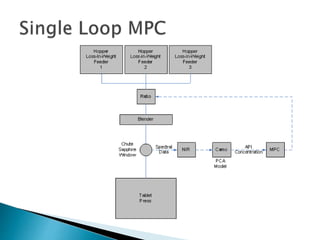
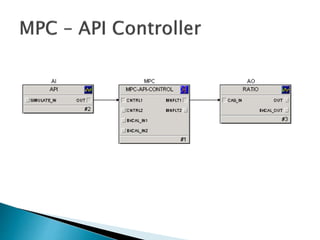
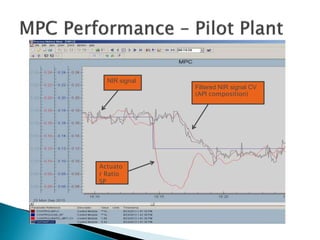
Filtered NIR signal CV
(API composition)
Actuato
r Ratio
SP
NIR signal
3
1
2
 Statistically Optimal Estimator
 Numerous Applications
◦ De facto Standard Robotics
◦ Aerospace
◦ Missile Guidance
◦ Economics
◦ Signal Processing
 State Prediction based on:
◦ Noisy Data
◦ Physical Model (Error increases w/ Time)
 Takes a statistical average of:
◦ Measured Variable
◦ Model
 Acts Recursively to continuously predict most
probable state.
 First used by NASA to predict location of rockets
◦ Uncertain GPS Signal
◦ Physical Model error increases with time
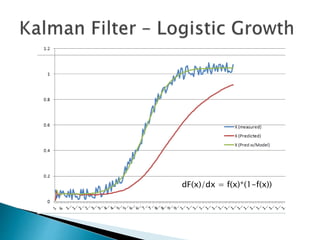
 Use measurement signal to correct errors with
model.
 Use model to validate measured values.
dF(x)/dx = f(x)*(1-f(x))
 E-mail Spam
 Internet Browser
 Recommender systems
 Pattern Recognition
◦ Bar coders
◦ Facial identification
◦ Robotics
 Pharma
◦ Soft Sensors
◦ Non-Linear Control
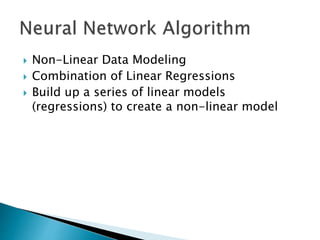
 Non-Linear Data Modeling
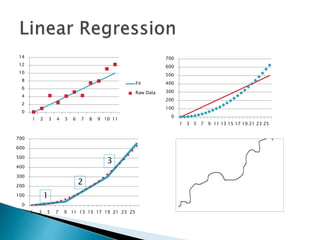
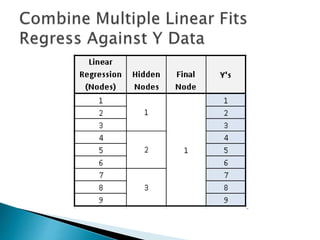
 Combination of Linear Regressions
 Build up a series of linear models
(regressions) to create a non-linear model
0
2
4
6
8
10
12
14
1 2 3 4 5 6 7 8 9 10 11
Fit
Raw Data
0
100
200
300
400
500
600
700
1 3 5 7 9 11 13 15 17 19 21 23 25
0
100
200
300
400
500
600
700
1 3 5 7 9 11 13 15 17 19 21 23 25
1
2
3
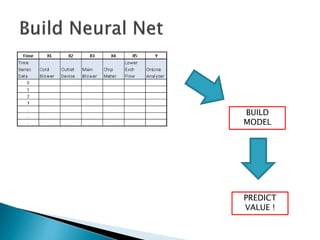
BUILD
MODEL
PREDICT
VALUE !
 Linear Programming
 A mathematical/computer optimization
technique – Simplex Method
 Solve a system of linear equations
 Can be used to find the minimum and
maximum states of process control
 Can be made subject to multiple constraints
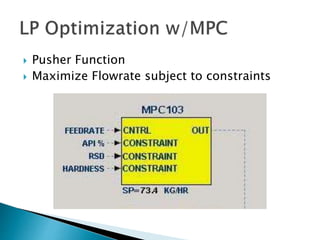
 Pusher Function
 Maximize Flowrate subject to constraints
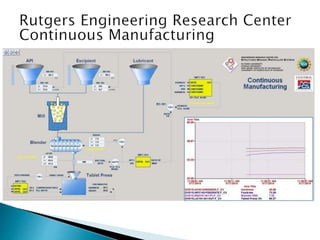
 Introduction of Technology
◦ PAT
◦ Continuous Manufacturing
 Introduce Advanced Controls
◦ MPC
◦ Kalman Filter
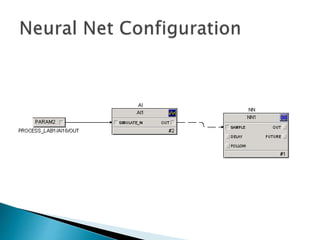
◦ Neural Net
◦ LP Optimization
◦ MultiVariable SPC

AAPS Advanced Controls Uploaded 2

  • 1.
    Advanced Process Controland Continuous Processing in Pharmaceutical Manufacturing: What Can We Learn from Other Industries Paul Brodbeck/Control Associates Inc.
  • 2.
     What isProcess Control?  How?  Why?  Benefits?  Why Advanced Process Control?  Advanced Controls ◦ MPC ◦ Kalman Filter ◦ Neural Networks ◦ LP Optimization
  • 3.
     Controlling processvariable to a desired SP. ◦ Reactor Temperature ◦ Heat Exchanger Flow Rate ◦ Boiler Pressure ◦ OTC Tablet (API) Concentration. ◦ Dryer Moisture Content ◦ House Temperature ◦ Car Speed ◦ Distillation Column Production Rate  Controller
  • 4.
     First FeedBack Controller – Humans  Closed Loop Control – Level, Press, Flow, API Concentration (%)  Vary output – Valve, Pump, Agitator, Fan
  • 5.
     WHY?  Manualvs. Automatic  Easy  Quality – Temperature Variability  Temperature Cycling ◦ Poor Quality ◦ Inefficient ◦ Wear and Tear on Heater and Parts  Auto change SP at day/night Cost Savings  Control Improves Quality & Reduces Costs
  • 6.
     WHY?  Manualvs. Automatic  Quality – Constant Speed  Speed Cycling ◦ Poor QualityInefficient ◦ Wear and Tear on Car and Parts  Get there faster! ◦ Set Speed closer to speed limit ◦ Less Risk/Less Speeding Tickets  Control Improves Quality & Reduces Costs
  • 7.
     WHY?  Manualvs. Automatic  Production  Yields  Profit  Reduces Costs ◦ Labor ◦ Energy  Safer  Lower Risk
  • 8.
     Improves Quality Reduces Costs  Increases Production
  • 9.
     Reduce Variability! ◦Almost at end in itself.  Edward Deming – Quality Program Founder  Japan Post WWWII Better Quality ◦ Autos, Semi-Conductors, Steel…  1980’s American Manufacturing Poor Quality  Statistical Process Control Introduced into US  Get Process under Control (Statistically) ◦ Control Charts  Reduce Variability  Increase Quality
  • 10.
  • 12.
     Improve Quality Increase Yields  Increase Production  Reduce off-spec  Reduce Bad Batches  Reduce Energy Costs  Reduce Production Costs  Improve Safety  Reduce Risk  Increase Profitability
  • 13.
     Optimal Control Better Control  Control  Poor Control  Manual Control
  • 14.
  • 15.
    Tuning Constants: 1. Proportional(P) 2. Integral (I) 3. Derivative (D)
  • 16.
    Applications  Car CruiseControl  Home Heating/AC,  Distillation Columns  Chemical Reactors  Bioreactors  Crystallization  Chromatography Industries  Chemical  Pharmaceutical  Petroleum  Automotive  Robots  Aerospace  Boilers  Missile Guidance
  • 17.
    Applications  Distillation Columns Robotics  Drones  Aerospace  Robots  Missile Guidance  Stock Market,  Operations Research  Economics  Scheduling Industries  Chemical  Pharmaceutical  Petroleum  Automotive  Robots  Aerospace  Boilers  Missile Guidance
  • 18.
     1. ModelPredictive Control (MPC) ◦ Distillation Columns, Robotics, Drones, Aerospace…  2. Kalman Filter ◦ Robots, Aerospace, Missile Guidance…  3. Neural Networks (NN) ◦ Pattern Recognition, Stock Market, Genetics…  4. Linear Programming (LP) Optimization ◦ Operations Research, Economics, Scheduling
  • 19.
     Machine Learning ◦Computer Science & Statistics ◦ Real World Problem Prediction/Optimization  Search Engines  Stock Market Prediction  Pattern Recognition (OCR)  Robotics  Recommender Systems  DNA Sequencing  Chemometrics
  • 20.
     Numerical Methods Least Squares  Statistics  Modeling  Analytics  Linear Programming  Optimization  MPC  Neural Networks  MVA Tools  MLR  PCA  PLS  Kalman Filter  Multivariate SPC
  • 21.
     Optimal Control Slow Processes  Large Dead Times  Multiple Loops (50x25)  Complex Dynamics  Strongly Correlated Loops
  • 23.
  • 24.
              22 2 1 1 1 1 1 1 1 1 y u u n n nP M M y set u u j j j j j j j j i j i j i j J w y k i y k i w u k i w u k i u                          y: Controlled variable u: Actuator △u: Predicted adjustment manipulated variable deviations Controlled variable deviations controller adjustments Singh, R., Ierapetritou, M., Ramachandran, R. (2013). European Journal of Pharmaceutics and Biopharmaceutics, http://dx.doi.org/10.1016/j.ejpb.2013.02.019. Tuning parameters 1. Output weights (wy j) 2. Rate weights ( ) 3.Input weight ( ) 4. Prediction horizon 5. Control horizon u jw u jw
  • 28.
  • 32.
  • 33.
    Filtered NIR signalCV (API composition) Actuato r Ratio SP NIR signal
  • 34.
  • 35.
     Statistically OptimalEstimator  Numerous Applications ◦ De facto Standard Robotics ◦ Aerospace ◦ Missile Guidance ◦ Economics ◦ Signal Processing  State Prediction based on: ◦ Noisy Data ◦ Physical Model (Error increases w/ Time)
  • 36.
     Takes astatistical average of: ◦ Measured Variable ◦ Model  Acts Recursively to continuously predict most probable state.  First used by NASA to predict location of rockets ◦ Uncertain GPS Signal ◦ Physical Model error increases with time  Use measurement signal to correct errors with model.  Use model to validate measured values.
  • 38.
  • 39.
     E-mail Spam Internet Browser  Recommender systems  Pattern Recognition ◦ Bar coders ◦ Facial identification ◦ Robotics  Pharma ◦ Soft Sensors ◦ Non-Linear Control
  • 40.
     Non-Linear DataModeling  Combination of Linear Regressions  Build up a series of linear models (regressions) to create a non-linear model
  • 41.
    0 2 4 6 8 10 12 14 1 2 34 5 6 7 8 9 10 11 Fit Raw Data 0 100 200 300 400 500 600 700 1 3 5 7 9 11 13 15 17 19 21 23 25 0 100 200 300 400 500 600 700 1 3 5 7 9 11 13 15 17 19 21 23 25 1 2 3
  • 45.
  • 47.
     Linear Programming A mathematical/computer optimization technique – Simplex Method  Solve a system of linear equations  Can be used to find the minimum and maximum states of process control  Can be made subject to multiple constraints
  • 48.
     Pusher Function Maximize Flowrate subject to constraints
  • 50.
     Introduction ofTechnology ◦ PAT ◦ Continuous Manufacturing  Introduce Advanced Controls ◦ MPC ◦ Kalman Filter ◦ Neural Net ◦ LP Optimization ◦ MultiVariable SPC