1
ME 433 - State Space Control 1
ME 433 – STATE SPACE CONTROL
Lecture 1
ME 433 - State Space Control 2
State Space Control
•  Time/Place: Room 290, STEPS Building
M/W 12:45-2:00 PM
•  Instructor: Eugenio Schuster,
Office: Room 454, Packard Lab,
Phone: 610-758-5253
Email: schuster@lehigh.edu,
Office hours: By appointment
•  Webpage:
http://www.lehigh.edu/~eus204/Teaching/ME433/ME433.html
•  E-mail list: Make sure to be in the mailing list!!!
2
ME 433 - State Space Control 3
State Space Control
State-space methods of feedback control system design and design
optimization for invariant and time-varying deterministic, continuous
systems; pole positioning, observability, controllability, modal control,
observer design, the theory of optimal processes and Pontryagin's
Maximum principle, the linear quadratic optimal regulator problem,
Lyapunov functions and stability theorems, linear optimal open loop
control; introduction to the calculus of variations. Intended for engineers
with a variety of backgrounds. Examples will be drawn from
mechanical, electrical and chemical engineering applications. MATLAB
is used extensively during the course for the analysis, design and
simulation.
ME 433 - State Space Control 4
State Space Control – Part I
•  Topics:
- Course description, objectives, examples
- Review of Classical Control
- Transfer functions ↔ state-space representations
- Solution of linear differential equations, linearization
- Canonical systems, modes, modal signal-flow diagrams
- Observability & Controllability
- Observability & Controllability grammians; Rank tests
- Stability
- State feedback control; Accommodating reference inputs
- Linear observer design
- Separation principle
3
ME 433 - State Space Control 5
State Space Control – Part II
•  Topics:
- Static Optimization
Optimization without/with constraints
Numerical solution methods
- Dynamic Optimization
Discrete-time and continuous-time systems
Open loop and closed loop control
Linear Quadratic Regulator (LQR)
Pontryagin’s Minimum Principle
- Dynamic Programming
Bellman’s Principle of Optimality
Discrete-time and continuous-time systems
Hamilton-Jacobi-Bellman Equation
- Optimal Estimation/Kalman Filtering
Discrete-time and continuous-time systems
Linear Quadratic Gaussian Control (LQG)
ME 433 - State Space Control 6
Modern Control
•  Books:
–  B. Friedland, “Control System Design: An Introduction to State-
Space Methods,”
Dover Publications, 1986, ISBN: 0-486-44278-0.
–  Kailath, “Linear Systems”
–  Brogan, “Modern Control Theory”
–  Rugh, “Linear System Theory”
–  Dorf and Bishop, “Modern Control Systems”
–  Antsaklis and Michel, “Linear Systems”
–  Chen, “Linear system Theory and Design”
4
ME 433 - State Space Control 7
Optimal Control and Estimation
•  Books:
–  D.S. Naidu, “Optimal Control Systems”
CRC Press, 2002, ISBN: 0-849-30892-5.
–  D.E. Kirk, “Optimal Control Theory: An Introduction”
–  Bryson and Ho, “Applied Optimal Control”
–  Lewis and Syrmos, “Optimal Control”
–  Anderson and Moore, “Optimal Filtering”
–  Gelb, “Applied Optimal Estimation”
–  Stengel, “Optimal Control and Estimation”
ME 433 - State Space Control 8
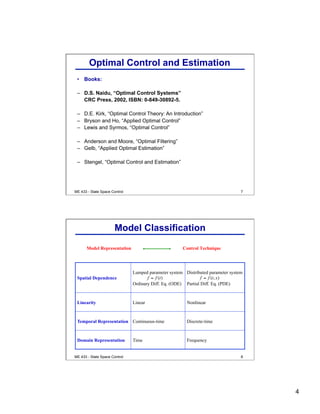
Model Classification
Spatial Dependence
Lumped parameter system
Ordinary Diff. Eq. (ODE)
Distributed parameter system
Partial Diff. Eq. (PDE)
Linearity Linear Nonlinear
Temporal Representation Continuous-time Discrete-time
Domain Representation Time Frequency
Model Representation Control Technique
5
ME 433 - State Space Control 9
Spatial Dependence
Distributed Parameter Systems
PDE
Lumped Parameter Systems
ODE
Reduction
Keep the PDE representation (problem specific)
Control: Interior Boundary
Linearity: Nonlinear/Linear
Linear/Nonlinear Distributed Parameter Control
Linear/Nonlinear Lumped Parameter Control
ME 433 - State Space Control 10
Linearity
Nonlinear (ODE) Systems Linear (ODE) Systems
Nonlinear Control
Linearization
LTI
LTV
Autonomous
Non-Autonomous states
input
output
Linear Control
Output/State Feedback
Estimation: How to estimate states from input/output?
Keep the nonlinearities
6
ME 433 - State Space Control 11
Linearity
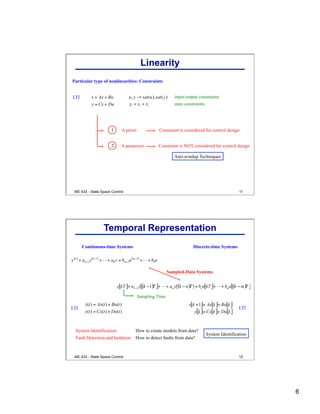
Particular type of nonlinearities: Constraints
Anti-windup Techniques
A priori
A posteriori
LTI
Constraint is considered for control design
Constraint is NOT considered for control design
input/output constraints
state constraints
ME 433 - State Space Control 12
Temporal Representation
Continuous-time Systems Discrete-time Systems
System Identification
LTI LTI
Sampled-Data Systems
Sampling Time
System Identification: How to create models from data?
Fault Detection and Isolation: How to detect faults from data?
7
ME 433 - State Space Control 13
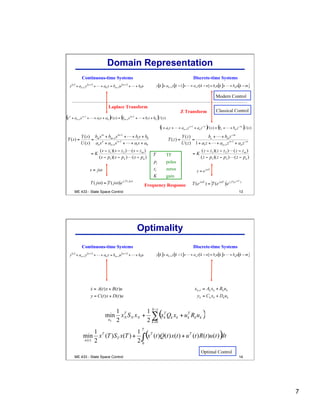
Domain Representation
Continuous-time Systems Discrete-time Systems
Laplace Transform
Z Transform
TF
poles
zeros
gain
Frequency Response
Modern Control
Classical Control
ME 433 - State Space Control 14
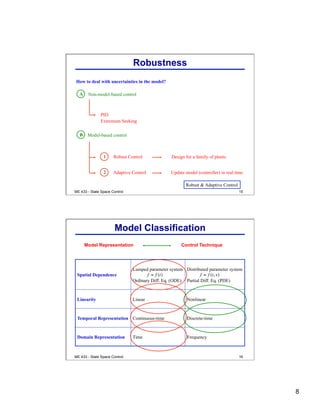
Optimality
Continuous-time Systems Discrete-time Systems
Optimal Control
8
ME 433 - State Space Control 15
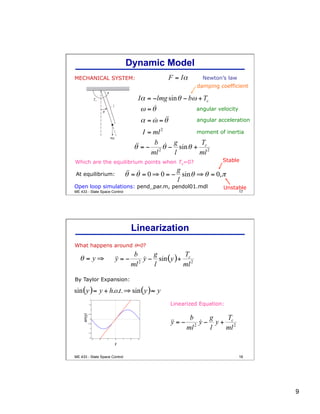
Robustness
How to deal with uncertainties in the model?
Adaptive Control
Design for a family of plants
Update model (controller) in real time
Robust Control
B Model-based control
A Non-model-based control
PID
Extremum Seeking
Robust & Adaptive Control
ME 433 - State Space Control 16
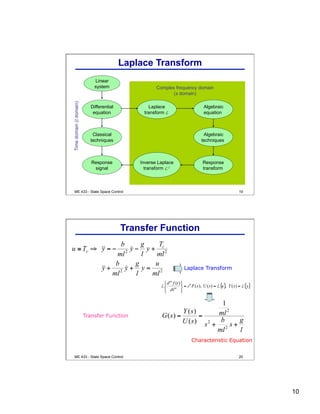
Model Classification
Spatial Dependence
Lumped parameter system
Ordinary Diff. Eq. (ODE)
Distributed parameter system
Partial Diff. Eq. (PDE)
Linearity Linear Nonlinear
Temporal Representation Continuous-time Discrete-time
Domain Representation Time Frequency
Model Representation Control Technique
9
17
MECHANICAL SYSTEM: Newton’s law
Which are the equilibrium points when Tc=0?
At equilibrium:
damping coefficient
angular velocity
angular acceleration
moment of inertia
Open loop simulations: pend_par.m, pendol01.mdl
Stable
Unstable
Dynamic Model
ME 433 - State Space Control
18
What happens around θ=0?
By Taylor Expansion:
Linearized Equation:
y
sin(y)
Linearization
ME 433 - State Space Control
10
19
Linear
system
Differential
equation
Classical
techniques
Response
signal
Laplace
transform L
Inverse Laplace
transform L-1
Algebraic
equation
Algebraic
techniques
Response
transform
Timedomain(tdomain)
Complex frequency domain
(s domain)
Laplace Transform
ME 433 - State Space Control
20
Laplace Transform
Characteristic Equation
Transfer Function
Transfer Function
ME 433 - State Space Control
11
21
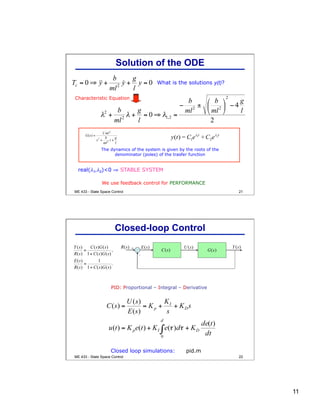
What is the solutions y(t)?
real(λ1,λ2)<0 ⇒ STABLE SYSTEM
We use feedback control for PERFORMANCE
Characteristic Equation
The dynamics of the system is given by the roots of the
denominator (poles) of the trasfer function
Solution of the ODE
ME 433 - State Space Control
22
-
+
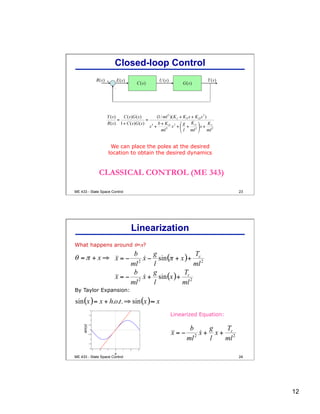
PID: Proportional – Integral – Derivative
Closed loop simulations: pid.m
Closed-loop Control
ME 433 - State Space Control
12
23
-
+
We can place the poles at the desired
location to obtain the desired dynamics
CLASSICAL CONTROL (ME 343)
Closed-loop Control
ME 433 - State Space Control
24
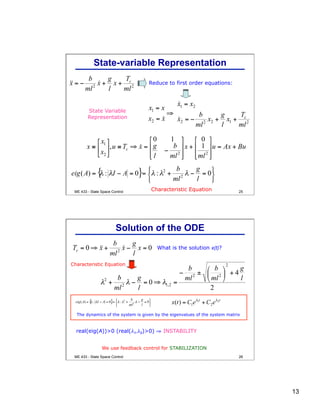
What happens around θ=π?
By Taylor Expansion:
Linearized Equation:
x
sin(x)
Linearization
ME 433 - State Space Control
13
25
Reduce to first order equations:
State Variable
Representation
Characteristic Equation
State-variable Representation
ME 433 - State Space Control
26
What is the solution x(t)?
real(eig(A))>0 (real(λ1,λ2)>0) ⇒ INSTABILITY
We use feedback control for STABILIZATION
Characteristic Equation
The dynamics of the system is given by the eigenvalues of the system matrix
Solution of the ODE
ME 433 - State Space Control
14
27
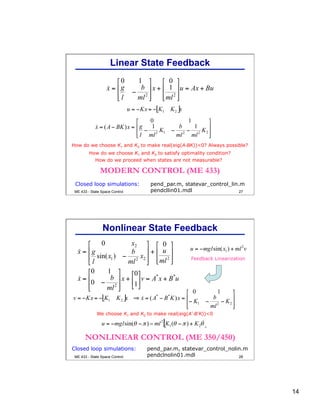
How do we choose K1 and K2 to make real(eig(A-BK))<0? Always possible?
MODERN CONTROL (ME 433)
Closed loop simulations: pend_par.m, statevar_control_lin.m
pendcllin01.mdl
Linear State Feedback
How do we choose K1 and K2 to satisfy optimality condition?
How do we proceed when states are not measurable?
ME 433 - State Space Control
28
We choose K1 and K2 to make real(eig(A*-B*K))<0
Feedback Linearization
Closed loop simulations: pend_par.m, statevar_control_nolin.m
pendclnolin01.mdl
NONLINEAR CONTROL (ME 350/450)
Nonlinear State Feedback
ME 433 - State Space Control
15
29
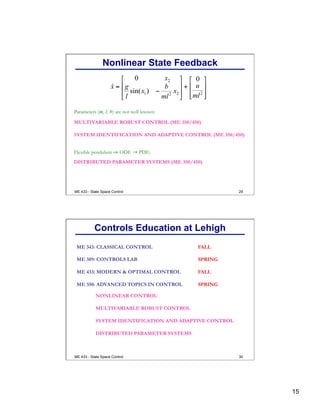
Parameters (m, l, b) are not well known:
MULTIVARIABLE ROBUST CONTROL (ME 350/450)
SYSTEM IDENTIFICATION AND ADAPTIVE CONTROL (ME 350/450)
Nonlinear State Feedback
Flexible pendulum ⇒ ODE → PDE:
DISTRIBUTED PARAMETER SYSTEMS (ME 350/450)
ME 433 - State Space Control
30
ME 343: CLASSICAL CONTROL FALL
ME 433: MODERN & OPTIMAL CONTROL FALL
ME 389: CONTROLS LAB SPRING
ME 350: ADVANCED TOPICS IN CONTROL SPRING
NONLINEAR CONTROL
MULTIVARIABLE ROBUST CONTROL
SYSTEM IDENTIFICATION AND ADAPTIVE CONTROL
DISTRIBUTED PARAMETER SYSTEMS
Controls Education at Lehigh
ME 433 - State Space Control

State space

  • 1.
    1 ME 433 -State Space Control 1 ME 433 – STATE SPACE CONTROL Lecture 1 ME 433 - State Space Control 2 State Space Control •  Time/Place: Room 290, STEPS Building M/W 12:45-2:00 PM •  Instructor: Eugenio Schuster, Office: Room 454, Packard Lab, Phone: 610-758-5253 Email: schuster@lehigh.edu, Office hours: By appointment •  Webpage: http://www.lehigh.edu/~eus204/Teaching/ME433/ME433.html •  E-mail list: Make sure to be in the mailing list!!!
  • 2.
    2 ME 433 -State Space Control 3 State Space Control State-space methods of feedback control system design and design optimization for invariant and time-varying deterministic, continuous systems; pole positioning, observability, controllability, modal control, observer design, the theory of optimal processes and Pontryagin's Maximum principle, the linear quadratic optimal regulator problem, Lyapunov functions and stability theorems, linear optimal open loop control; introduction to the calculus of variations. Intended for engineers with a variety of backgrounds. Examples will be drawn from mechanical, electrical and chemical engineering applications. MATLAB is used extensively during the course for the analysis, design and simulation. ME 433 - State Space Control 4 State Space Control – Part I •  Topics: - Course description, objectives, examples - Review of Classical Control - Transfer functions ↔ state-space representations - Solution of linear differential equations, linearization - Canonical systems, modes, modal signal-flow diagrams - Observability & Controllability - Observability & Controllability grammians; Rank tests - Stability - State feedback control; Accommodating reference inputs - Linear observer design - Separation principle
  • 3.
    3 ME 433 -State Space Control 5 State Space Control – Part II •  Topics: - Static Optimization Optimization without/with constraints Numerical solution methods - Dynamic Optimization Discrete-time and continuous-time systems Open loop and closed loop control Linear Quadratic Regulator (LQR) Pontryagin’s Minimum Principle - Dynamic Programming Bellman’s Principle of Optimality Discrete-time and continuous-time systems Hamilton-Jacobi-Bellman Equation - Optimal Estimation/Kalman Filtering Discrete-time and continuous-time systems Linear Quadratic Gaussian Control (LQG) ME 433 - State Space Control 6 Modern Control •  Books: –  B. Friedland, “Control System Design: An Introduction to State- Space Methods,” Dover Publications, 1986, ISBN: 0-486-44278-0. –  Kailath, “Linear Systems” –  Brogan, “Modern Control Theory” –  Rugh, “Linear System Theory” –  Dorf and Bishop, “Modern Control Systems” –  Antsaklis and Michel, “Linear Systems” –  Chen, “Linear system Theory and Design”
  • 4.
    4 ME 433 -State Space Control 7 Optimal Control and Estimation •  Books: –  D.S. Naidu, “Optimal Control Systems” CRC Press, 2002, ISBN: 0-849-30892-5. –  D.E. Kirk, “Optimal Control Theory: An Introduction” –  Bryson and Ho, “Applied Optimal Control” –  Lewis and Syrmos, “Optimal Control” –  Anderson and Moore, “Optimal Filtering” –  Gelb, “Applied Optimal Estimation” –  Stengel, “Optimal Control and Estimation” ME 433 - State Space Control 8 Model Classification Spatial Dependence Lumped parameter system Ordinary Diff. Eq. (ODE) Distributed parameter system Partial Diff. Eq. (PDE) Linearity Linear Nonlinear Temporal Representation Continuous-time Discrete-time Domain Representation Time Frequency Model Representation Control Technique
  • 5.
    5 ME 433 -State Space Control 9 Spatial Dependence Distributed Parameter Systems PDE Lumped Parameter Systems ODE Reduction Keep the PDE representation (problem specific) Control: Interior Boundary Linearity: Nonlinear/Linear Linear/Nonlinear Distributed Parameter Control Linear/Nonlinear Lumped Parameter Control ME 433 - State Space Control 10 Linearity Nonlinear (ODE) Systems Linear (ODE) Systems Nonlinear Control Linearization LTI LTV Autonomous Non-Autonomous states input output Linear Control Output/State Feedback Estimation: How to estimate states from input/output? Keep the nonlinearities
  • 6.
    6 ME 433 -State Space Control 11 Linearity Particular type of nonlinearities: Constraints Anti-windup Techniques A priori A posteriori LTI Constraint is considered for control design Constraint is NOT considered for control design input/output constraints state constraints ME 433 - State Space Control 12 Temporal Representation Continuous-time Systems Discrete-time Systems System Identification LTI LTI Sampled-Data Systems Sampling Time System Identification: How to create models from data? Fault Detection and Isolation: How to detect faults from data?
  • 7.
    7 ME 433 -State Space Control 13 Domain Representation Continuous-time Systems Discrete-time Systems Laplace Transform Z Transform TF poles zeros gain Frequency Response Modern Control Classical Control ME 433 - State Space Control 14 Optimality Continuous-time Systems Discrete-time Systems Optimal Control
  • 8.
    8 ME 433 -State Space Control 15 Robustness How to deal with uncertainties in the model? Adaptive Control Design for a family of plants Update model (controller) in real time Robust Control B Model-based control A Non-model-based control PID Extremum Seeking Robust & Adaptive Control ME 433 - State Space Control 16 Model Classification Spatial Dependence Lumped parameter system Ordinary Diff. Eq. (ODE) Distributed parameter system Partial Diff. Eq. (PDE) Linearity Linear Nonlinear Temporal Representation Continuous-time Discrete-time Domain Representation Time Frequency Model Representation Control Technique
  • 9.
    9 17 MECHANICAL SYSTEM: Newton’slaw Which are the equilibrium points when Tc=0? At equilibrium: damping coefficient angular velocity angular acceleration moment of inertia Open loop simulations: pend_par.m, pendol01.mdl Stable Unstable Dynamic Model ME 433 - State Space Control 18 What happens around θ=0? By Taylor Expansion: Linearized Equation: y sin(y) Linearization ME 433 - State Space Control
  • 10.
    10 19 Linear system Differential equation Classical techniques Response signal Laplace transform L Inverse Laplace transformL-1 Algebraic equation Algebraic techniques Response transform Timedomain(tdomain) Complex frequency domain (s domain) Laplace Transform ME 433 - State Space Control 20 Laplace Transform Characteristic Equation Transfer Function Transfer Function ME 433 - State Space Control
  • 11.
    11 21 What is thesolutions y(t)? real(λ1,λ2)<0 ⇒ STABLE SYSTEM We use feedback control for PERFORMANCE Characteristic Equation The dynamics of the system is given by the roots of the denominator (poles) of the trasfer function Solution of the ODE ME 433 - State Space Control 22 - + PID: Proportional – Integral – Derivative Closed loop simulations: pid.m Closed-loop Control ME 433 - State Space Control
  • 12.
    12 23 - + We can placethe poles at the desired location to obtain the desired dynamics CLASSICAL CONTROL (ME 343) Closed-loop Control ME 433 - State Space Control 24 What happens around θ=π? By Taylor Expansion: Linearized Equation: x sin(x) Linearization ME 433 - State Space Control
  • 13.
    13 25 Reduce to firstorder equations: State Variable Representation Characteristic Equation State-variable Representation ME 433 - State Space Control 26 What is the solution x(t)? real(eig(A))>0 (real(λ1,λ2)>0) ⇒ INSTABILITY We use feedback control for STABILIZATION Characteristic Equation The dynamics of the system is given by the eigenvalues of the system matrix Solution of the ODE ME 433 - State Space Control
  • 14.
    14 27 How do wechoose K1 and K2 to make real(eig(A-BK))<0? Always possible? MODERN CONTROL (ME 433) Closed loop simulations: pend_par.m, statevar_control_lin.m pendcllin01.mdl Linear State Feedback How do we choose K1 and K2 to satisfy optimality condition? How do we proceed when states are not measurable? ME 433 - State Space Control 28 We choose K1 and K2 to make real(eig(A*-B*K))<0 Feedback Linearization Closed loop simulations: pend_par.m, statevar_control_nolin.m pendclnolin01.mdl NONLINEAR CONTROL (ME 350/450) Nonlinear State Feedback ME 433 - State Space Control
  • 15.
    15 29 Parameters (m, l,b) are not well known: MULTIVARIABLE ROBUST CONTROL (ME 350/450) SYSTEM IDENTIFICATION AND ADAPTIVE CONTROL (ME 350/450) Nonlinear State Feedback Flexible pendulum ⇒ ODE → PDE: DISTRIBUTED PARAMETER SYSTEMS (ME 350/450) ME 433 - State Space Control 30 ME 343: CLASSICAL CONTROL FALL ME 433: MODERN & OPTIMAL CONTROL FALL ME 389: CONTROLS LAB SPRING ME 350: ADVANCED TOPICS IN CONTROL SPRING NONLINEAR CONTROL MULTIVARIABLE ROBUST CONTROL SYSTEM IDENTIFICATION AND ADAPTIVE CONTROL DISTRIBUTED PARAMETER SYSTEMS Controls Education at Lehigh ME 433 - State Space Control