



The protection of information systems
against unauthorized access to or
modification of information, whether in
storage, processing or transit, and against
the denial of service to authorized users or
the provision of service to unauthorized
users, including those measures necessary to
detect, document, and counter such threats
The result of any system of administrative
policies and procedures for identifying,
controlling, and protecting from
unauthorized disclosure, information the
protection of which is authorized by
executive order


Information Security Management provides:

- a systematic approach to achieving effective

information security within an organization;
- a realistic understanding of information security risks
and issues facing organizations; and
effective techniques for matching information security
requirements with business requirements.
- consists of various facets : security policy, risk analysis,
risk management, contingency planning, and disaster
recovery
Information Security Threats
Software agents and malicious code
Virus :
A program which gets executed when ever a
program is run on computer

Trojan Horse :
A program which does its supposed job but also
includes unsuspected and undesirable
functions. e. g. deletion of desirable items

Worm :
A self replicating program, creates its own
copies and executes, works in networks.
Information Security Threats
contd
Threats to Servers on Networks
Hackers have potential access to large systems
with prospects of security holes
Hackers use popular UNIX programs to discover
account names and guess passwords
Hackers can use electronic eavesdropping to
trap user and un-encrypted passwords
Hackers can spoof or configure a system to
mimic some other system
Security Architecture
Business
Data and application security
Network Security
Authentication and Authorization
Physical Security
Procedural Security

External World
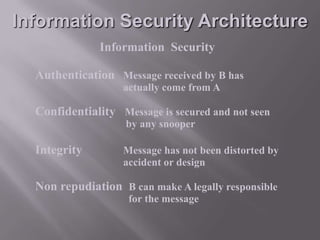
Information Security Architecture
Information Security
Authentication Message received by B has
actually come from A

Confidentiality Message is secured and not seen
by any snooper

Integrity

Message has not been distorted by
accident or design

Non repudiation B can make A legally responsible
for the message
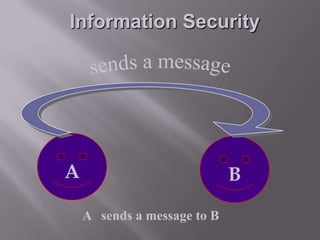
Information Security

A

B
A sends a message to B
Information Security contd
Encryption and Decryption Technology
Transfer Rs. 10,000 to the account of X
Encrypt
bjqhiudiiodo
Send
Decrypt

Receive

Transfer Rs. 10,000 to the account of X
Information Security contd
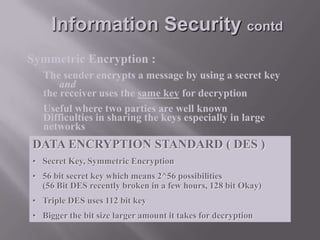
Symmetric Encryption :
The sender encrypts a message by using a secret key
and
the receiver uses the same key for decryption
Useful where two parties are well known
Difficulties in sharing the keys especially in large
networks

DATA ENCRYPTION STANDARD ( DES )
• Secret Key, Symmetric Encryption
• 56 bit secret key which means 2^56 possibilities
(56 Bit DES recently broken in a few hours, 128 bit Okay)
• Triple DES uses 112 bit key
• Bigger the bit size larger amount it takes for decryption
Information Security contd
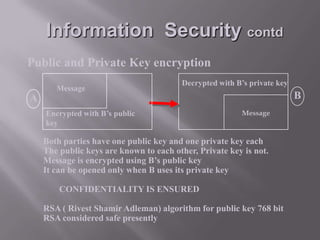
Public and Private Key encryption
Message

Decrypted with B’s private key

B

A
Encrypted with B’s public
key

Message

Both parties have one public key and one private key each
The public keys are known to each other, Private key is not.
Message is encrypted using B’s public key
It can be opened only when B uses its private key
CONFIDENTIALITY IS ENSURED

RSA ( Rivest Shamir Adleman) algorithm for public key 768 bit
RSA considered safe presently
Information Security contd
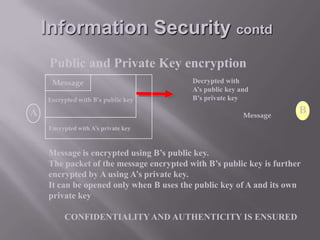
Public and Private Key encryption
Message
Encrypted with B’s public key

A

Decrypted with
A’s public key and
B’s private key
Message

B

Encrypted with A’s private key

Message is encrypted using B’s public key.
The packet of the message encrypted with B’s public key is further
encrypted by A using A’s private key.
It can be opened only when B uses the public key of A and its own
private key
CONFIDENTIALITY AND AUTHENTICITY IS ENSURED
Information Security contd
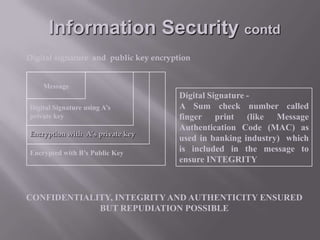
Digital signature and public key encryption

Message
Digital Signature using A’s
private key

Encryption with A’s private key
Encrypted with B’s Public Key

Digital Signature A Sum check number called
finger print (like Message
Authentication Code (MAC) as
used in banking industry) which
is included in the message to
ensure INTEGRITY

CONFIDENTIALITY, INTEGRITY AND AUTHENTICITY ENSURED
BUT REPUDIATION POSSIBLE
Information Security

contd

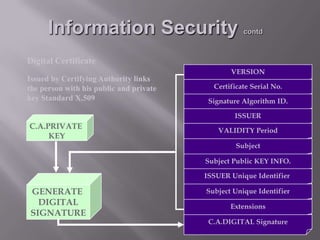
Digital Certificate
Issued by Certifying Authority links
the person with his public and private
key Standard X.509

VERSION
Certificate Serial No.
Signature Algorithm ID.
ISSUER

C.A.PRIVATE
KEY

VALIDITY Period
Subject
Subject Public KEY INFO.
ISSUER Unique Identifier

GENERATE
DIGITAL
SIGNATURE

Subject Unique Identifier

Extensions
C.A.DIGITAL Signature
Information Security contd
Public Key Infrastructure
Set of agreed upon standards, certification
authorities, structure between multiple authorities,
methods to discover and validate certification
paths,operational protocols, management protocols,
inter operable tools and supporting legislature

PKI Issues : Regulation
• Governments are producing legislation to govern
e-commerce
• Who regulates Certification Authorities
• C A Liability
• Revocation of certificates
Internet Security
• Internet provides global reach at very low
cost and
high speed but is not secure due to its inherent
weakness in TCP/IP
• Growth of the Internet Exponential results in
a rise
of security incidents
• Most ISP and user organisations use public
domain
software such as LINUX, Apache for Internet
that
are more prone to security threads
• Default network OS setting and access to
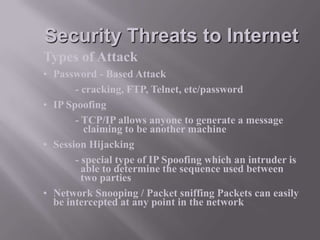
Security Threats to Internet
Types of Attack
• Password - Based Attack
- cracking, FTP, Telnet, etc/password
• IP Spoofing
- TCP/IP allows anyone to generate a message
claiming to be another machine
• Session Hijacking
- special type of IP Spoofing which an intruder is
able to determine the sequence used between
two parties
• Network Snooping / Packet sniffing Packets can easily
be intercepted at any point in the network
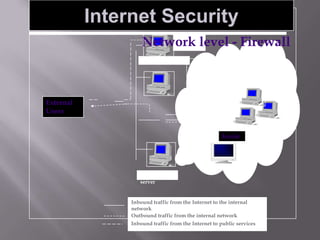
Internet Security
Web
Network level - Firewall
server
FTP server

External
Users
Inside

Gopher
server

Inbound traffic from the Internet to the internal
network
Outbound traffic from the internal network
Inbound traffic from the Internet to public services
Internet Security
Technology
Operational Technology
•One-Time passwords
•Network Monitoring Tools
•Network Security Analysis Tools
•Firewalls

Cryptography Policy based Technology
•Digital Signature
•PKI Policy
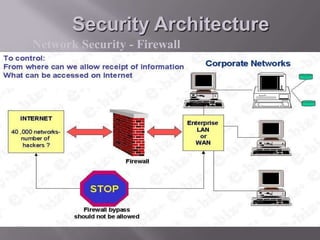
Security Architecture
Network Security - Firewall

Mis jaiswal-chapter-11

  • 2.
      The protection ofinformation systems against unauthorized access to or modification of information, whether in storage, processing or transit, and against the denial of service to authorized users or the provision of service to unauthorized users, including those measures necessary to detect, document, and counter such threats The result of any system of administrative policies and procedures for identifying, controlling, and protecting from unauthorized disclosure, information the protection of which is authorized by executive order
  • 3.
     Information Security Managementprovides: - a systematic approach to achieving effective information security within an organization; - a realistic understanding of information security risks and issues facing organizations; and effective techniques for matching information security requirements with business requirements. - consists of various facets : security policy, risk analysis, risk management, contingency planning, and disaster recovery
  • 4.
    Information Security Threats Softwareagents and malicious code Virus : A program which gets executed when ever a program is run on computer Trojan Horse : A program which does its supposed job but also includes unsuspected and undesirable functions. e. g. deletion of desirable items Worm : A self replicating program, creates its own copies and executes, works in networks.
  • 5.
    Information Security Threats contd Threatsto Servers on Networks Hackers have potential access to large systems with prospects of security holes Hackers use popular UNIX programs to discover account names and guess passwords Hackers can use electronic eavesdropping to trap user and un-encrypted passwords Hackers can spoof or configure a system to mimic some other system
  • 6.
    Security Architecture Business Data andapplication security Network Security Authentication and Authorization Physical Security Procedural Security External World
  • 7.
    Information Security Architecture InformationSecurity Authentication Message received by B has actually come from A Confidentiality Message is secured and not seen by any snooper Integrity Message has not been distorted by accident or design Non repudiation B can make A legally responsible for the message
  • 8.
  • 9.
    Information Security contd Encryptionand Decryption Technology Transfer Rs. 10,000 to the account of X Encrypt bjqhiudiiodo Send Decrypt Receive Transfer Rs. 10,000 to the account of X
  • 10.
    Information Security contd SymmetricEncryption : The sender encrypts a message by using a secret key and the receiver uses the same key for decryption Useful where two parties are well known Difficulties in sharing the keys especially in large networks DATA ENCRYPTION STANDARD ( DES ) • Secret Key, Symmetric Encryption • 56 bit secret key which means 2^56 possibilities (56 Bit DES recently broken in a few hours, 128 bit Okay) • Triple DES uses 112 bit key • Bigger the bit size larger amount it takes for decryption
  • 11.
    Information Security contd Publicand Private Key encryption Message Decrypted with B’s private key B A Encrypted with B’s public key Message Both parties have one public key and one private key each The public keys are known to each other, Private key is not. Message is encrypted using B’s public key It can be opened only when B uses its private key CONFIDENTIALITY IS ENSURED RSA ( Rivest Shamir Adleman) algorithm for public key 768 bit RSA considered safe presently
  • 12.
    Information Security contd Publicand Private Key encryption Message Encrypted with B’s public key A Decrypted with A’s public key and B’s private key Message B Encrypted with A’s private key Message is encrypted using B’s public key. The packet of the message encrypted with B’s public key is further encrypted by A using A’s private key. It can be opened only when B uses the public key of A and its own private key CONFIDENTIALITY AND AUTHENTICITY IS ENSURED
  • 13.
    Information Security contd Digitalsignature and public key encryption Message Digital Signature using A’s private key Encryption with A’s private key Encrypted with B’s Public Key Digital Signature A Sum check number called finger print (like Message Authentication Code (MAC) as used in banking industry) which is included in the message to ensure INTEGRITY CONFIDENTIALITY, INTEGRITY AND AUTHENTICITY ENSURED BUT REPUDIATION POSSIBLE
  • 14.
    Information Security contd Digital Certificate Issuedby Certifying Authority links the person with his public and private key Standard X.509 VERSION Certificate Serial No. Signature Algorithm ID. ISSUER C.A.PRIVATE KEY VALIDITY Period Subject Subject Public KEY INFO. ISSUER Unique Identifier GENERATE DIGITAL SIGNATURE Subject Unique Identifier Extensions C.A.DIGITAL Signature
  • 15.
    Information Security contd PublicKey Infrastructure Set of agreed upon standards, certification authorities, structure between multiple authorities, methods to discover and validate certification paths,operational protocols, management protocols, inter operable tools and supporting legislature PKI Issues : Regulation • Governments are producing legislation to govern e-commerce • Who regulates Certification Authorities • C A Liability • Revocation of certificates
  • 16.
    Internet Security • Internetprovides global reach at very low cost and high speed but is not secure due to its inherent weakness in TCP/IP • Growth of the Internet Exponential results in a rise of security incidents • Most ISP and user organisations use public domain software such as LINUX, Apache for Internet that are more prone to security threads • Default network OS setting and access to
  • 17.
    Security Threats toInternet Types of Attack • Password - Based Attack - cracking, FTP, Telnet, etc/password • IP Spoofing - TCP/IP allows anyone to generate a message claiming to be another machine • Session Hijacking - special type of IP Spoofing which an intruder is able to determine the sequence used between two parties • Network Snooping / Packet sniffing Packets can easily be intercepted at any point in the network
  • 18.
    Internet Security Web Network level- Firewall server FTP server External Users Inside Gopher server Inbound traffic from the Internet to the internal network Outbound traffic from the internal network Inbound traffic from the Internet to public services
  • 19.
    Internet Security Technology Operational Technology •One-Timepasswords •Network Monitoring Tools •Network Security Analysis Tools •Firewalls Cryptography Policy based Technology •Digital Signature •PKI Policy
  • 20.