
Implementing, Monitoring
Measuring & Reporting CSR
Important Websites










www.unglobalcompact.org
www.bitc.org.uk
www.globalreporting.org
www.globalsullivanprinciples.org
www.accountability.org.uk
www.oecd.org
www.iso.org
www.ftse.com
www.dowsustainabilityindexes.com
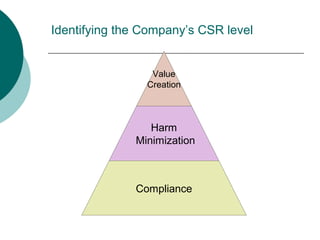
Identifying the Company’s CSR level

Value
Creation

Harm
Minimization

Compliance
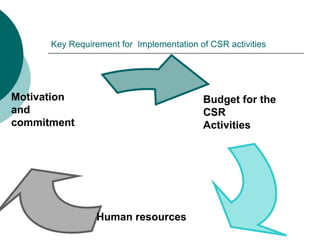
Key Requirement for Implementation of CSR activities

Motivation
and
commitment

Budget for the
CSR
Activities

Human resources
Steps for Operationalizing
CSR
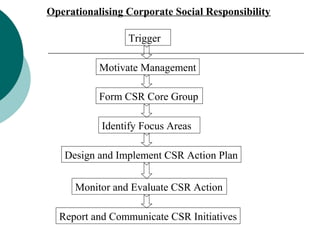
Operationalising Corporate Social Responsibility
Trigger
Motivate Management
Form CSR Core Group
Identify Focus Areas
Design and Implement CSR Action Plan
Monitor and Evaluate CSR Action
Report and Communicate CSR Initiatives
Operationalizing CSR
• Trigger : The process normally begins with a trigger or an event
that requires management attention and action. This trigger or
motivation can come from a product, workplace crisis, from
external pressures or from inner values and principles.
• Motivated Management : Motivated management formulates
the CSR Policy and describes the Vision and Mission Statement of
the Company.
•Written CSR Policy ensures a common understanding amongst
Board members, will define how much and what a company wants
to achieve and will ensure effective implementation.
•The CSR Policy of the company should clearly define the key
stakeholders and their level of involvement.
Operationalizing CSR
(Contd.)



Forming a CSR Core Group : Management should
form a Core Group or a Committee. A core group
will be responsible to plan, execute, monitor,
evaluate, report and communicate the progress and
impact of CSR programmes.



The Core Group will be responsible to identify the
resources, execute planned activities and sustain
the commitment for motivation to responsible
business practices.
Operationalizing CSR
(Contd.)








CSR CORE GROUP MEMBERS
CEO or MD should be the Chairman of
CSR Core Group and responsible for
overall coordination and decision making.
CSR Personnel
Human resource personnel : Employee
Welfare, Employee Volunteering
Corporate Communication and Public
Relations Personnel
Finance Personnel
Operationalizing CSR
(Contd.)

Identify the Focus Area
 The CSR core group must identify the focus
area of the company. The focus area will be
based on the CSR Policy, Vision and Mission
of the Company.
 For example: Orchid Hotel, CSR action is
focussed around environmental issues.
 Tata Group thru’ TCCI focuses on
community & environmental issues in Tata
Companies.
Operationalizing CSR
(Contd.)

Design and Implement CSR Action Plan
 The CSR core group will design and
implement the CSR action plan for the
company, integrating company values,
focus areas and resources.
Operationalizing CSR
(Contd.)
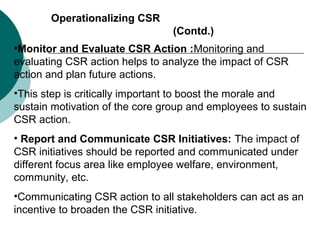
•Monitor and Evaluate CSR Action :Monitoring and
evaluating CSR action helps to analyze the impact of CSR
action and plan future actions.
•This step is critically important to boost the morale and
sustain motivation of the core group and employees to sustain
CSR action.
• Report and Communicate CSR Initiatives: The impact of
CSR initiatives should be reported and communicated under
different focus area like employee welfare, environment,
community, etc.
•Communicating CSR action to all stakeholders can act as an
incentive to broaden the CSR initiative.
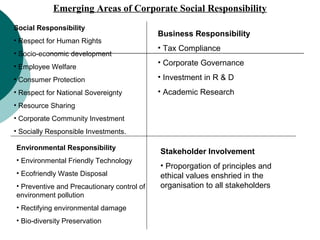
Emerging Areas of Corporate Social Responsibility
Social Responsibility
• Respect for Human Rights
• Socio-economic development

Business Responsibility
• Tax Compliance

• Employee Welfare

• Corporate Governance

• Consumer Protection

• Investment in R & D

• Respect for National Sovereignty

• Academic Research

• Resource Sharing
• Corporate Community Investment
• Socially Responsible Investments.
Environmental Responsibility
• Environmental Friendly Technology
• Ecofriendly Waste Disposal
• Preventive and Precautionary control of
environment pollution
• Rectifying environmental damage
• Bio-diversity Preservation

Stakeholder Involvement
• Proporgation of principles and
ethical values enshried in the
organisation to all stakeholders
Which are the areas where a
company can implement CSR
activities?
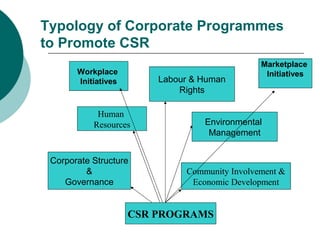
Typology of Corporate Programmes
to Promote CSR
Workplace
Initiatives

Labour & Human
Rights

Human
Resources

Corporate Structure
&
Governance

Marketplace
Initiatives

Environmental
Management

Community Involvement &
Economic Development

CSR PROGRAMS
Labour and Human Rights Initiatives








Engagement with unions and
adherence to union standards
Codes of conduct that set standards
for a company or entire industry on
labour treatment
Responsible supply chain
management ensuring that suppliers
adhere to company’s code of conduct
Product design and development
Human Resources Initiatives










Health and other insurance benefits
Employee recognition and rewards
Equal opportunity, diversity, diversity training
and religious freedom
Work/life balance and wellness programs
Employee compensation for downsizing,
plant closing and reengineering measures
Volunteering in local communities
Health and safety of the job
Environment Management
Initiatives











Environment supply chain management
Consumption reduction
Natural resource stewardship
Alternative energy
Green real estate development and
ecological building design
Clean technology innovation
Product and packaging design
End-of-life-cycle product stewardship
Philanthropy and sponsorships
Why measure, monitor and report
CSR?
Measuring , Monitoring & Reporting CSR









Satisfy regulators
To determine the level of compliance with
statutory requirements
Accountability
Avoiding action from pressure groups and local
communities
Avoid reputation (and hence business) risk
Improve brand (targeted at customers,
employees, investors and suppliers)
Improve financial performance
Plan future actions
Measurement through extra-financial ratings
Company’s fitness to manage risks in Four Categories:
a) Governance/Business Ethics: code of conduct,
bribery & corruption
a) Environment: emissions, resources, climate change,
ecosystems
c) Social: product safety, marketplace, community,
human rights
d) Employment: diversity, recruitment, strategy,
workplace condition
Measurement of Community Initiatives










Cash value of community support as a percentage of pretax profit.
Impact evaluations carried out on community programmes
such as improved educational attainment, number of jobs
created, professional support for community organizations
etc.
Project progress and achievement measures
Perception measures of the company as a Good Corporate
citizen
Positive and negative media comment on community
activities
Individual value of staff time, gifts in kind and
management costs
Frequency of formal and informal dialogue between the
stakeholders
Measuring impact on the beneficiaries.
Measurement of Workplace Initiatives












Workplace profile (race, gender, disability, age, etc)
Staff absenteeism
Number of legal non-compliance (on health and safety,
equal opportunities and other legislation)
Number of staff grievances
Upheld cases of corrupt or unprofessional behavior
Staff turnover
Training and development provided to staff
Pay and conditions compared against local equivalent
averages
Workplace profile compared to the community profile for
the travel to work area or equivalent
Evaluating impact as a result of downsizing, re-skilling,
etc
Perception measures of the company (eg: equal
opportunities, work/life balance)
Measurement of Environment Initiatives
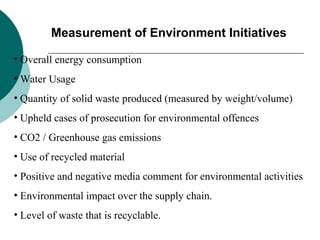
• Overall energy consumption
• Water Usage
• Quantity of solid waste produced (measured by weight/volume)
• Upheld cases of prosecution for environmental offences
• CO2 / Greenhouse gas emissions
• Use of recycled material
• Positive and negative media comment for environmental activities
• Environmental impact over the supply chain.
• Level of waste that is recyclable.
Measurement of Marketplace Initiatives














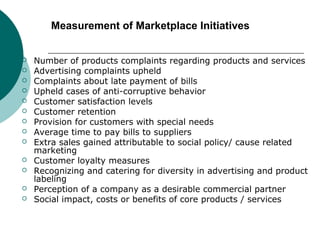
Number of products complaints regarding products and services
Advertising complaints upheld
Complaints about late payment of bills
Upheld cases of anti-corruptive behavior
Customer satisfaction levels
Customer retention
Provision for customers with special needs
Average time to pay bills to suppliers
Extra sales gained attributable to social policy/ cause related
marketing
Customer loyalty measures
Recognizing and catering for diversity in advertising and product
labeling
Perception of a company as a desirable commercial partner
Social impact, costs or benefits of core products / services
Measuring CSR
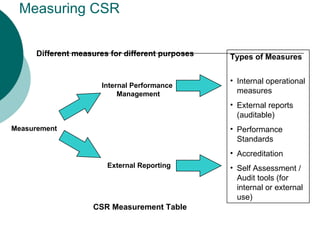
Different measures for different purposes

Internal Performance
Management

Types of Measures
• Internal operational
measures
• External reports
(auditable)
• Performance
Standards

Measurement

• Accreditation
External Reporting

CSR Measurement Table

• Self Assessment /
Audit tools (for
internal or external
use)
Few Measurement Tools
The Global Sullivan Principles


In 1971, Reverend Leon H. Sullivan, a Human & Civil
Rights, leader was appointed to the Board of Directors
of General Motors, becoming the first African-American
to serve on the board of a major corporation.



Six years after joining the board of General Motors,
Sullivan developed the Sullivan Principles, which
became an international standard for businesses
operating throughout the world. The Global Sullivan
Principles of Social Responsibility is a voluntary code of
conduct built on a vision of aspiration and inclusion.



The aspiration of the Principles is to have companies
and organizations of all sizes, and cultures, working
toward the common goals of human rights, social
justice and economic opportunity.
The Equator Principles
(www.equator-principles.com).


For a number of years, banks working in the project finance
sector had been seeking ways to develop a common and
coherent set of environmental and social policies and
guidelines that could be applied globally and across all industry
sectors.



In October 2002, a small number of banks convened in
London, together with the World Bank Group's International
Finance Corporation (IFC), to discuss these issues.



The Banks present decided jointly to try and develop a banking
industry framework for addressing environmental and social
risks in project financing. This led to the drafting of the first set
of Equator Principles by these banks which were then launched
in Washington, DC on June 4 2003 and updated in July 2006
Rating Indices


Rating indices are generated to compare
companies on specific aspects of CSR and can
produce pressure on companies to improve their
performance in those areas. Participants in
indices such as the Great Place to Work annual
index select themselves to showcase their human
resources achievements.



Investment indices such as the Dow Jones
Sustainability Indexes (
www.sustainability-indexes.com) sustainability
provides information on the quality of
management—a basic consideration for an
investor making long-term decisions
DJSI






Launched in 1999, the Dow Jones
Sustainability Indexes are the first global
indexes tracking the financial
performance of the leading sustainabilitydriven companies worldwide .
The Dow Jones Sustainability Indexes are
a cooperation of Dow Jones Indexes,
STOXX Limited and SAM Group.
Currently 66 DJSI licenses are held by
asset managers in 16 countries to
manage a variety of financial products
including active and passive funds,
certificates and segregated accounts.
FTSE4


The Financial Times and the London Stock Exchange.
(FTSE4)Good (www.ftse.com/ftse4good/index.jsp).



The FTSE4Good Index Series has been designed to
measure the performance of companies that meet
globally recognised corporate responsibility standards,
and to facilitate investment in those companies.



FTSE brand make FTSE4Good the index of choice for the
creation of Socially Responsible Investment products.
Reporting of CSR


What gets measured and monitored
needs to be reported.



To whom should you report CSR?
And How?
Importance of Reporting
•To build trust
• To demonstrate clear purpose, vision and mission
• To enhance business reputation
• To provide information to interested stakeholders
• To demonstrate commitment to operate business in a
responsible ways
• Drive forward change and stimulate dialogue
• Reward employee volunteering
• To create awareness
Reporting methods


Key methods of accounting are as
follows:
- Descriptive performance reporting
- Quantitative reporting
- Full cost reporting
- Triple bottom line reporting
Descriptive performance reporting








Such disclosures are the most
commonly made by entities
They appear in a stand-alone report
Take the form of an “inventory” of
CSR
Typically contains “good” news
May be regarded as the “smiling
faces” approach to CSR
Descriptive performance reporting


The inventory commonly includes:
- Physical resources and
environmental contributions
- Energy
- Human resources
- Product or service contribution
- Community involvement
- Other


Problems with this approach:
- The list of headings and related
issues is virtually limitless
- Difficulty in obtaining benchmarks
by which to compare and contrast
an entity’s performance
- Captured by marketing
departments and reflects a “feel
good” (i.e. soft) approach
Quantitative reporting

Reporting is based on attempts to quantify an
entity’s social and environmental interactions
An entity may, for example, attempt the quantify
the environmental impacts of its products over
their life cycles
Full cost reporting



Such systems are intended to
include in accounting and economic
numbers all the potential/actual
costs and benefits including
environmental and social
externalities
Impediments to Full Cost Reporting
-

Measurement of financial values
Data availability
Additivity of measurement unit
Reliability of measurement
Suitability of certain estimates
Triple bottom line reporting (TBL
reporting)


“Triple bottom line” or “sustainability reporting”,

the focus is widen to embrace the economic,
environmental and social performance of entities


Economic bottom line” refers to the traditional
bottom line as well as to issues relating to the
long-term sustainability of an entity’s costs, of the
demand for its product, profit margins and so on



“Environmental bottom line” encompasses the
sustainability of the entity’s use of natural,
renewable or substitutable resources and its
restoration performance


“Social bottom line” is concerned broadly
with social capital with a focus on human
capital, such as in the form of public
health, skills and education, and more
generally with society’s health and
wealth creation capabilities
TBL reporting method


The implementation of a TBL
reporting approach to CSR is an
incremental process, dealing with
the complex and contestable issues
involved in attempting to effectively
integrate economic, environmental
and social performance
measurement into a single report
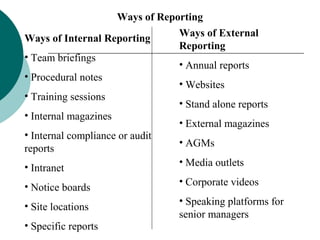
Ways of Reporting
Ways of External
Ways of Internal Reporting
Reporting
• Team briefings
• Annual reports
• Procedural notes
• Websites
• Training sessions
• Stand alone reports
• Internal magazines
• External magazines
• Internal compliance or audit
• AGMs
reports
• Media outlets
• Intranet
• Corporate videos
• Notice boards
• Speaking platforms for
• Site locations
senior managers
• Specific reports

Csr13 5(imple)

  • 1.
  • 2.
  • 3.
    Identifying the Company’sCSR level Value Creation Harm Minimization Compliance
  • 4.
    Key Requirement forImplementation of CSR activities Motivation and commitment Budget for the CSR Activities Human resources
  • 5.
  • 6.
    Operationalising Corporate SocialResponsibility Trigger Motivate Management Form CSR Core Group Identify Focus Areas Design and Implement CSR Action Plan Monitor and Evaluate CSR Action Report and Communicate CSR Initiatives
  • 7.
    Operationalizing CSR • Trigger: The process normally begins with a trigger or an event that requires management attention and action. This trigger or motivation can come from a product, workplace crisis, from external pressures or from inner values and principles. • Motivated Management : Motivated management formulates the CSR Policy and describes the Vision and Mission Statement of the Company. •Written CSR Policy ensures a common understanding amongst Board members, will define how much and what a company wants to achieve and will ensure effective implementation. •The CSR Policy of the company should clearly define the key stakeholders and their level of involvement.
  • 8.
    Operationalizing CSR (Contd.)  Forming aCSR Core Group : Management should form a Core Group or a Committee. A core group will be responsible to plan, execute, monitor, evaluate, report and communicate the progress and impact of CSR programmes.  The Core Group will be responsible to identify the resources, execute planned activities and sustain the commitment for motivation to responsible business practices.
  • 9.
    Operationalizing CSR (Contd.)      CSR COREGROUP MEMBERS CEO or MD should be the Chairman of CSR Core Group and responsible for overall coordination and decision making. CSR Personnel Human resource personnel : Employee Welfare, Employee Volunteering Corporate Communication and Public Relations Personnel Finance Personnel
  • 10.
    Operationalizing CSR (Contd.) Identify theFocus Area  The CSR core group must identify the focus area of the company. The focus area will be based on the CSR Policy, Vision and Mission of the Company.  For example: Orchid Hotel, CSR action is focussed around environmental issues.  Tata Group thru’ TCCI focuses on community & environmental issues in Tata Companies.
  • 11.
    Operationalizing CSR (Contd.) Design andImplement CSR Action Plan  The CSR core group will design and implement the CSR action plan for the company, integrating company values, focus areas and resources.
  • 12.
    Operationalizing CSR (Contd.) •Monitor andEvaluate CSR Action :Monitoring and evaluating CSR action helps to analyze the impact of CSR action and plan future actions. •This step is critically important to boost the morale and sustain motivation of the core group and employees to sustain CSR action. • Report and Communicate CSR Initiatives: The impact of CSR initiatives should be reported and communicated under different focus area like employee welfare, environment, community, etc. •Communicating CSR action to all stakeholders can act as an incentive to broaden the CSR initiative.
  • 13.
    Emerging Areas ofCorporate Social Responsibility Social Responsibility • Respect for Human Rights • Socio-economic development Business Responsibility • Tax Compliance • Employee Welfare • Corporate Governance • Consumer Protection • Investment in R & D • Respect for National Sovereignty • Academic Research • Resource Sharing • Corporate Community Investment • Socially Responsible Investments. Environmental Responsibility • Environmental Friendly Technology • Ecofriendly Waste Disposal • Preventive and Precautionary control of environment pollution • Rectifying environmental damage • Bio-diversity Preservation Stakeholder Involvement • Proporgation of principles and ethical values enshried in the organisation to all stakeholders
  • 14.
    Which are theareas where a company can implement CSR activities?
  • 15.
    Typology of CorporateProgrammes to Promote CSR Workplace Initiatives Labour & Human Rights Human Resources Corporate Structure & Governance Marketplace Initiatives Environmental Management Community Involvement & Economic Development CSR PROGRAMS
  • 16.
    Labour and HumanRights Initiatives     Engagement with unions and adherence to union standards Codes of conduct that set standards for a company or entire industry on labour treatment Responsible supply chain management ensuring that suppliers adhere to company’s code of conduct Product design and development
  • 17.
    Human Resources Initiatives        Healthand other insurance benefits Employee recognition and rewards Equal opportunity, diversity, diversity training and religious freedom Work/life balance and wellness programs Employee compensation for downsizing, plant closing and reengineering measures Volunteering in local communities Health and safety of the job
  • 18.
    Environment Management Initiatives          Environment supplychain management Consumption reduction Natural resource stewardship Alternative energy Green real estate development and ecological building design Clean technology innovation Product and packaging design End-of-life-cycle product stewardship Philanthropy and sponsorships
  • 19.
    Why measure, monitorand report CSR?
  • 20.
    Measuring , Monitoring& Reporting CSR         Satisfy regulators To determine the level of compliance with statutory requirements Accountability Avoiding action from pressure groups and local communities Avoid reputation (and hence business) risk Improve brand (targeted at customers, employees, investors and suppliers) Improve financial performance Plan future actions
  • 21.
    Measurement through extra-financialratings Company’s fitness to manage risks in Four Categories: a) Governance/Business Ethics: code of conduct, bribery & corruption a) Environment: emissions, resources, climate change, ecosystems c) Social: product safety, marketplace, community, human rights d) Employment: diversity, recruitment, strategy, workplace condition
  • 22.
    Measurement of CommunityInitiatives         Cash value of community support as a percentage of pretax profit. Impact evaluations carried out on community programmes such as improved educational attainment, number of jobs created, professional support for community organizations etc. Project progress and achievement measures Perception measures of the company as a Good Corporate citizen Positive and negative media comment on community activities Individual value of staff time, gifts in kind and management costs Frequency of formal and informal dialogue between the stakeholders Measuring impact on the beneficiaries.
  • 23.
    Measurement of WorkplaceInitiatives            Workplace profile (race, gender, disability, age, etc) Staff absenteeism Number of legal non-compliance (on health and safety, equal opportunities and other legislation) Number of staff grievances Upheld cases of corrupt or unprofessional behavior Staff turnover Training and development provided to staff Pay and conditions compared against local equivalent averages Workplace profile compared to the community profile for the travel to work area or equivalent Evaluating impact as a result of downsizing, re-skilling, etc Perception measures of the company (eg: equal opportunities, work/life balance)
  • 24.
    Measurement of EnvironmentInitiatives • Overall energy consumption • Water Usage • Quantity of solid waste produced (measured by weight/volume) • Upheld cases of prosecution for environmental offences • CO2 / Greenhouse gas emissions • Use of recycled material • Positive and negative media comment for environmental activities • Environmental impact over the supply chain. • Level of waste that is recyclable.
  • 25.
    Measurement of MarketplaceInitiatives              Number of products complaints regarding products and services Advertising complaints upheld Complaints about late payment of bills Upheld cases of anti-corruptive behavior Customer satisfaction levels Customer retention Provision for customers with special needs Average time to pay bills to suppliers Extra sales gained attributable to social policy/ cause related marketing Customer loyalty measures Recognizing and catering for diversity in advertising and product labeling Perception of a company as a desirable commercial partner Social impact, costs or benefits of core products / services
  • 26.
    Measuring CSR Different measuresfor different purposes Internal Performance Management Types of Measures • Internal operational measures • External reports (auditable) • Performance Standards Measurement • Accreditation External Reporting CSR Measurement Table • Self Assessment / Audit tools (for internal or external use)
  • 27.
  • 29.
    The Global SullivanPrinciples  In 1971, Reverend Leon H. Sullivan, a Human & Civil Rights, leader was appointed to the Board of Directors of General Motors, becoming the first African-American to serve on the board of a major corporation.  Six years after joining the board of General Motors, Sullivan developed the Sullivan Principles, which became an international standard for businesses operating throughout the world. The Global Sullivan Principles of Social Responsibility is a voluntary code of conduct built on a vision of aspiration and inclusion.  The aspiration of the Principles is to have companies and organizations of all sizes, and cultures, working toward the common goals of human rights, social justice and economic opportunity.
  • 30.
    The Equator Principles (www.equator-principles.com).  Fora number of years, banks working in the project finance sector had been seeking ways to develop a common and coherent set of environmental and social policies and guidelines that could be applied globally and across all industry sectors.  In October 2002, a small number of banks convened in London, together with the World Bank Group's International Finance Corporation (IFC), to discuss these issues.  The Banks present decided jointly to try and develop a banking industry framework for addressing environmental and social risks in project financing. This led to the drafting of the first set of Equator Principles by these banks which were then launched in Washington, DC on June 4 2003 and updated in July 2006
  • 31.
    Rating Indices  Rating indicesare generated to compare companies on specific aspects of CSR and can produce pressure on companies to improve their performance in those areas. Participants in indices such as the Great Place to Work annual index select themselves to showcase their human resources achievements.  Investment indices such as the Dow Jones Sustainability Indexes ( www.sustainability-indexes.com) sustainability provides information on the quality of management—a basic consideration for an investor making long-term decisions
  • 32.
    DJSI    Launched in 1999,the Dow Jones Sustainability Indexes are the first global indexes tracking the financial performance of the leading sustainabilitydriven companies worldwide . The Dow Jones Sustainability Indexes are a cooperation of Dow Jones Indexes, STOXX Limited and SAM Group. Currently 66 DJSI licenses are held by asset managers in 16 countries to manage a variety of financial products including active and passive funds, certificates and segregated accounts.
  • 33.
    FTSE4  The Financial Timesand the London Stock Exchange. (FTSE4)Good (www.ftse.com/ftse4good/index.jsp).  The FTSE4Good Index Series has been designed to measure the performance of companies that meet globally recognised corporate responsibility standards, and to facilitate investment in those companies.  FTSE brand make FTSE4Good the index of choice for the creation of Socially Responsible Investment products.
  • 34.
    Reporting of CSR  Whatgets measured and monitored needs to be reported.  To whom should you report CSR? And How?
  • 35.
    Importance of Reporting •Tobuild trust • To demonstrate clear purpose, vision and mission • To enhance business reputation • To provide information to interested stakeholders • To demonstrate commitment to operate business in a responsible ways • Drive forward change and stimulate dialogue • Reward employee volunteering • To create awareness
  • 36.
    Reporting methods  Key methodsof accounting are as follows: - Descriptive performance reporting - Quantitative reporting - Full cost reporting - Triple bottom line reporting
  • 37.
    Descriptive performance reporting      Suchdisclosures are the most commonly made by entities They appear in a stand-alone report Take the form of an “inventory” of CSR Typically contains “good” news May be regarded as the “smiling faces” approach to CSR
  • 38.
    Descriptive performance reporting  Theinventory commonly includes: - Physical resources and environmental contributions - Energy - Human resources - Product or service contribution - Community involvement - Other
  • 39.
     Problems with thisapproach: - The list of headings and related issues is virtually limitless - Difficulty in obtaining benchmarks by which to compare and contrast an entity’s performance - Captured by marketing departments and reflects a “feel good” (i.e. soft) approach
  • 40.
    Quantitative reporting Reporting isbased on attempts to quantify an entity’s social and environmental interactions An entity may, for example, attempt the quantify the environmental impacts of its products over their life cycles
  • 41.
    Full cost reporting  Suchsystems are intended to include in accounting and economic numbers all the potential/actual costs and benefits including environmental and social externalities
  • 42.
    Impediments to FullCost Reporting - Measurement of financial values Data availability Additivity of measurement unit Reliability of measurement Suitability of certain estimates
  • 43.
    Triple bottom linereporting (TBL reporting)  “Triple bottom line” or “sustainability reporting”, the focus is widen to embrace the economic, environmental and social performance of entities  Economic bottom line” refers to the traditional bottom line as well as to issues relating to the long-term sustainability of an entity’s costs, of the demand for its product, profit margins and so on  “Environmental bottom line” encompasses the sustainability of the entity’s use of natural, renewable or substitutable resources and its restoration performance
  • 44.
     “Social bottom line”is concerned broadly with social capital with a focus on human capital, such as in the form of public health, skills and education, and more generally with society’s health and wealth creation capabilities
  • 45.
    TBL reporting method  Theimplementation of a TBL reporting approach to CSR is an incremental process, dealing with the complex and contestable issues involved in attempting to effectively integrate economic, environmental and social performance measurement into a single report
  • 46.
    Ways of Reporting Waysof External Ways of Internal Reporting Reporting • Team briefings • Annual reports • Procedural notes • Websites • Training sessions • Stand alone reports • Internal magazines • External magazines • Internal compliance or audit • AGMs reports • Media outlets • Intranet • Corporate videos • Notice boards • Speaking platforms for • Site locations senior managers • Specific reports