
We are living in the information age. We need to keep
information about every aspect of our lives. In other words,
information is an asset that has a value like any other asset.
As an asset, information needs to be secured from attacks.
To be secured, information needs to be hidden from
unauthorized access (confidentiality), protected from
unauthorized change (integrity), and available to an authorized
entity when it is needed (availability).
In the computer industry, the term security refers to
techniques for ensuring that data stored in a computer cannot
be read or compromised by any individuals without authorization
•Confidentiality: only sender, intended receiver should “understand”
message contents

•Authentication: sender, receiver want to confirm identity of each
other
• Message integrity: sender, receiver want to ensure message not
altered without detection.
•Access and availability: services must be accessible and available
to users
Network security refers to any activities
designed to protect your network. Specifically, these
activities protect the usability, reliability, integrity, and
safety of your network and data.

Effective network security targets a variety of threats
and stops them from entering or spreading on your
network
The most common include :
1 Viruses, worms, and Trojan horses
2 Spyware and adware
3 Zero-day attacks, also called zero-hour attacks
4 Hacker attacks
5 Denial of service attacks
6 Data interception and theft
7 Identity theft
Network security is accomplished through hardware and
software.
Network security components often include:
• Anti-virus and anti-spyware
• Firewall, to block unauthorized access to your network
• Intrusion prevention systems (IPS), to identify fastspreading threats, such as zero-day or zero-hour attacks
• Virtual Private Networks (VPNs), to provide secure remote
access


Antivirus software packages : These packages counter most
virus threats if regularly updated and correctly maintained.



Network infrastructure : Switches and routers have
hardware and software features that support secure
connectivity, intrusion protection, identity services, and
security management.



Dedicated network security hardware and software-Tools
such as firewalls and intrusion detection systems provide
protection for all areas of the network and enable secure
connections.


Identity services : These services help to identify users and
control their activities and transactions on the network.
Services include passwords, digital certificates, and digital
authentication keys.



Encryption : Encryption ensures that messages cannot be
intercepted or read by anyone other than the authorized
recipient.



Security management : This is the glue that holds together
the other building blocks of a strong security solution



Virtual private networks : These networks provide access
control and data encryption between two different computers
on a network.
A set of mathematical functions with a set of nice
properties. A common mechanism for enforcing policies. Encrypt
clear text into cipher text, and vice versa .
Properties of good encryption techniques encryption
scheme depends not on secrecy of algorithm but on parameter of
algorithm .
1) symmetric key algorithm: one shared by a pair of users
used for both encryption and decryption
2) Asymmetric or public/private key algorithms are based
on each user having two keys: public key – in public
private key – key known only to individual user
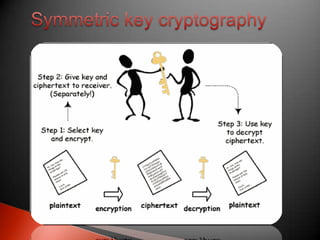
Private key cryptography:Traditional private key cryptography uses one key
• shared by both sender and receiver
• if this key is disclosed communications are compromised
• also is symmetric, because parties are equal
•hence does not protect sender from receiver forging a
message & claiming is sent by sender
Public key cryptography:Requires sender, receiver know shared secret key
radically different approach sender, receiver do not share
secret key public encryption key known to all private
decryption key known only to receiver


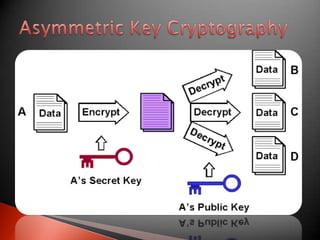
Asymmetric cryptography involves the use of two keys:



A public-key, which may be known by anybody, and can
be used to encrypt messages, and verify signatures



A private-key, known only to the recipient, used to
decrypt messages, and sign (create) signatures is
asymmetric because those who encrypt messages or
verify signatures cannot decrypt messages or create
signatures


Message integrity



Digital signature



End point authentication
 Information security is increasingly important .
 Have varying degrees of sensitivity of information.
 So we need to secure our data. As I said in this
presentation there are different ways for securing our
network.

Network security & cryptography

  • 2.
    We are livingin the information age. We need to keep information about every aspect of our lives. In other words, information is an asset that has a value like any other asset. As an asset, information needs to be secured from attacks. To be secured, information needs to be hidden from unauthorized access (confidentiality), protected from unauthorized change (integrity), and available to an authorized entity when it is needed (availability).
  • 3.
    In the computerindustry, the term security refers to techniques for ensuring that data stored in a computer cannot be read or compromised by any individuals without authorization •Confidentiality: only sender, intended receiver should “understand” message contents •Authentication: sender, receiver want to confirm identity of each other • Message integrity: sender, receiver want to ensure message not altered without detection. •Access and availability: services must be accessible and available to users
  • 4.
    Network security refersto any activities designed to protect your network. Specifically, these activities protect the usability, reliability, integrity, and safety of your network and data. Effective network security targets a variety of threats and stops them from entering or spreading on your network
  • 5.
    The most commoninclude : 1 Viruses, worms, and Trojan horses 2 Spyware and adware 3 Zero-day attacks, also called zero-hour attacks 4 Hacker attacks 5 Denial of service attacks 6 Data interception and theft 7 Identity theft
  • 6.
    Network security isaccomplished through hardware and software. Network security components often include: • Anti-virus and anti-spyware • Firewall, to block unauthorized access to your network • Intrusion prevention systems (IPS), to identify fastspreading threats, such as zero-day or zero-hour attacks • Virtual Private Networks (VPNs), to provide secure remote access
  • 7.
     Antivirus software packages: These packages counter most virus threats if regularly updated and correctly maintained.  Network infrastructure : Switches and routers have hardware and software features that support secure connectivity, intrusion protection, identity services, and security management.  Dedicated network security hardware and software-Tools such as firewalls and intrusion detection systems provide protection for all areas of the network and enable secure connections.
  • 8.
     Identity services :These services help to identify users and control their activities and transactions on the network. Services include passwords, digital certificates, and digital authentication keys.  Encryption : Encryption ensures that messages cannot be intercepted or read by anyone other than the authorized recipient.  Security management : This is the glue that holds together the other building blocks of a strong security solution  Virtual private networks : These networks provide access control and data encryption between two different computers on a network.
  • 9.
    A set ofmathematical functions with a set of nice properties. A common mechanism for enforcing policies. Encrypt clear text into cipher text, and vice versa . Properties of good encryption techniques encryption scheme depends not on secrecy of algorithm but on parameter of algorithm .
  • 10.
    1) symmetric keyalgorithm: one shared by a pair of users used for both encryption and decryption 2) Asymmetric or public/private key algorithms are based on each user having two keys: public key – in public private key – key known only to individual user
  • 11.
    Private key cryptography:Traditionalprivate key cryptography uses one key • shared by both sender and receiver • if this key is disclosed communications are compromised • also is symmetric, because parties are equal •hence does not protect sender from receiver forging a message & claiming is sent by sender Public key cryptography:Requires sender, receiver know shared secret key radically different approach sender, receiver do not share secret key public encryption key known to all private decryption key known only to receiver
  • 13.
     Asymmetric cryptography involvesthe use of two keys:  A public-key, which may be known by anybody, and can be used to encrypt messages, and verify signatures  A private-key, known only to the recipient, used to decrypt messages, and sign (create) signatures is asymmetric because those who encrypt messages or verify signatures cannot decrypt messages or create signatures
  • 15.
  • 16.
     Information securityis increasingly important .  Have varying degrees of sensitivity of information.  So we need to secure our data. As I said in this presentation there are different ways for securing our network.