General Environment
SWOT Analysis
Strengths
Weakness
Opportunities
Threats
General Environment
TOWS Matrix
Threats
Opportunities
Strengths
Weaknesses
TOWS Matrix
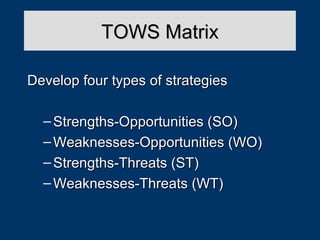
Develop four types of strategies
– Strengths-Opportunities (SO)
– Weaknesses-Opportunities (WO)
– Strengths-Threats (ST)
– Weaknesses-Threats (WT)
SO Strategies

Threats
Opportunities
Weaknesses
Strengths
(TOWS)

SO
Strategies

Use a firm’s
internal
strengths to take
advantage of
external
opportunities
WO Strategies

Threats
Opportunities
Weaknesses
Strengths
(TOWS)

WO
Strategies

Improving
internal
weaknesses by
taking
advantage of
external
opportunities
ST Strategies

Threats
Opportunities
Weaknesses
Strengths
(TOWS)

ST
Strategies

Using firm’s
strengths to
avoid or reduce
the impact of
external threats.
WT Strategies

Threats
Opportunities
Weaknesses
Strengths
(TOWS)

WT
Strategies

Defensive
tactics aimed at
reducing internal
weaknesses
and avoiding
environmental
threats.
TOWS Matrix
Steps in developing the TOWS Matrix
1.
2.
3.
4.

List the firm’s key external opportunities
List the firm’s key external threats
List the firm’s key internal strengths
List the firm’s key internal weaknesses
TOWS Matrix
Developing the TOWS Matrix

5.
6.
7.
8.

Match internal strengths with external opportunities
and record the resultant SO Strategies
Match internal weaknesses with external
opportunities and record the resultant WO Strategies
Match internal strengths with external threats and
record the resultant ST Strategies
Match internal weaknesses with external threats and
record the resultant WT Strategies
TOWS Matrix
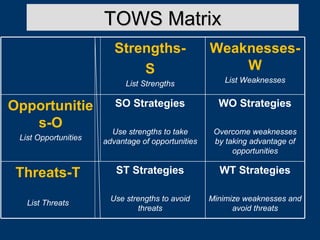
StrengthsS

WeaknessesW

List Strengths

List Weaknesses

SO Strategies

WO Strategies

Use strengths to take
advantage of opportunities

Overcome weaknesses
by taking advantage of
opportunities

Threats-T

ST Strategies

WT Strategies

List Threats

Use strengths to avoid
threats

Minimize weaknesses and
avoid threats

Opportunitie
s-O
List Opportunities
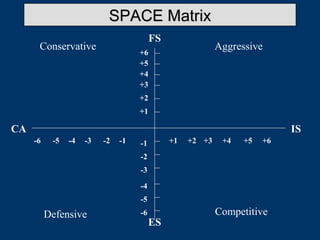
SPACE Matrix
Strategic Position and Action Evaluation Matrix



Four quadrant framework
Determines appropriate strategies





Aggressive
Conservative
Defensive
Competitive
SPACE Matrix
Two Internal Dimensions



Financial Strength [FS]
Competitive Advantage [CA]

Two External Dimensions



Environmental Stability [ES]
Industry Strength [IS]
SPACE Matrix
Overall Strategic position determined by:
–
–
–
–

Financial Strength [FS]
Competitive Advantage [CA]
Environmental Stability [ES]
Industry Strength [IS]
SPACE Matrix
Developing the SPACE Matrix:
•
•
•
•
•
•

EFE Matrix
IFE Matrix
Financial Strength
Competitive Advantage
Environmental Stability
Industry Strength
SPACE Matrix
•
•

•

Select variables to define FS, CA, ES,
& IS
Assign numerical ranking from +1
(worst) to +6 (best) for FS and IS;
Assign numerical ranking from –1
(best) to –6 (worst) for ES and CA.
Compute average score for FS, CA,
ES, & IS
SPACE Matrix
•
•

•

Plot the average scores on the Matrix
Add the two scores on the x-axis and
plot point on X. Add the scores on the
y-axis and plot Y. Plot the intersection
of the new xy point.
Draw a directional vector from origin
through the new intersection point.
SPACE Factors
Internal Strategic Position

External Strategic Position

Financial Strength (FS)

Environmental Stability (ES)

Return on investment
Leverage
Liquidity
Working capital
Cash flow
Ease of exit from market
Risk involved in business

Technological changes
Rate of inflation
Demand variability
Price range of competing products
Barriers to entry
Competitive pressure
Price elasticity of demand
SPACE Factors
Internal Strategic Position

External Strategic Position

Competitive Advantage CA

Industry Strength (IS)

Market share
Product quality
Product life cycle
Customer loyalty
Competition’s capacity utilization
Technological know-how
Control over suppliers & distributors

Growth potential
Profit potential
Financial stability
Technological know-how
Resource utilization
Capital intensify
Ease of entry into market
Productivity, capacity utilization
SPACE Matrix
FS

Conservative

Aggressive

+6
+5
+4
+3
+2
+1

CA

IS
-6

-5

-4

-3

-2

-1

+1

-1

+2 +3

+4

+5

+6

-2
-3
-4
-5

Defensive

-6

ES

Competitive

Environmental analysis