•
•

•
•

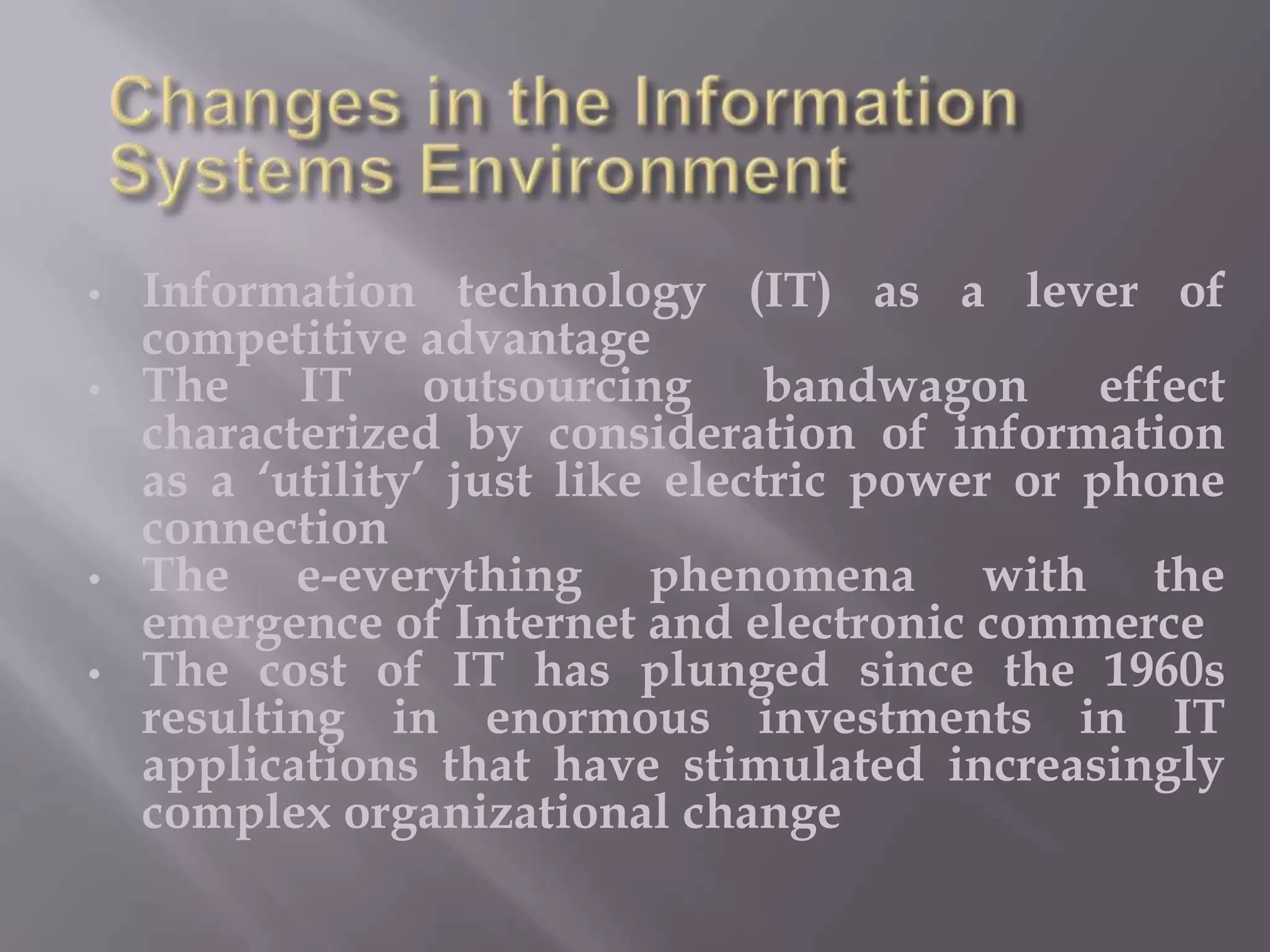
Information technology (IT) as a lever of
competitive advantage
The IT outsourcing bandwagon effect
characterized by consideration of information
as a „utility‟ just like electric power or phone
connection
The e-everything phenomena with the
emergence of Internet and electronic commerce
The cost of IT has plunged since the 1960s
resulting in enormous investments in IT
applications that have stimulated increasingly
complex organizational change
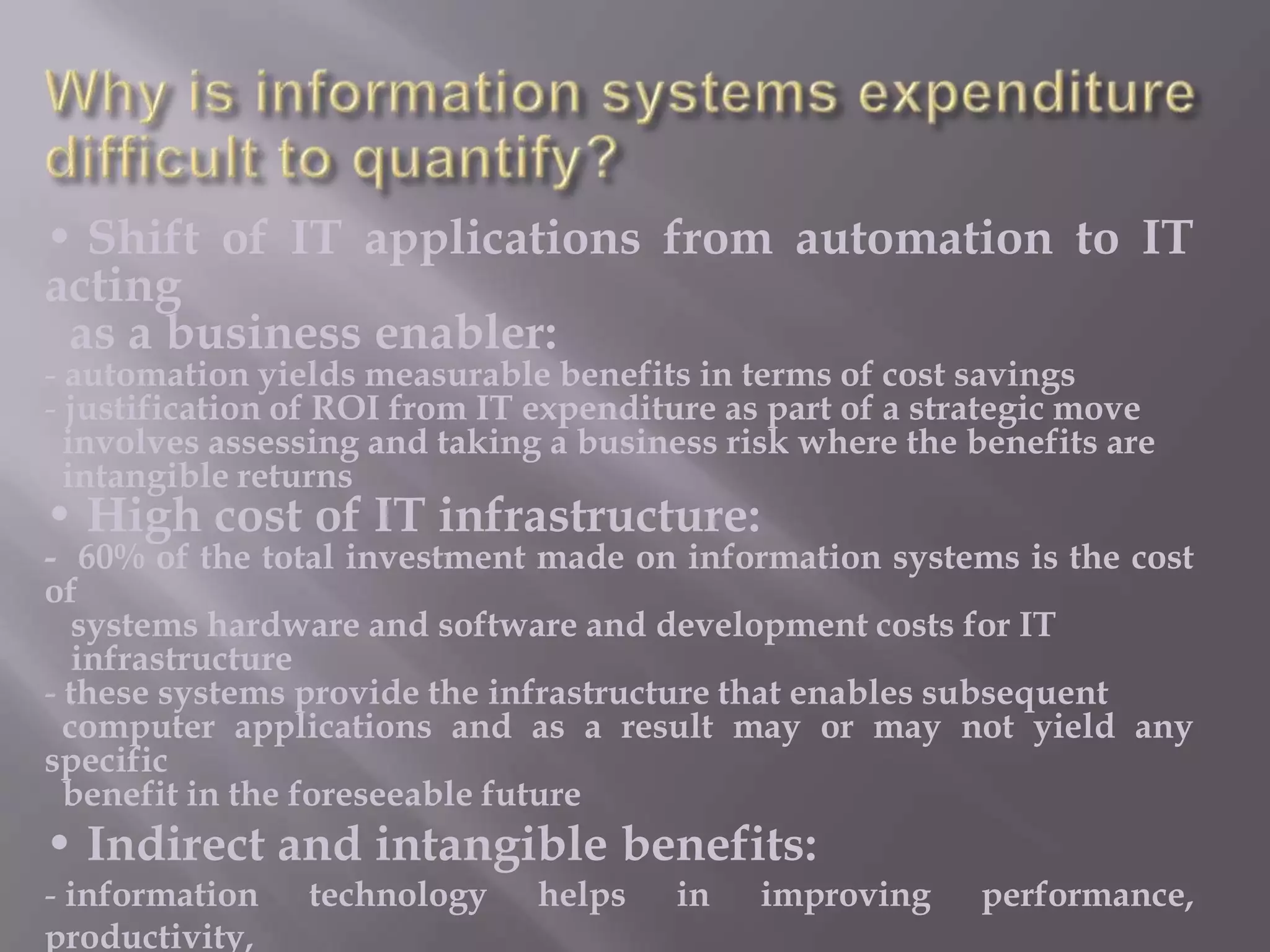
• Shift of IT applications from automation to IT
acting
as a business enabler:
- automation yields measurable benefits in terms of cost savings
- justification of ROI from IT expenditure as part of a strategic move
involves assessing and taking a business risk where the benefits are
intangible returns

• High cost of IT infrastructure:

- 60% of the total investment made on information systems is the cost
of
systems hardware and software and development costs for IT
infrastructure
- these systems provide the infrastructure that enables subsequent
computer applications and as a result may or may not yield any
specific
benefit in the foreseeable future

• Indirect and intangible benefits:
- information
productivity,

technology

helps

in

improving

performance,
•

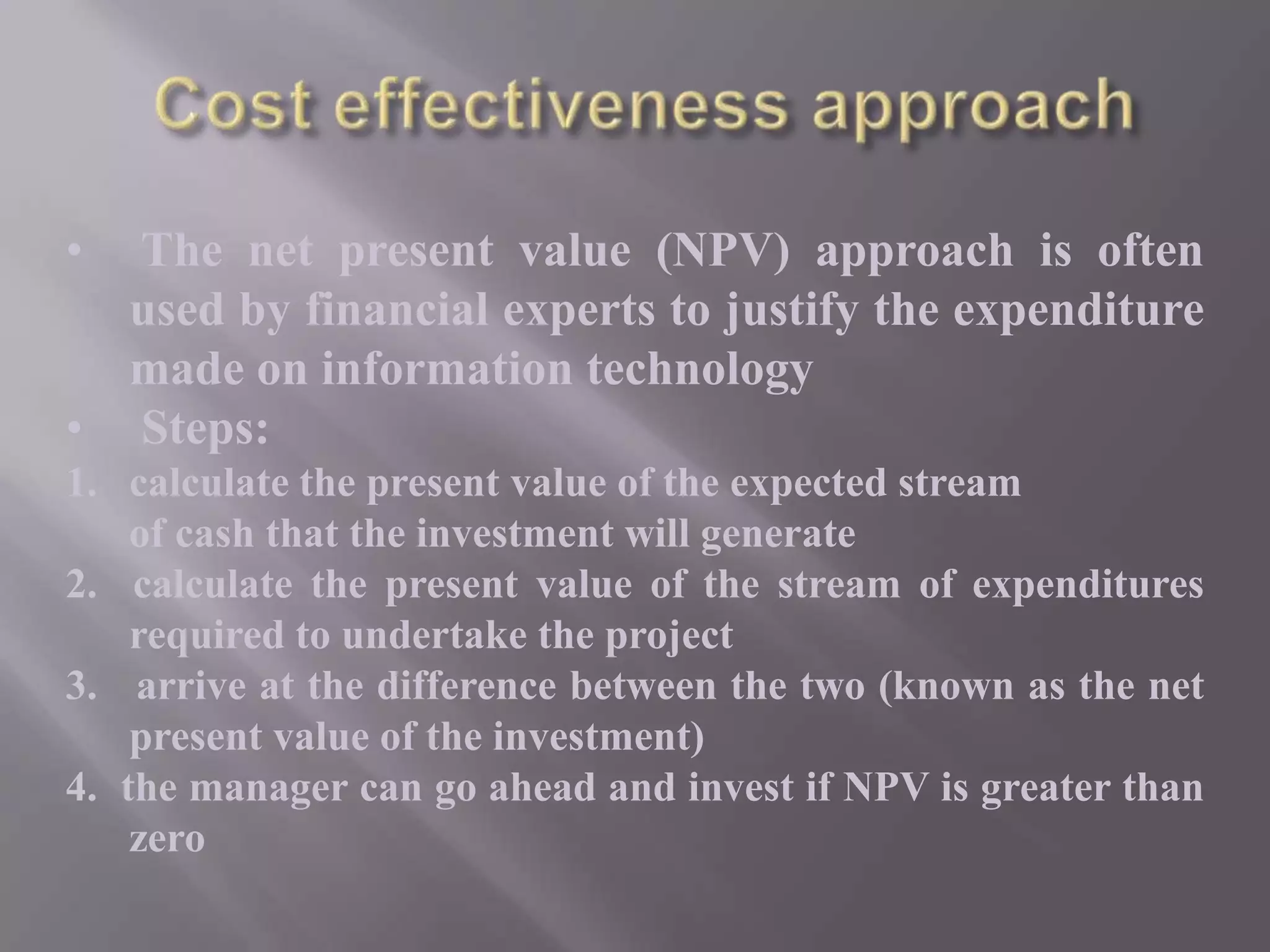
The net present value (NPV) approach is often
used by financial experts to justify the expenditure
made on information technology
• Steps:
1. calculate the present value of the expected stream
of cash that the investment will generate
2. calculate the present value of the stream of expenditures
required to undertake the project
3. arrive at the difference between the two (known as the net
present value of the investment)
4. the manager can go ahead and invest if NPV is greater than
zero
Cost effectiveness
approach contd.
•
•

•
•
•
•

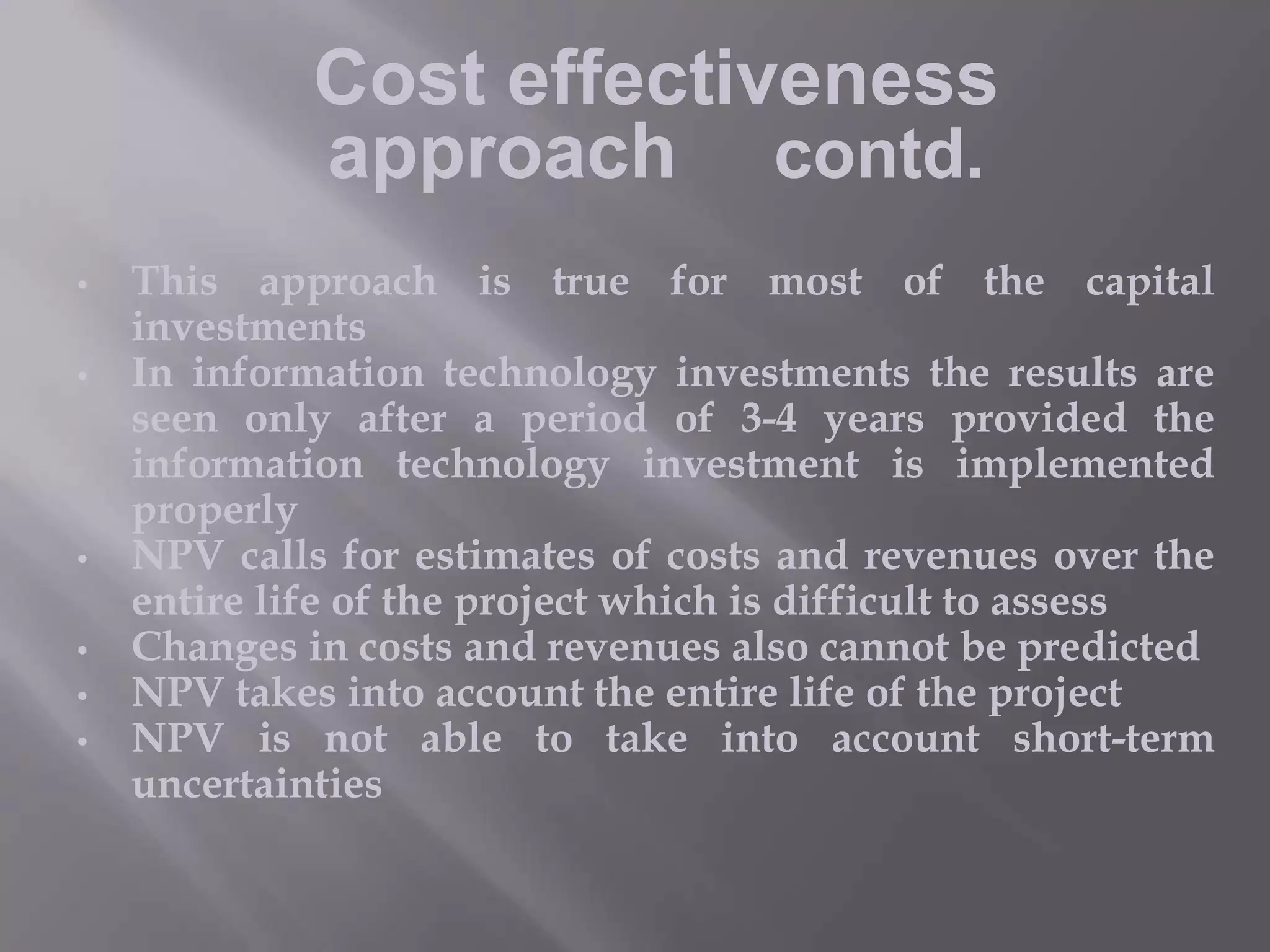
This approach is true for most of the capital
investments
In information technology investments the results are
seen only after a period of 3-4 years provided the
information technology investment is implemented
properly
NPV calls for estimates of costs and revenues over the
entire life of the project which is difficult to assess
Changes in costs and revenues also cannot be predicted
NPV takes into account the entire life of the project
NPV is not able to take into account short-term
uncertainties
The Business value
approach
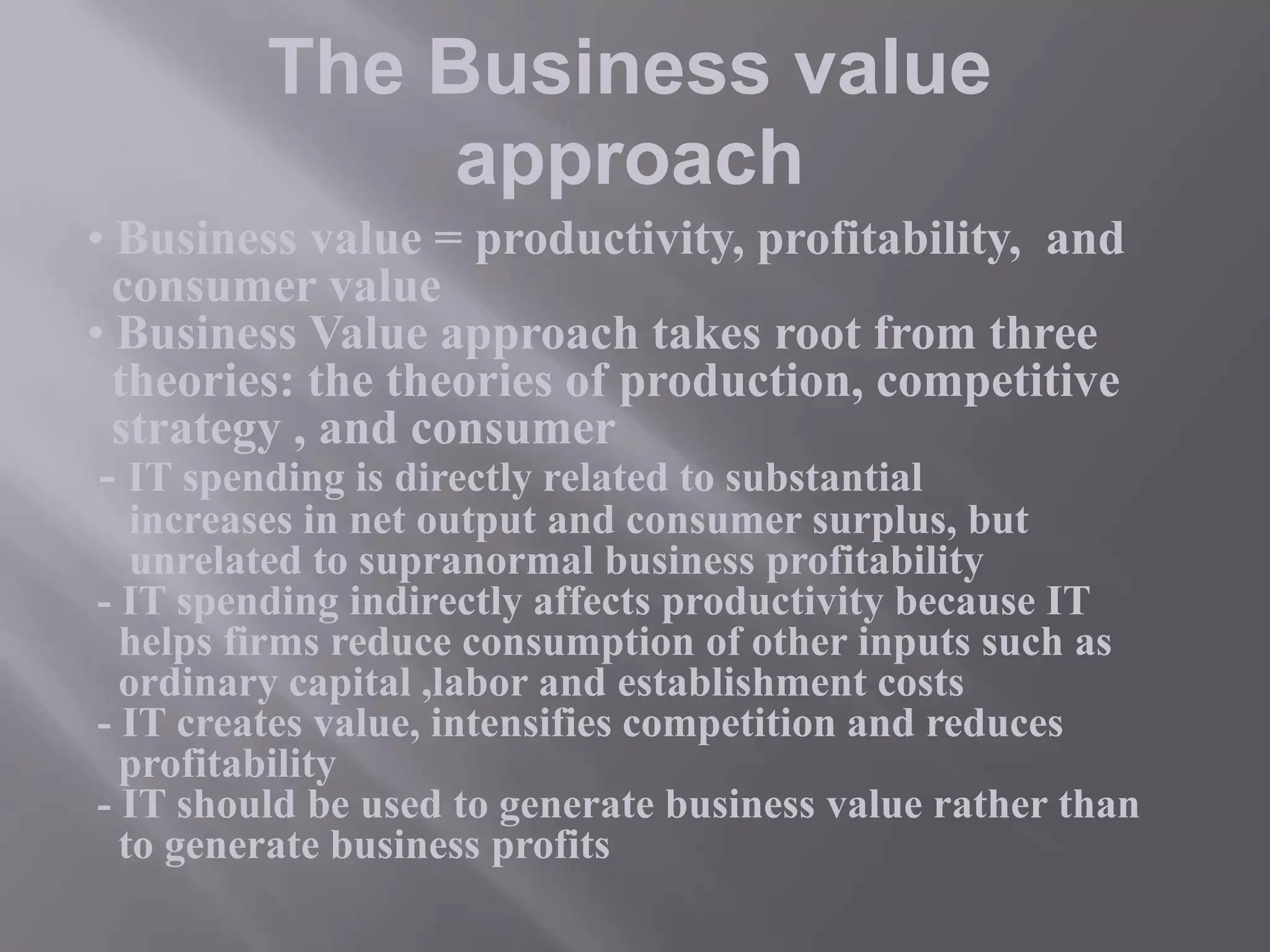
• Business value = productivity, profitability, and
consumer value
• Business Value approach takes root from three
theories: the theories of production, competitive
strategy , and consumer
- IT spending is directly related to substantial
increases in net output and consumer surplus, but
unrelated to supranormal business profitability
- IT spending indirectly affects productivity because IT
helps firms reduce consumption of other inputs such as
ordinary capital ,labor and establishment costs
- IT creates value, intensifies competition and reduces
profitability
- IT should be used to generate business value rather than
to generate business profits
IT Chargeback approach
•

•

•

•

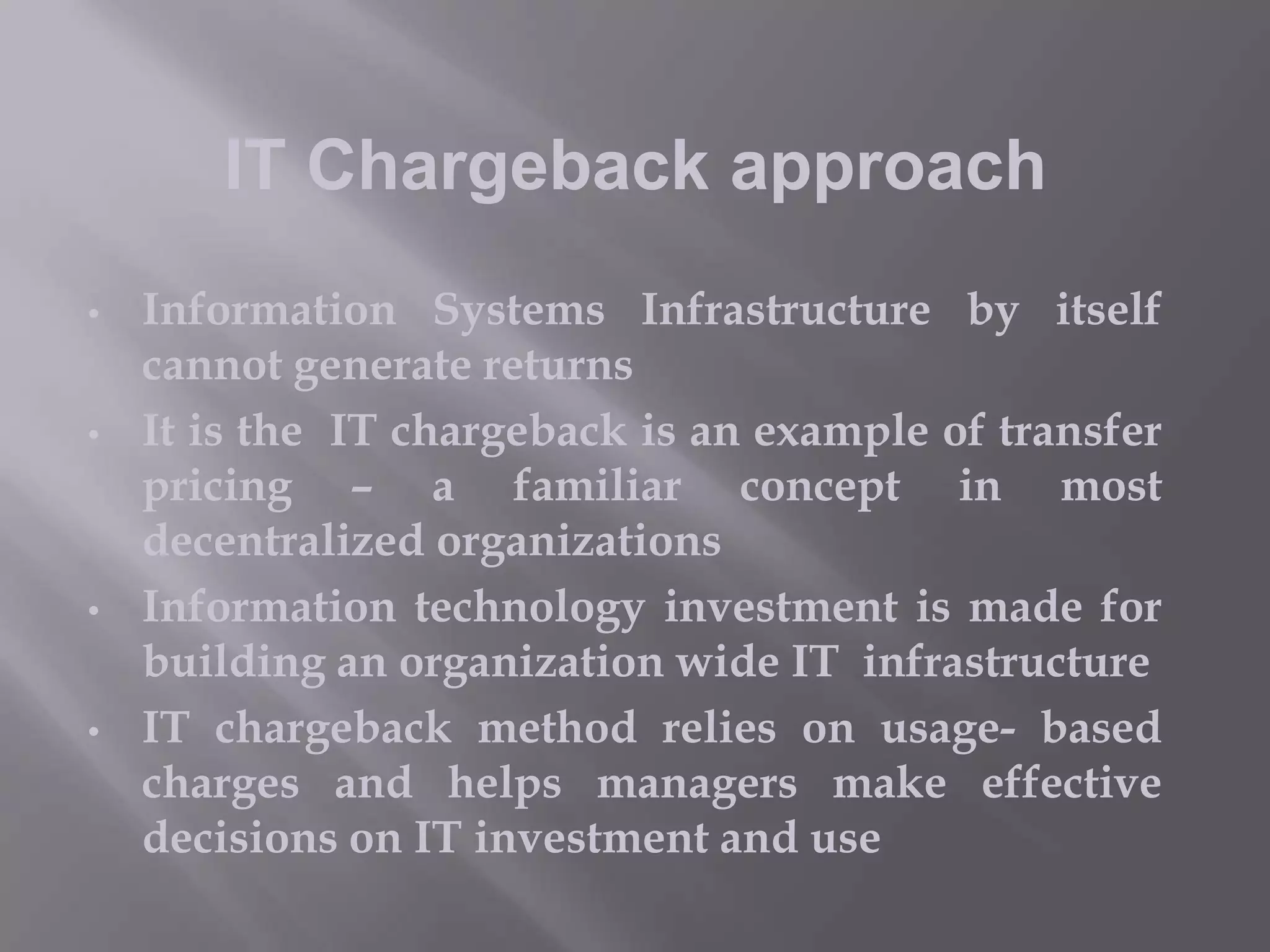
Information Systems Infrastructure by itself
cannot generate returns
It is the IT chargeback is an example of transfer
pricing – a familiar concept in most
decentralized organizations
Information technology investment is made for
building an organization wide IT infrastructure
IT chargeback method relies on usage- based
charges and helps managers make effective
decisions on IT investment and use
•
•

•
•
•

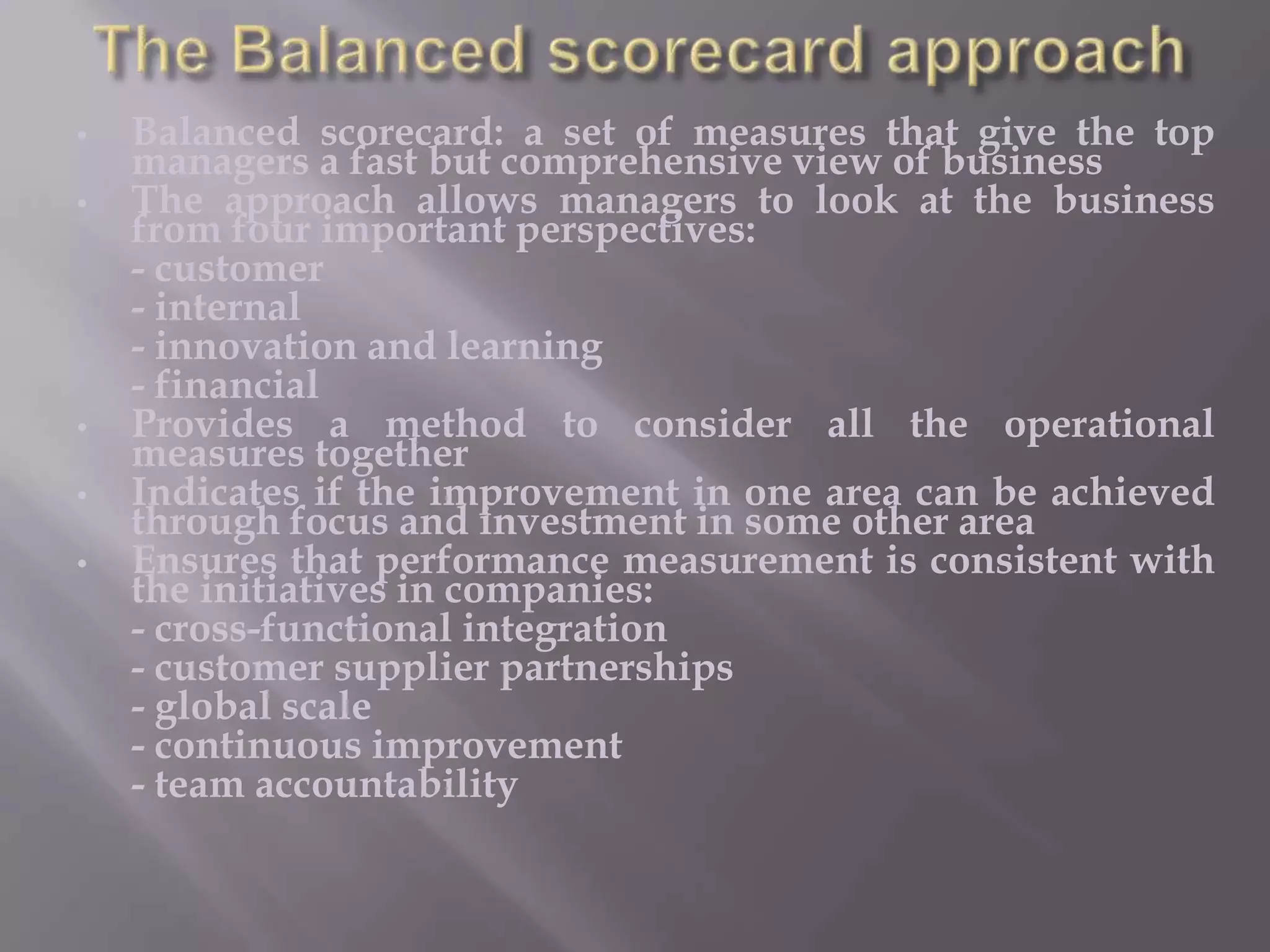
Balanced scorecard: a set of measures that give the top
managers a fast but comprehensive view of business
The approach allows managers to look at the business
from four important perspectives:
- customer
- internal
- innovation and learning
- financial
Provides a method to consider all the operational
measures together
Indicates if the improvement in one area can be achieved
through focus and investment in some other area
Ensures that performance measurement is consistent with
the initiatives in companies:
- cross-functional integration
- customer supplier partnerships
- global scale
- continuous improvement
- team accountability
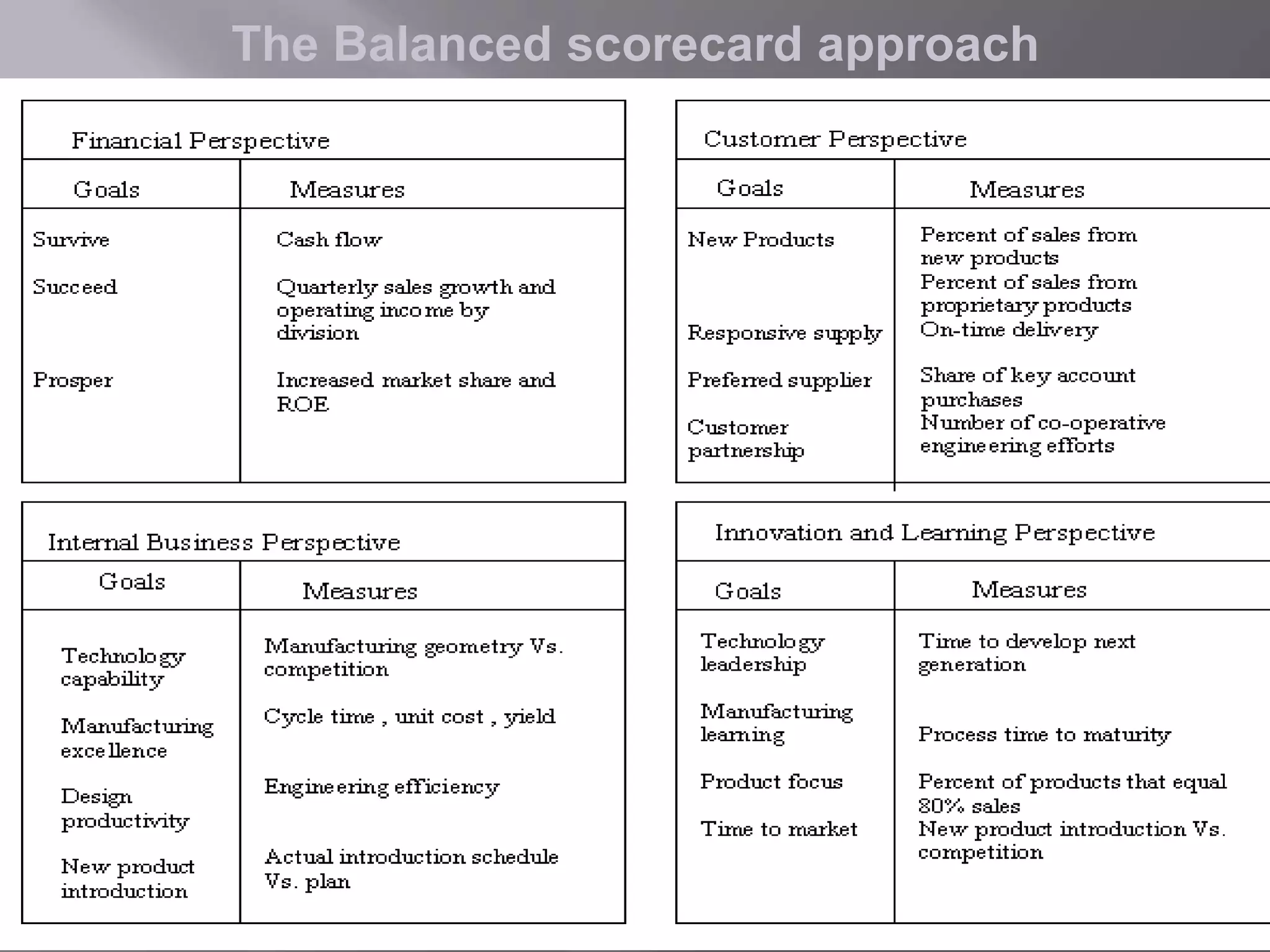
The Balanced scorecard approach
The Options Approach
•
•
•
•
•

•

•

•

Capital investments create and exploit profit
opportunities
Opportunities include “options”
Options are characterized by irreversibility and
uncertainty
The choice of timing alters the investment decision
in critical ways
The approach stresses opportunities to invest and
decisions to exploit opportunities
The approach depends upon the firms how to
exercise those options optimally and at the right
time
Options approach does not ignore the value of
creating options
An investment opportunity in information systems
has the option to invest now or in the future
The Benchmarking Approach






Benchmarking: process of improving
performance by continuously identifying,
understanding, and adapting outstanding
practices and processes found inside and
outside the organization
A tool that aids organizations in searching
for best practices that lead to superior
performance and in achieving these best
practices
Focuses on how to improve any given
organisation process, product or service by
exploiting “best practices”
The Benchmarking Approach
Maximizing Returns from IT
Investments


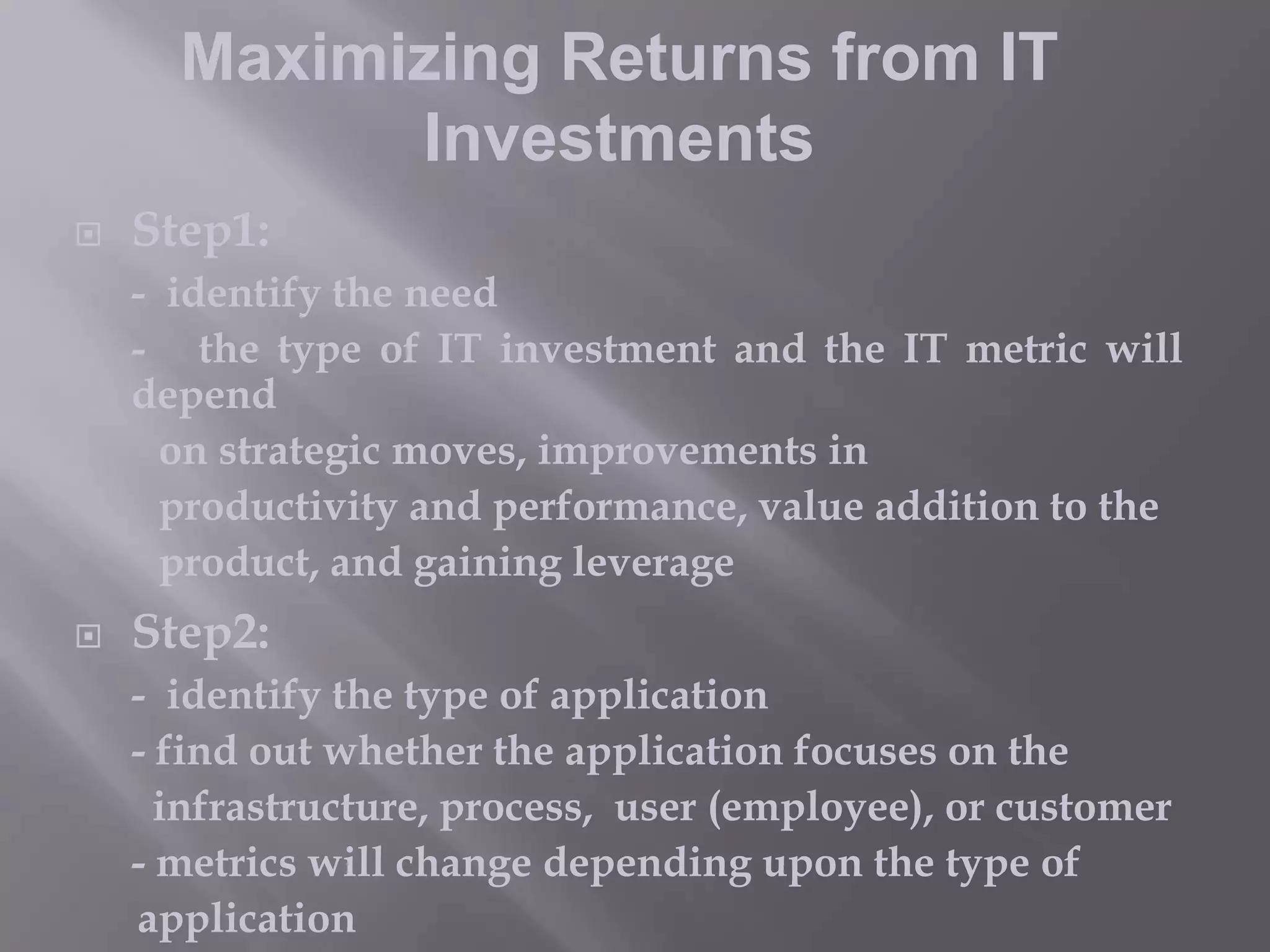
Step1:
- identify the need
- the type of IT investment and the IT metric will
depend
on strategic moves, improvements in
productivity and performance, value addition to the
product, and gaining leverage



Step2:
- identify the type of application
- find out whether the application focuses on the
infrastructure, process, user (employee), or customer
- metrics will change depending upon the type of
application
Maximizing Returns from IT
Investments contd


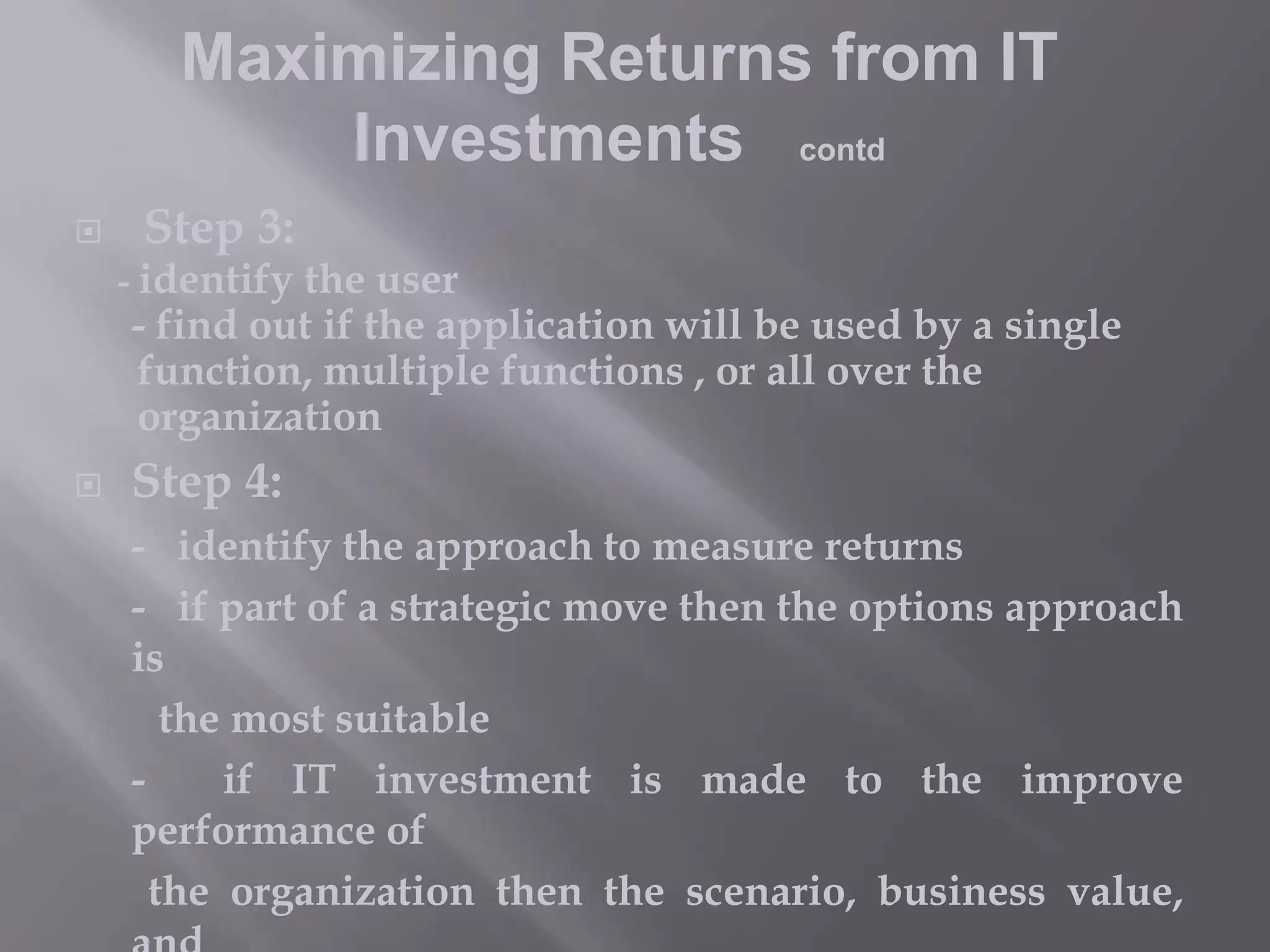
Step 3:

- identify the user

- find out if the application will be used by a single
function, multiple functions , or all over the
organization



Step 4:
- identify the approach to measure returns
- if part of a strategic move then the options approach
is
the most suitable
if IT investment is made to the improve
performance of
the organization then the scenario, business value,








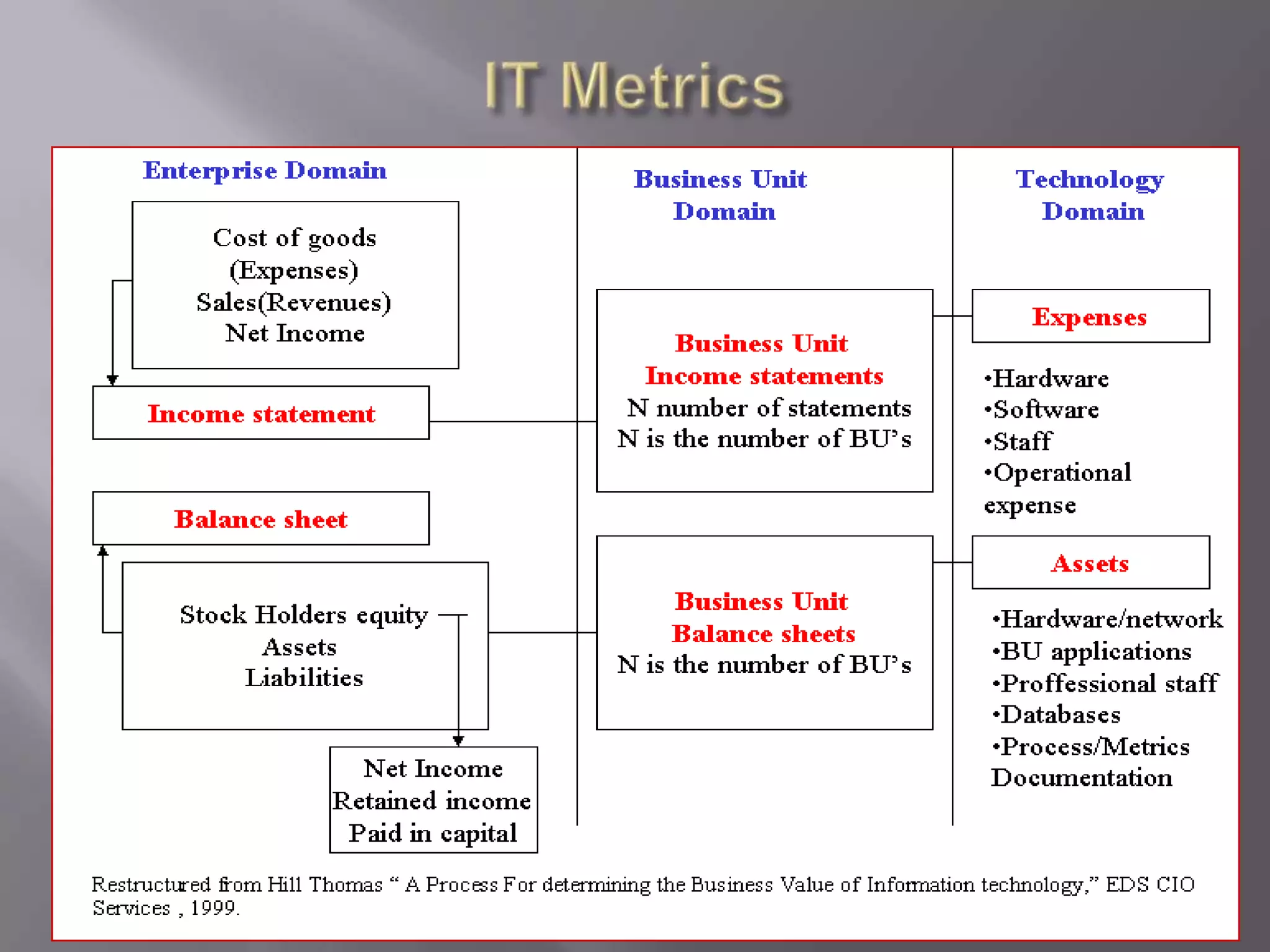
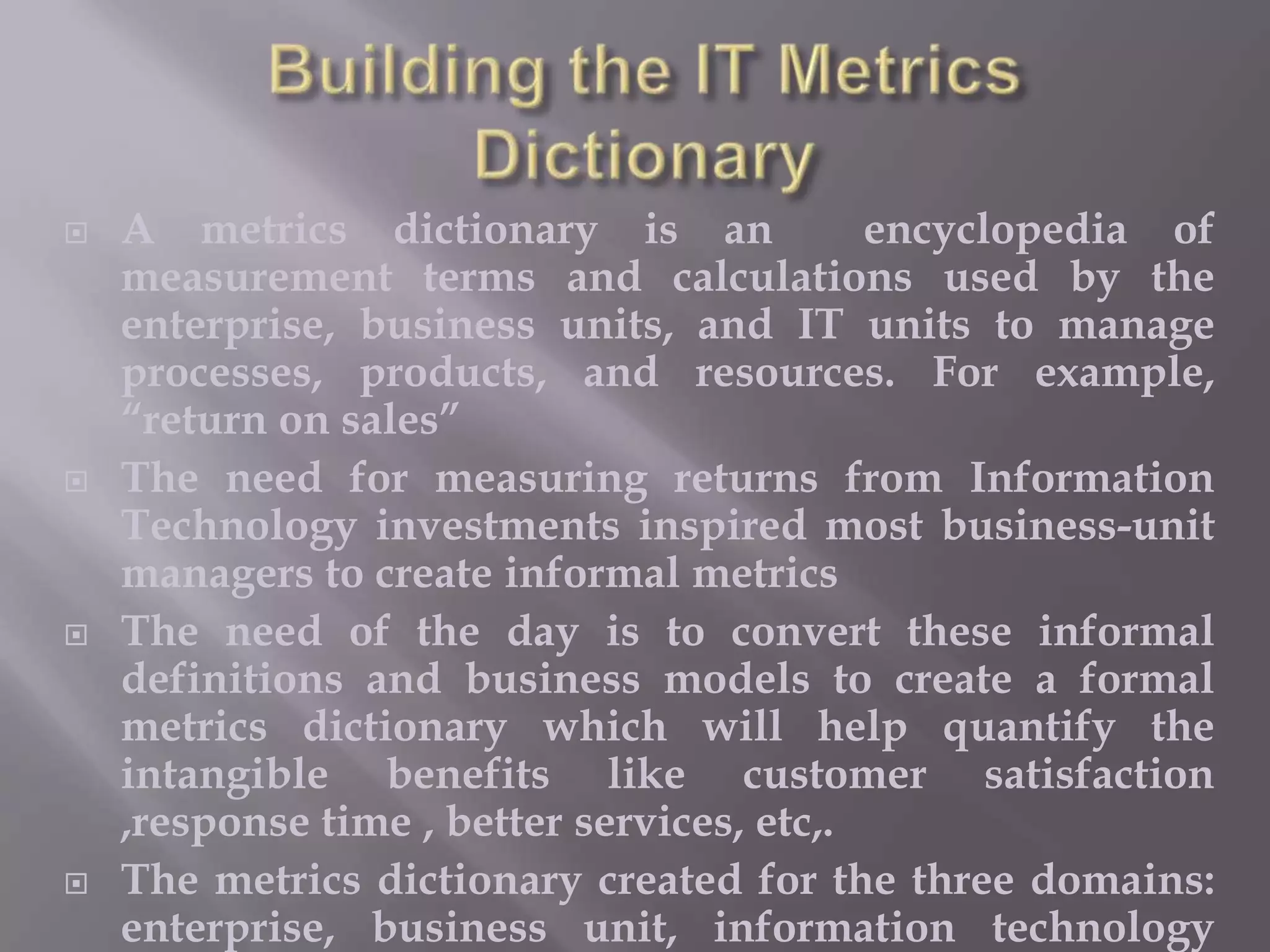
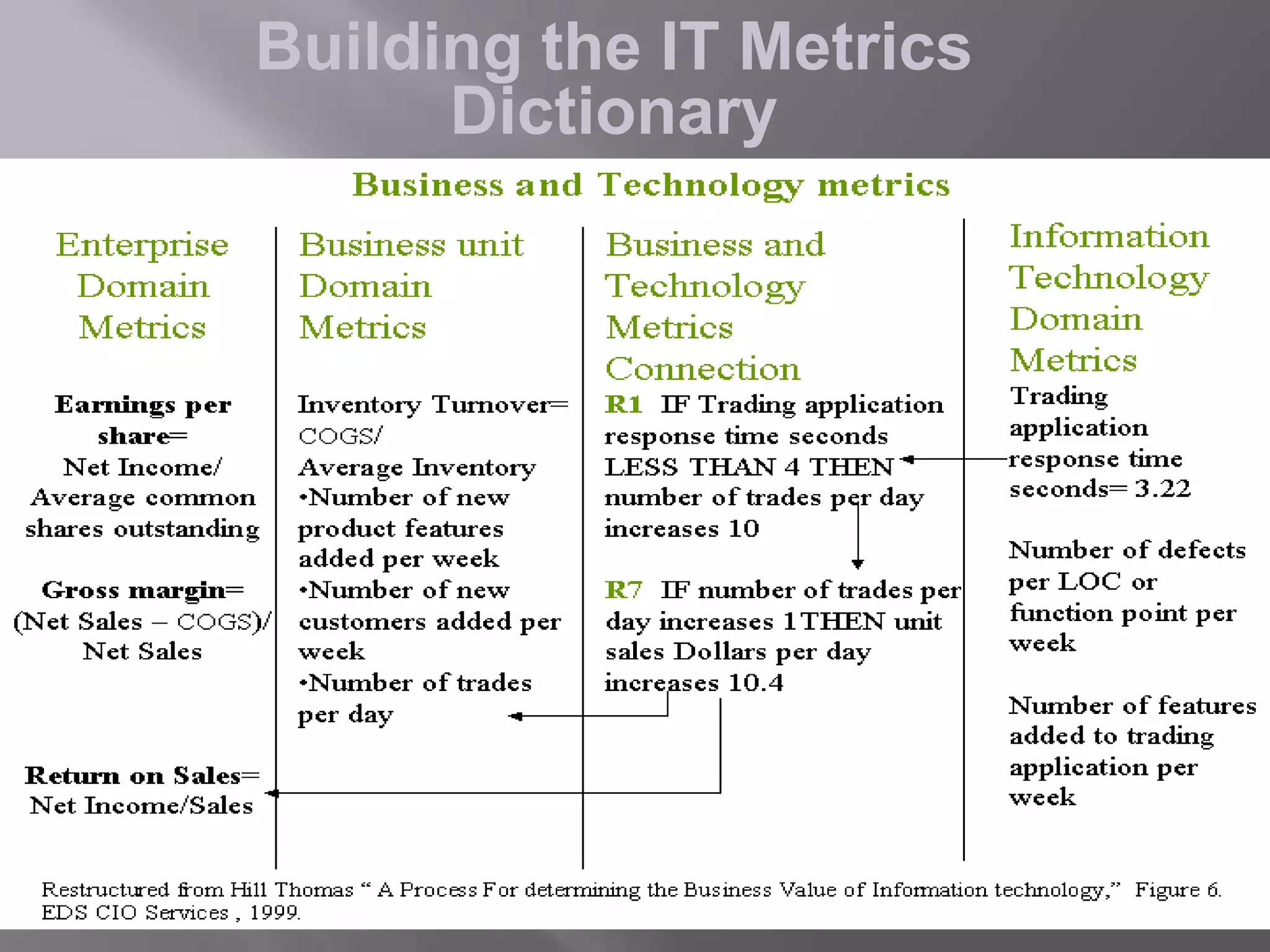
A metrics dictionary is an
encyclopedia of
measurement terms and calculations used by the
enterprise, business units, and IT units to manage
processes, products, and resources. For example,
“return on sales”
The need for measuring returns from Information
Technology investments inspired most business-unit
managers to create informal metrics
The need of the day is to convert these informal
definitions and business models to create a formal
metrics dictionary which will help quantify the
intangible benefits like customer satisfaction
,response time , better services, etc,.
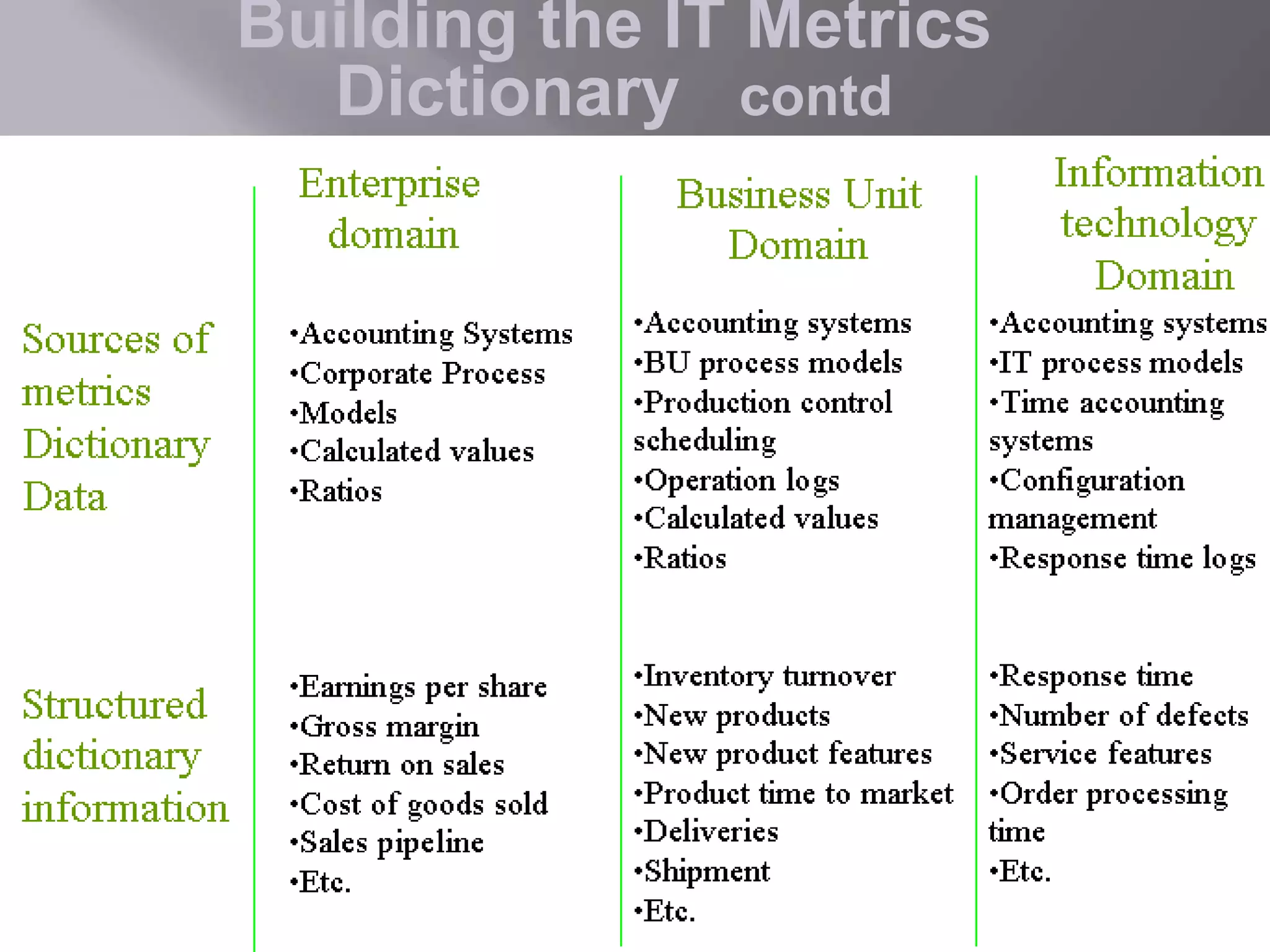
The metrics dictionary created for the three domains:
enterprise, business unit, information technology
Building the IT Metrics
Dictionary contd
Building the IT Metrics
Dictionary

Mis jaiswal-chapter-12

  • 2.
    • • • • Information technology (IT)as a lever of competitive advantage The IT outsourcing bandwagon effect characterized by consideration of information as a „utility‟ just like electric power or phone connection The e-everything phenomena with the emergence of Internet and electronic commerce The cost of IT has plunged since the 1960s resulting in enormous investments in IT applications that have stimulated increasingly complex organizational change
  • 3.
    • Shift ofIT applications from automation to IT acting as a business enabler: - automation yields measurable benefits in terms of cost savings - justification of ROI from IT expenditure as part of a strategic move involves assessing and taking a business risk where the benefits are intangible returns • High cost of IT infrastructure: - 60% of the total investment made on information systems is the cost of systems hardware and software and development costs for IT infrastructure - these systems provide the infrastructure that enables subsequent computer applications and as a result may or may not yield any specific benefit in the foreseeable future • Indirect and intangible benefits: - information productivity, technology helps in improving performance,
  • 5.
    • The net presentvalue (NPV) approach is often used by financial experts to justify the expenditure made on information technology • Steps: 1. calculate the present value of the expected stream of cash that the investment will generate 2. calculate the present value of the stream of expenditures required to undertake the project 3. arrive at the difference between the two (known as the net present value of the investment) 4. the manager can go ahead and invest if NPV is greater than zero
  • 6.
    Cost effectiveness approach contd. • • • • • • Thisapproach is true for most of the capital investments In information technology investments the results are seen only after a period of 3-4 years provided the information technology investment is implemented properly NPV calls for estimates of costs and revenues over the entire life of the project which is difficult to assess Changes in costs and revenues also cannot be predicted NPV takes into account the entire life of the project NPV is not able to take into account short-term uncertainties
  • 7.
    The Business value approach •Business value = productivity, profitability, and consumer value • Business Value approach takes root from three theories: the theories of production, competitive strategy , and consumer - IT spending is directly related to substantial increases in net output and consumer surplus, but unrelated to supranormal business profitability - IT spending indirectly affects productivity because IT helps firms reduce consumption of other inputs such as ordinary capital ,labor and establishment costs - IT creates value, intensifies competition and reduces profitability - IT should be used to generate business value rather than to generate business profits
  • 8.
    IT Chargeback approach • • • • InformationSystems Infrastructure by itself cannot generate returns It is the IT chargeback is an example of transfer pricing – a familiar concept in most decentralized organizations Information technology investment is made for building an organization wide IT infrastructure IT chargeback method relies on usage- based charges and helps managers make effective decisions on IT investment and use
  • 9.
    • • • • • Balanced scorecard: aset of measures that give the top managers a fast but comprehensive view of business The approach allows managers to look at the business from four important perspectives: - customer - internal - innovation and learning - financial Provides a method to consider all the operational measures together Indicates if the improvement in one area can be achieved through focus and investment in some other area Ensures that performance measurement is consistent with the initiatives in companies: - cross-functional integration - customer supplier partnerships - global scale - continuous improvement - team accountability
  • 10.
  • 11.
    The Options Approach • • • • • • • • Capitalinvestments create and exploit profit opportunities Opportunities include “options” Options are characterized by irreversibility and uncertainty The choice of timing alters the investment decision in critical ways The approach stresses opportunities to invest and decisions to exploit opportunities The approach depends upon the firms how to exercise those options optimally and at the right time Options approach does not ignore the value of creating options An investment opportunity in information systems has the option to invest now or in the future
  • 12.
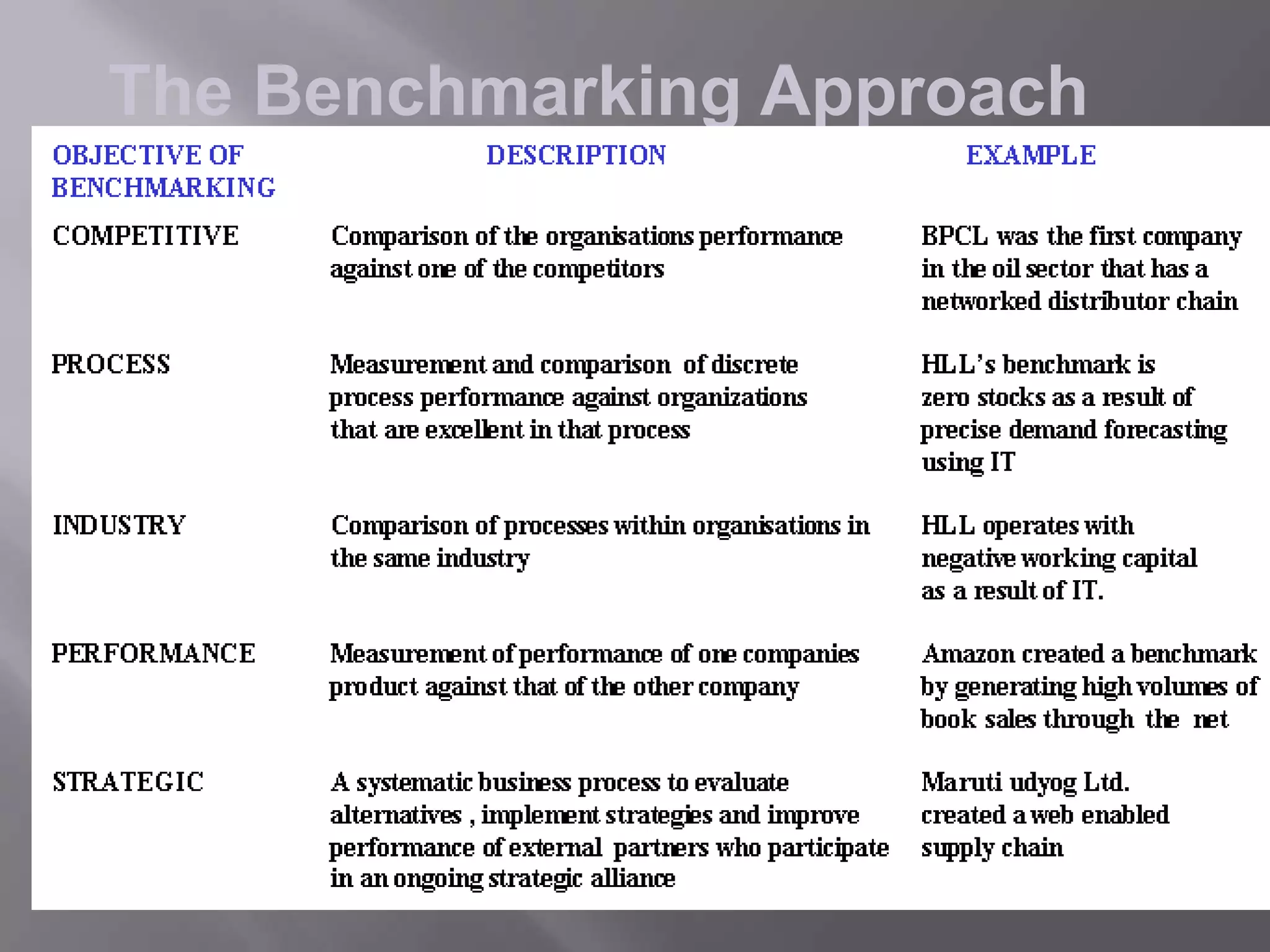
    The Benchmarking Approach    Benchmarking:process of improving performance by continuously identifying, understanding, and adapting outstanding practices and processes found inside and outside the organization A tool that aids organizations in searching for best practices that lead to superior performance and in achieving these best practices Focuses on how to improve any given organisation process, product or service by exploiting “best practices”
  • 13.
  • 14.
    Maximizing Returns fromIT Investments  Step1: - identify the need - the type of IT investment and the IT metric will depend on strategic moves, improvements in productivity and performance, value addition to the product, and gaining leverage  Step2: - identify the type of application - find out whether the application focuses on the infrastructure, process, user (employee), or customer - metrics will change depending upon the type of application
  • 15.
    Maximizing Returns fromIT Investments contd  Step 3: - identify the user - find out if the application will be used by a single function, multiple functions , or all over the organization  Step 4: - identify the approach to measure returns - if part of a strategic move then the options approach is the most suitable if IT investment is made to the improve performance of the organization then the scenario, business value,
  • 16.
        A metrics dictionaryis an encyclopedia of measurement terms and calculations used by the enterprise, business units, and IT units to manage processes, products, and resources. For example, “return on sales” The need for measuring returns from Information Technology investments inspired most business-unit managers to create informal metrics The need of the day is to convert these informal definitions and business models to create a formal metrics dictionary which will help quantify the intangible benefits like customer satisfaction ,response time , better services, etc,. The metrics dictionary created for the three domains: enterprise, business unit, information technology
  • 17.
    Building the ITMetrics Dictionary contd
  • 18.
    Building the ITMetrics Dictionary