*
Cryptographic Security
Security Goals
*
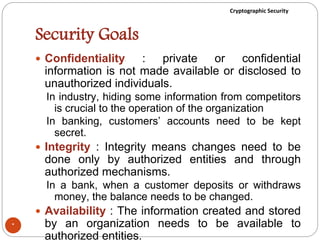
 Confidentiality : private or confidential
information is not made available or disclosed to
unauthorized individuals.
In industry, hiding some information from competitors
is crucial to the operation of the organization
In banking, customers’ accounts need to be kept
secret.
 Integrity : Integrity means changes need to be
done only by authorized entities and through
authorized mechanisms.
In a bank, when a customer deposits or withdraws
money, the balance needs to be changed.
 Availability : The information created and stored
by an organization needs to be available to
authorized entities.
Cryptographic Security
OSI security Architecture
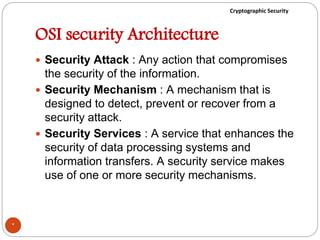
 Security Attack : Any action that compromises
the security of the information.
 Security Mechanism : A mechanism that is
designed to detect, prevent or recover from a
security attack.
 Security Services : A service that enhances the
security of data processing systems and
information transfers. A security service makes
use of one or more security mechanisms.
*
Cryptographic Security
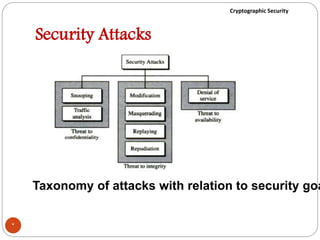
Security Attacks
*
Taxonomy of attacks with relation to security goa
Cryptographic Security
Attacks threatening to confidentiality
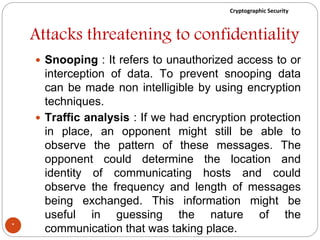
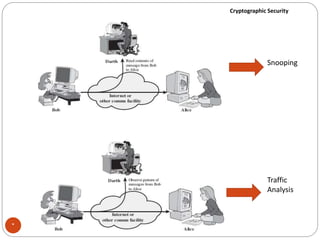
 Snooping : It refers to unauthorized access to or
interception of data. To prevent snooping data
can be made non intelligible by using encryption
techniques.
 Traffic analysis : If we had encryption protection
in place, an opponent might still be able to
observe the pattern of these messages. The
opponent could determine the location and
identity of communicating hosts and could
observe the frequency and length of messages
being exchanged. This information might be
useful in guessing the nature of the
communication that was taking place.*
Cryptographic Security
*
Snooping
Traffic
Analysis
Cryptographic Security
Attacks threatening to integrity
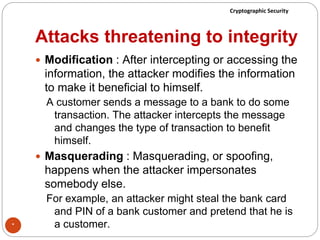
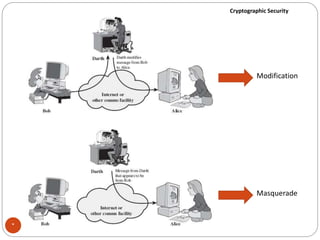
 Modification : After intercepting or accessing the
information, the attacker modifies the information
to make it beneficial to himself.
A customer sends a message to a bank to do some
transaction. The attacker intercepts the message
and changes the type of transaction to benefit
himself.
 Masquerading : Masquerading, or spoofing,
happens when the attacker impersonates
somebody else.
For example, an attacker might steal the bank card
and PIN of a bank customer and pretend that he is
a customer.*
Cryptographic Security
*
Modification
Masquerade
Cryptographic Security
Attacks threatening to integrity
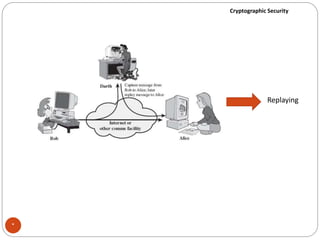
 Replaying : The attacker obtains a copy of a
message sent by a user and later tries to replay
it.
A person sends a request to his bank to ask for
payment to the attacker, who has done a job for
her. The attacker intercepts the message and sends
it again to receive another payment from the bank.
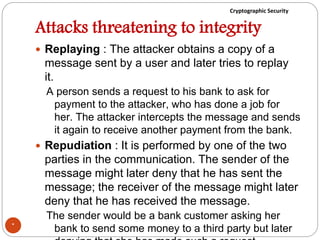
 Repudiation : It is performed by one of the two
parties in the communication. The sender of the
message might later deny that he has sent the
message; the receiver of the message might later
deny that he has received the message.
The sender would be a bank customer asking her
bank to send some money to a third party but later*
Cryptographic Security
*
Replaying
Cryptographic Security
Attacks threatening to availability
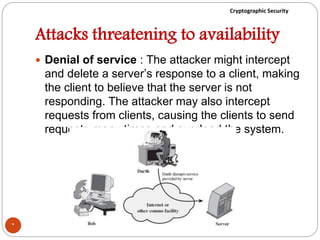
 Denial of service : The attacker might intercept
and delete a server’s response to a client, making
the client to believe that the server is not
responding. The attacker may also intercept
requests from clients, causing the clients to send
requests many times and overload the system.
*
Cryptographic Security
Passive Vs Active Attacks
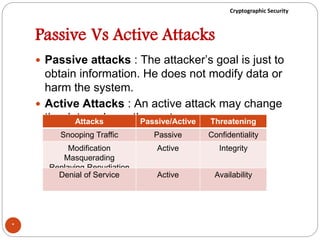
 Passive attacks : The attacker’s goal is just to
obtain information. He does not modify data or
harm the system.
 Active Attacks : An active attack may change
the data or harm the system.
*
Attacks Passive/Active Threatening
Snooping Traffic
analysis
Passive Confidentiality
Modification
Masquerading
Replaying Repudiation
Active Integrity
Denial of Service Active Availability
Cryptographic Security
Security Services
 ITU-T(X.800)[International Telecommunication
Union-Telecommunication Standardization
Sector] has defined five services related to the
security goals and attacks.
 Authentication: This service provides the
authentication of the party at the other end of the
line.
Peer entity authentication: In connection oriented
communication, it provides authentication of the
sender or receiver during the connection
establishment.
Data origin authentication: In connectionless
communication, it authenticates the source of the
data.
*
Cryptographic Security
Security Services
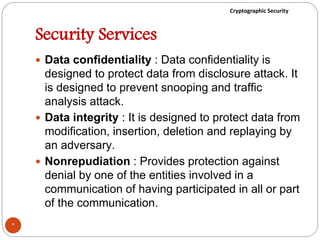
 Data confidentiality : Data confidentiality is
designed to protect data from disclosure attack. It
is designed to prevent snooping and traffic
analysis attack.
 Data integrity : It is designed to protect data from
modification, insertion, deletion and replaying by
an adversary.
 Nonrepudiation : Provides protection against
denial by one of the entities involved in a
communication of having participated in all or part
of the communication.
*
Cryptographic Security
Security Mechanisms
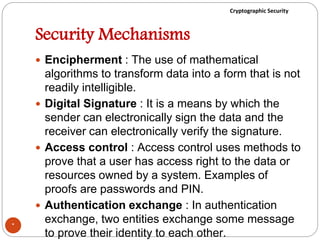
 Encipherment : The use of mathematical
algorithms to transform data into a form that is not
readily intelligible.
 Digital Signature : It is a means by which the
sender can electronically sign the data and the
receiver can electronically verify the signature.
 Access control : Access control uses methods to
prove that a user has access right to the data or
resources owned by a system. Examples of
proofs are passwords and PIN.
 Authentication exchange : In authentication
exchange, two entities exchange some message
to prove their identity to each other.
*
Cryptographic Security
Security Mechanisms
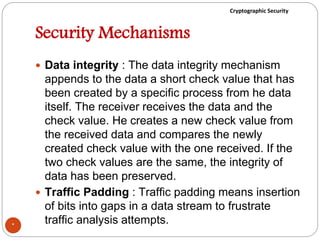
 Data integrity : The data integrity mechanism
appends to the data a short check value that has
been created by a specific process from he data
itself. The receiver receives the data and the
check value. He creates a new check value from
the received data and compares the newly
created check value with the one received. If the
two check values are the same, the integrity of
data has been preserved.
 Traffic Padding : Traffic padding means insertion
of bits into gaps in a data stream to frustrate
traffic analysis attempts.*
Cryptographic Security
Security Mechanisms
 Routing Control : Routing control means
selecting and continuously changing different
available routes between the sender and the
receiver.
 Notarization : The use of a trusted third party to
assure certain properties of a data exchange. The
receiver can involve a trusted party to store the
sender request in order to prevent the sender
from later denying that he has made such a
request.
*
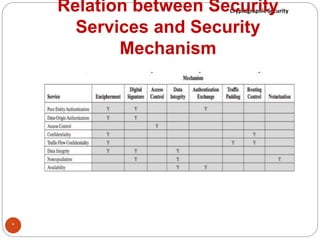
Cryptographic SecurityRelation between Security
Services and Security
Mechanism
*
Cryptographic Security
Cryptography – Basic Concepts
 Cryptography is the study of
Secret (crypto-) writing (-graphy)
 Cryptography
The art or science encompassing the principles
and methods of transforming an intelligible
message into one that is unintelligible, and then
retransforming that message back to its original
form.
 Plaintext
" The original intelligible message”
 Ciphertext
" The transformed message”
*
Cryptographic Security
Basic Concepts
 Cipher
An algorithm for transforming an intelligible
message into unintelligible by transposition
and/or substitution.
 Key
Some critical information used by the cipher,
known only to the sender & receiver.
 Encipher (encode)
The process of converting plaintext to ciphertext
 Decipher (decode)
The process of converting ciphertext back into
plaintext
*
Cryptographic Security
Basic Concepts
 Cryptanalysis
The study of principles and methods of
transforming an
unintelligible message back into an intelligible
message without knowledge of the key. Also
called codebreaking.
 Cryptology
Both cryptography and cryptanalysis
*
Cryptographic Security
Cryptography
*
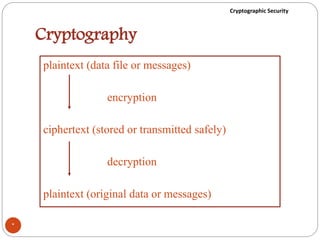
plaintext (data file or messages)
encryption
ciphertext (stored or transmitted safely)
decryption
plaintext (original data or messages)

Cryptographic Security

  • 1.
  • 2.
    Cryptographic Security Security Goals * Confidentiality : private or confidential information is not made available or disclosed to unauthorized individuals. In industry, hiding some information from competitors is crucial to the operation of the organization In banking, customers’ accounts need to be kept secret.  Integrity : Integrity means changes need to be done only by authorized entities and through authorized mechanisms. In a bank, when a customer deposits or withdraws money, the balance needs to be changed.  Availability : The information created and stored by an organization needs to be available to authorized entities.
  • 3.
    Cryptographic Security OSI securityArchitecture  Security Attack : Any action that compromises the security of the information.  Security Mechanism : A mechanism that is designed to detect, prevent or recover from a security attack.  Security Services : A service that enhances the security of data processing systems and information transfers. A security service makes use of one or more security mechanisms. *
  • 4.
    Cryptographic Security Security Attacks * Taxonomyof attacks with relation to security goa
  • 5.
    Cryptographic Security Attacks threateningto confidentiality  Snooping : It refers to unauthorized access to or interception of data. To prevent snooping data can be made non intelligible by using encryption techniques.  Traffic analysis : If we had encryption protection in place, an opponent might still be able to observe the pattern of these messages. The opponent could determine the location and identity of communicating hosts and could observe the frequency and length of messages being exchanged. This information might be useful in guessing the nature of the communication that was taking place.*
  • 6.
  • 7.
    Cryptographic Security Attacks threateningto integrity  Modification : After intercepting or accessing the information, the attacker modifies the information to make it beneficial to himself. A customer sends a message to a bank to do some transaction. The attacker intercepts the message and changes the type of transaction to benefit himself.  Masquerading : Masquerading, or spoofing, happens when the attacker impersonates somebody else. For example, an attacker might steal the bank card and PIN of a bank customer and pretend that he is a customer.*
  • 8.
  • 9.
    Cryptographic Security Attacks threateningto integrity  Replaying : The attacker obtains a copy of a message sent by a user and later tries to replay it. A person sends a request to his bank to ask for payment to the attacker, who has done a job for her. The attacker intercepts the message and sends it again to receive another payment from the bank.  Repudiation : It is performed by one of the two parties in the communication. The sender of the message might later deny that he has sent the message; the receiver of the message might later deny that he has received the message. The sender would be a bank customer asking her bank to send some money to a third party but later*
  • 10.
  • 11.
    Cryptographic Security Attacks threateningto availability  Denial of service : The attacker might intercept and delete a server’s response to a client, making the client to believe that the server is not responding. The attacker may also intercept requests from clients, causing the clients to send requests many times and overload the system. *
  • 12.
    Cryptographic Security Passive VsActive Attacks  Passive attacks : The attacker’s goal is just to obtain information. He does not modify data or harm the system.  Active Attacks : An active attack may change the data or harm the system. * Attacks Passive/Active Threatening Snooping Traffic analysis Passive Confidentiality Modification Masquerading Replaying Repudiation Active Integrity Denial of Service Active Availability
  • 13.
    Cryptographic Security Security Services ITU-T(X.800)[International Telecommunication Union-Telecommunication Standardization Sector] has defined five services related to the security goals and attacks.  Authentication: This service provides the authentication of the party at the other end of the line. Peer entity authentication: In connection oriented communication, it provides authentication of the sender or receiver during the connection establishment. Data origin authentication: In connectionless communication, it authenticates the source of the data. *
  • 14.
    Cryptographic Security Security Services Data confidentiality : Data confidentiality is designed to protect data from disclosure attack. It is designed to prevent snooping and traffic analysis attack.  Data integrity : It is designed to protect data from modification, insertion, deletion and replaying by an adversary.  Nonrepudiation : Provides protection against denial by one of the entities involved in a communication of having participated in all or part of the communication. *
  • 15.
    Cryptographic Security Security Mechanisms Encipherment : The use of mathematical algorithms to transform data into a form that is not readily intelligible.  Digital Signature : It is a means by which the sender can electronically sign the data and the receiver can electronically verify the signature.  Access control : Access control uses methods to prove that a user has access right to the data or resources owned by a system. Examples of proofs are passwords and PIN.  Authentication exchange : In authentication exchange, two entities exchange some message to prove their identity to each other. *
  • 16.
    Cryptographic Security Security Mechanisms Data integrity : The data integrity mechanism appends to the data a short check value that has been created by a specific process from he data itself. The receiver receives the data and the check value. He creates a new check value from the received data and compares the newly created check value with the one received. If the two check values are the same, the integrity of data has been preserved.  Traffic Padding : Traffic padding means insertion of bits into gaps in a data stream to frustrate traffic analysis attempts.*
  • 17.
    Cryptographic Security Security Mechanisms Routing Control : Routing control means selecting and continuously changing different available routes between the sender and the receiver.  Notarization : The use of a trusted third party to assure certain properties of a data exchange. The receiver can involve a trusted party to store the sender request in order to prevent the sender from later denying that he has made such a request. *
  • 18.
    Cryptographic SecurityRelation betweenSecurity Services and Security Mechanism *
  • 19.
    Cryptographic Security Cryptography –Basic Concepts  Cryptography is the study of Secret (crypto-) writing (-graphy)  Cryptography The art or science encompassing the principles and methods of transforming an intelligible message into one that is unintelligible, and then retransforming that message back to its original form.  Plaintext " The original intelligible message”  Ciphertext " The transformed message” *
  • 20.
    Cryptographic Security Basic Concepts Cipher An algorithm for transforming an intelligible message into unintelligible by transposition and/or substitution.  Key Some critical information used by the cipher, known only to the sender & receiver.  Encipher (encode) The process of converting plaintext to ciphertext  Decipher (decode) The process of converting ciphertext back into plaintext *
  • 21.
    Cryptographic Security Basic Concepts Cryptanalysis The study of principles and methods of transforming an unintelligible message back into an intelligible message without knowledge of the key. Also called codebreaking.  Cryptology Both cryptography and cryptanalysis *
  • 22.
    Cryptographic Security Cryptography * plaintext (datafile or messages) encryption ciphertext (stored or transmitted safely) decryption plaintext (original data or messages)