



The DeLone & McLean Model
The Seddon Model
The Organizational Transformation
Model











Constructed by DeLone and McLean in
1992
Considered to be the pioneer in the
information system field
Overcomes the short-comings of the
Technology Acceptance Model (TAM)
Synthesizes a six-factor taxonomy of IS
success such as:
Systems Quality
Information Quality
IS use
User satisfaction
Individual impact and
Organizational impact
System
Quality

Use

Individual
Impact

Information
Quality

Use
Satisfaction

The DeLone & McLean Model

Organizationa
l Impact









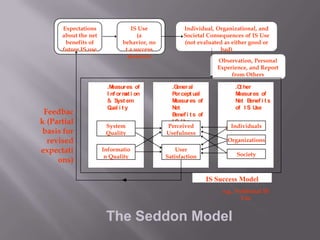
Seddon proposed this model in 1997
Model focuses on the variance aspects of the
interrelationships among the taxonomic
categories
Considers three classes of interrelated
variables:
Measures of Information and System
Quality
General measures of net benefits of IS use
Behaviour with respect to IS use
Expectations
about the net
benefits of
future IS use

Feedbac
k (Partial
basis for
revised
expectati
ons)

IS Use
(a
behavior, no
t a success
measure)

.M
easur es of
I nf or m i on
at
& Syst em
Q i ty
ual
System
Quality

Individual, Organizational, and
Societal Consequences of IS Use
(not evaluated as either good or
bad)
Observation, Personal
Experience, and Report
from Others
.G
ener al
Per cept ual
M
easur es of
N
et
B
enef i t s of
IS U
se
Perceived
Usefulness

.O her
t
M
easur es of
N B
et enef i t s
of I S U
se
Individuals
Net benefits to:
Organizations

Informatio
n Quality

User
Satisfaction

Society

IS Success Model
e.g., Volitional IS
Use

The Seddon Model








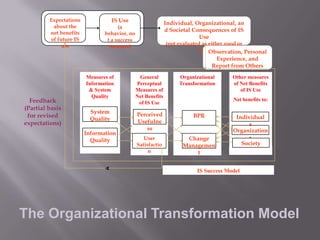
Earlier models do not capture the organization
transformation dimension of successful IS
implementation
This model has three dimensions:
Systems and Information Quality
Organizational usage of IS
Organization transformation due to IS
Expectations
about the
net benefits
of future IS
use

IS Use

Individual, Organizational, an
d Societal Consequences of IS
Use

(a
behavior, no
t a success
measure)

(not evaluated as either good or
bad)
Observation, Personal

Experience, and
Report from Others

Feedback
(Partial basis
for revised
expectations)

Measures of
Information
& System
Quality

General
Perceptual
Measures of
Net Benefits
of IS Use

System
Quality

Perceived
Usefulne
ss

BPR

User
Satisfactio
n

Change
Managemen
t

Information
Quality

Organizational
Transformation

Other measures
of Net Benefits
of IS Use
Net benefits to:

Individual
s
Organization
s
Society

IS Success Model

The Organizational Transformation Model
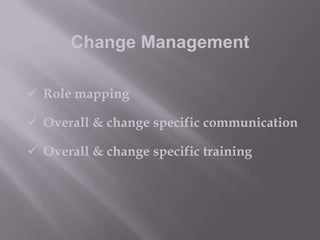
Change Management
 Role mapping
 Overall & change specific communication

 Overall & change specific training




Change Management is an
organized, systematic application of the
knowledge, tools, and resources of change that
provides organizations with a key process to
achieve their business strategy
Change management
plans, initiates, realizes, controls, and finally
stabilizes change processes on both, corporate
and personal levels








First effects of change on
employees, leaders, and on performance levels
are negative

These effects include fears, stress, frustration
and denial of change
Most employees tend to react with resistance to
change rather than seeing change as a chance to
initiate improvements
They are afraid of losing something, because
they have incomplete information on how the
change processes will effect their personal
situation in terms of tasks, workload, or
responsibilities

Mis jaiswal-chapter-13

  • 2.
       The DeLone &McLean Model The Seddon Model The Organizational Transformation Model
  • 3.
              Constructed by DeLoneand McLean in 1992 Considered to be the pioneer in the information system field Overcomes the short-comings of the Technology Acceptance Model (TAM) Synthesizes a six-factor taxonomy of IS success such as: Systems Quality Information Quality IS use User satisfaction Individual impact and Organizational impact
  • 4.
  • 5.
          Seddon proposed thismodel in 1997 Model focuses on the variance aspects of the interrelationships among the taxonomic categories Considers three classes of interrelated variables: Measures of Information and System Quality General measures of net benefits of IS use Behaviour with respect to IS use
  • 6.
    Expectations about the net benefitsof future IS use Feedbac k (Partial basis for revised expectati ons) IS Use (a behavior, no t a success measure) .M easur es of I nf or m i on at & Syst em Q i ty ual System Quality Individual, Organizational, and Societal Consequences of IS Use (not evaluated as either good or bad) Observation, Personal Experience, and Report from Others .G ener al Per cept ual M easur es of N et B enef i t s of IS U se Perceived Usefulness .O her t M easur es of N B et enef i t s of I S U se Individuals Net benefits to: Organizations Informatio n Quality User Satisfaction Society IS Success Model e.g., Volitional IS Use The Seddon Model
  • 7.
         Earlier models donot capture the organization transformation dimension of successful IS implementation This model has three dimensions: Systems and Information Quality Organizational usage of IS Organization transformation due to IS
  • 8.
    Expectations about the net benefits offuture IS use IS Use Individual, Organizational, an d Societal Consequences of IS Use (a behavior, no t a success measure) (not evaluated as either good or bad) Observation, Personal Experience, and Report from Others Feedback (Partial basis for revised expectations) Measures of Information & System Quality General Perceptual Measures of Net Benefits of IS Use System Quality Perceived Usefulne ss BPR User Satisfactio n Change Managemen t Information Quality Organizational Transformation Other measures of Net Benefits of IS Use Net benefits to: Individual s Organization s Society IS Success Model The Organizational Transformation Model
  • 9.
    Change Management  Rolemapping  Overall & change specific communication  Overall & change specific training
  • 10.
      Change Management isan organized, systematic application of the knowledge, tools, and resources of change that provides organizations with a key process to achieve their business strategy Change management plans, initiates, realizes, controls, and finally stabilizes change processes on both, corporate and personal levels
  • 11.
        First effects ofchange on employees, leaders, and on performance levels are negative These effects include fears, stress, frustration and denial of change Most employees tend to react with resistance to change rather than seeing change as a chance to initiate improvements They are afraid of losing something, because they have incomplete information on how the change processes will effect their personal situation in terms of tasks, workload, or responsibilities