The business model is a holistic view of the overall business
with varying levels of detail from high level business
management perspectives to low level operational perspectives.
A business model cannot be static. It must be and will be
reinvented as customer needs and priorities change.
The modeling system permits redesign of the processes to
eliminate these wasted activities in the business, thus cutting
costs from the process and operations of the business. The
relational nature of the modeling system permits a business to
link the IT systems to the organization information and
processes








Why should IT architects be concerned with an
architecture of business concepts, in the context of
building software systems? After all, IT architects do
not create businesses; they create technology-based
information systems. However, the systems that they
create do have a fundamental impact on businesses
The mutually evolving relationship between business
organizations and IT systems requires the ability to
capture and portray business and technical
information in a way that makes the two sets of
information easy to interrelate
How to organize work.? The work of building
information systems is most effective if it is organized
as a value-chain.
Organized business knowledge gives rise to
requirements for enterprise information systems




In this methodology the firm recognizes its
business mission , objectives and functions
and how these determine its business
processes.
Data is seen as a valuable corporate
resource and describes the overall
information architecture






Technical IS plan – What is the technology
infrastructure? Who designs , builds and manages it?
Application/operational
IS
plan
–
What
operations/functions/processes are supported by
systems and technology? Who takes the initiative in
developing and managing them?
Strategic IS plan – Developing the business plan and
articulating the mission ,vision and objectives of the
organization. Developing the IS vision and planning
how information systems can improve the
performance of the organization. Defining the critical
success factors and how information systems can
support them .









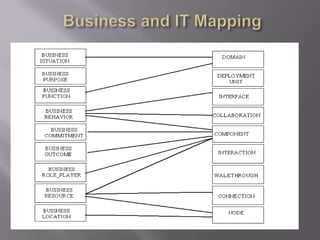
The business situation provides both motivation
and constraint on what the business can aspire to
accomplish, and the current state of available and
actual information technology is a major factor in
this situation.
Business concept that maps to the whole world of
information systems is the concept of business
function .
The concept of business behavior is the key to
organizing IT functionality. Behavior is defined
and performed by such software components as
workflow engines.
The behavior of a component is made externally
accessible through the interfaces of the component.
It also drives and is embodied in the IT concepts of
collaboration








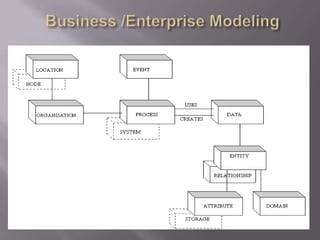
The Business / Enterprise Modeling
process constitutes developing the:
The information architecture (functions,
entity types, and interactions),
The business systems architecture
(systems and shared data stores), and
The technical architecture (hardware,
software, and communications) - plus the
information management organization
(organizational structure and tasks)


Record the Process flow documentation



Describe the "inputs" and "outputs" for
the process





"data mapping" or "data modeling" -- the
process of articulating the data (key data
elements ) that must be captured, stored,
and managed, the purpose and/or use of
the data
Selecting or developing an effective
information system is not, primarily, a
technical decision. feedback from the
business process teams








System
development
life
cycle
(SDLC)
methodologies are mechanisms to assure that
software systems meet established requirements
The approach deals with all components of the
system, i.e. not only hardware, networking,
systems software and applications software, but
also the substantial amount of human activity
that is involved
There are many review activities that check the
product, the process and resource usage against
plans
The process is cyclical, in the sense that each
version of a product becomes part of the
environment within which the next version is
developed
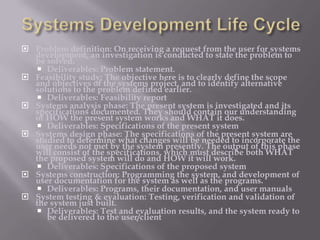
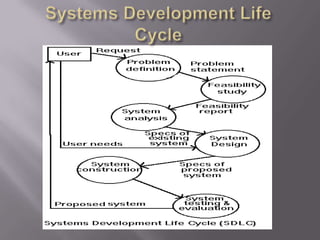
 Problem definition: On receiving a request from the user for systems
development, an investigation is conducted to state the problem to
be solved.
 Deliverables: Problem statement.
 Feasibility study: The objective here is to clearly define the scope
and objectives of the systems project, and to identify alternative
solutions to the problem defined earlier.
 Deliverables: Feasibility report
 Systems analysis phase: The present system is investigated and its
specifications documented. They should contain our understanding
of HOW the present system works and WHAT it does.
 Deliverables: Specifications of the present system
 Systems design phase: The specifications of the present system are
studied to determine what changes will be needed to incorporate the
user needs not met by the system presently. The output of this phase
will consist of the specifications, which must describe both WHAT
the proposed system will do and HOW it will work.
 Deliverables: Specifications of the proposed system
 Systems construction: Programming the system, and development of
user documentation for the system as well as the programs.
 Deliverables: Programs, their documentation, and user manuals
 System testing & evaluation: Testing, verification and validation of
the system just built.
 Deliverables: Test and evaluation results, and the system ready to
be delivered to the user/client








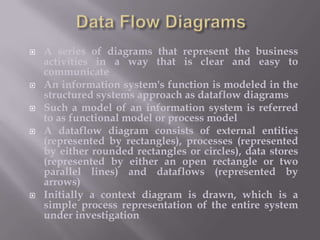
A series of diagrams that represent the business
activities in a way that is clear and easy to
communicate
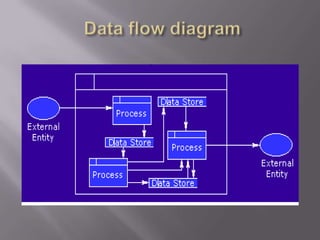
An information system's function is modeled in the
structured systems approach as dataflow diagrams
Such a model of an information system is referred
to as functional model or process model
A dataflow diagram consists of external entities
(represented by rectangles), processes (represented
by either rounded rectangles or circles), data stores
(represented by either an open rectangle or two
parallel lines) and dataflows (represented by
arrows)
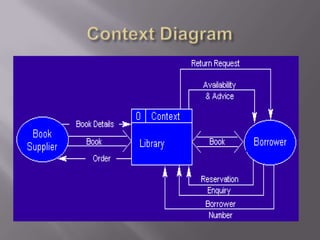
Initially a context diagram is drawn, which is a
simple process representation of the entire system
under investigation




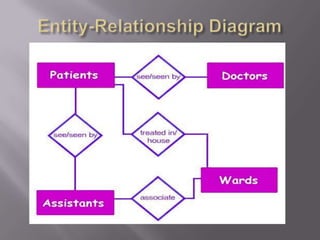
Entity Relationship Diagrams are a major
data modelling tool and will help organize
the data in your project into entities and
define the relationships between the entities
This process has proved to enable the analyst
to produce a good database structure so that
the data can be stored and retrieved in a most
efficient manner








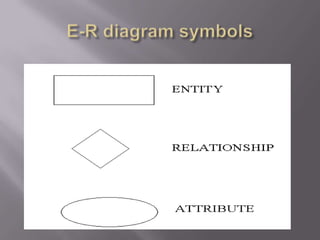
Entity: a data entity is anything real or abstract
about which we want to store data
Relationship: a data relationship is a natural
association that exists between one or more
entities e.g. Employees process payments
Attribute: a data attribute is a characteristic
common to all or most instances of a particular
entity
Synonyms include property, data element, field
e.g. Name, address, Employee Number, pay rate
are all attributes of the entity employee
Mis jaiswal-chapter-09

Mis jaiswal-chapter-09

  • 2.
    The business modelis a holistic view of the overall business with varying levels of detail from high level business management perspectives to low level operational perspectives. A business model cannot be static. It must be and will be reinvented as customer needs and priorities change. The modeling system permits redesign of the processes to eliminate these wasted activities in the business, thus cutting costs from the process and operations of the business. The relational nature of the modeling system permits a business to link the IT systems to the organization information and processes
  • 3.
        Why should ITarchitects be concerned with an architecture of business concepts, in the context of building software systems? After all, IT architects do not create businesses; they create technology-based information systems. However, the systems that they create do have a fundamental impact on businesses The mutually evolving relationship between business organizations and IT systems requires the ability to capture and portray business and technical information in a way that makes the two sets of information easy to interrelate How to organize work.? The work of building information systems is most effective if it is organized as a value-chain. Organized business knowledge gives rise to requirements for enterprise information systems
  • 4.
      In this methodologythe firm recognizes its business mission , objectives and functions and how these determine its business processes. Data is seen as a valuable corporate resource and describes the overall information architecture
  • 5.
       Technical IS plan– What is the technology infrastructure? Who designs , builds and manages it? Application/operational IS plan – What operations/functions/processes are supported by systems and technology? Who takes the initiative in developing and managing them? Strategic IS plan – Developing the business plan and articulating the mission ,vision and objectives of the organization. Developing the IS vision and planning how information systems can improve the performance of the organization. Defining the critical success factors and how information systems can support them .
  • 6.
         The business situationprovides both motivation and constraint on what the business can aspire to accomplish, and the current state of available and actual information technology is a major factor in this situation. Business concept that maps to the whole world of information systems is the concept of business function . The concept of business behavior is the key to organizing IT functionality. Behavior is defined and performed by such software components as workflow engines. The behavior of a component is made externally accessible through the interfaces of the component. It also drives and is embodied in the IT concepts of collaboration
  • 9.
        The Business /Enterprise Modeling process constitutes developing the: The information architecture (functions, entity types, and interactions), The business systems architecture (systems and shared data stores), and The technical architecture (hardware, software, and communications) - plus the information management organization (organizational structure and tasks)
  • 10.
     Record the Processflow documentation  Describe the "inputs" and "outputs" for the process   "data mapping" or "data modeling" -- the process of articulating the data (key data elements ) that must be captured, stored, and managed, the purpose and/or use of the data Selecting or developing an effective information system is not, primarily, a technical decision. feedback from the business process teams
  • 11.
        System development life cycle (SDLC) methodologies are mechanismsto assure that software systems meet established requirements The approach deals with all components of the system, i.e. not only hardware, networking, systems software and applications software, but also the substantial amount of human activity that is involved There are many review activities that check the product, the process and resource usage against plans The process is cyclical, in the sense that each version of a product becomes part of the environment within which the next version is developed
  • 12.
     Problem definition:On receiving a request from the user for systems development, an investigation is conducted to state the problem to be solved.  Deliverables: Problem statement.  Feasibility study: The objective here is to clearly define the scope and objectives of the systems project, and to identify alternative solutions to the problem defined earlier.  Deliverables: Feasibility report  Systems analysis phase: The present system is investigated and its specifications documented. They should contain our understanding of HOW the present system works and WHAT it does.  Deliverables: Specifications of the present system  Systems design phase: The specifications of the present system are studied to determine what changes will be needed to incorporate the user needs not met by the system presently. The output of this phase will consist of the specifications, which must describe both WHAT the proposed system will do and HOW it will work.  Deliverables: Specifications of the proposed system  Systems construction: Programming the system, and development of user documentation for the system as well as the programs.  Deliverables: Programs, their documentation, and user manuals  System testing & evaluation: Testing, verification and validation of the system just built.  Deliverables: Test and evaluation results, and the system ready to be delivered to the user/client
  • 14.
         A series ofdiagrams that represent the business activities in a way that is clear and easy to communicate An information system's function is modeled in the structured systems approach as dataflow diagrams Such a model of an information system is referred to as functional model or process model A dataflow diagram consists of external entities (represented by rectangles), processes (represented by either rounded rectangles or circles), data stores (represented by either an open rectangle or two parallel lines) and dataflows (represented by arrows) Initially a context diagram is drawn, which is a simple process representation of the entire system under investigation
  • 17.
      Entity Relationship Diagramsare a major data modelling tool and will help organize the data in your project into entities and define the relationships between the entities This process has proved to enable the analyst to produce a good database structure so that the data can be stored and retrieved in a most efficient manner
  • 18.
        Entity: a dataentity is anything real or abstract about which we want to store data Relationship: a data relationship is a natural association that exists between one or more entities e.g. Employees process payments Attribute: a data attribute is a characteristic common to all or most instances of a particular entity Synonyms include property, data element, field e.g. Name, address, Employee Number, pay rate are all attributes of the entity employee