Vulnerability
Attack
Threat
Network Security Mechanisms
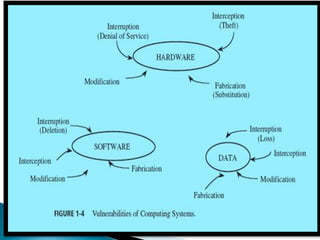
Vulnerabilities are weak points or loopholes in
security that an attacker exploits in order to gain
access to the network or to resources on the
network.
Attack is any attempt to destroy, expose,
alter, disable, steal or gain unauthorized
access to or make unauthorized use of an
asset.
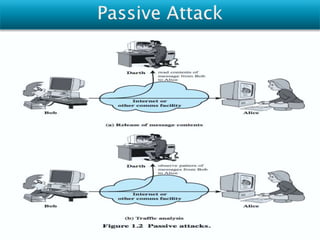
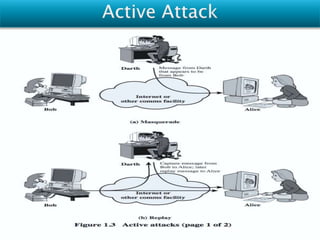
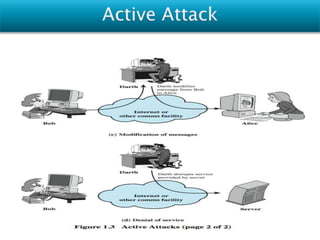
Two types of attack are:
 Passive Attack
 Active Attack
A mechanism that is designed to detect, prevent,
or recover from a security attack.
Different types of security Mechanisms are:
 Routing control
 Traffic padding
 Encipherment
 Access Control
 Digital Signatures
 Data Integrity
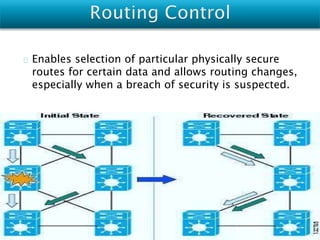
Enables selection of particular physically secure
routes for certain data and allows routing changes,
especially when a breach of security is suspected.
The insertion of bits into gaps in a data stream
to frustrate traffic analysis attempts.
Encipherment is the process of translating
plaintext into ciphertext.
The use of mathematical algorithms to
transform data into a form that is not readily
intelligible.
Cryptography technique is used for
enciphering.
A word with greek origin, means “Secret
Writing”.
Two distinct mechanisms:
 Symmetric-Key Encipherment
 Asymmetric-Key Encipherment
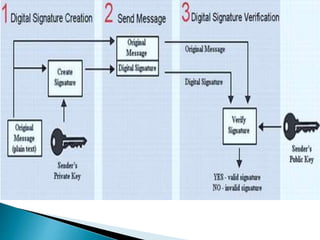
A digital signature or digital signature
scheme is a mathematical scheme for
demonstrating the authenticity of a digital
message or document.
It uses methods to prove that a user has
access rights to the data or resources owned
by a system.
Examples: passwords and PINs
Data integrity refers to maintaining and
assuring the accuracy and consistency
of data.
A variety of mechanisms used to assure the
integrity of a data unit or stream of data
units.
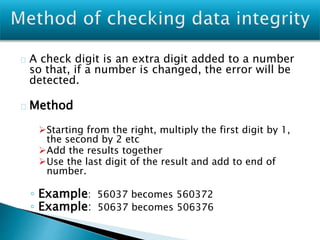
A check digit is an extra digit added to a number
so that, if a number is changed, the error will be
detected.
Method
Starting from the right, multiply the first digit by 1,
the second by 2 etc
Add the results together
Use the last digit of the result and add to end of
number.
◦ Example: 56037 becomes 560372
◦ Example: 50637 becomes 506376
Security Mechanisms

Security Mechanisms

  • 2.
  • 3.
    Vulnerabilities are weakpoints or loopholes in security that an attacker exploits in order to gain access to the network or to resources on the network.
  • 5.
    Attack is anyattempt to destroy, expose, alter, disable, steal or gain unauthorized access to or make unauthorized use of an asset. Two types of attack are:  Passive Attack  Active Attack
  • 10.
    A mechanism thatis designed to detect, prevent, or recover from a security attack. Different types of security Mechanisms are:  Routing control  Traffic padding  Encipherment  Access Control  Digital Signatures  Data Integrity
  • 11.
    Enables selection ofparticular physically secure routes for certain data and allows routing changes, especially when a breach of security is suspected.
  • 12.
    The insertion ofbits into gaps in a data stream to frustrate traffic analysis attempts.
  • 13.
    Encipherment is theprocess of translating plaintext into ciphertext. The use of mathematical algorithms to transform data into a form that is not readily intelligible. Cryptography technique is used for enciphering.
  • 14.
    A word withgreek origin, means “Secret Writing”. Two distinct mechanisms:  Symmetric-Key Encipherment  Asymmetric-Key Encipherment
  • 15.
    A digital signatureor digital signature scheme is a mathematical scheme for demonstrating the authenticity of a digital message or document.
  • 17.
    It uses methodsto prove that a user has access rights to the data or resources owned by a system. Examples: passwords and PINs
  • 18.
    Data integrity refersto maintaining and assuring the accuracy and consistency of data. A variety of mechanisms used to assure the integrity of a data unit or stream of data units.
  • 19.
    A check digitis an extra digit added to a number so that, if a number is changed, the error will be detected. Method Starting from the right, multiply the first digit by 1, the second by 2 etc Add the results together Use the last digit of the result and add to end of number. ◦ Example: 56037 becomes 560372 ◦ Example: 50637 becomes 506376