HiPIMS: technology, physics and thin film applications 
Tiberiu MINEA 
Laboratoire de Physique des Gaz et Plasmas – LPGP UMR 8578 CNRS, Université Paris-Sud, 91405 Orsay Cedex, France 
tiberiu.minea@u-psud.fr
PARIS 
SACLAY 
PALAISEAU 
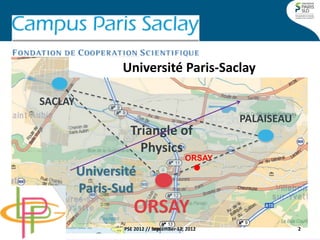
Triangle of Physics 
ORSAY 
Université Paris-Sud 
T. Minea 
2 
PSE 2012 // September 12, 2012 
Université Paris-Saclay 
ORSAY
Diffusion and residence time: example 
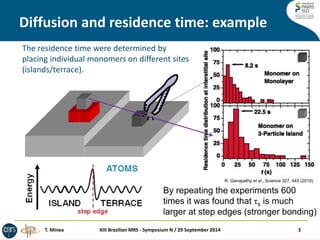
The residence time were determined by 
placing individual monomers on different sites 
(islands/terrace). 
By repeating the experiments 600 
times it was found that τs is much 
larger at step edges (stronger bonding) 
R. Ganapathy et al., Science 327, 445 (2010) 
T. Minea XIII Brazilian MRS - Symposium N / 29 September 2014 3
Kinetic roughening 
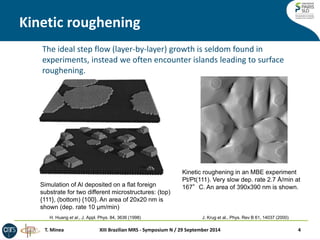
The ideal step flow (layer-by-layer) growth is seldom found in 
experiments, instead we often encounter islands leading to surface 
roughening. 
H. Huang et al., J. Appl. Phys. 84, 3636 (1998) 
Simulation of Al deposited on a flat foreign 
substrate for two different microstructures: (top) 
{111}, (bottom) {100}. An area of 20x20 nm is 
shown (dep. rate 10 μm/min) 
Kinetic roughening in an MBE experiment 
Pt/Pt(111). Very slow dep. rate 2.7 Å/min at 
167°C. An area of 390x390 nm is shown. 
J. Krug et al., Phys. Rev B 61, 14037 (2000) 
XIII Brazilian T. Minea MRS - Symposium N / 29 September 2014 4
Microstructure: structure zone models 
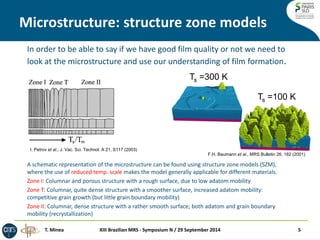
In order to be able to say if we have good film quality or not we need to 
look at the microstructure and use our understanding of film formation. 
A schematic representation of the microstructure can be found using structure zone models (SZM), 
where the use of reduced temp. scale makes the model generally applicable for different materials. 
Zone I: Columnar and porous structure with a rough surface, due to low adatom mobility 
Zone T: Columnar, quite dense structure with a smoother surface, increased adatom mobility: 
competitive grain growth (but little grain boundary mobility) 
Zone II: Columnar, dense structure with a rather smooth surface; both adatom and grain boundary 
mobility (recrystallization) 
Ts =300 K 
Ts =100 K 
F.H. Baumann et al., MRS Bulletin 26, 182 (2001) 
I. Petrov et al., J. Vac. Sci. Technol. A 21, S117 (2003) 
XIII Brazilian T. Minea MRS - Symposium N / 29 September 2014 5
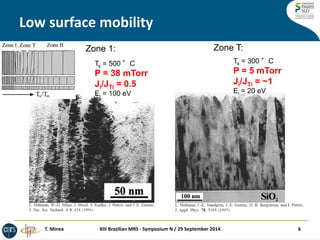
Low surface mobility 
Ts = 500 °C 
P = 38 mTorr 
Ji/JTi = 0.5 
Ei = 100 eV 
Ts = 300 °C 
P = 5 mTorr 
Ji/JTi = ~1 
Ei = 20 eV 
6 
Zone 1: Zone T: 
XIII Brazilian T. Minea MRS - Symposium N / 29 September 2014
Results of ion bombardment 
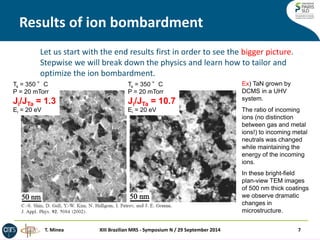
Let us start with the end results first in order to see the bigger picture. 
Stepwise we will break down the physics and learn how to tailor and 
optimize the ion bombardment. 
Ts = 350 °C 
P = 20 mTorr 
Ji/JTa = 1.3 
Ei = 20 eV 
Ts = 350 °C 
P = 20 mTorr 
Ji/JTa = 10.7 
Ei = 20 eV 
Ex) TaN grown by 
DCMS in a UHV 
system. 
The ratio of incoming 
ions (no distinction 
between gas and metal 
ions!) to incoming metal 
neutrals was changed 
while maintaining the 
energy of the incoming 
ions. 
In these bright-field 
plan-view TEM images 
of 500 nm thick coatings 
we observe dramatic 
changes in 
microstructure. 
XIII Brazilian T. Minea MRS - Symposium N / 29 September 2014 7
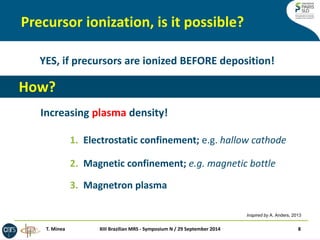
Precursor ionization, is it possible? 
XIII Brazilian MRS - Symposium N / 29 September 2014 
8 
1.Electrostatic confinement; e.g. hallow cathode 
2.Magnetic confinement; e.g. magnetic bottle 
3.Magnetron plasma 
T. Minea 
YES, if precursors are ionized BEFORE deposition! 
How? 
Increasing plasma density! 
Inspired by A. Anders, 2013
Outline 
XIII Brazilian MRS - Symposium N / 29 September 2014 
9 
1.HiPIMS technology 
2.HiPIMS magnetron plasma modelling (OHIPIC, I-OMEGA) 
3.Thin Films by HiPIMS 
4.Conclusions 
T. Minea
XIII Brazilian MRS - Symposium N / 29 September 2014 
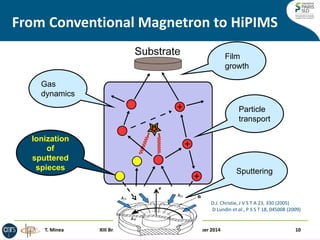
From Conventional Magnetron to HiPIMS 
Film growth 
Particle transport 
D.J. Christie, J V S T A 23, 330 (2005) D Lundin et al., P S S T 18, 045008 (2009) 
Ionization of sputtered spieces 
Gas dynamics 
10 
T. Minea 
Sputtering 
+
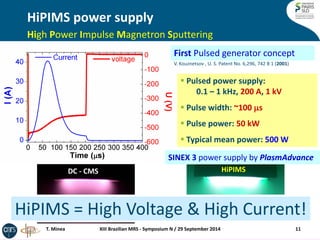
V. Kouznetsov , U. S. Patent No. 6,296, 742 B 1 (2001) 
 Pulsed power supply: 0.1 – 1 kHz, 200 A, 1 kV 
 Pulse width: ~100 s 
 Pulse power: 50 kW 
 Typical mean power: 500 W 
HiPIMS power supply 
HiPIMS 
First Pulsed generator concept 
DC - CMS 
11 
XIII Brazilian MRS - Symposium N / 29 September 2014 
SINEX 3 power supply by PlasmAdvance 
T. Minea 
HiPIMS = High Voltage & High Current! 
High Power Impulse Magnetron Sputtering
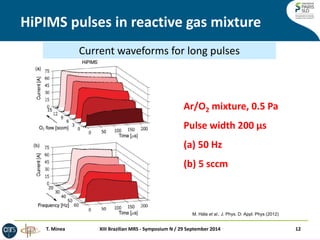
HiPIMS pulses in reactive gas mixture 
XIII Brazilian MRS - Symposium N / 29 September 2014 
12 
Current waveforms for long pulses 
Ar/O2 mixture, 0.5 Pa 
Pulse width 200 μs 
(a) 50 Hz 
(b) 5 sccm 
M. Hála et al., J. Phys. D: Appl. Phys (2012) 
(b) 
T. Minea
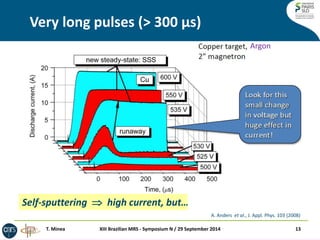
Self-sputtering  high current, but… limited deposition rate! 
Very long pulses (> 300 μs) 
T. Minea 
XIII Brazilian MRS - Symposium N / 29 September 2014 
13 
A. Anders et al., J. Appl. Phys. 103 (2008) 
Argon
T. Minea 
XIII Brazilian MRS - Symposium N / 29 September 2014 
14 
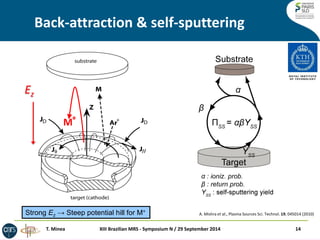
Back-attraction & self-sputtering 
Strong Ez → Steep potential hill for M+ 
A. Mishra et al., Plasma Sources Sci. Technol. 19, 045014 (2010) 
M 
+ 
Ez
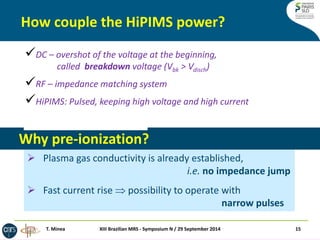
How couple the HiPIMS power? 
XIII Brazilian MRS - Symposium N / 29 September 2014 
15 
T. Minea 
DC – overshot of the voltage at the beginning, called breakdown voltage (Vbk > Vdisch) 
RF – impedance matching system 
HiPIMS: Pulsed, keeping high voltage and high current 
Pre-ionization before pulse 
Why pre-ionization? 
Plasma gas conductivity is already established, i.e. no impedance jump 
Fast current rise  possibility to operate with narrow pulses
Pulse time [μs] 
Ganciu et al, US Patent No. 7, 927, 466 B2 (19 April 2011) 
Fast HiPIMS with pre-ionization 
 Average Power 80 W 
 Pulse width ~10 μs 
 Frequency < 1kHz 
 Umax ~ 1kV 
 Imax ~ 100 A 
16 
SHORT & FAST Pulsed generator concept [2]; developed 2004 
XIII Brazilian MRS - Symposium N / 29 September 2014 
T. Minea
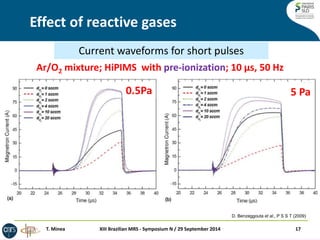
Effect of reactive gases 
XIII Brazilian MRS - Symposium N / 29 September 2014 
17 
Current waveforms for short pulses 
D. Benzeggouta et al., P S S T (2009) 
T. Minea 
5 Pa 
0.5Pa 
Ar/O2 mixture; HiPIMS with pre-ionization; 10 μs, 50 Hz
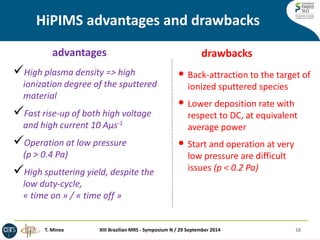
HiPIMS advantages and drawbacks 
advantages 
drawbacks 
•Back-attraction to the target of ionized sputtered species 
•Lower deposition rate with respect to DC, at equivalent average power 
•Start and operation at very low pressure are difficult issues (p < 0.2 Pa) 
High plasma density => high ionization degree of the sputtered material 
Fast rise-up of both high voltage and high current 10 Aμs-1 
Operation at low pressure (p > 0.4 Pa) 
High sputtering yield, despite the low duty-cycle, « time on » / « time off » 
18 
T. Minea 
XIII Brazilian MRS - Symposium N / 29 September 2014
19 
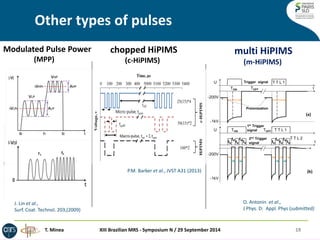
Other types of pulses 
Modulated Pulse Power 
(MPP) 
P.M. Barker et al., JVST A31 (2013) 
t 
J. Lin et al., 
Surf. Coat. Technol. 203,(2009) 
O. Antonin et al., 
J Phys. D: Appl. Phys (submitted) 
chopped HiPIMS 
(c-HiPIMS) 
multi HiPIMS 
(m-HiPIMS) 
T. Minea XIII Brazilian MRS - Symposium N / 29 September 2014
20 
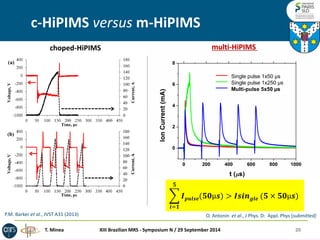
c-HiPIMS versus m-HiPIMS 
choped-HiPIMS 
P.M. Barker et al., JVST A31 (2013) 
Single pulse 1x50 μs 
Single pulse 1x250 μs 
Multi-pulse 5x50 μs 
O. Antonin et al., J Phys. D: Appl. Phys (submitted) 
multi-HiPIMS 
T. Minea 
XIII Brazilian MRS - Symposium N / 29 September 2014 
푰풑풖풍풔풆(ퟓퟎμ풔) ퟓ 풊=ퟏ >푰풔풊풏품풍풆 (ퟓ×ퟓퟎμ풔)
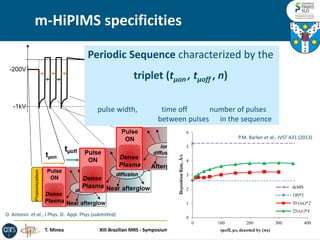
m-HiPIMS specificities 
COST Action MP-0804, HIPP Processes, O.Antonin, V.Tiron, C.Costin, G.Popa, T.Minea, 2013 
21 
T. Minea 
XIII Brazilian MRS - Symposium N / 29 September 2014 
t 
-1kV 
-200V 
TOFF 
Afterglow 
ion 
diffusion 
Pulse 
ON 
Dense 
Plasma 
Periodic Sequence characterized by the 
triplet (tμon , tμoff , n) 
pulse width, time off number of pulses between pulses in the sequence 
P.M. Barker et al., JVST A31 (2013) 
O. Antonin et al., J Phys. D: Appl. Phys (submitted)
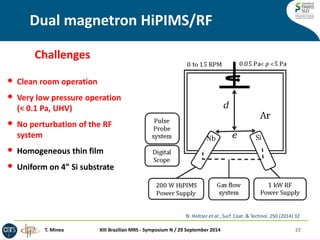
Dual magnetron HiPIMS/RF 
Challenges 
•Clean room operation 
•Very low pressure operation (< 0.1 Pa, UHV) 
•No perturbation of the RF system 
•Homogeneous thin film 
•Uniform on 4” Si substrate 
22 
T. Minea 
XIII Brazilian MRS - Symposium N / 29 September 2014 
N. Holtzer et al., Surf. Coat. & Technol. 250 (2014) 32
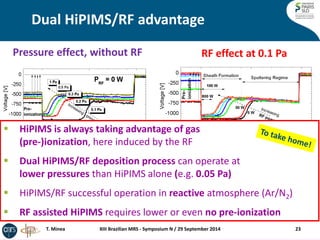
Dual HiPIMS/RF advantage 
T. Minea 
XIII Brazilian MRS - Symposium N / 29 September 2014 
23 
N. Holtzer et al., Surf. Coat. & Technol. 250 (2014) 32 
Pressure effect, without RF 
RF effect at 0.1 Pa 
HiPIMS is always taking advantage of gas (pre-)ionization, here induced by the RF 
Dual HiPIMS/RF deposition process can operate at lower pressures than HiPIMS alone (e.g. 0.05 Pa) 
HiPIMS/RF successful operation in reactive atmosphere (Ar/N2) 
RF assisted HiPIMS requires lower or even no pre-ionization
Outline 
XIII Brazilian MRS - Symposium N / 29 September 2014 
24 
1.HiPIMS technology 
2.HiPIMS magnetron plasma modelling (OHIPIC, I-OMEGA) 
3.Thin Films by HiPIMS 
4.Conclusions 
T. Minea
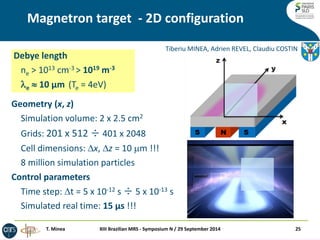
Magnetron target - 2D configuration 
Tiberiu MINEA, Adrien REVEL, Claudiu COSTIN 
Geometry (x, z) 
Simulation volume: 2 x 2.5 cm2 
Grids: 201 x 512 ÷ 401 x 2048 
Cell dimensions: Dx, Dz = 10 m !!! 
8 million simulation particles 
Control parameters 
Time step: Dt = 5 x 10-12 s ÷ 5 x 10-13 s 
Simulated real time: 15 μs !!! 
25 
XIII Brazilian MRS - Symposium N / 29 September 2014 
Debye length 
ne > 1013 cm-3 > 1019 m-3 
le  10 μm (Te = 4eV) 
T. Minea
HiPIMS current 
XIII Brazilian MRS - Symposium N / 29 September 2014 
26 
0 2 4 6 8 10 
Pulse time [μs] 
OHIPIC: Orsay HIgh density plasma Particle-In-Cell model 
Experiment using fast pre-ionization HiPIMS 
OHIPIC model simulated discharge current 
0 1 2 3 4 5 6 
Pulse time [μs] 
0 
-300 
- 600 
Voltage (V) 
Current 
T. Minea et al, Surf. Coat. Tech. 255, (2014) 52 
T. Minea
T. Minea et al, Surf. Coat. Tech. (2014), Available online 5 December 2013 
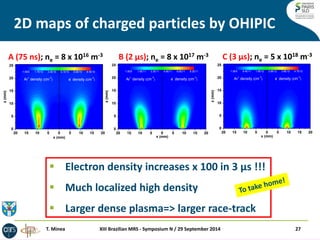
2D maps of charged particles by OHIPIC 
XIII Brazilian MRS - Symposium N / 29 September 2014 27 
20 15 10 5 0 5 10 15 20 
0 
5 
10 
15 
20 
25 
e- density (cm-3 
) 
1.0E6 1.7E10 3.4E10 5.1E10 6.8E10 8.5E10 
x (mm) 
z (mm) 
Ar+ density (cm-3 
) 
20 15 10 5 0 5 10 15 20 
0 
5 
10 
15 
20 
25 
Ar+ density (cm-3 
) e- density (cm-3 
) 
1.0E6 1.6E11 3.3E11 4.9E11 6.6E11 8.2E11 
x (mm) 
z (mm) 
20 15 10 5 0 5 10 15 20 
0 
5 
10 
15 
20 
25 
Ar+ density (cm-3 
) 
1.0E6 9.4E11 1.9E12 2.8E12 3.8E12 4.7E12 
e- density (cm-3 
) 
x (mm) 
z (mm) 
A (75 ns); ne = 8 x 10¹⁶ m-3 B (2 μs); ne = 8 x 10¹⁷ m-3 C (3 μs); ne = 5 x 10¹⁸ m-3 
 Electron density increases x 100 in 3 μs !!! 
 Much localized high density 
 Larger dense plasma=> larger race-track 
T. Minea
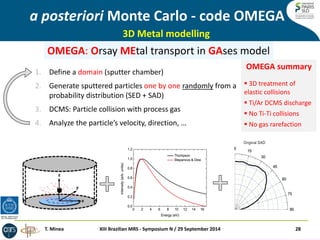
a posteriori Monte Carlo - code OMEGA 
1.Define a domain (sputter chamber) 
2.Generate sputtered particles one by one randomly from a probability distribution (SED + SAD) 
3.DCMS: Particle collision with process gas 
4.Analyze the particle’s velocity, direction, … 
OMEGA summary 
 3D treatment of elastic collisions 
 Ti/Ar DCMS discharge 
 No Ti-Ti collisions 
 No gas rarefaction 
3D Metal modelling 
OMEGA: Orsay MEtal transport in GAses model 
XIII Brazilian MRS - Symposium N / 29 September 2014 
28 
T. Minea
T. Minea et al, Surf. Coat. Tech. 255, (2014) 52 
0 1 2 3 4 5 6 
-600 
-400 
-200 
0 
C (3.0 s) 
B (2.0 s) 
Cathode voltage (V) 
t (s) 
A (75 ns) 
Short pulse 
Pre-ionization 
A (75 ns) 
B (2 μs) 
C (3 μs) 
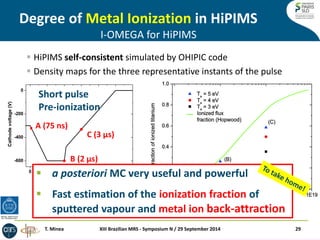
Degree of Metal Ionization in HiPIMS 
XIII Brazilian MRS - Symposium N / 29 September 2014 29 
 HiPIMS self-consistent simulated by OHIPIC code 
 Density maps for the three representative instants of the pulse 
 a posteriori MC very useful and powerful 
 Fast estimation of the ionization fraction of 
sputtered vapour and metal ion back-attraction 
I-OMEGA for HiPIMS 
T. Minea
Outline 
XIII Brazilian MRS - Symposium N / 29 September 2014 
30 
1.HiPIMS technology 
2.HiPIMS magnetron plasma modelling (OHIPIC, I-OMEGA) 
3.Thin Films by HiPIMS 
4.Conclusions 
T. Minea
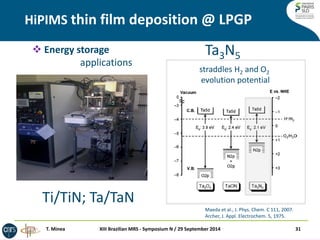
HiPIMS thin film deposition @ LPGP 
31 
- 
Ti/TiN; Ta/TaN 
Ta3N5 
T. Minea XIII Brazilian MRS - Symposium N / 29 September 2014 
straddles H2 and O2 
evolution potential 
Maeda et al., J. Phys. Chem. C 111, 2007. 
Archer, J. Appl. Electrochem. 5, 1975. 
 Energy storage 
applications
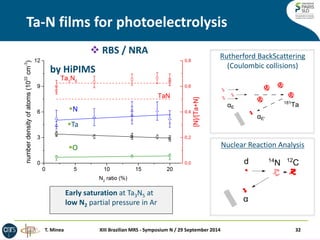
Ta-N films for photoelectrolysis 
32 
Early saturation at Ta3N5 at low N2 partial pressure in Ar 
N 
Ta 
O 
Rutherford BackScattering (Coulombic collisions) 
Nuclear Reaction Analysis 
RBS / NRA 
T. Minea 
XIII Brazilian MRS - Symposium N / 29 September 2014 
by HiPIMS
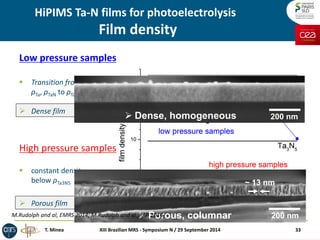
HiPIMS Ta-N films for photoelectrolysis Film density 
Low pressure samples 
Transition from ρTa, ρTaN to ρTa3N5 
Dense film 
High pressure samples 
constant density below ρTa3N5 
Porous film 
33 
200 nm 
Porous, columnar 
~ 13 nm 
200 nm 
Dense, homogeneous 
M.Rudolph and al, EMRS 2014; M.Rudolph and al., IAP 2014 
T. Minea 
XIII Brazilian MRS - Symposium N / 29 September 2014
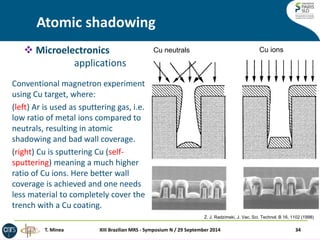
Atomic shadowing 
Conventional magnetron experiment using Cu target, where: 
(left) Ar is used as sputtering gas, i.e. low ratio of metal ions compared to neutrals, resulting in atomic shadowing and bad wall coverage. 
(right) Cu is sputtering Cu (self- sputtering) meaning a much higher ratio of Cu ions. Here better wall coverage is achieved and one needs less material to completely cover the trench with a Cu coating. 
Cu neutrals 
Cu ions 
Z. J. Radzimski, J. Vac. Sci. Technol. B 16, 1102 (1998) 
XIII Brazilian MRS - Symposium N / 29 September 2014 
34 
T. Minea 
Microelectronics applications
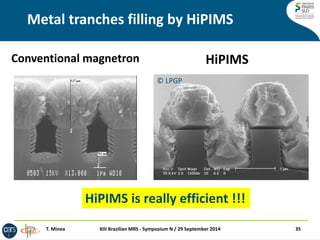
Metal tranches filling by HiPIMS 
Conventional magnetron HiPIMS 
© LPGP 
XIII Brazilian MRS - Symposium N / 29 September 2014 35 
HiPIMS is really efficient !!! 
T. Minea
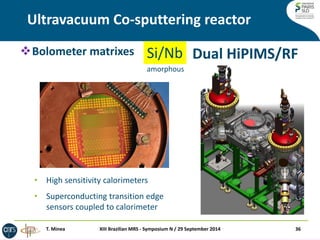
Ultravacuum Co-sputtering reactor 
36 
Si/Nb 
Dual HiPIMS/RF 
XIII Brazilian MRS - Symposium N / 29 September 2014 
T. Minea 
Bolometer matrixes 
•High sensitivity calorimeters 
•Superconducting transition edge sensors coupled to calorimeter 
amorphous
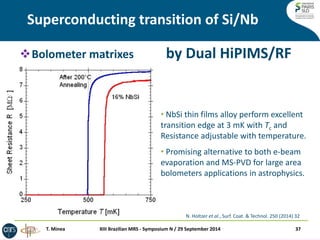
Superconducting transition of Si/Nb 
37 
by Dual HiPIMS/RF 
XIII Brazilian MRS - Symposium N / 29 September 2014 
T. Minea 
Bolometer matrixes 
• NbSi thin films alloy perform excellent transition edge at 3 mK with Tc and Resistance adjustable with temperature. 
• Promising alternative to both e-beam evaporation and MS-PVD for large area bolometers applications in astrophysics. 
N. Holtzer et al., Surf. Coat. & Technol. 250 (2014) 32
Conclusions 
 HiPIMS is an emerging technology with very high applicative potential: - particle and film nano-structuring - better control of the energy deposited during the growth - better stability and stoichiometry control, etc. 
Diagnostic and modelling give today a better understanding of the HiPIMS physics, space and time evolution of plasmas species and energy carried to the growing film 
Compatible with Clean Room requirements and already successful 
38 
XIII Brazilian MRS - Symposium N / 29 September 2014 
T. Minea
 Claudiu COSTIN 
 Catalin VITELARU 
 Vasile TIRON 
Contributors 
France 
Romania 
 Lise CAILLAULT 
 Marie-Christine HUGON 
 Brigitte BOUCHER 
 Jean BRETAGNE 
 Daniel LUNDIN 
 Adrien REVEL 
 Martin RUDOLF 
 Olivier ANTONIN 
 Nils BRENING 
 Daniel LUNDIN 
39 
XIII Brazilian MRS - Symposium N / 29 September 2014 
Sweden 
Thanks you all for your attention! 
T. Minea
XIII Brazilian MRS - Symposium N / 29 September 2014 
40 
T. Minea 
December 9-11 2015 Paris, France 
4th MIATEC – Magnetron, Ion processing & Arc Technologies European Conference 
14th RSD - International Conference on Reactive Sputter Deposition 
DC - CMS 
Scientific joint event in Paris at the CNAM Conservatoire National des Arts et Métiers 
since 1794 
Social event: Visit of the « Arts and Science Museum »
Many THANKS to 
XIII Brazilian MRS - Symposium N / 29 September 2014 41 
Interuniversity Attraction Poles (IAP) 
Phase VII - P7/34 
T. Minea

HiPIMS: technology, physics and thin film applications.

  • 1.
    HiPIMS: technology, physicsand thin film applications Tiberiu MINEA Laboratoire de Physique des Gaz et Plasmas – LPGP UMR 8578 CNRS, Université Paris-Sud, 91405 Orsay Cedex, France tiberiu.minea@u-psud.fr
  • 2.
    PARIS SACLAY PALAISEAU Triangle of Physics ORSAY Université Paris-Sud T. Minea 2 PSE 2012 // September 12, 2012 Université Paris-Saclay ORSAY
  • 3.
    Diffusion and residencetime: example The residence time were determined by placing individual monomers on different sites (islands/terrace). By repeating the experiments 600 times it was found that τs is much larger at step edges (stronger bonding) R. Ganapathy et al., Science 327, 445 (2010) T. Minea XIII Brazilian MRS - Symposium N / 29 September 2014 3
  • 4.
    Kinetic roughening Theideal step flow (layer-by-layer) growth is seldom found in experiments, instead we often encounter islands leading to surface roughening. H. Huang et al., J. Appl. Phys. 84, 3636 (1998) Simulation of Al deposited on a flat foreign substrate for two different microstructures: (top) {111}, (bottom) {100}. An area of 20x20 nm is shown (dep. rate 10 μm/min) Kinetic roughening in an MBE experiment Pt/Pt(111). Very slow dep. rate 2.7 Å/min at 167°C. An area of 390x390 nm is shown. J. Krug et al., Phys. Rev B 61, 14037 (2000) XIII Brazilian T. Minea MRS - Symposium N / 29 September 2014 4
  • 5.
    Microstructure: structure zonemodels In order to be able to say if we have good film quality or not we need to look at the microstructure and use our understanding of film formation. A schematic representation of the microstructure can be found using structure zone models (SZM), where the use of reduced temp. scale makes the model generally applicable for different materials. Zone I: Columnar and porous structure with a rough surface, due to low adatom mobility Zone T: Columnar, quite dense structure with a smoother surface, increased adatom mobility: competitive grain growth (but little grain boundary mobility) Zone II: Columnar, dense structure with a rather smooth surface; both adatom and grain boundary mobility (recrystallization) Ts =300 K Ts =100 K F.H. Baumann et al., MRS Bulletin 26, 182 (2001) I. Petrov et al., J. Vac. Sci. Technol. A 21, S117 (2003) XIII Brazilian T. Minea MRS - Symposium N / 29 September 2014 5
  • 6.
    Low surface mobility Ts = 500 °C P = 38 mTorr Ji/JTi = 0.5 Ei = 100 eV Ts = 300 °C P = 5 mTorr Ji/JTi = ~1 Ei = 20 eV 6 Zone 1: Zone T: XIII Brazilian T. Minea MRS - Symposium N / 29 September 2014
  • 7.
    Results of ionbombardment Let us start with the end results first in order to see the bigger picture. Stepwise we will break down the physics and learn how to tailor and optimize the ion bombardment. Ts = 350 °C P = 20 mTorr Ji/JTa = 1.3 Ei = 20 eV Ts = 350 °C P = 20 mTorr Ji/JTa = 10.7 Ei = 20 eV Ex) TaN grown by DCMS in a UHV system. The ratio of incoming ions (no distinction between gas and metal ions!) to incoming metal neutrals was changed while maintaining the energy of the incoming ions. In these bright-field plan-view TEM images of 500 nm thick coatings we observe dramatic changes in microstructure. XIII Brazilian T. Minea MRS - Symposium N / 29 September 2014 7
  • 8.
    Precursor ionization, isit possible? XIII Brazilian MRS - Symposium N / 29 September 2014 8 1.Electrostatic confinement; e.g. hallow cathode 2.Magnetic confinement; e.g. magnetic bottle 3.Magnetron plasma T. Minea YES, if precursors are ionized BEFORE deposition! How? Increasing plasma density! Inspired by A. Anders, 2013
  • 9.
    Outline XIII BrazilianMRS - Symposium N / 29 September 2014 9 1.HiPIMS technology 2.HiPIMS magnetron plasma modelling (OHIPIC, I-OMEGA) 3.Thin Films by HiPIMS 4.Conclusions T. Minea
  • 10.
    XIII Brazilian MRS- Symposium N / 29 September 2014 From Conventional Magnetron to HiPIMS Film growth Particle transport D.J. Christie, J V S T A 23, 330 (2005) D Lundin et al., P S S T 18, 045008 (2009) Ionization of sputtered spieces Gas dynamics 10 T. Minea Sputtering +
  • 11.
    V. Kouznetsov ,U. S. Patent No. 6,296, 742 B 1 (2001)  Pulsed power supply: 0.1 – 1 kHz, 200 A, 1 kV  Pulse width: ~100 s  Pulse power: 50 kW  Typical mean power: 500 W HiPIMS power supply HiPIMS First Pulsed generator concept DC - CMS 11 XIII Brazilian MRS - Symposium N / 29 September 2014 SINEX 3 power supply by PlasmAdvance T. Minea HiPIMS = High Voltage & High Current! High Power Impulse Magnetron Sputtering
  • 12.
    HiPIMS pulses inreactive gas mixture XIII Brazilian MRS - Symposium N / 29 September 2014 12 Current waveforms for long pulses Ar/O2 mixture, 0.5 Pa Pulse width 200 μs (a) 50 Hz (b) 5 sccm M. Hála et al., J. Phys. D: Appl. Phys (2012) (b) T. Minea
  • 13.
    Self-sputtering  highcurrent, but… limited deposition rate! Very long pulses (> 300 μs) T. Minea XIII Brazilian MRS - Symposium N / 29 September 2014 13 A. Anders et al., J. Appl. Phys. 103 (2008) Argon
  • 14.
    T. Minea XIIIBrazilian MRS - Symposium N / 29 September 2014 14 Back-attraction & self-sputtering Strong Ez → Steep potential hill for M+ A. Mishra et al., Plasma Sources Sci. Technol. 19, 045014 (2010) M + Ez
  • 15.
    How couple theHiPIMS power? XIII Brazilian MRS - Symposium N / 29 September 2014 15 T. Minea DC – overshot of the voltage at the beginning, called breakdown voltage (Vbk > Vdisch) RF – impedance matching system HiPIMS: Pulsed, keeping high voltage and high current Pre-ionization before pulse Why pre-ionization? Plasma gas conductivity is already established, i.e. no impedance jump Fast current rise  possibility to operate with narrow pulses
  • 16.
    Pulse time [μs] Ganciu et al, US Patent No. 7, 927, 466 B2 (19 April 2011) Fast HiPIMS with pre-ionization  Average Power 80 W  Pulse width ~10 μs  Frequency < 1kHz  Umax ~ 1kV  Imax ~ 100 A 16 SHORT & FAST Pulsed generator concept [2]; developed 2004 XIII Brazilian MRS - Symposium N / 29 September 2014 T. Minea
  • 17.
    Effect of reactivegases XIII Brazilian MRS - Symposium N / 29 September 2014 17 Current waveforms for short pulses D. Benzeggouta et al., P S S T (2009) T. Minea 5 Pa 0.5Pa Ar/O2 mixture; HiPIMS with pre-ionization; 10 μs, 50 Hz
  • 18.
    HiPIMS advantages anddrawbacks advantages drawbacks •Back-attraction to the target of ionized sputtered species •Lower deposition rate with respect to DC, at equivalent average power •Start and operation at very low pressure are difficult issues (p < 0.2 Pa) High plasma density => high ionization degree of the sputtered material Fast rise-up of both high voltage and high current 10 Aμs-1 Operation at low pressure (p > 0.4 Pa) High sputtering yield, despite the low duty-cycle, « time on » / « time off » 18 T. Minea XIII Brazilian MRS - Symposium N / 29 September 2014
  • 19.
    19 Other typesof pulses Modulated Pulse Power (MPP) P.M. Barker et al., JVST A31 (2013) t J. Lin et al., Surf. Coat. Technol. 203,(2009) O. Antonin et al., J Phys. D: Appl. Phys (submitted) chopped HiPIMS (c-HiPIMS) multi HiPIMS (m-HiPIMS) T. Minea XIII Brazilian MRS - Symposium N / 29 September 2014
  • 20.
    20 c-HiPIMS versusm-HiPIMS choped-HiPIMS P.M. Barker et al., JVST A31 (2013) Single pulse 1x50 μs Single pulse 1x250 μs Multi-pulse 5x50 μs O. Antonin et al., J Phys. D: Appl. Phys (submitted) multi-HiPIMS T. Minea XIII Brazilian MRS - Symposium N / 29 September 2014 푰풑풖풍풔풆(ퟓퟎμ풔) ퟓ 풊=ퟏ >푰풔풊풏품풍풆 (ퟓ×ퟓퟎμ풔)
  • 21.
    m-HiPIMS specificities COSTAction MP-0804, HIPP Processes, O.Antonin, V.Tiron, C.Costin, G.Popa, T.Minea, 2013 21 T. Minea XIII Brazilian MRS - Symposium N / 29 September 2014 t -1kV -200V TOFF Afterglow ion diffusion Pulse ON Dense Plasma Periodic Sequence characterized by the triplet (tμon , tμoff , n) pulse width, time off number of pulses between pulses in the sequence P.M. Barker et al., JVST A31 (2013) O. Antonin et al., J Phys. D: Appl. Phys (submitted)
  • 22.
    Dual magnetron HiPIMS/RF Challenges •Clean room operation •Very low pressure operation (< 0.1 Pa, UHV) •No perturbation of the RF system •Homogeneous thin film •Uniform on 4” Si substrate 22 T. Minea XIII Brazilian MRS - Symposium N / 29 September 2014 N. Holtzer et al., Surf. Coat. & Technol. 250 (2014) 32
  • 23.
    Dual HiPIMS/RF advantage T. Minea XIII Brazilian MRS - Symposium N / 29 September 2014 23 N. Holtzer et al., Surf. Coat. & Technol. 250 (2014) 32 Pressure effect, without RF RF effect at 0.1 Pa HiPIMS is always taking advantage of gas (pre-)ionization, here induced by the RF Dual HiPIMS/RF deposition process can operate at lower pressures than HiPIMS alone (e.g. 0.05 Pa) HiPIMS/RF successful operation in reactive atmosphere (Ar/N2) RF assisted HiPIMS requires lower or even no pre-ionization
  • 24.
    Outline XIII BrazilianMRS - Symposium N / 29 September 2014 24 1.HiPIMS technology 2.HiPIMS magnetron plasma modelling (OHIPIC, I-OMEGA) 3.Thin Films by HiPIMS 4.Conclusions T. Minea
  • 25.
    Magnetron target -2D configuration Tiberiu MINEA, Adrien REVEL, Claudiu COSTIN Geometry (x, z) Simulation volume: 2 x 2.5 cm2 Grids: 201 x 512 ÷ 401 x 2048 Cell dimensions: Dx, Dz = 10 m !!! 8 million simulation particles Control parameters Time step: Dt = 5 x 10-12 s ÷ 5 x 10-13 s Simulated real time: 15 μs !!! 25 XIII Brazilian MRS - Symposium N / 29 September 2014 Debye length ne > 1013 cm-3 > 1019 m-3 le  10 μm (Te = 4eV) T. Minea
  • 26.
    HiPIMS current XIIIBrazilian MRS - Symposium N / 29 September 2014 26 0 2 4 6 8 10 Pulse time [μs] OHIPIC: Orsay HIgh density plasma Particle-In-Cell model Experiment using fast pre-ionization HiPIMS OHIPIC model simulated discharge current 0 1 2 3 4 5 6 Pulse time [μs] 0 -300 - 600 Voltage (V) Current T. Minea et al, Surf. Coat. Tech. 255, (2014) 52 T. Minea
  • 27.
    T. Minea etal, Surf. Coat. Tech. (2014), Available online 5 December 2013 2D maps of charged particles by OHIPIC XIII Brazilian MRS - Symposium N / 29 September 2014 27 20 15 10 5 0 5 10 15 20 0 5 10 15 20 25 e- density (cm-3 ) 1.0E6 1.7E10 3.4E10 5.1E10 6.8E10 8.5E10 x (mm) z (mm) Ar+ density (cm-3 ) 20 15 10 5 0 5 10 15 20 0 5 10 15 20 25 Ar+ density (cm-3 ) e- density (cm-3 ) 1.0E6 1.6E11 3.3E11 4.9E11 6.6E11 8.2E11 x (mm) z (mm) 20 15 10 5 0 5 10 15 20 0 5 10 15 20 25 Ar+ density (cm-3 ) 1.0E6 9.4E11 1.9E12 2.8E12 3.8E12 4.7E12 e- density (cm-3 ) x (mm) z (mm) A (75 ns); ne = 8 x 10¹⁶ m-3 B (2 μs); ne = 8 x 10¹⁷ m-3 C (3 μs); ne = 5 x 10¹⁸ m-3  Electron density increases x 100 in 3 μs !!!  Much localized high density  Larger dense plasma=> larger race-track T. Minea
  • 28.
    a posteriori MonteCarlo - code OMEGA 1.Define a domain (sputter chamber) 2.Generate sputtered particles one by one randomly from a probability distribution (SED + SAD) 3.DCMS: Particle collision with process gas 4.Analyze the particle’s velocity, direction, … OMEGA summary  3D treatment of elastic collisions  Ti/Ar DCMS discharge  No Ti-Ti collisions  No gas rarefaction 3D Metal modelling OMEGA: Orsay MEtal transport in GAses model XIII Brazilian MRS - Symposium N / 29 September 2014 28 T. Minea
  • 29.
    T. Minea etal, Surf. Coat. Tech. 255, (2014) 52 0 1 2 3 4 5 6 -600 -400 -200 0 C (3.0 s) B (2.0 s) Cathode voltage (V) t (s) A (75 ns) Short pulse Pre-ionization A (75 ns) B (2 μs) C (3 μs) Degree of Metal Ionization in HiPIMS XIII Brazilian MRS - Symposium N / 29 September 2014 29  HiPIMS self-consistent simulated by OHIPIC code  Density maps for the three representative instants of the pulse  a posteriori MC very useful and powerful  Fast estimation of the ionization fraction of sputtered vapour and metal ion back-attraction I-OMEGA for HiPIMS T. Minea
  • 30.
    Outline XIII BrazilianMRS - Symposium N / 29 September 2014 30 1.HiPIMS technology 2.HiPIMS magnetron plasma modelling (OHIPIC, I-OMEGA) 3.Thin Films by HiPIMS 4.Conclusions T. Minea
  • 31.
    HiPIMS thin filmdeposition @ LPGP 31 - Ti/TiN; Ta/TaN Ta3N5 T. Minea XIII Brazilian MRS - Symposium N / 29 September 2014 straddles H2 and O2 evolution potential Maeda et al., J. Phys. Chem. C 111, 2007. Archer, J. Appl. Electrochem. 5, 1975.  Energy storage applications
  • 32.
    Ta-N films forphotoelectrolysis 32 Early saturation at Ta3N5 at low N2 partial pressure in Ar N Ta O Rutherford BackScattering (Coulombic collisions) Nuclear Reaction Analysis RBS / NRA T. Minea XIII Brazilian MRS - Symposium N / 29 September 2014 by HiPIMS
  • 33.
    HiPIMS Ta-N filmsfor photoelectrolysis Film density Low pressure samples Transition from ρTa, ρTaN to ρTa3N5 Dense film High pressure samples constant density below ρTa3N5 Porous film 33 200 nm Porous, columnar ~ 13 nm 200 nm Dense, homogeneous M.Rudolph and al, EMRS 2014; M.Rudolph and al., IAP 2014 T. Minea XIII Brazilian MRS - Symposium N / 29 September 2014
  • 34.
    Atomic shadowing Conventionalmagnetron experiment using Cu target, where: (left) Ar is used as sputtering gas, i.e. low ratio of metal ions compared to neutrals, resulting in atomic shadowing and bad wall coverage. (right) Cu is sputtering Cu (self- sputtering) meaning a much higher ratio of Cu ions. Here better wall coverage is achieved and one needs less material to completely cover the trench with a Cu coating. Cu neutrals Cu ions Z. J. Radzimski, J. Vac. Sci. Technol. B 16, 1102 (1998) XIII Brazilian MRS - Symposium N / 29 September 2014 34 T. Minea Microelectronics applications
  • 35.
    Metal tranches fillingby HiPIMS Conventional magnetron HiPIMS © LPGP XIII Brazilian MRS - Symposium N / 29 September 2014 35 HiPIMS is really efficient !!! T. Minea
  • 36.
    Ultravacuum Co-sputtering reactor 36 Si/Nb Dual HiPIMS/RF XIII Brazilian MRS - Symposium N / 29 September 2014 T. Minea Bolometer matrixes •High sensitivity calorimeters •Superconducting transition edge sensors coupled to calorimeter amorphous
  • 37.
    Superconducting transition ofSi/Nb 37 by Dual HiPIMS/RF XIII Brazilian MRS - Symposium N / 29 September 2014 T. Minea Bolometer matrixes • NbSi thin films alloy perform excellent transition edge at 3 mK with Tc and Resistance adjustable with temperature. • Promising alternative to both e-beam evaporation and MS-PVD for large area bolometers applications in astrophysics. N. Holtzer et al., Surf. Coat. & Technol. 250 (2014) 32
  • 38.
    Conclusions  HiPIMSis an emerging technology with very high applicative potential: - particle and film nano-structuring - better control of the energy deposited during the growth - better stability and stoichiometry control, etc. Diagnostic and modelling give today a better understanding of the HiPIMS physics, space and time evolution of plasmas species and energy carried to the growing film Compatible with Clean Room requirements and already successful 38 XIII Brazilian MRS - Symposium N / 29 September 2014 T. Minea
  • 39.
     Claudiu COSTIN  Catalin VITELARU  Vasile TIRON Contributors France Romania  Lise CAILLAULT  Marie-Christine HUGON  Brigitte BOUCHER  Jean BRETAGNE  Daniel LUNDIN  Adrien REVEL  Martin RUDOLF  Olivier ANTONIN  Nils BRENING  Daniel LUNDIN 39 XIII Brazilian MRS - Symposium N / 29 September 2014 Sweden Thanks you all for your attention! T. Minea
  • 40.
    XIII Brazilian MRS- Symposium N / 29 September 2014 40 T. Minea December 9-11 2015 Paris, France 4th MIATEC – Magnetron, Ion processing & Arc Technologies European Conference 14th RSD - International Conference on Reactive Sputter Deposition DC - CMS Scientific joint event in Paris at the CNAM Conservatoire National des Arts et Métiers since 1794 Social event: Visit of the « Arts and Science Museum »
  • 41.
    Many THANKS to XIII Brazilian MRS - Symposium N / 29 September 2014 41 Interuniversity Attraction Poles (IAP) Phase VII - P7/34 T. Minea