Plasma Application Group, April 29, 2013
Real-Time Determination of
Compositional Profiles in Structured
Materials Using Laser Ablation and
LA-ICPMS
Alexander A. Boľshakov, Jong H. Yoo, Jhanis J. González,
and Richard E. Russo
Plasma Application Group, April 29, 2013
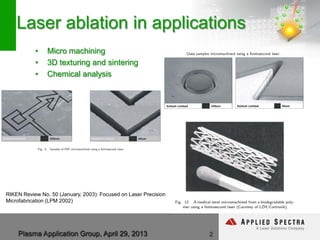
Laser ablation in applications
2
• Micro machining
• 3D texturing and sintering
• Chemical analysis
RIKEN Review No. 50 (January, 2003): Focused on Laser Precision
Microfabrication (LPM 2002)
Plasma Application Group, April 29, 2013
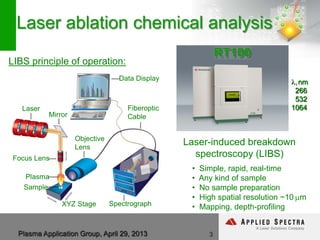
Laser ablation chemical analysis
3
Laser
Data Display
Mirror
Objective
Lens
Fiberoptic
Cable
Focus Lens
Plasma
Sample
SpectrographXYZ Stage
LIBS principle of operation:
• Simple, rapid, real-time
• Any kind of sample
• No sample preparation
• High spatial resolution ~10 µm
• Mapping, depth-profiling
Laser-induced breakdown
spectroscopy (LIBS)
RT100RT100
λ,nm
266
532
1064
Plasma Application Group, April 29, 2013
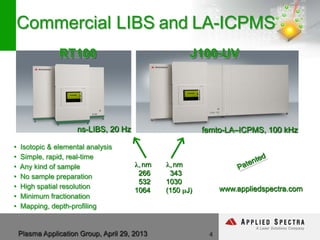
Commercial LIBS and LA-ICPMS
4
• Isotopic & elemental analysis
• Simple, rapid, real-time
• Any kind of sample
• No sample preparation
• High spatial resolution
• Minimum fractionation
• Mapping, depth-profiling
RT100RT100 J100-UVJ100-UV
femto-LA–ICPMS, 100 kHzns-LIBS, 20 Hz
www.appliedspectra.com
λ,nm
266
532
1064
λ,nm
343
1030
(150 µJ)
Plasma Application Group, April 29, 2013
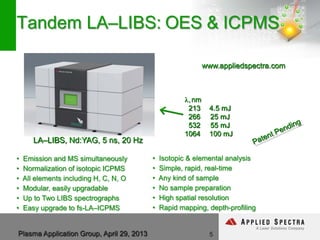
Tandem LA–LIBS: OES & ICPMS
5
• Emission and MS simultaneously
• Normalization of isotopic ICPMS
• All elements including H, C, N, O
• Modular, easily upgradable
• Up to Two LIBS spectrographs
• Easy upgrade to fs-LA–ICPMS
LA–LIBS, Nd:YAG, 5 ns, 20 Hz
www.appliedspectra.com
λ,nm
213 4.5 mJ
266 25 mJ
532 55 mJ
1064 100 mJ
• Isotopic & elemental analysis
• Simple, rapid, real-time
• Any kind of sample
• No sample preparation
• High spatial resolution
• Rapid mapping, depth-profiling
Plasma Application Group, April 29, 2013
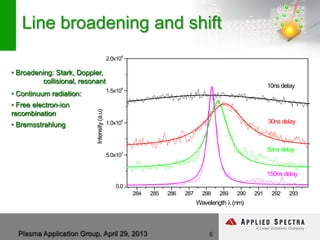
Line broadening and shift
6
284 285 286 287 288 289 290 291 292 293
0.0
5.0x10³
1.0x10⁴
1.5x10⁴
2.0x10⁴
150ns delay
50ns delay
30ns delay
10ns delay
Intensity(a.u)
Wavelength λ(nm)
• Broadening: Stark, Doppler,
collisional, resonant
• Continuum radiation:
• Free electron-ion
recombination
• Bremsstrahlung
Plasma Application Group, April 29, 2013
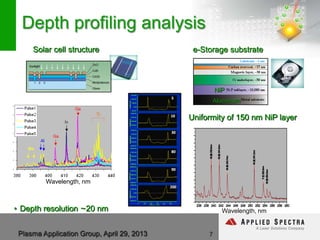
Depth profiling analysis
7
• Depth resolution ~20 nm
Solar cell structure e-Storage substrate
Wavelength, nm
236 238 240 242 244 246 248 250 252 254 256 258 260
NI(II)239.9nm
Ni(II)241.6nm
Ni(II)243.7nm
Ni(II)251.2nm
P(I)253.5nm
Ni(II)254.3nm
236 238 240 242 244 246 248 250 252 254 256 258 260
NI(II)239.9nm
Ni(II)241.6nm
Ni(II)243.7nm
Ni(II)251.2nm
P(I)253.5nm
Ni(II)254.3nm
Uniformity of 150 nm NiP layer
Wavelength, nm
Aluminum
NiP
Plasma Application Group, April 29, 2013
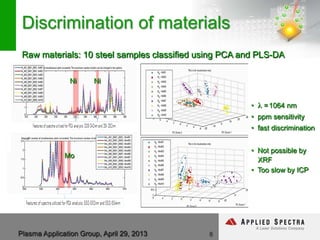
Discrimination of materials
8
Raw materials: 10 steel samples classified using PCA and PLS-DA
Ni Ni
Mo
• λ =1064 nm
• ppm sensitivity
• fast discrimination
• Not possible by
XRF
• Too slow by ICP
Plasma Application Group, April 29, 2013
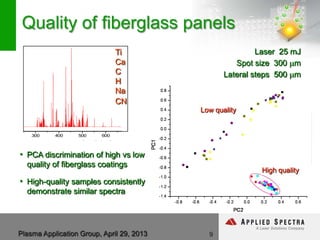
Quality of fiberglass panels
9
300 400 500 600
l th ( )
Ti
Ca
C
H
Na
CN
PCA discrimination of high vs low
quality of fiberglass coatings
High-quality samples consistently
demonstrate similar spectra
•
•
High quality
Low quality
Laser 25 mJ
Spot size 300 µm
Lateral steps 500 µm
Plasma Application Group, April 29, 2013
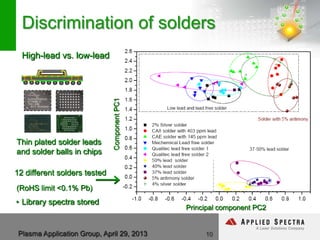
High-lead vs. low-lead
12 different solders tested
(RoHS limit <0.1% Pb)
ComponentPC1
Principal component PC2
Discrimination of solders
10
Thin plated solder leads
and solder balls in chips
• Library spectra stored
Plasma Application Group, April 29, 2013
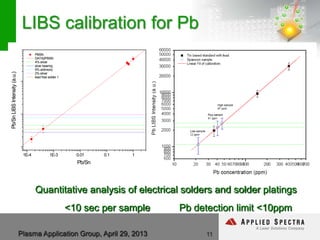
LIBS calibration for Pb
11
Quantitative analysis of electrical solders and solder platings
Pb detection limit <10ppm
1E-4 1E-3 0.01 0.1 1
PBSN
DATA2PBSN
4% silver
slver bearing
5% antimony
2% silver
lead free solder 1
Pb/SnLIBSIntensity(a.u.)
Pb/Sn
<10 sec per sample
Plasma Application Group, April 29, 2013
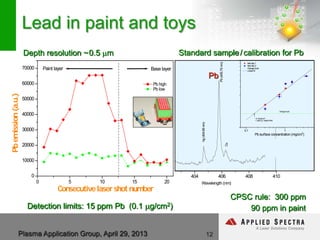
Lead in paint and toys
12
404 406 408 410
Cu
Pb(405.75nm)
hg(404.66nm)
Wavelength (nm)
Standard sample/ calibration for Pb
Pb
0.1 1
~0.15mg/cm2
~1.85%or 18500 PPM
Orange truck
test day1
test day2
Orange truck
Linear fit
Pb surface concentration (mg/cm2
)
0 5 10 15 20
0
10000
20000
30000
40000
50000
60000
70000 Base layerPaint layer
Pb high
Pb low
Pbemission(a.u.)
Consecutivelaser shot number
CPSC rule: 300 ppm
90 ppm in paint
Depth resolution ~0.5 µm
Detection limits: 15 ppm Pb (0.1 µg/cm2)
13Plasma Application Group, April 29, 2013
200 300 400 500 600 700 800 900
Ca (393, 396 nm)
O (777 nm)H (656 nm)C (247 nm)
Icy inhibitor
Diesel
Lubricity improver
Cetane boost
NISTdeisel
NormalizedLIBSEmission
Wavelength (nm)
C H O
300 400 500 600 700 800
0.0
0.5
1.0
CN CN
N
H
O
Sodium (Na)
NormalizedLIBSIntensity
Wavelength (nm)
Valvoline
Chevron
Mobil
Shell
H
CN
C2
Ca
280 290 300 310
200
400
600
800
1000
gate delay=0.5 µs
gate width= 5 µs
laser energy=40mJ
Mg
Intensity
Wavelength (nm)
Clean motor oil
Used motor oilMg
10W-30
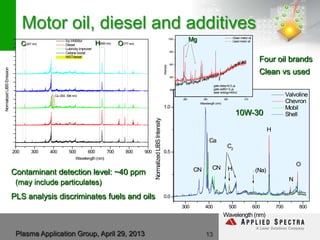
Four oil brands
Clean vs used
Contaminant detection level: ~40 ppm
(may include particulates)
PLS analysis discriminates fuels and oils
Motor oil, diesel and additives
Plasma Application Group, April 29, 2013
High repetition LA-ICPMS
14
0 50 100 150 200 250 300 350 400
102
103
104
105
106
107
108
109
Time (sec)
27
Al
232
Th
238
U
Laser on
Laser offGlass samples
2 mm
(30 s)
Concentration of 232Th, 238U – 37 µg/g
Laser repetition rate – 20 kHz (λ=343 nm)
Stage moving speed – 20 mm/s
X~10µm
Z~5µm
NIST-612
X~5µm
15Plasma Application Group, April 29, 2013
232Th, 238U intensities and their ratio at repetition rate of 20kHz
102
103
104
105
106
107
232
Th
238
U
0.0
0.2
0.4
0.6
0.8
1.0
1.2
1.4
1.6
1.8
2.0
2.2
2.4
2.6
2.8
3.0
3.2
3.4
3.6
3.8
4.0
232
Th/238
U 0.71 +/-0.035, RSD%=5
232
Th/238
U
103
104
105
106
107
232
Th
238
U
0.0
0.2
0.4
0.6
0.8
1.0
1.2
1.4
1.6
1.8
2.0
2.2
2.4
2.6
2.8
3.0
3.2
3.4
3.6
3.8
4.0
232
Th/238
U 0.71 +/-0.035, RSD%=5
Quasi-continuous LA scanning
16Plasma Application Group, April 29, 2013
1E-4 1E-3 0.01 0.1 1
104
105
106
107
108
Log Y = 8.045 + 1.043 Log X
R = 0.9985
208Pb
Concentration (%)
λ = 343nm
Laser energy ~0.1 mJ
Fluence ~20 J/cm2
Spot size ~ 25µm
Repetition rate 0.1 kHz
Scan speed – 0.1 mm/s
Quantitative LA-ICPMS results
• Lead in zinc alloys
• Linear calibration
Plasma Application Group, April 29, 2013
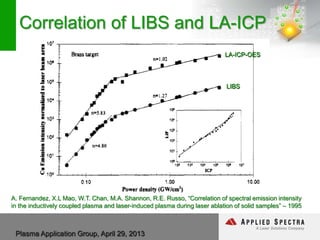
Correlation of LIBS and LA-ICP
A. Fernandez, X.L Mao, W.T. Chan, M.A. Shannon, R.E. Russo, “Correlation of spectral emission intensity
in the inductively coupled plasma and laser-induced plasma during laser ablation of solid samples” – 1995
LA-ICP-OES
LIBS
Plasma Application Group, April 29, 2013
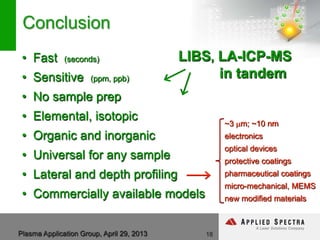
Conclusion
18
• Fast (seconds)
• Sensitive (ppm, ppb)
• No sample prep
• Elemental, isotopic
• Organic and inorganic
• Universal for any sample
• Lateral and depth profiling
• Commercially available models
LIBS, LA-ICP-MS
in tandem
~3 µm; ~10 nm
electronics
optical devices
protective coatings
pharmaceutical coatings
micro-mechanical, MEMS
new modified materials
Plasma Application Group, April 29, 2013
Thank you
19
www.appliedspectra.com

LIBS and LA-ICPMS for structured materials

  • 1.
    Plasma Application Group,April 29, 2013 Real-Time Determination of Compositional Profiles in Structured Materials Using Laser Ablation and LA-ICPMS Alexander A. Boľshakov, Jong H. Yoo, Jhanis J. González, and Richard E. Russo
  • 2.
    Plasma Application Group,April 29, 2013 Laser ablation in applications 2 • Micro machining • 3D texturing and sintering • Chemical analysis RIKEN Review No. 50 (January, 2003): Focused on Laser Precision Microfabrication (LPM 2002)
  • 3.
    Plasma Application Group,April 29, 2013 Laser ablation chemical analysis 3 Laser Data Display Mirror Objective Lens Fiberoptic Cable Focus Lens Plasma Sample SpectrographXYZ Stage LIBS principle of operation: • Simple, rapid, real-time • Any kind of sample • No sample preparation • High spatial resolution ~10 µm • Mapping, depth-profiling Laser-induced breakdown spectroscopy (LIBS) RT100RT100 λ,nm 266 532 1064
  • 4.
    Plasma Application Group,April 29, 2013 Commercial LIBS and LA-ICPMS 4 • Isotopic & elemental analysis • Simple, rapid, real-time • Any kind of sample • No sample preparation • High spatial resolution • Minimum fractionation • Mapping, depth-profiling RT100RT100 J100-UVJ100-UV femto-LA–ICPMS, 100 kHzns-LIBS, 20 Hz www.appliedspectra.com λ,nm 266 532 1064 λ,nm 343 1030 (150 µJ)
  • 5.
    Plasma Application Group,April 29, 2013 Tandem LA–LIBS: OES & ICPMS 5 • Emission and MS simultaneously • Normalization of isotopic ICPMS • All elements including H, C, N, O • Modular, easily upgradable • Up to Two LIBS spectrographs • Easy upgrade to fs-LA–ICPMS LA–LIBS, Nd:YAG, 5 ns, 20 Hz www.appliedspectra.com λ,nm 213 4.5 mJ 266 25 mJ 532 55 mJ 1064 100 mJ • Isotopic & elemental analysis • Simple, rapid, real-time • Any kind of sample • No sample preparation • High spatial resolution • Rapid mapping, depth-profiling
  • 6.
    Plasma Application Group,April 29, 2013 Line broadening and shift 6 284 285 286 287 288 289 290 291 292 293 0.0 5.0x10³ 1.0x10⁴ 1.5x10⁴ 2.0x10⁴ 150ns delay 50ns delay 30ns delay 10ns delay Intensity(a.u) Wavelength λ(nm) • Broadening: Stark, Doppler, collisional, resonant • Continuum radiation: • Free electron-ion recombination • Bremsstrahlung
  • 7.
    Plasma Application Group,April 29, 2013 Depth profiling analysis 7 • Depth resolution ~20 nm Solar cell structure e-Storage substrate Wavelength, nm 236 238 240 242 244 246 248 250 252 254 256 258 260 NI(II)239.9nm Ni(II)241.6nm Ni(II)243.7nm Ni(II)251.2nm P(I)253.5nm Ni(II)254.3nm 236 238 240 242 244 246 248 250 252 254 256 258 260 NI(II)239.9nm Ni(II)241.6nm Ni(II)243.7nm Ni(II)251.2nm P(I)253.5nm Ni(II)254.3nm Uniformity of 150 nm NiP layer Wavelength, nm Aluminum NiP
  • 8.
    Plasma Application Group,April 29, 2013 Discrimination of materials 8 Raw materials: 10 steel samples classified using PCA and PLS-DA Ni Ni Mo • λ =1064 nm • ppm sensitivity • fast discrimination • Not possible by XRF • Too slow by ICP
  • 9.
    Plasma Application Group,April 29, 2013 Quality of fiberglass panels 9 300 400 500 600 l th ( ) Ti Ca C H Na CN PCA discrimination of high vs low quality of fiberglass coatings High-quality samples consistently demonstrate similar spectra • • High quality Low quality Laser 25 mJ Spot size 300 µm Lateral steps 500 µm
  • 10.
    Plasma Application Group,April 29, 2013 High-lead vs. low-lead 12 different solders tested (RoHS limit <0.1% Pb) ComponentPC1 Principal component PC2 Discrimination of solders 10 Thin plated solder leads and solder balls in chips • Library spectra stored
  • 11.
    Plasma Application Group,April 29, 2013 LIBS calibration for Pb 11 Quantitative analysis of electrical solders and solder platings Pb detection limit <10ppm 1E-4 1E-3 0.01 0.1 1 PBSN DATA2PBSN 4% silver slver bearing 5% antimony 2% silver lead free solder 1 Pb/SnLIBSIntensity(a.u.) Pb/Sn <10 sec per sample
  • 12.
    Plasma Application Group,April 29, 2013 Lead in paint and toys 12 404 406 408 410 Cu Pb(405.75nm) hg(404.66nm) Wavelength (nm) Standard sample/ calibration for Pb Pb 0.1 1 ~0.15mg/cm2 ~1.85%or 18500 PPM Orange truck test day1 test day2 Orange truck Linear fit Pb surface concentration (mg/cm2 ) 0 5 10 15 20 0 10000 20000 30000 40000 50000 60000 70000 Base layerPaint layer Pb high Pb low Pbemission(a.u.) Consecutivelaser shot number CPSC rule: 300 ppm 90 ppm in paint Depth resolution ~0.5 µm Detection limits: 15 ppm Pb (0.1 µg/cm2)
  • 13.
    13Plasma Application Group,April 29, 2013 200 300 400 500 600 700 800 900 Ca (393, 396 nm) O (777 nm)H (656 nm)C (247 nm) Icy inhibitor Diesel Lubricity improver Cetane boost NISTdeisel NormalizedLIBSEmission Wavelength (nm) C H O 300 400 500 600 700 800 0.0 0.5 1.0 CN CN N H O Sodium (Na) NormalizedLIBSIntensity Wavelength (nm) Valvoline Chevron Mobil Shell H CN C2 Ca 280 290 300 310 200 400 600 800 1000 gate delay=0.5 µs gate width= 5 µs laser energy=40mJ Mg Intensity Wavelength (nm) Clean motor oil Used motor oilMg 10W-30 Four oil brands Clean vs used Contaminant detection level: ~40 ppm (may include particulates) PLS analysis discriminates fuels and oils Motor oil, diesel and additives
  • 14.
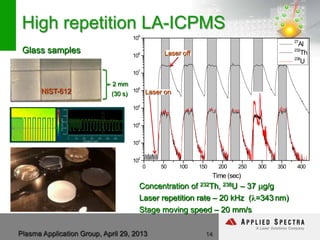
    Plasma Application Group,April 29, 2013 High repetition LA-ICPMS 14 0 50 100 150 200 250 300 350 400 102 103 104 105 106 107 108 109 Time (sec) 27 Al 232 Th 238 U Laser on Laser offGlass samples 2 mm (30 s) Concentration of 232Th, 238U – 37 µg/g Laser repetition rate – 20 kHz (λ=343 nm) Stage moving speed – 20 mm/s X~10µm Z~5µm NIST-612 X~5µm
  • 15.
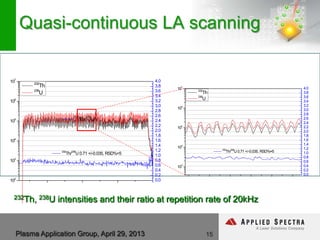
    15Plasma Application Group,April 29, 2013 232Th, 238U intensities and their ratio at repetition rate of 20kHz 102 103 104 105 106 107 232 Th 238 U 0.0 0.2 0.4 0.6 0.8 1.0 1.2 1.4 1.6 1.8 2.0 2.2 2.4 2.6 2.8 3.0 3.2 3.4 3.6 3.8 4.0 232 Th/238 U 0.71 +/-0.035, RSD%=5 232 Th/238 U 103 104 105 106 107 232 Th 238 U 0.0 0.2 0.4 0.6 0.8 1.0 1.2 1.4 1.6 1.8 2.0 2.2 2.4 2.6 2.8 3.0 3.2 3.4 3.6 3.8 4.0 232 Th/238 U 0.71 +/-0.035, RSD%=5 Quasi-continuous LA scanning
  • 16.
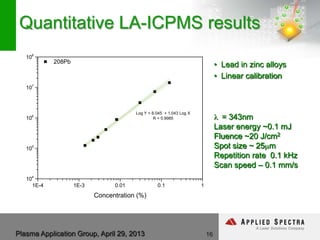
    16Plasma Application Group,April 29, 2013 1E-4 1E-3 0.01 0.1 1 104 105 106 107 108 Log Y = 8.045 + 1.043 Log X R = 0.9985 208Pb Concentration (%) λ = 343nm Laser energy ~0.1 mJ Fluence ~20 J/cm2 Spot size ~ 25µm Repetition rate 0.1 kHz Scan speed – 0.1 mm/s Quantitative LA-ICPMS results • Lead in zinc alloys • Linear calibration
  • 17.
    Plasma Application Group,April 29, 2013 Correlation of LIBS and LA-ICP A. Fernandez, X.L Mao, W.T. Chan, M.A. Shannon, R.E. Russo, “Correlation of spectral emission intensity in the inductively coupled plasma and laser-induced plasma during laser ablation of solid samples” – 1995 LA-ICP-OES LIBS
  • 18.
    Plasma Application Group,April 29, 2013 Conclusion 18 • Fast (seconds) • Sensitive (ppm, ppb) • No sample prep • Elemental, isotopic • Organic and inorganic • Universal for any sample • Lateral and depth profiling • Commercially available models LIBS, LA-ICP-MS in tandem ~3 µm; ~10 nm electronics optical devices protective coatings pharmaceutical coatings micro-mechanical, MEMS new modified materials
  • 19.
    Plasma Application Group,April 29, 2013 Thank you 19 www.appliedspectra.com