
Thin films seen in the light of high energy synchro-tron 
radiation: Stress and microstructure analysis 
using energy-dispersive diffraction Dept. of Microstructure and 
XIII Brazilian MRS meeting, João Pessoa, Brazil, September 28 – October 02, 2014 
Residual Stress Analysis 
XIII Brazilian MRS meeting, João Pessoa, Brazil, 
September 28 – October 02, 2014 
Ch. Genzel
Outline 
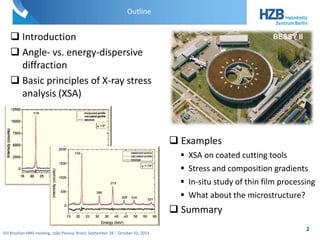
 Introduction BESSY II 
 Angle- vs. energy-dispersive 
diffraction 
 Basic principles of X-ray stress 
analysis (XSA) 
XIII Brazilian MRS meeting, João Pessoa, Brazil, September 28 – October 02, 2014 
 Examples 
 XSA on coated cutting tools 
 Stress and composition gradients 
 In-situ study of thin film processing 
 What about the microstructure? 
 Summary 
2
XIII Brazilian MRS meeting, João Pessoa, Brazil, September 28 – October 02, 2014 
3 
The Mission of the Helmholtz-Zentrum Berlin 
Wannsee 
BER II Reactor 
Adlershof 
BESSY II 
Two large scale facilities for 
investigating the structure 
and function of matter 
Energy research 
Neutrons Synchrotron
XIII Brazilian MRS meeting, João Pessoa, Brazil, September 28 – October 02, 2014 
4 
Department of microstructure and residual stress analysis 
Synchrotron 
ASAXS 
Diffraction: 
Stress, texture, 
microstructure 
Scattering: 
Nanostructure 
Imaging: 
Neutrons 
E3 
Synchrotron 
EDDI 
Time resolution 
Depth resolution 
Spatial resolution 
X-ray 
ETA
Thin films and coatings in every day use 
XIII Brazilian MRS meeting, João Pessoa, Brazil, September 28 – October 02, 2014 
CIS 
Thin films and coatings fulfill 
various important functions in 
our daily life … 
5
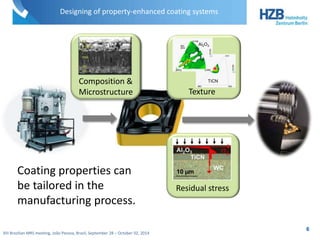
Designing of property-enhanced coating systems 
Al2O3 
Composition & 
Microstructure Texture 
XIII Brazilian MRS meeting, João Pessoa, Brazil, September 28 – October 02, 2014 
TiCN 
Residual stress 
Coating properties can 
be tailored in the 
manufacturing process. 
6
The role of diffraction methods ... 
XIII Brazilian MRS meeting, João Pessoa, Brazil, September 28 – October 02, 2014 
7
Information provided by X-ray diffraction 
X-Ray Diffraction: Crystal structure 
Nondestructive 
Phase-selective 
Information depth nm ... cm 
before sulphurization 
after 
Energy [keV] 
Intensity [a. u.] 
XIII Brazilian MRS meeting, João Pessoa, Brazil, September 28 – October 02, 2014 
Line position and shift: 
 Crystal structure 
 Residual stresses 
Line width and shape: 
 Domain/particle size 
 Microstrain, lattice defects 
Line intensity: 
 crystallographic texture 
 Reaction kinetics 
Fluorescence lines: 
 Element distribution 
8
sload 
1000 ºC 
T 
RT 
0 t 5 min ... with high spatial 
XIII Brazilian MRS meeting, João Pessoa, Brazil, September 28 – October 02, 2014 
9 
Challenges in structural research with diffraction methods 
Investigations 
should be done ... 
... in situ (time 
resolution) 
resolution 
z 
y x 
... under service conditions 
Thin films: Superposition of gradients 
of residual stress, texture and 
composition on very limited space!
Well-known and mainly used: Angle-dispersive X-ray diffraction 
 0D: Scintillation counter 
 1D: Position sensitive det. 
 2D: Channel plate 
2q 
Photon 
source 
monochromatic 
X-ray beam 
coating 
E1 = E2 = E3 … 
CoKa  surface sensitive (low energies) 
30 40 50 60 70 80 90 
2q [deg] 
15 
10 
5 
0 
I [cps] 
XIII Brazilian MRS meeting, João Pessoa, Brazil, September 28 – October 02, 2014 
 high angular resolution 
 long counting times (scintillation 
counter) 
 complex experimental setup 
variable! 
substrate 
10
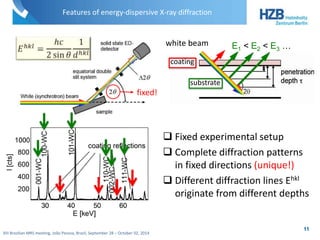
Features of energy-dispersive X-ray diffraction 
fixed! 
XIII Brazilian MRS meeting, João Pessoa, Brazil, September 28 – October 02, 2014 
white beam 
coating 
substrate 
E1 < E2 < E3 … 
 Fixed experimental setup 
 Complete diffraction patterns 
in fixed directions (unique!) 
 Different diffraction lines Ehkl 
originate from different depths 
11
XIII Brazilian MRS meeting, João Pessoa, Brazil, September 28 – October 02, 2014 
12 
Strategy for coating stress analysis 
Materials Science Beamline EDDI 
ETA diffractometer 
Angle-dispersive diffraction (lab) 
 Low energies (5 … 17 keV) 
 Surface sensitive 
coating 
substrate 
Energy-dispersive diffraction 
(synchrotron) 
 Energies up to 120 keV 
 Sensitive in deeper zones
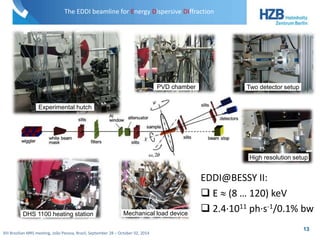
The EDDI beamline for Energy Dispersive DIffraction 
XIII Brazilian MRS meeting, João Pessoa, Brazil, September 28 – October 02, 2014 
EDDI@BESSY II: 
 E  (8 … 120) keV 
 2.4·1011 ph·s-1/0.1% bw 
Experimental hutch 
PVD chamber Two detector setup 
DHS 1100 heating station Mechanical load device 
High resolution setup 
13
Basic principles of X-ray stress analysis 
XIII Brazilian MRS meeting, João Pessoa, Brazil, September 28 – October 02, 2014 
14
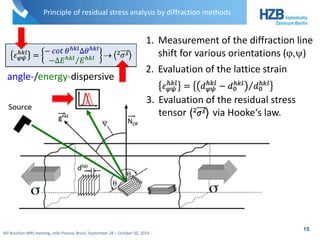
Principle of residual stress analysis by diffraction methods 
angle-/energy-dispersive 
1. Measurement of the diffraction line 
XIII Brazilian MRS meeting, João Pessoa, Brazil, September 28 – October 02, 2014 
shift for various orientations (j,y) 
15 
2. Evaluation of the lattice strain 
3. Evaluation of the residual stress 
tensor via Hooke‘s law.
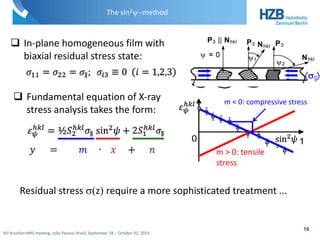
The sin2y-method 
XIII Brazilian MRS meeting, João Pessoa, Brazil, September 28 – October 02, 2014 
m < 0: compressive stress 
0 1 
 In-plane homogeneous film with 
biaxial residual stress state: 
 Fundamental equation of X-ray 
stress analysis takes the form: 
m > 0: tensile 
stress 
Residual stress s(z) require a more sophisticated treatment ... 
16
XSA on coated cutting tools 
XIII Brazilian MRS meeting, João Pessoa, Brazil, September 28 – October 02, 2014 
17
„Thin“system (D = 5 μm) „Thick“system (D = 18 μm) 
Al2O3 
TiCN 
0.176 
0.174 
0.0877 
0.0875 
as-grown 
blasted 
as-grown 
blasted 
XIII Brazilian MRS meeting, João Pessoa, Brazil, September 28 – October 02, 2014 
18 
XSA on multilayer systems: Influence of the coating design 
WC 5μm 
Al2O3 
TiCN 
WC 
10μm 
TiCN 
0.2 0.4 0.6 0.8 1 
0.0873 
0 
d422 [nm] 
sin²y 
as-grown 
as-grown 
0.2 0.4 0.6 0.8 1 
0.1745 
0.1735 
0.1725 
0.08760 
0.08755 
0.08750 
0 
d422 [nm] 
sin²y 
blasted 
CuKa 
Al2O3 
0.2 0.4 0.6 0.8 1 
0.172 
0 
d024 [nm] 
sin²y 
0.2 0.4 0.6 0.8 1 
0.1715 
0 
d024 [nm] 
sin²y 
blasted 
CuKa 
steep 
stress 
gradient!
ED-XSA in the interfacial substrate zone 
Al2O3 
TiCN 
0 
- 0.5 
-1.0 
001 
101 
110 
002 
as-grown 
blasted 
XIII Brazilian MRS meeting, João Pessoa, Brazil, September 28 – October 02, 2014 
2q = 9° 
30 40 50 60 
1000 
800 
600 
400 
200 
E [keV] 
I [cts] 
100-WC 
001-WC 
101-WC 
110-WC 
002-WC 
111-WC 
coating reflections 
5μm 
WC 
E1 < E2 < E3 
M. Klaus et al., Thin solid films 517 (2008), 1172. 
1 2 3 4 5 6 7 
-1.5 
001 
111 
0 
s|| [GPa] 
 [μm] 
coating 
19 
 Application of the sin2y-method 
to each line Ehkl 
 Assignment of the obtained 
stress values <shkl> to average 
information depth <hkl>
Interlayer gradient: Balance between coating and substrate 
TiCN 
Al2O3 
WC 5μm 
1 2 3 4 5 
Intralayer gradient: Balance within the Al2O3 top layer 
TiCN 
Al O 3 
BL 
2 
as-grown 
blasted 
4 8 12 16 20 
z [μm] 
2 
0 
- 2 
- 4 
- 8 
2 
0 
- 2 
- 4 
- 6 
- 8 
TiN 
0 
s|| [GPa] 
Al2O3 
TiCN 
WC 
XIII Brazilian MRS meeting, João Pessoa, Brazil, September 28 – October 02, 2014 
10μm 
z [μm] 
- 6 
0 
s|| [GPa] 
TiCN 
TiN 
Al O 
BL 
as-grown 
blasted 
2 3 
001 
101 
110 
002 
as-grown 
blasted 
1 2 3 4 5 6 7 
0 
- 0.5 
-1.0 
-1.5 
001 
111 
0 
s|| [GPa] 
 [μm] 
001 
101 
110 
002 
blasted 
1 2 3 5 6 7 
0 
-0.5 
-1.0 
-1.5 
111 
0 4 
s|| [MPa] 
 [μm] 
unblasted 
Residual stress balance in multilayer systems 
20
Separation of residual stress and 
composition gradients 
XIII Brazilian MRS meeting, João Pessoa, Brazil, September 28 – October 02, 2014 21
111 
Exp. austenite 
Residual stress (-N) Composition (-N) 
XIII Brazilian MRS meeting, João Pessoa, Brazil, September 28 – October 02, 2014 
22 
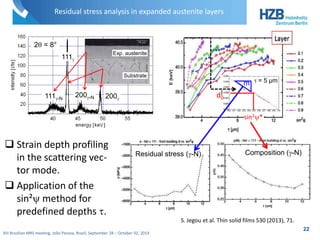
Residual stress analysis in expanded austenite layers 
2q = 8° 
111-N 
200-N 200 
Substrate 
S. Jegou et al. Thin solid films 530 (2013), 71. 
 Strain depth profiling 
in the scattering vec-tor 
mode. 
 Application of the 
sin²y method for 
predefined depths . 
m  = 5 μm 
sin2y* 
d0
Energy-dispersive diffraction: 
In-situ study of thin film processing 
XIII Brazilian MRS meeting, João Pessoa, Brazil, September 28 – October 02, 2014 
23
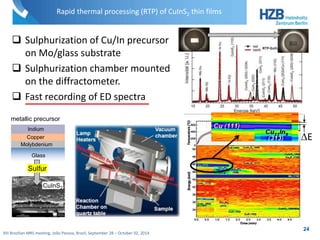
metallic precursor 
Sulfur 
XIII Brazilian MRS meeting, João Pessoa, Brazil, September 28 – October 02, 2014 
24 
Rapid thermal processing (RTP) of CuInS2 thin films 
 Sulphurization of Cu/In precursor 
on Mo/glass substrate 
 Sulphurization chamber mounted 
on the diffractometer. 
 Fast recording of ED spectra 
Indium 
Copper 
Molybdenium 
Glass 
CuInS2 
DE
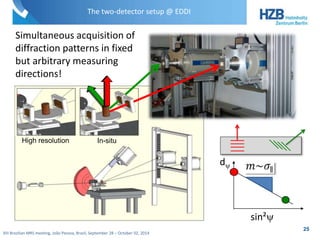
The two-detector setup @ EDDI 
Simultaneous acquisition of 
diffraction patterns in fixed 
but arbitrary measuring 
directions! 
High resolution In-situ 
XIII Brazilian MRS meeting, João Pessoa, Brazil, September 28 – October 02, 2014 
sin²y 
dy 
25
In-situ analysis of thermal stresses in thin Mo films on glass 
aMo = 510-6 K-1 / aGlass = 9.510-6 K-1 
Ch. Genzel et al., J. Strain Analysis 46 (2011), 615 
XIII Brazilian MRS meeting, João Pessoa, Brazil, September 28 – October 02, 2014 
sin2y-based stress analysis 
Ds 
26
What can we learn about 
the microstructure? 
XIII Brazilian MRS meeting, João Pessoa, Brazil, September 28 – October 02, 2014 
27
In-situ microstructure analysis: recrystallization of CuInS2 
Substrate temperature [ºC] 
50 150 250 350 450 
Recrystal-lization 
112- CuInS2 
10 50 100 150 
Process time [min] 
Energy [keV] 
30 
Recrystallized CuInS2 
112- CuInS2 
Lorentzian, 
broad 
Gaussian, 
small 
29 30 31 32 33 
Energy [keV] 
Energy-dispersive 
diffraction line 
profile analysis? 
H. Rodriguez-Alvarez, PhD thesis, TU Berlin, 2010. 
Small-grained, 
defective CuInS2 
Driving Forces? 
Enhancement? 
Normalized Intensity [a. u.] 
XIII Brazilian MRS meeting, João Pessoa, Brazil, September 28 – October 02, 2014 28
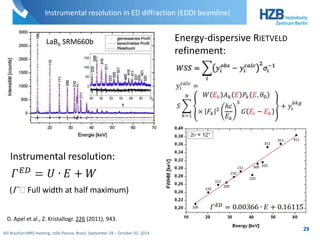
Instrumental resolution in ED diffraction (EDDI beamline) 
LaB6 SRM660b Energy-dispersive RIETVELD 
Instrumental resolution: 
(G  Full width at half maximum) 
XIII Brazilian MRS meeting, João Pessoa, Brazil, September 28 – October 02, 2014 
refinement: 
D. Apel et al., Z. Kristallogr. 226 (2011), 943. 
29
Multiple vs. single line analysis 
2q = 10° 
CeOED Rietveld study of size-related 
2 XIII Brazilian MRS meeting, João Pessoa, Brazil, September 28 – October 02, 2014 
broadening in ceria powder: 
 EDDI: DV = 226(31) Å+) 
 Size-Strain RR: DV = 221…236 Å++) 
+) D. Apel et al., Z. Kristallogr. 226 (2011), 943. 
++) D. Balzar et al., JAC 37 (2004), 911. 
112- CuInS2 
29 30 31 32 33 
Energy [keV] 
Normalized Intensity [a. u.] 
Energy [keV] 
Intensity [counts x 103] 
Needs single line 
analysis! 
30
Single line analysis of domain size and microstrain 
 Line profiles described by pseudo-Voigt 
(pV) functions: 
pV(E) = x·Cauchy(E) + (1-x)·Gaussian(E) 
(0  x  1) 
 Domain size  Cauchy width bC 
 Micro strain  Gaussian width bG 
Broadening angle dispersive energy dispersive 
Size 
Strain 
Size and strain broa-dening 
depend on q! 
Only strain broade-ning 
D. Thomas, PhD thesis, TU Berlin, 2012. 
depends on E! 
XIII Brazilian MRS meeting, João Pessoa, Brazil, September 28 – October 02, 2014 
domain size [nm] 
interrupt temperature [°C] 
micro strain [%] 
initial 
state 
31
Summary 
 Energy-dispersive synchrotron X-ray diffraction: 
Versatile tool for many fields of materials sciences. 
 Under fixed diffraction conditions complete diffrac-tion 
patterns are recorded. 
 Thin film analysis and (high energy) ED diffraction fit 
together! The methods allows for: 
o (Residual) stress analysis, even in complex cases (multi-layers, 
separation of stress and composition gradients ...) 
o Fast in-situ study of thin film growth processes 
o Microstructural characterization (ED line profile analysis) 
o ... 
XIII Brazilian MRS meeting, João Pessoa, Brazil, September 28 – October 02, 2014 
32
My special thanks go to: 
Manuela Klaus 
Ingwer A. Denks 
Rodrigo Coelho 
Daniel Apel 
Diana Thomas 
Matthias Meixner 
Tillman Fuss 
Guido Wagener 
Roland Mainz 
Humberto Rodriguez-Alvarez 
Davor Balzar 
XIII Brazilian MRS meeting, João Pessoa, Brazil, September 28 – October 02, 2014 
33
Thank you very much 
for your attention! 
XIII Brazilian MRS meeting, João Pessoa, Brazil, September 28 – October 02, 2014 
34

Thin films seen in the light of high energy synchrotron radiation: stress and microstructure analysis using energy-dispersive diffraction.

  • 1.
    Thin films seenin the light of high energy synchro-tron radiation: Stress and microstructure analysis using energy-dispersive diffraction Dept. of Microstructure and XIII Brazilian MRS meeting, João Pessoa, Brazil, September 28 – October 02, 2014 Residual Stress Analysis XIII Brazilian MRS meeting, João Pessoa, Brazil, September 28 – October 02, 2014 Ch. Genzel
  • 2.
    Outline  IntroductionBESSY II  Angle- vs. energy-dispersive diffraction  Basic principles of X-ray stress analysis (XSA) XIII Brazilian MRS meeting, João Pessoa, Brazil, September 28 – October 02, 2014  Examples  XSA on coated cutting tools  Stress and composition gradients  In-situ study of thin film processing  What about the microstructure?  Summary 2
  • 3.
    XIII Brazilian MRSmeeting, João Pessoa, Brazil, September 28 – October 02, 2014 3 The Mission of the Helmholtz-Zentrum Berlin Wannsee BER II Reactor Adlershof BESSY II Two large scale facilities for investigating the structure and function of matter Energy research Neutrons Synchrotron
  • 4.
    XIII Brazilian MRSmeeting, João Pessoa, Brazil, September 28 – October 02, 2014 4 Department of microstructure and residual stress analysis Synchrotron ASAXS Diffraction: Stress, texture, microstructure Scattering: Nanostructure Imaging: Neutrons E3 Synchrotron EDDI Time resolution Depth resolution Spatial resolution X-ray ETA
  • 5.
    Thin films andcoatings in every day use XIII Brazilian MRS meeting, João Pessoa, Brazil, September 28 – October 02, 2014 CIS Thin films and coatings fulfill various important functions in our daily life … 5
  • 6.
    Designing of property-enhancedcoating systems Al2O3 Composition & Microstructure Texture XIII Brazilian MRS meeting, João Pessoa, Brazil, September 28 – October 02, 2014 TiCN Residual stress Coating properties can be tailored in the manufacturing process. 6
  • 7.
    The role ofdiffraction methods ... XIII Brazilian MRS meeting, João Pessoa, Brazil, September 28 – October 02, 2014 7
  • 8.
    Information provided byX-ray diffraction X-Ray Diffraction: Crystal structure Nondestructive Phase-selective Information depth nm ... cm before sulphurization after Energy [keV] Intensity [a. u.] XIII Brazilian MRS meeting, João Pessoa, Brazil, September 28 – October 02, 2014 Line position and shift:  Crystal structure  Residual stresses Line width and shape:  Domain/particle size  Microstrain, lattice defects Line intensity:  crystallographic texture  Reaction kinetics Fluorescence lines:  Element distribution 8
  • 9.
    sload 1000 ºC T RT 0 t 5 min ... with high spatial XIII Brazilian MRS meeting, João Pessoa, Brazil, September 28 – October 02, 2014 9 Challenges in structural research with diffraction methods Investigations should be done ... ... in situ (time resolution) resolution z y x ... under service conditions Thin films: Superposition of gradients of residual stress, texture and composition on very limited space!
  • 10.
    Well-known and mainlyused: Angle-dispersive X-ray diffraction  0D: Scintillation counter  1D: Position sensitive det.  2D: Channel plate 2q Photon source monochromatic X-ray beam coating E1 = E2 = E3 … CoKa  surface sensitive (low energies) 30 40 50 60 70 80 90 2q [deg] 15 10 5 0 I [cps] XIII Brazilian MRS meeting, João Pessoa, Brazil, September 28 – October 02, 2014  high angular resolution  long counting times (scintillation counter)  complex experimental setup variable! substrate 10
  • 11.
    Features of energy-dispersiveX-ray diffraction fixed! XIII Brazilian MRS meeting, João Pessoa, Brazil, September 28 – October 02, 2014 white beam coating substrate E1 < E2 < E3 …  Fixed experimental setup  Complete diffraction patterns in fixed directions (unique!)  Different diffraction lines Ehkl originate from different depths 11
  • 12.
    XIII Brazilian MRSmeeting, João Pessoa, Brazil, September 28 – October 02, 2014 12 Strategy for coating stress analysis Materials Science Beamline EDDI ETA diffractometer Angle-dispersive diffraction (lab)  Low energies (5 … 17 keV)  Surface sensitive coating substrate Energy-dispersive diffraction (synchrotron)  Energies up to 120 keV  Sensitive in deeper zones
  • 13.
    The EDDI beamlinefor Energy Dispersive DIffraction XIII Brazilian MRS meeting, João Pessoa, Brazil, September 28 – October 02, 2014 EDDI@BESSY II:  E  (8 … 120) keV  2.4·1011 ph·s-1/0.1% bw Experimental hutch PVD chamber Two detector setup DHS 1100 heating station Mechanical load device High resolution setup 13
  • 14.
    Basic principles ofX-ray stress analysis XIII Brazilian MRS meeting, João Pessoa, Brazil, September 28 – October 02, 2014 14
  • 15.
    Principle of residualstress analysis by diffraction methods angle-/energy-dispersive 1. Measurement of the diffraction line XIII Brazilian MRS meeting, João Pessoa, Brazil, September 28 – October 02, 2014 shift for various orientations (j,y) 15 2. Evaluation of the lattice strain 3. Evaluation of the residual stress tensor via Hooke‘s law.
  • 16.
    The sin2y-method XIIIBrazilian MRS meeting, João Pessoa, Brazil, September 28 – October 02, 2014 m < 0: compressive stress 0 1  In-plane homogeneous film with biaxial residual stress state:  Fundamental equation of X-ray stress analysis takes the form: m > 0: tensile stress Residual stress s(z) require a more sophisticated treatment ... 16
  • 17.
    XSA on coatedcutting tools XIII Brazilian MRS meeting, João Pessoa, Brazil, September 28 – October 02, 2014 17
  • 18.
    „Thin“system (D =5 μm) „Thick“system (D = 18 μm) Al2O3 TiCN 0.176 0.174 0.0877 0.0875 as-grown blasted as-grown blasted XIII Brazilian MRS meeting, João Pessoa, Brazil, September 28 – October 02, 2014 18 XSA on multilayer systems: Influence of the coating design WC 5μm Al2O3 TiCN WC 10μm TiCN 0.2 0.4 0.6 0.8 1 0.0873 0 d422 [nm] sin²y as-grown as-grown 0.2 0.4 0.6 0.8 1 0.1745 0.1735 0.1725 0.08760 0.08755 0.08750 0 d422 [nm] sin²y blasted CuKa Al2O3 0.2 0.4 0.6 0.8 1 0.172 0 d024 [nm] sin²y 0.2 0.4 0.6 0.8 1 0.1715 0 d024 [nm] sin²y blasted CuKa steep stress gradient!
  • 19.
    ED-XSA in theinterfacial substrate zone Al2O3 TiCN 0 - 0.5 -1.0 001 101 110 002 as-grown blasted XIII Brazilian MRS meeting, João Pessoa, Brazil, September 28 – October 02, 2014 2q = 9° 30 40 50 60 1000 800 600 400 200 E [keV] I [cts] 100-WC 001-WC 101-WC 110-WC 002-WC 111-WC coating reflections 5μm WC E1 < E2 < E3 M. Klaus et al., Thin solid films 517 (2008), 1172. 1 2 3 4 5 6 7 -1.5 001 111 0 s|| [GPa]  [μm] coating 19  Application of the sin2y-method to each line Ehkl  Assignment of the obtained stress values <shkl> to average information depth <hkl>
  • 20.
    Interlayer gradient: Balancebetween coating and substrate TiCN Al2O3 WC 5μm 1 2 3 4 5 Intralayer gradient: Balance within the Al2O3 top layer TiCN Al O 3 BL 2 as-grown blasted 4 8 12 16 20 z [μm] 2 0 - 2 - 4 - 8 2 0 - 2 - 4 - 6 - 8 TiN 0 s|| [GPa] Al2O3 TiCN WC XIII Brazilian MRS meeting, João Pessoa, Brazil, September 28 – October 02, 2014 10μm z [μm] - 6 0 s|| [GPa] TiCN TiN Al O BL as-grown blasted 2 3 001 101 110 002 as-grown blasted 1 2 3 4 5 6 7 0 - 0.5 -1.0 -1.5 001 111 0 s|| [GPa]  [μm] 001 101 110 002 blasted 1 2 3 5 6 7 0 -0.5 -1.0 -1.5 111 0 4 s|| [MPa]  [μm] unblasted Residual stress balance in multilayer systems 20
  • 21.
    Separation of residualstress and composition gradients XIII Brazilian MRS meeting, João Pessoa, Brazil, September 28 – October 02, 2014 21
  • 22.
    111 Exp. austenite Residual stress (-N) Composition (-N) XIII Brazilian MRS meeting, João Pessoa, Brazil, September 28 – October 02, 2014 22 Residual stress analysis in expanded austenite layers 2q = 8° 111-N 200-N 200 Substrate S. Jegou et al. Thin solid films 530 (2013), 71.  Strain depth profiling in the scattering vec-tor mode.  Application of the sin²y method for predefined depths . m  = 5 μm sin2y* d0
  • 23.
    Energy-dispersive diffraction: In-situstudy of thin film processing XIII Brazilian MRS meeting, João Pessoa, Brazil, September 28 – October 02, 2014 23
  • 24.
    metallic precursor Sulfur XIII Brazilian MRS meeting, João Pessoa, Brazil, September 28 – October 02, 2014 24 Rapid thermal processing (RTP) of CuInS2 thin films  Sulphurization of Cu/In precursor on Mo/glass substrate  Sulphurization chamber mounted on the diffractometer.  Fast recording of ED spectra Indium Copper Molybdenium Glass CuInS2 DE
  • 25.
    The two-detector setup@ EDDI Simultaneous acquisition of diffraction patterns in fixed but arbitrary measuring directions! High resolution In-situ XIII Brazilian MRS meeting, João Pessoa, Brazil, September 28 – October 02, 2014 sin²y dy 25
  • 26.
    In-situ analysis ofthermal stresses in thin Mo films on glass aMo = 510-6 K-1 / aGlass = 9.510-6 K-1 Ch. Genzel et al., J. Strain Analysis 46 (2011), 615 XIII Brazilian MRS meeting, João Pessoa, Brazil, September 28 – October 02, 2014 sin2y-based stress analysis Ds 26
  • 27.
    What can welearn about the microstructure? XIII Brazilian MRS meeting, João Pessoa, Brazil, September 28 – October 02, 2014 27
  • 28.
    In-situ microstructure analysis:recrystallization of CuInS2 Substrate temperature [ºC] 50 150 250 350 450 Recrystal-lization 112- CuInS2 10 50 100 150 Process time [min] Energy [keV] 30 Recrystallized CuInS2 112- CuInS2 Lorentzian, broad Gaussian, small 29 30 31 32 33 Energy [keV] Energy-dispersive diffraction line profile analysis? H. Rodriguez-Alvarez, PhD thesis, TU Berlin, 2010. Small-grained, defective CuInS2 Driving Forces? Enhancement? Normalized Intensity [a. u.] XIII Brazilian MRS meeting, João Pessoa, Brazil, September 28 – October 02, 2014 28
  • 29.
    Instrumental resolution inED diffraction (EDDI beamline) LaB6 SRM660b Energy-dispersive RIETVELD Instrumental resolution: (G  Full width at half maximum) XIII Brazilian MRS meeting, João Pessoa, Brazil, September 28 – October 02, 2014 refinement: D. Apel et al., Z. Kristallogr. 226 (2011), 943. 29
  • 30.
    Multiple vs. singleline analysis 2q = 10° CeOED Rietveld study of size-related 2 XIII Brazilian MRS meeting, João Pessoa, Brazil, September 28 – October 02, 2014 broadening in ceria powder:  EDDI: DV = 226(31) Å+)  Size-Strain RR: DV = 221…236 Å++) +) D. Apel et al., Z. Kristallogr. 226 (2011), 943. ++) D. Balzar et al., JAC 37 (2004), 911. 112- CuInS2 29 30 31 32 33 Energy [keV] Normalized Intensity [a. u.] Energy [keV] Intensity [counts x 103] Needs single line analysis! 30
  • 31.
    Single line analysisof domain size and microstrain  Line profiles described by pseudo-Voigt (pV) functions: pV(E) = x·Cauchy(E) + (1-x)·Gaussian(E) (0  x  1)  Domain size  Cauchy width bC  Micro strain  Gaussian width bG Broadening angle dispersive energy dispersive Size Strain Size and strain broa-dening depend on q! Only strain broade-ning D. Thomas, PhD thesis, TU Berlin, 2012. depends on E! XIII Brazilian MRS meeting, João Pessoa, Brazil, September 28 – October 02, 2014 domain size [nm] interrupt temperature [°C] micro strain [%] initial state 31
  • 32.
    Summary  Energy-dispersivesynchrotron X-ray diffraction: Versatile tool for many fields of materials sciences.  Under fixed diffraction conditions complete diffrac-tion patterns are recorded.  Thin film analysis and (high energy) ED diffraction fit together! The methods allows for: o (Residual) stress analysis, even in complex cases (multi-layers, separation of stress and composition gradients ...) o Fast in-situ study of thin film growth processes o Microstructural characterization (ED line profile analysis) o ... XIII Brazilian MRS meeting, João Pessoa, Brazil, September 28 – October 02, 2014 32
  • 33.
    My special thanksgo to: Manuela Klaus Ingwer A. Denks Rodrigo Coelho Daniel Apel Diana Thomas Matthias Meixner Tillman Fuss Guido Wagener Roland Mainz Humberto Rodriguez-Alvarez Davor Balzar XIII Brazilian MRS meeting, João Pessoa, Brazil, September 28 – October 02, 2014 33
  • 34.
    Thank you verymuch for your attention! XIII Brazilian MRS meeting, João Pessoa, Brazil, September 28 – October 02, 2014 34