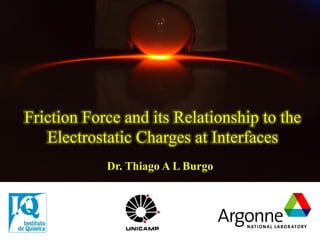
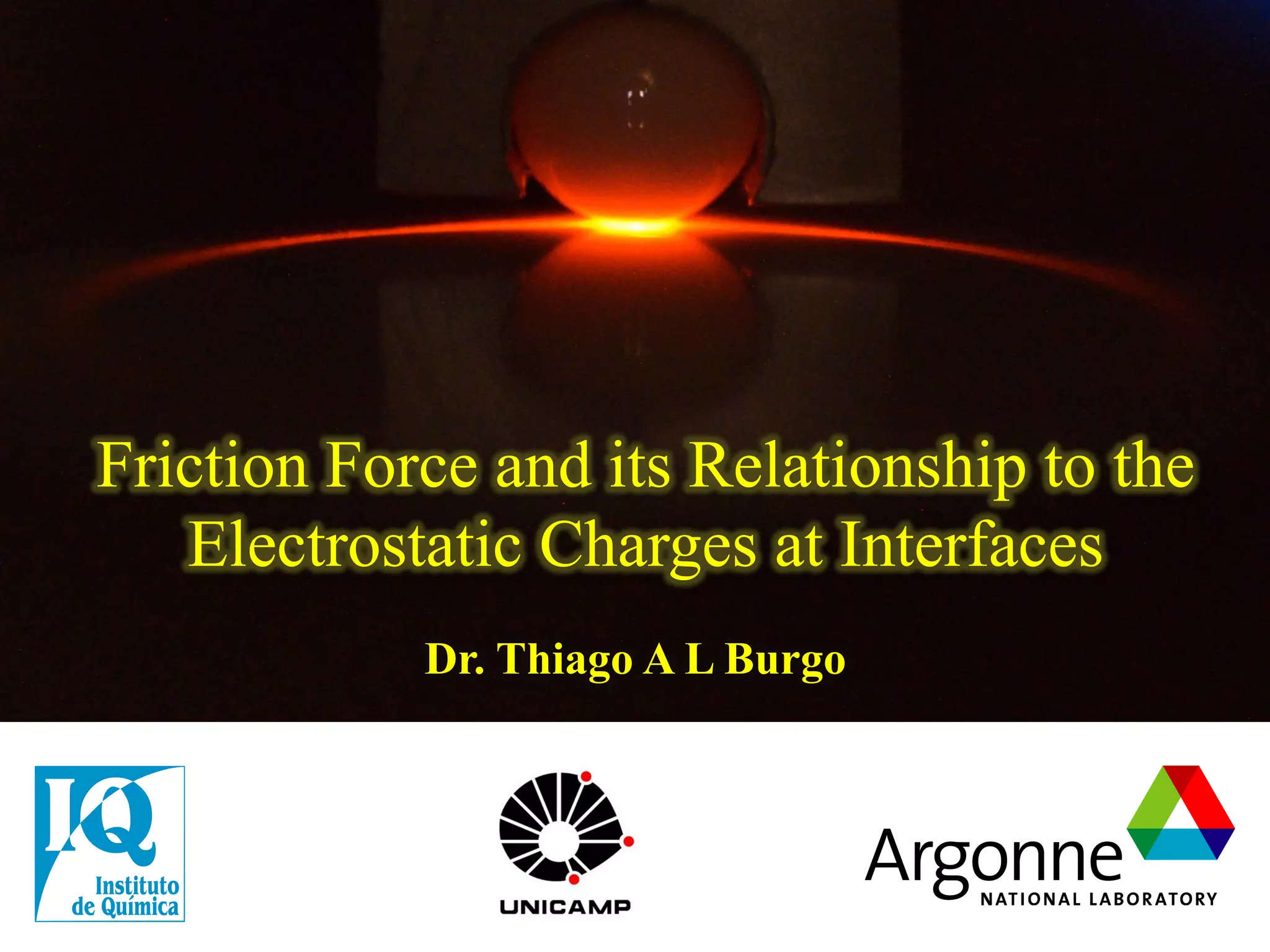
Friction Force and its Relationship to the
Electrostatic Charges at Interfaces
Dr. Thiago A L Burgo
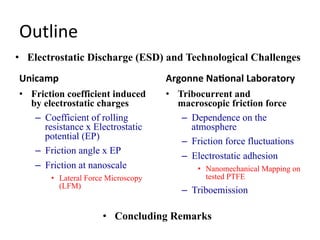
Outline	
  
Unicamp	
  
•  Friction coefficient induced
by electrostatic charges
–  Coefficient of rolling
resistance x Electrostatic
potential (EP)
–  Friction angle x EP
–  Friction at nanoscale
•  Lateral Force Microscopy
(LFM)
Argonne	
  Na/onal	
  Laboratory	
  
•  Tribocurrent and
macroscopic friction force
–  Dependence on the
atmosphere
–  Friction force fluctuations
–  Electrostatic adhesion
•  Nanomechanical Mapping on
tested PTFE
–  Triboemission
•  Concluding Remarks
•  Electrostatic Discharge (ESD) and Technological Challenges
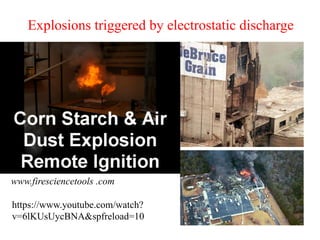
Explosions triggered by electrostatic discharge
https://www.youtube.com/watch?
v=6lKUsUycBNA&spfreload=10
www.firesciencetools .com
In October 2013, a fire of
great proportions hit
Copersucar facilities.
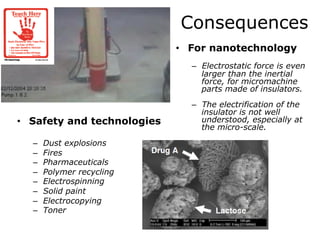
•  For nanotechnology
–  Electrostatic force is even
larger than the inertial
force, for micromachine
parts made of insulators.
–  The electrification of the
insulator is not well
understood, especially at
the micro-scale.
•  Safety and technologies
–  Dust explosions
–  Fires
–  Pharmaceuticals
–  Polymer recycling
–  Electrospinning
–  Solid paint
–  Electrocopying
–  Toner
Consequences
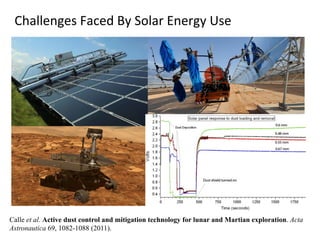
Challenges	
  Faced	
  By	
  Solar	
  Energy	
  Use	
  
Calle et al. Active dust control and mitigation technology for lunar and Martian exploration. Acta
Astronautica 69, 1082-1088 (2011).
Electrodynamic	
  Repulsion	
  
Courtesy of Carlos Calle, Electrostatics and Surface Physics Laboratory - NASA
Surfaces	
  under	
  rela<ve	
  mo<on:	
  
Triboplasma	
  
Heinicke G.
Tribochemistry.
(1984)
Matta et al. J.
Phys. D: Appl.
Phys. (2009)
Camara, et al.
Nature (2008)
Burgo, et al.
Polym. Degrad.
Stabil. (2014)
enerated. All these
na follow a certain
plained by Suh [3].
city, normal load,
nt of hydrocarbons
,5], are correlated
s. According to
emission of both
les was measured
ls, ceramics, and
conditions with
ould be considered
y discovered by
s mostly composed
rding to the most
noemission is an
g from mechanical
Fig. 1. General scheme of triboemission [7].
K. Kajdas / Tribology International 38 (2005) 337–353
How	
  powerful	
  is	
  the	
  triboplasma?	
  
!
Camara et al. Correlation between nanosecond X-ray
flashes and stick–slip friction in peeling tape. Nature,
455, 1089-1093 (2008).
X-Rays!
X-ray Fluorescence
(XRF) technology
Tribogenics
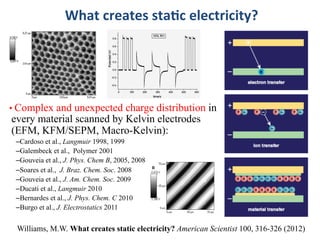
What	
  creates	
  sta/c	
  electricity?	
  
Williams, M.W. What creates static electricity? American Scientist 100, 316-326 (2012)
• Complex and unexpected charge distribution in
every material scanned by Kelvin electrodes
(EFM, KFM/SEPM, Macro-Kelvin):
– Cardoso et al., Langmuir 1998, 1999
– Galembeck et al., Polymer 2001
– Gouveia et al., J. Phys. Chem B, 2005, 2008
– Soares et al., J. Braz. Chem. Soc. 2008
– Gouveia et al., J. Am. Chem. Soc. 2009
– Ducati et al., Langmuir 2010
– Bernardes et al., J. Phys. Chem. C 2010
– Burgo et al., J. Electrostatics 2011
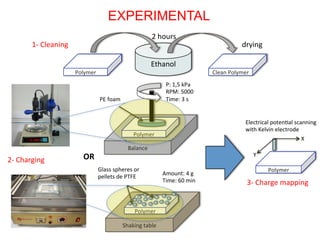
Polymer	
  
Ethanol	
  
2	
  hours	
  
Clean	
  Polymer	
  
drying	
  
Electrical	
  poten<al	
  scanning	
  
with	
  Kelvin	
  electrode	
  
OR	
  
EXPERIMENTAL
Balance	
  
Polymer	
  
P:	
  1,5	
  kPa	
  
RPM:	
  5000	
  
Time:	
  3	
  s	
  PE	
  foam	
  
Shaking	
  table	
  
Polymer	
  
Glass	
  spheres	
  or	
  
pellets	
  de	
  PTFE	
  
Amount:	
  4	
  g	
  
Time:	
  60	
  min	
  
1-­‐	
  Cleaning	
  
2-­‐	
  Charging	
  
3-­‐	
  Charge	
  mapping	
  
X	
  
Y	
  
Polymer	
  
1 cm
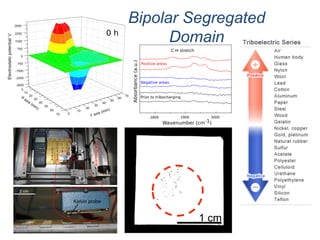
Bipolar Segregated
Domain
Formation free-radicals is followed by electron transfer:
from the hydrocarbon free-radicals to the more
electronegative fluorocarbon radicals. Ions are segregated
due to the chain size, following Flory−Huggins theory
and superseding weak electrostatic interactions between
highly spaced charges.	
  !
Burgo et al. Triboelectricity: macroscopic charge patterns formed by self-arraying ions on polymer
surfaces, Langmuir, 28(19), 7407-7416 (2012).
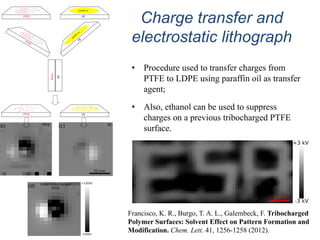
Francisco, K. R., Burgo, T. A. L., Galembeck, F. Tribocharged
Polymer Surfaces: Solvent Effect on Pattern Formation and
Modification. Chem. Lett. 41, 1256-1258 (2012).
•  Procedure used to transfer charges from
PTFE to LDPE using paraffin oil as transfer
agent;
•  Also, ethanol can be used to suppress
charges on a previous tribocharged PTFE
surface.
Charge transfer and
electrostatic lithograph
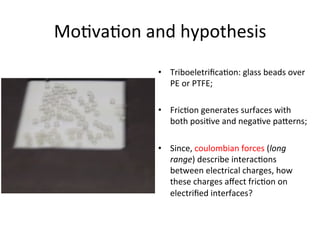
Mo<va<on	
  and	
  hypothesis	
  
•  Triboeletrifica<on:	
  glass	
  beads	
  over	
  
PE	
  or	
  PTFE;	
  
•  Fric<on	
  generates	
  surfaces	
  with	
  
both	
  posi<ve	
  and	
  nega<ve	
  paWerns;	
  
•  Since,	
  coulombian	
  forces	
  (long	
  
range)	
  describe	
  interac<ons	
  
between	
  electrical	
  charges,	
  how	
  
these	
  charges	
  affect	
  fric<on	
  on	
  
electrified	
  interfaces?	
  
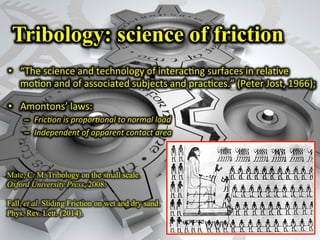
Tribology: science of friction
•  “The	
  science	
  and	
  technology	
  of	
  interac<ng	
  surfaces	
  in	
  rela<ve	
  
mo<on	
  and	
  of	
  associated	
  subjects	
  and	
  prac<ces.”	
  (Peter	
  Jost,	
  1966);	
  
•  Amontons’	
  laws:	
  
–  Fric,on	
  is	
  propor,onal	
  to	
  normal	
  load	
  
–  Independent	
  of	
  apparent	
  contact	
  area	
  
Mate, C. M. Tribology on the small scale.
Oxford University Press, 2008.
Fall, et al. Sliding Friction on wet and dry sand.
Phys. Rev. Lett. (2014).
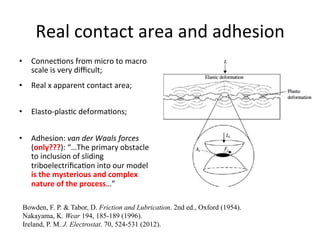
Real	
  contact	
  area	
  and	
  adhesion	
  
•  Connec<ons	
  from	
  micro	
  to	
  macro	
  
scale	
  is	
  very	
  difficult;	
  
•  Real	
  x	
  apparent	
  contact	
  area;	
  
•  Elasto-­‐plas<c	
  deforma<ons;	


•  Adhesion:	
  van	
  der	
  Waals	
  forces	
  
(only???):	
  “…The	
  primary	
  obstacle	
  
to	
  inclusion	
  of	
  sliding	
  
triboelectrifica<on	
  into	
  our	
  model	
  
is	
  the	
  mysterious	
  and	
  complex	
  
nature	
  of	
  the	
  process…”	
  	
  
Bowden, F. P. & Tabor, D. Friction and Lubrication. 2nd ed., Oxford (1954).
Nakayama, K. Wear 194, 185-189 (1996).
Ireland, P. M. J. Electrostat. 70, 524-531 (2012).
Mechanical	
  contact:	
  
JKR,	
  DMT	
  and	
  Maugis	
  
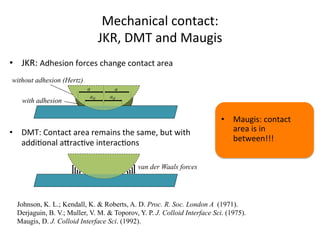
•  JKR:	
  Adhesion	
  forces	
  change	
  contact	
  area	
  
•  DMT:	
  Contact	
  area	
  remains	
  the	
  same,	
  but	
  with	
  
addi<onal	
  aWrac<ve	
  interac<ons	


•  Maugis:	
  contact	
  
area	
  is	
  in	
  
between!!!	
  
Johnson, K. L.; Kendall, K. & Roberts, A. D. Proc. R. Soc. London A (1971).
Derjaguin, B. V.; Muller, V. M. & Toporov, Y. P. J. Colloid Interface Sci. (1975).
Maugis, D. J. Colloid Interface Sci. (1992).
with adhesion
aH aH
a a
without adhesion (Hertz)
van der Waals forces
…and	
  the	
  Coulombic	
  contribu<on?	
  
“…The primary obstacle to inclusion of sliding
triboelectrification into our model is the mysterious
and complex nature of the process…”
Ireland, P. M. J. Electrostat. (2012).
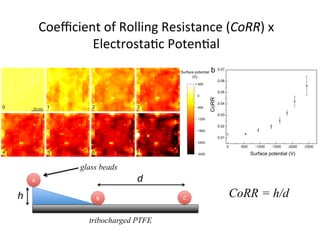
Coefficient	
  of	
  Rolling	
  Resistance	
  (CoRR)	
  x	
  	
  
Electrosta<c	
  Poten<al	
  
A"
B" C"h
d
CoRR = h/d
glass beads
tribocharged PTFE
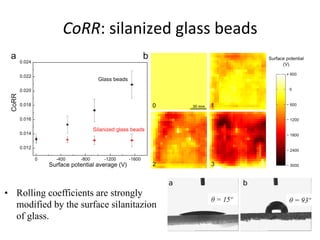
CoRR:	
  silanized	
  glass	
  beads	
  
a b
θ=25˚ θ=93˚
•  Rolling coefficients are strongly
modified by the surface silanitazion
of glass.
θ = 15º θ = 93º
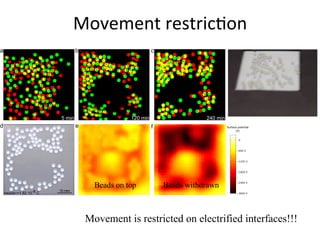
Movement	
  restric<on	
  
Movement is restricted on electrified interfaces!!!
Beads on top Beads withdrawn
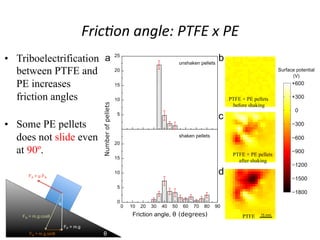
Fric,on	
  angle:	
  PTFE	
  x	
  PE	
  
•  Triboelectrification
between PTFE and
PE increases
friction angles
•  Some PE pellets
does not slide even
at 90º. PTFE + PE pellets
after shaking
PTFE
PTFE + PE pellets
before shaking
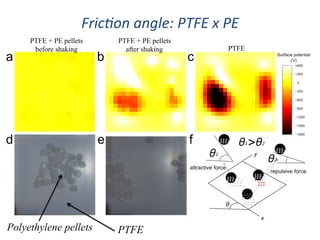
Polyethylene pellets PTFE
Fric,on	
  angle:	
  PTFE	
  x	
  PE	
  
PTFE + PE pellets
after shaking PTFE
PTFE + PE pellets
before shaking
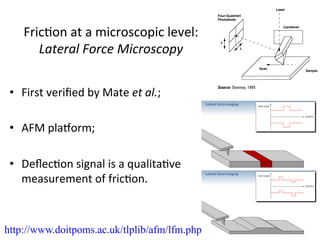
Fric<on	
  at	
  a	
  microscopic	
  level:	
  
Lateral	
  Force	
  Microscopy	
  
•  First	
  verified	
  by	
  Mate	
  et	
  al.;	
  
•  AFM	
  plahorm;	
  
•  Deflec<on	
  signal	
  is	
  a	
  qualita<ve	
  
measurement	
  of	
  fric<on.	
  
http://www.doitpoms.ac.uk/tlplib/afm/lfm.php
α∆´ =
(1+µ2)sinθcosθ
cosθ2 − µ2 sin2θ
αW´ =
µ
cosθ2 − µ2 sin2θ
µ + =
2∆´
W´sin2θ
1
µ
LFM	
  calibra<on:	
  
volts	
  (V)	
  to	
  units	
  of	
  
force	
  (N)	
  
Ogletree, D. F., Carpick, R. W. & Salmeron M.
Calibration of frictional forces in atomic force
microscopy. Rev. Sci. Instrum. 67(9), 3298-3306 (1996).
Lateral	
  force	
  microscopy	
  (LFM)	
  
•  Friction is largely affected
by surface charges at the
nanometer scale;
•  Fractal dimension D of
friction signal is bigger
than topography signal!!!
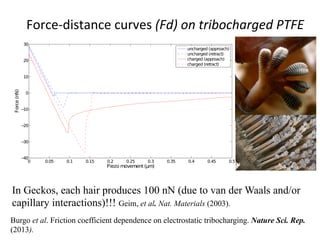
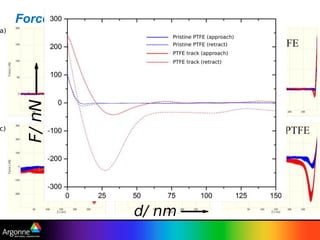
Force-­‐distance	
  curves	
  (Fd)	
  on	
  tribocharged	
  PTFE	
  
In Geckos, each hair produces 100 nN (due to van der Waals and/or
capillary interactions)!!! Geim, et al. Nat. Materials (2003).
Burgo et al. Friction coefficient dependence on electrostatic tribocharging. Nature Sci. Rep.
(2013).
Parcial	
  Conclusions	
  
•  Tribocharges produced by friction have a large effect
on the friction coefficients of dielectrics:
–  They may exceed all other factors for mechanical energy
dissipation;
•  Controlling surface electrostatics should thus open the
way to new approaches for controlling friction in
many important systems and equipment.
•  Since	
  tribocharge	
  paWerns	
  are	
  fractal,	
  their	
  
contribu<on	
  to	
  fric<on	
  coefficients	
  is	
  also	
  fractal.
Bipolar	
  Tribocharging	
  Signal	
  During	
  
Fric3on	
  Force	
  Fluctua3ons	
  at	
  
Metal–Insulator	
  Interfaces	
  
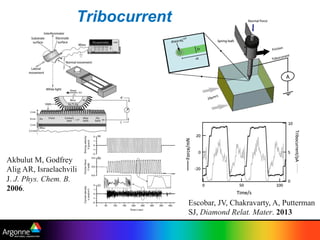
Escobar, JV, Chakravarty, A, Putterman
SJ, Diamond Relat. Mater. 2013
Akbulut M, Godfrey
Alig AR, Israelachvili
J. J. Phys. Chem. B.
2006.
Tribocurrent
Setup
Tribocurrent x friction force
vacuum nitrogen
hydrogen open air
1N normal load
50 cm/s speed
PTFE x Steel
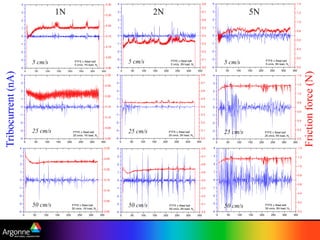
Tribocurrent(nA)
Frictionforce(N)
1N 2N 5N
5 cm/s 5 cm/s 5 cm/s
25 cm/s 25 cm/s 25 cm/s
50 cm/s 50 cm/s 50 cm/s
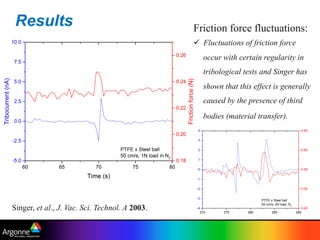
Results Friction force fluctuations:
ü  Fluctuations of friction force
occur with certain regularity in
tribological tests and Singer has
shown that this effect is generally
caused by the presence of third
bodies (material transfer).
Singer, et al., J. Vac. Sci. Technol. A 2003.
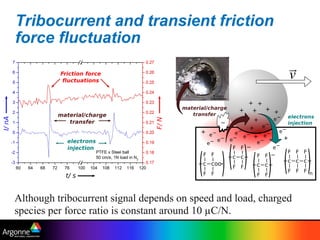
Tribocurrent and transient friction
force fluctuation
Although tribocurrent signal depends on speed and load, charged
species per force ratio is constant around 10 µC/N.
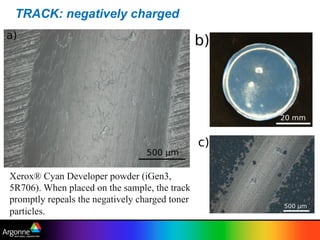
TRACK: negatively charged
Xerox® Cyan Developer powder (iGen3,
5R706). When placed on the sample, the track
promptly repeals the negatively charged toner
particles.
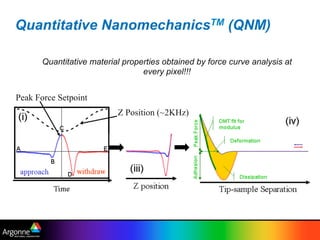
Quantitative NanomechanicsTM (QNM)
Quantitative material properties obtained by force curve analysis at
every pixel!!!
Z Position (~2KHz)
Peak Force Setpoint
Force distance curves
Clean PTFE
Charged PTFE
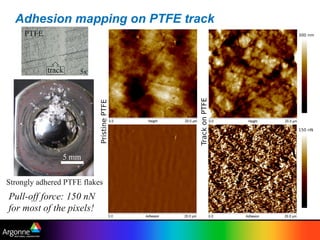
Adhesion mapping on PTFE track
Strongly adhered PTFE flakes
5 mm
Pull-off force: 150 nN
for most of the pixels!
PTFE
track 5x
Triboemission
(triboluminescence) under
Neon atmosphere
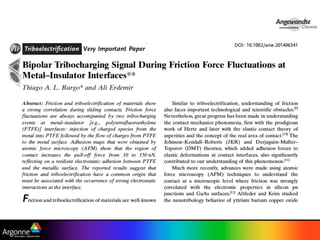
Burgo, T. A. L. & Erdemir, A.
Ang. Chem. Int. Ed., 53, 2014.
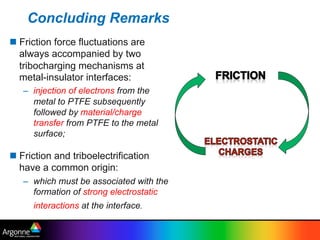
Concluding Remarks
n Friction force fluctuations are
always accompanied by two
tribocharging mechanisms at
metal-insulator interfaces:
–  injection of electrons from the
metal to PTFE subsequently
followed by material/charge
transfer from PTFE to the metal
surface;
n Friction and triboelectrification
have a common origin:
–  which must be associated with the
formation of strong electrostatic
interactions at the interface.
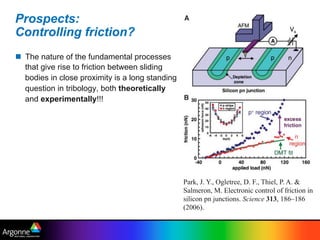
Prospects:
Controlling friction?
n  The nature of the fundamental processes
that give rise to friction between sliding
bodies in close proximity is a long standing
question in tribology, both theoretically
and experimentally!!!
Park, J. Y., Ogletree, D. F., Thiel, P. A. &
Salmeron, M. Electronic control of friction in
silicon pn junctions. Science 313, 186–186
(2006).
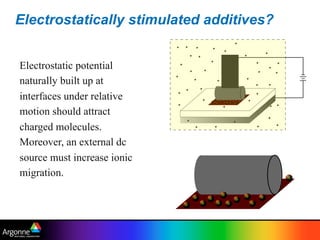
Electrostatically stimulated additives?
Electrostatic potential
naturally built up at
interfaces under relative
motion should attract
charged molecules.
Moreover, an external dc
source must increase ionic
migration.
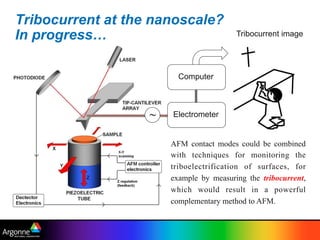
Tribocurrent at the nanoscale?
In progress…
AFM contact modes could be combined
with techniques for monitoring the
triboelectrification of surfaces, for
example by measuring the tribocurrent,
which would result in a powerful
complementary method to AFM.
Electrometer~
Computer
Tribocurrent image
Acknowledgements
n  Department of Energy (DOE)
n  Argonne National Laboratory
–  Tribology Section
–  Center for Nanoscale Materials
Unicamp
Instituto de
Química
“God made the bulk; surfaces
were invented by the devil.”
Wolfgang Pauli
Thank you…

Friction Force and its Relationship to the Electrostatic Charges at Interfaces.

  • 1.
    Friction Force andits Relationship to the Electrostatic Charges at Interfaces Dr. Thiago A L Burgo
  • 2.
    Outline   Unicamp   • Friction coefficient induced by electrostatic charges –  Coefficient of rolling resistance x Electrostatic potential (EP) –  Friction angle x EP –  Friction at nanoscale •  Lateral Force Microscopy (LFM) Argonne  Na/onal  Laboratory   •  Tribocurrent and macroscopic friction force –  Dependence on the atmosphere –  Friction force fluctuations –  Electrostatic adhesion •  Nanomechanical Mapping on tested PTFE –  Triboemission •  Concluding Remarks •  Electrostatic Discharge (ESD) and Technological Challenges
  • 3.
    Explosions triggered byelectrostatic discharge https://www.youtube.com/watch? v=6lKUsUycBNA&spfreload=10 www.firesciencetools .com
  • 4.
    In October 2013,a fire of great proportions hit Copersucar facilities.
  • 5.
    •  For nanotechnology – Electrostatic force is even larger than the inertial force, for micromachine parts made of insulators. –  The electrification of the insulator is not well understood, especially at the micro-scale. •  Safety and technologies –  Dust explosions –  Fires –  Pharmaceuticals –  Polymer recycling –  Electrospinning –  Solid paint –  Electrocopying –  Toner Consequences
  • 6.
    Challenges  Faced  By  Solar  Energy  Use   Calle et al. Active dust control and mitigation technology for lunar and Martian exploration. Acta Astronautica 69, 1082-1088 (2011).
  • 7.
    Electrodynamic  Repulsion   Courtesyof Carlos Calle, Electrostatics and Surface Physics Laboratory - NASA
  • 8.
    Surfaces  under  rela<ve  mo<on:   Triboplasma   Heinicke G. Tribochemistry. (1984) Matta et al. J. Phys. D: Appl. Phys. (2009) Camara, et al. Nature (2008) Burgo, et al. Polym. Degrad. Stabil. (2014) enerated. All these na follow a certain plained by Suh [3]. city, normal load, nt of hydrocarbons ,5], are correlated s. According to emission of both les was measured ls, ceramics, and conditions with ould be considered y discovered by s mostly composed rding to the most noemission is an g from mechanical Fig. 1. General scheme of triboemission [7]. K. Kajdas / Tribology International 38 (2005) 337–353
  • 9.
    How  powerful  is  the  triboplasma?   ! Camara et al. Correlation between nanosecond X-ray flashes and stick–slip friction in peeling tape. Nature, 455, 1089-1093 (2008). X-Rays! X-ray Fluorescence (XRF) technology Tribogenics
  • 10.
    What  creates  sta/c  electricity?   Williams, M.W. What creates static electricity? American Scientist 100, 316-326 (2012) • Complex and unexpected charge distribution in every material scanned by Kelvin electrodes (EFM, KFM/SEPM, Macro-Kelvin): – Cardoso et al., Langmuir 1998, 1999 – Galembeck et al., Polymer 2001 – Gouveia et al., J. Phys. Chem B, 2005, 2008 – Soares et al., J. Braz. Chem. Soc. 2008 – Gouveia et al., J. Am. Chem. Soc. 2009 – Ducati et al., Langmuir 2010 – Bernardes et al., J. Phys. Chem. C 2010 – Burgo et al., J. Electrostatics 2011
  • 11.
    Polymer   Ethanol   2  hours   Clean  Polymer   drying   Electrical  poten<al  scanning   with  Kelvin  electrode   OR   EXPERIMENTAL Balance   Polymer   P:  1,5  kPa   RPM:  5000   Time:  3  s  PE  foam   Shaking  table   Polymer   Glass  spheres  or   pellets  de  PTFE   Amount:  4  g   Time:  60  min   1-­‐  Cleaning   2-­‐  Charging   3-­‐  Charge  mapping   X   Y   Polymer  
  • 12.
  • 13.
    Formation free-radicals isfollowed by electron transfer: from the hydrocarbon free-radicals to the more electronegative fluorocarbon radicals. Ions are segregated due to the chain size, following Flory−Huggins theory and superseding weak electrostatic interactions between highly spaced charges.  ! Burgo et al. Triboelectricity: macroscopic charge patterns formed by self-arraying ions on polymer surfaces, Langmuir, 28(19), 7407-7416 (2012).
  • 14.
    Francisco, K. R.,Burgo, T. A. L., Galembeck, F. Tribocharged Polymer Surfaces: Solvent Effect on Pattern Formation and Modification. Chem. Lett. 41, 1256-1258 (2012). •  Procedure used to transfer charges from PTFE to LDPE using paraffin oil as transfer agent; •  Also, ethanol can be used to suppress charges on a previous tribocharged PTFE surface. Charge transfer and electrostatic lithograph
  • 15.
    Mo<va<on  and  hypothesis   •  Triboeletrifica<on:  glass  beads  over   PE  or  PTFE;   •  Fric<on  generates  surfaces  with   both  posi<ve  and  nega<ve  paWerns;   •  Since,  coulombian  forces  (long   range)  describe  interac<ons   between  electrical  charges,  how   these  charges  affect  fric<on  on   electrified  interfaces?  
  • 16.
    Tribology: science offriction •  “The  science  and  technology  of  interac<ng  surfaces  in  rela<ve   mo<on  and  of  associated  subjects  and  prac<ces.”  (Peter  Jost,  1966);   •  Amontons’  laws:   –  Fric,on  is  propor,onal  to  normal  load   –  Independent  of  apparent  contact  area   Mate, C. M. Tribology on the small scale. Oxford University Press, 2008. Fall, et al. Sliding Friction on wet and dry sand. Phys. Rev. Lett. (2014).
  • 17.
    Real  contact  area  and  adhesion   •  Connec<ons  from  micro  to  macro   scale  is  very  difficult;   •  Real  x  apparent  contact  area;   •  Elasto-­‐plas<c  deforma<ons;     •  Adhesion:  van  der  Waals  forces   (only???):  “…The  primary  obstacle   to  inclusion  of  sliding   triboelectrifica<on  into  our  model   is  the  mysterious  and  complex   nature  of  the  process…”     Bowden, F. P. & Tabor, D. Friction and Lubrication. 2nd ed., Oxford (1954). Nakayama, K. Wear 194, 185-189 (1996). Ireland, P. M. J. Electrostat. 70, 524-531 (2012).
  • 18.
    Mechanical  contact:   JKR,  DMT  and  Maugis   •  JKR:  Adhesion  forces  change  contact  area   •  DMT:  Contact  area  remains  the  same,  but  with   addi<onal  aWrac<ve  interac<ons     •  Maugis:  contact   area  is  in   between!!!   Johnson, K. L.; Kendall, K. & Roberts, A. D. Proc. R. Soc. London A (1971). Derjaguin, B. V.; Muller, V. M. & Toporov, Y. P. J. Colloid Interface Sci. (1975). Maugis, D. J. Colloid Interface Sci. (1992). with adhesion aH aH a a without adhesion (Hertz) van der Waals forces
  • 19.
    …and  the  Coulombic  contribu<on?   “…The primary obstacle to inclusion of sliding triboelectrification into our model is the mysterious and complex nature of the process…” Ireland, P. M. J. Electrostat. (2012).
  • 20.
    Coefficient  of  Rolling  Resistance  (CoRR)  x     Electrosta<c  Poten<al   A" B" C"h d CoRR = h/d glass beads tribocharged PTFE
  • 21.
    CoRR:  silanized  glass  beads   a b θ=25˚ θ=93˚ •  Rolling coefficients are strongly modified by the surface silanitazion of glass. θ = 15º θ = 93º
  • 22.
    Movement  restric<on   Movementis restricted on electrified interfaces!!! Beads on top Beads withdrawn
  • 23.
    Fric,on  angle:  PTFE  x  PE   •  Triboelectrification between PTFE and PE increases friction angles •  Some PE pellets does not slide even at 90º. PTFE + PE pellets after shaking PTFE PTFE + PE pellets before shaking
  • 24.
    Polyethylene pellets PTFE Fric,on  angle:  PTFE  x  PE   PTFE + PE pellets after shaking PTFE PTFE + PE pellets before shaking
  • 25.
    Fric<on  at  a  microscopic  level:   Lateral  Force  Microscopy   •  First  verified  by  Mate  et  al.;   •  AFM  plahorm;   •  Deflec<on  signal  is  a  qualita<ve   measurement  of  fric<on.   http://www.doitpoms.ac.uk/tlplib/afm/lfm.php
  • 26.
    α∆´ = (1+µ2)sinθcosθ cosθ2 −µ2 sin2θ αW´ = µ cosθ2 − µ2 sin2θ µ + = 2∆´ W´sin2θ 1 µ LFM  calibra<on:   volts  (V)  to  units  of   force  (N)   Ogletree, D. F., Carpick, R. W. & Salmeron M. Calibration of frictional forces in atomic force microscopy. Rev. Sci. Instrum. 67(9), 3298-3306 (1996).
  • 27.
    Lateral  force  microscopy  (LFM)   •  Friction is largely affected by surface charges at the nanometer scale; •  Fractal dimension D of friction signal is bigger than topography signal!!!
  • 28.
    Force-­‐distance  curves  (Fd)  on  tribocharged  PTFE   In Geckos, each hair produces 100 nN (due to van der Waals and/or capillary interactions)!!! Geim, et al. Nat. Materials (2003). Burgo et al. Friction coefficient dependence on electrostatic tribocharging. Nature Sci. Rep. (2013).
  • 29.
    Parcial  Conclusions   • Tribocharges produced by friction have a large effect on the friction coefficients of dielectrics: –  They may exceed all other factors for mechanical energy dissipation; •  Controlling surface electrostatics should thus open the way to new approaches for controlling friction in many important systems and equipment. •  Since  tribocharge  paWerns  are  fractal,  their   contribu<on  to  fric<on  coefficients  is  also  fractal.
  • 30.
    Bipolar  Tribocharging  Signal  During   Fric3on  Force  Fluctua3ons  at   Metal–Insulator  Interfaces  
  • 31.
    Escobar, JV, Chakravarty,A, Putterman SJ, Diamond Relat. Mater. 2013 Akbulut M, Godfrey Alig AR, Israelachvili J. J. Phys. Chem. B. 2006. Tribocurrent
  • 32.
  • 33.
    Tribocurrent x frictionforce vacuum nitrogen hydrogen open air 1N normal load 50 cm/s speed PTFE x Steel
  • 34.
    Tribocurrent(nA) Frictionforce(N) 1N 2N 5N 5cm/s 5 cm/s 5 cm/s 25 cm/s 25 cm/s 25 cm/s 50 cm/s 50 cm/s 50 cm/s
  • 35.
    Results Friction forcefluctuations: ü  Fluctuations of friction force occur with certain regularity in tribological tests and Singer has shown that this effect is generally caused by the presence of third bodies (material transfer). Singer, et al., J. Vac. Sci. Technol. A 2003.
  • 36.
    Tribocurrent and transientfriction force fluctuation Although tribocurrent signal depends on speed and load, charged species per force ratio is constant around 10 µC/N.
  • 37.
    TRACK: negatively charged Xerox®Cyan Developer powder (iGen3, 5R706). When placed on the sample, the track promptly repeals the negatively charged toner particles.
  • 38.
    Quantitative NanomechanicsTM (QNM) Quantitativematerial properties obtained by force curve analysis at every pixel!!! Z Position (~2KHz) Peak Force Setpoint
  • 39.
    Force distance curves CleanPTFE Charged PTFE
  • 40.
    Adhesion mapping onPTFE track Strongly adhered PTFE flakes 5 mm Pull-off force: 150 nN for most of the pixels! PTFE track 5x
  • 41.
  • 43.
    Burgo, T. A.L. & Erdemir, A. Ang. Chem. Int. Ed., 53, 2014.
  • 44.
    Concluding Remarks n Friction forcefluctuations are always accompanied by two tribocharging mechanisms at metal-insulator interfaces: –  injection of electrons from the metal to PTFE subsequently followed by material/charge transfer from PTFE to the metal surface; n Friction and triboelectrification have a common origin: –  which must be associated with the formation of strong electrostatic interactions at the interface.
  • 45.
    Prospects: Controlling friction? n  Thenature of the fundamental processes that give rise to friction between sliding bodies in close proximity is a long standing question in tribology, both theoretically and experimentally!!! Park, J. Y., Ogletree, D. F., Thiel, P. A. & Salmeron, M. Electronic control of friction in silicon pn junctions. Science 313, 186–186 (2006).
  • 46.
    Electrostatically stimulated additives? Electrostaticpotential naturally built up at interfaces under relative motion should attract charged molecules. Moreover, an external dc source must increase ionic migration.
  • 47.
    Tribocurrent at thenanoscale? In progress… AFM contact modes could be combined with techniques for monitoring the triboelectrification of surfaces, for example by measuring the tribocurrent, which would result in a powerful complementary method to AFM. Electrometer~ Computer Tribocurrent image
  • 48.
    Acknowledgements n  Department ofEnergy (DOE) n  Argonne National Laboratory –  Tribology Section –  Center for Nanoscale Materials
  • 49.
  • 50.
    “God made thebulk; surfaces were invented by the devil.” Wolfgang Pauli Thank you…