International Research Journal of Engineering and Technology (IRJET) e-ISSN: 2395-0056
Volume: 06 Issue: 03 | Mar 2019 www.irjet.net p-ISSN: 2395-0072
© 2019, IRJET | Impact Factor value: 7.211 | ISO 9001:2008 Certified Journal | Page 6550
DESIGN OF MID-BAND FREQUENCY PATCH ANTENNA FOR
5G APPLICATIONS
HARINI. D1, JAGADESHWAR. V2, MOHANAPRIYA. E3, SHERIBA. T.S4
1,2,3Student, Dept. of ECE Engineering, Valliammai Engineering College, Tamil Nadu, India
4Professor, Dept. of ECE Engineering, Valliammai Engineering College, Tamil Nadu,
---------------------------------------------------------------------***----------------------------------------------------------------------
Abstract – The purpose of the paper is to investigate the
design of rectangular patch antenna array fed by microstrip
line at 5.2GHz for 5G applications. Our objective is to design
a two element antenna array with bandwidth of about 1GHz
and maximum radiation gain. The performance of
rectangular 2*1 patch antenna array designed on FR-4 was
analyzed. We obtain for topology of 2*1 rectangular array
patch array antenna a bandwidth of 1 GHz respectively with
almost similar gain of the order of 6 dBi.
Keywords - component; 5G applications; microstrip
line; patch array antenna
1. INTRODUCTION
4G has reached maturity after being deployed around
2010.No major changes in the network structure have
been made while the mobile communications market is
expanding. 4G cannot meet current requirements such as
spectral congestion or the reduction of energy
consumption. That is why the world focuses on the 5G.
The standardization of 5G is being developed, with a
first deployment planned for the moment in 2020[1]. 5G,
which will probably still see a large increase in data
volumes exchanged, and which will use millimeter
bands, with low propagation capacity, will probably
require the generalization of the implementation of
small-cell radio transmitter [2].
Modern wireless communication systems require
low profile, high gain, and simple structure antennas.
Microstrip antennas meet some requirements due to their
simplicity and compatibility with printed circuit
technology [4].
However their limitations are specifically narrow
frequency band. For these reasons, many studies have
been made to improve the performances of the
antenna patch. Bandwidth can be enhanced by using
multiple numbers of slots in ground plane [ 5 ] .
Another way to improve the bandwidth and
efficiency of the conventional patch antenna is to
reduce the substrate dielectric constant [6] [7]. It is also
known that the antenna return loss can be
considerably increased by searching the optimal position
in case of coaxial feed or designing progressive
matching network in case of microstrip line feed [9].
It deals with how to improve the performances of a
rectangular patch antenna and a rectangular patch
antenna array at 5.2 GHz for WLAN, WiMax and Wi-Fi
applications. First, we will describe the design of the
rectangular patch antenna at 5.2 GHz which is
necessary to calculate radiation parameters of the
antenna (return loss, radiation pattern, gain).Finally we
will show the simulation results of the return loss for the
optimal position of the microstrip line feed for the
rectangular patch antenna array.
1.1 ATENNA THEORY
The components of a microstrip patch antenna
are a conducting rectangular patch and a ground plane
separated by a dielectric substrate given by fig. 1.
The width W and length L of the antenna are
calculated using the equations from (1) to (4) [9].
Figure 1. Rectangular patch antenna
Where is the resonant frequency and is the
dielectric constant.
The radiations pass through air and some through the
substrate to reach the ground. The air and the substrate
have different dielectric constant values, therefore an
effective dielectric constant ( eff ) has to be considered.
It is calculated using the equation (2) [9].
International Research Journal of Engineering and Technology (IRJET) e-ISSN: 2395-0056
Volume: 06 Issue: 03 | Mar 2019 www.irjet.net p-ISSN: 2395-0072
© 2019, IRJET | Impact Factor value: 7.211 | ISO 9001:2008 Certified Journal | Page 6551
Where h is the thickness of the substrate.
The length of the patch is calculated using equation(3)[9].
Electrically the size of the antenna is
increased by an amount of due to fringing.The
increased length is given using the equation (4).
The minimum length (Lsub) and the minimum width
(Wsub) of the substrate are calculated using equation (5)
and) [9].
Lsub=6h+L
Wsub=6h+W
The theoretical parameters of the single rectangular
patch were optimized for the microstrip feed to meet the
requirement of the resonant frequency at 5.2GHz. While
the design process of the patch antenna was carried out,
we found that when h is increased the antenna bandwidth
is improved. So, we have considered the standard
thickness of 1.6mm as the height of the patch and the
ground plane. Our objective is to reach a return loss lower
than -10 dB.
Figure 2. Patch with microstrip line feed
2. EXISTING SYSTEM
The rectangular patch antenna containing two radiating
elements with coaxial feeding technique, designed with
Rogers RT/Duroid 5880, to operate at 28GHz frequency
does not have a complete planar structure and this feeding
method makes the design prone to narrow bandwidth and
in case of thicker substrates, the increased probe length
makes the input impedance more inductive leading to
matching problems. It also may have some asymmetries
due to which higher order modes are generated.
3. PROPOSED SYSTEM
Due to the drawbacks of coaxial line feeding technique,
we have used microstrip line feed for designing of a
microstrip patch antenna array with FR-4 substrate, that
consists of two radiating elements or patches connected
together by means of corporate feed which makes the
design to obtain a simple planar structure(fig.2.). However
as the thickness of the dielectric substrate being used,
increases, surface waves and spurious feed radiation also
increases, which hampers the bandwidth of the antenna.
This method helps in improving the gain and directivity of
the antenna which could be obtained in a compact
structure. Corporate feed includes the use of quarter-wave
transformers in the design process. Quarter-wave
transformers aid in providing proper impedance matching
between the two patches by using T-junction
configurations in the design.
4. FLOW
Figure 3. Flow of design process
(2)
(3)
(4)
(5)
(6)
International Research Journal of Engineering and Technology (IRJET) e-ISSN: 2395-0056
Volume: 06 Issue: 03 | Mar 2019 www.irjet.net p-ISSN: 2395-0072
© 2019, IRJET | Impact Factor value: 7.211 | ISO 9001:2008 Certified Journal | Page 6552
5. ANTENNA DESIGN
5.1 SINGLE PATCH
In this section dimensions of a rectangular patch
antenna fed by microstrip line will be derived using
equations(1)-(6).We used FR-4 (flame resistant) lossy
material as the substrate with a dielectric constant of 4.4
and a loss tangent ranging from 0.017 to 0.025.This
substrate is generally preferred for better radiation and
antenna gain at low cost.
TABLE I. RECTANGULAR PATCH ANTENNA THEORTICAL
DIMENSIONS
Table 1. Dimensions of a single patch antenna
h (mm) 1.6
W (mm) 12.95
3.87
0.726
L (mm) 25.02
Lsub (mm) 27.14
Wsub (mm) 22.79
t(mm) 1.6
We will be designing the patch antenna array using
the CST Microwave Studio Suite (Computer Simulation
Technology). Gain of single patch is obtained as 2.8dBi.
5.2 PATCH ANTENNA ARRAY
The gain of a single patch does not exceed 7 dBi.
For the systems of the 5G, 7 dBi is very little value; it
should be improved by the use of an antenna array which
gives a high value of gain compared to a single patch [12].
Also the fractional bandwidth will be improved compared
to a single patch which is of 3%. The adaptation to 50
ohms is necessary to ensure good operation of the
antenna. In order to power a two-element antenna array, a
T-junction is used. There are several T-junction
configurations with different calculation methods. This
technique allows having a good impedance matching over
a wide frequency band.
Figure 4. Designed Patch Array Antenna
Fig.4 shows the proposed design of 2*1 microstrip
patch antenna array, with each patch designed using the
dimensions given in table 1. The quarter-wave impedance
transformer is a transmission line or waveguide used in
electrical engineering of length one-quarter wavelength
terminated with some unknown impedance(ZL) .It
presents at its input(ZIN) the dual of the impedance with
which it is terminated which is given by equation(7)
Generally the quarter-wave transformer is used
for matching the impedance at the input with the
impedance at the output by varying it’s impedance with
respect to the characteristic impedance of the
circuit(ZO).Thus we have used quarter-wave transformer
for matching the impedance of the patch with the
impedance of the feed line. Table 2 shows the dimensions
of 2*1 patch array antenna.
Table 2. Dimensions of 2*1 patch array antenna
h(mm) 1.6
W(mm) 12.95
L (mm) 25.02
Lsub (mm) 60
Wsub (mm) 36.79
d (mm) 5
6. SIMULATION RESULTS
6.1 S-PARAMETER
S-parameter refers to Scattering parameter which is
represented in matrix form. It describes input-output
relation between ports in an electrical system. Many
electrical properties of network of components may be
expressed using S-parameters, such as gain, return loss,
directivity, Voltage Standing Wave Ratio(VSWR) and
reflection coefficient. S11 represents how much power is
reflected from the antenna and hence it is known as
reflection coefficient.
6.2 DIRECTIVITY
Antenna directivity is the ratio of energy
transmitted or received by the antenna in a particular
(7)
International Research Journal of Engineering and Technology (IRJET) e-ISSN: 2395-0056
Volume: 06 Issue: 03 | Mar 2019 www.irjet.net p-ISSN: 2395-0072
© 2019, IRJET | Impact Factor value: 7.211 | ISO 9001:2008 Certified Journal | Page 6553
direction to the energy transmitted or received in that
direction by an isotropic source.
3D plot of directivity
The output for the designed patch array antenna
were found and the directivity plot was obtained. The
directivity obtained is about 8.08dBi.
Polar plot for Directivity
6.3 GAIN
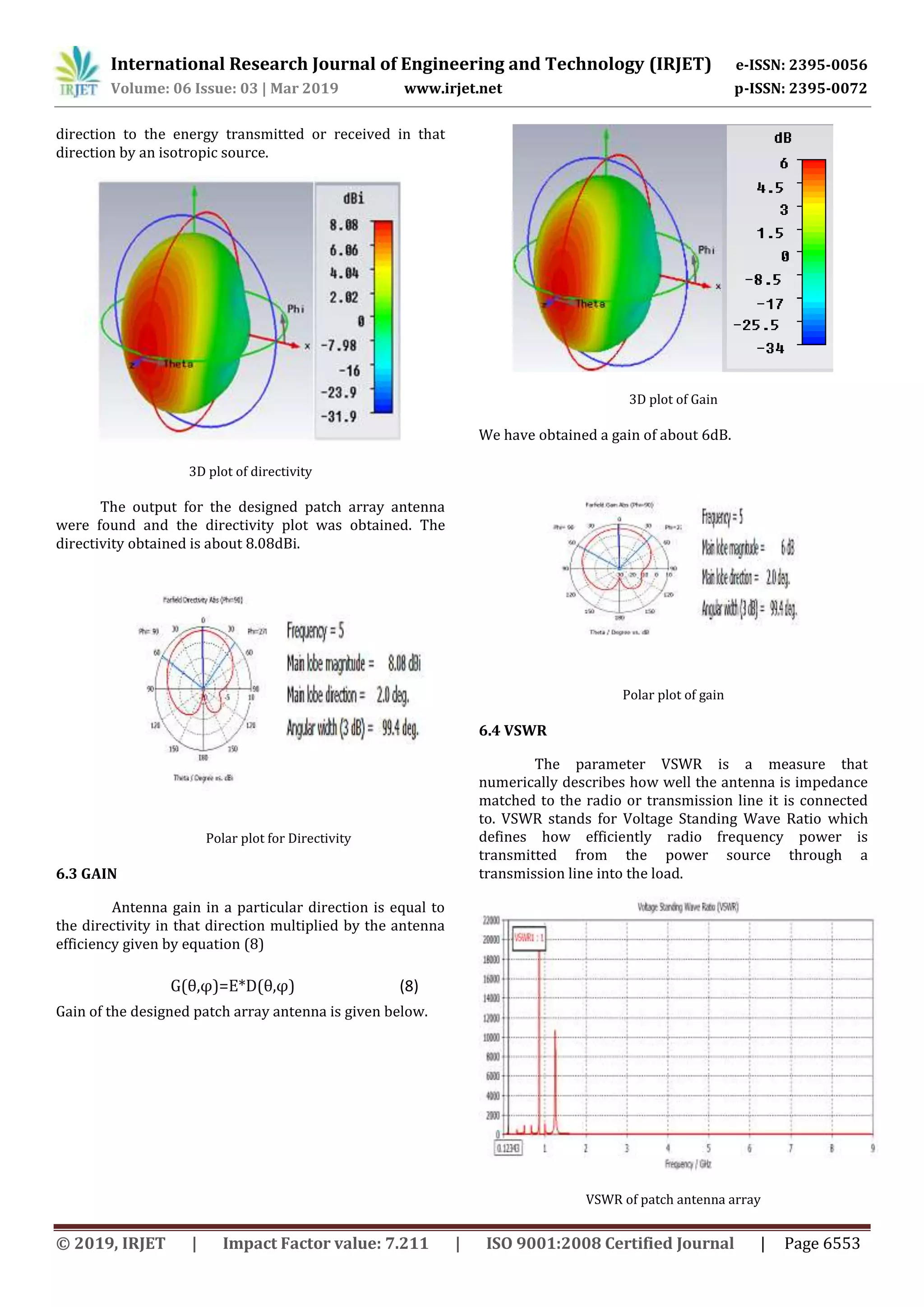
Antenna gain in a particular direction is equal to
the directivity in that direction multiplied by the antenna
efficiency given by equation (8)
Gain of the designed patch array antenna is given below.
3D plot of Gain
We have obtained a gain of about 6dB.
Polar plot of gain
6.4 VSWR
The parameter VSWR is a measure that
numerically describes how well the antenna is impedance
matched to the radio or transmission line it is connected
to. VSWR stands for Voltage Standing Wave Ratio which
defines how efficiently radio frequency power is
transmitted from the power source through a
transmission line into the load.
VSWR of patch antenna array
G(θ,φ)=E*D(θ,φ) (8)
International Research Journal of Engineering and Technology (IRJET) e-ISSN: 2395-0056
Volume: 06 Issue: 03 | Mar 2019 www.irjet.net p-ISSN: 2395-0072
© 2019, IRJET | Impact Factor value: 7.211 | ISO 9001:2008 Certified Journal | Page 6554
After the design process is completed the patch antenna
is fabricated. The fabricated patch array antenna is shown
below.
Fabricated design
7. CONCLUSION
The proposed design can be used for different
millimeter wave phased array applications and due to the
compact size, they could be used in Wi-Fi, Wi-Max and
WLAN applications. Due to the extremely high speed of 5G,
the proposed design could be used widely in applications
requiring high data rates in near future.
8. REFERENCES
1. Shivangi Verma, Leena Mahajan, Rajesh Kumar,
Hardeep Singh Saini, Naveen Kumar: "A small microstrip
patch antenna for future 5G applications" 5th
International IEEE Conference on Reliability, Infocom
Technologies and Optimization, INSPEC No.16544246,Nov
2017.
2. Wen-Shan Chen, Yung-Chi Lin: "Design and
analysis of microstrip patch antenna at 9GHz“IEEE
International Workshop on Electromagnetics, INSPEC No.
18265534, Aug 2018.
3, Ilhem Gharbi, Rim Barrak, Mourad Menif: “Design of
patch array antennas for future 5G” International
Workshop on Sciences and Techniques of Automatic
Control and Computer Engineering, INSPEC No. 17631813,
Aug 2018.

IRJET- Design of Mid-Band Frequency Patch Antenna for 5G Applications

  • 1.
    International Research Journalof Engineering and Technology (IRJET) e-ISSN: 2395-0056 Volume: 06 Issue: 03 | Mar 2019 www.irjet.net p-ISSN: 2395-0072 © 2019, IRJET | Impact Factor value: 7.211 | ISO 9001:2008 Certified Journal | Page 6550 DESIGN OF MID-BAND FREQUENCY PATCH ANTENNA FOR 5G APPLICATIONS HARINI. D1, JAGADESHWAR. V2, MOHANAPRIYA. E3, SHERIBA. T.S4 1,2,3Student, Dept. of ECE Engineering, Valliammai Engineering College, Tamil Nadu, India 4Professor, Dept. of ECE Engineering, Valliammai Engineering College, Tamil Nadu, ---------------------------------------------------------------------***---------------------------------------------------------------------- Abstract – The purpose of the paper is to investigate the design of rectangular patch antenna array fed by microstrip line at 5.2GHz for 5G applications. Our objective is to design a two element antenna array with bandwidth of about 1GHz and maximum radiation gain. The performance of rectangular 2*1 patch antenna array designed on FR-4 was analyzed. We obtain for topology of 2*1 rectangular array patch array antenna a bandwidth of 1 GHz respectively with almost similar gain of the order of 6 dBi. Keywords - component; 5G applications; microstrip line; patch array antenna 1. INTRODUCTION 4G has reached maturity after being deployed around 2010.No major changes in the network structure have been made while the mobile communications market is expanding. 4G cannot meet current requirements such as spectral congestion or the reduction of energy consumption. That is why the world focuses on the 5G. The standardization of 5G is being developed, with a first deployment planned for the moment in 2020[1]. 5G, which will probably still see a large increase in data volumes exchanged, and which will use millimeter bands, with low propagation capacity, will probably require the generalization of the implementation of small-cell radio transmitter [2]. Modern wireless communication systems require low profile, high gain, and simple structure antennas. Microstrip antennas meet some requirements due to their simplicity and compatibility with printed circuit technology [4]. However their limitations are specifically narrow frequency band. For these reasons, many studies have been made to improve the performances of the antenna patch. Bandwidth can be enhanced by using multiple numbers of slots in ground plane [ 5 ] . Another way to improve the bandwidth and efficiency of the conventional patch antenna is to reduce the substrate dielectric constant [6] [7]. It is also known that the antenna return loss can be considerably increased by searching the optimal position in case of coaxial feed or designing progressive matching network in case of microstrip line feed [9]. It deals with how to improve the performances of a rectangular patch antenna and a rectangular patch antenna array at 5.2 GHz for WLAN, WiMax and Wi-Fi applications. First, we will describe the design of the rectangular patch antenna at 5.2 GHz which is necessary to calculate radiation parameters of the antenna (return loss, radiation pattern, gain).Finally we will show the simulation results of the return loss for the optimal position of the microstrip line feed for the rectangular patch antenna array. 1.1 ATENNA THEORY The components of a microstrip patch antenna are a conducting rectangular patch and a ground plane separated by a dielectric substrate given by fig. 1. The width W and length L of the antenna are calculated using the equations from (1) to (4) [9]. Figure 1. Rectangular patch antenna Where is the resonant frequency and is the dielectric constant. The radiations pass through air and some through the substrate to reach the ground. The air and the substrate have different dielectric constant values, therefore an effective dielectric constant ( eff ) has to be considered. It is calculated using the equation (2) [9].
  • 2.
    International Research Journalof Engineering and Technology (IRJET) e-ISSN: 2395-0056 Volume: 06 Issue: 03 | Mar 2019 www.irjet.net p-ISSN: 2395-0072 © 2019, IRJET | Impact Factor value: 7.211 | ISO 9001:2008 Certified Journal | Page 6551 Where h is the thickness of the substrate. The length of the patch is calculated using equation(3)[9]. Electrically the size of the antenna is increased by an amount of due to fringing.The increased length is given using the equation (4). The minimum length (Lsub) and the minimum width (Wsub) of the substrate are calculated using equation (5) and) [9]. Lsub=6h+L Wsub=6h+W The theoretical parameters of the single rectangular patch were optimized for the microstrip feed to meet the requirement of the resonant frequency at 5.2GHz. While the design process of the patch antenna was carried out, we found that when h is increased the antenna bandwidth is improved. So, we have considered the standard thickness of 1.6mm as the height of the patch and the ground plane. Our objective is to reach a return loss lower than -10 dB. Figure 2. Patch with microstrip line feed 2. EXISTING SYSTEM The rectangular patch antenna containing two radiating elements with coaxial feeding technique, designed with Rogers RT/Duroid 5880, to operate at 28GHz frequency does not have a complete planar structure and this feeding method makes the design prone to narrow bandwidth and in case of thicker substrates, the increased probe length makes the input impedance more inductive leading to matching problems. It also may have some asymmetries due to which higher order modes are generated. 3. PROPOSED SYSTEM Due to the drawbacks of coaxial line feeding technique, we have used microstrip line feed for designing of a microstrip patch antenna array with FR-4 substrate, that consists of two radiating elements or patches connected together by means of corporate feed which makes the design to obtain a simple planar structure(fig.2.). However as the thickness of the dielectric substrate being used, increases, surface waves and spurious feed radiation also increases, which hampers the bandwidth of the antenna. This method helps in improving the gain and directivity of the antenna which could be obtained in a compact structure. Corporate feed includes the use of quarter-wave transformers in the design process. Quarter-wave transformers aid in providing proper impedance matching between the two patches by using T-junction configurations in the design. 4. FLOW Figure 3. Flow of design process (2) (3) (4) (5) (6)
  • 3.
    International Research Journalof Engineering and Technology (IRJET) e-ISSN: 2395-0056 Volume: 06 Issue: 03 | Mar 2019 www.irjet.net p-ISSN: 2395-0072 © 2019, IRJET | Impact Factor value: 7.211 | ISO 9001:2008 Certified Journal | Page 6552 5. ANTENNA DESIGN 5.1 SINGLE PATCH In this section dimensions of a rectangular patch antenna fed by microstrip line will be derived using equations(1)-(6).We used FR-4 (flame resistant) lossy material as the substrate with a dielectric constant of 4.4 and a loss tangent ranging from 0.017 to 0.025.This substrate is generally preferred for better radiation and antenna gain at low cost. TABLE I. RECTANGULAR PATCH ANTENNA THEORTICAL DIMENSIONS Table 1. Dimensions of a single patch antenna h (mm) 1.6 W (mm) 12.95 3.87 0.726 L (mm) 25.02 Lsub (mm) 27.14 Wsub (mm) 22.79 t(mm) 1.6 We will be designing the patch antenna array using the CST Microwave Studio Suite (Computer Simulation Technology). Gain of single patch is obtained as 2.8dBi. 5.2 PATCH ANTENNA ARRAY The gain of a single patch does not exceed 7 dBi. For the systems of the 5G, 7 dBi is very little value; it should be improved by the use of an antenna array which gives a high value of gain compared to a single patch [12]. Also the fractional bandwidth will be improved compared to a single patch which is of 3%. The adaptation to 50 ohms is necessary to ensure good operation of the antenna. In order to power a two-element antenna array, a T-junction is used. There are several T-junction configurations with different calculation methods. This technique allows having a good impedance matching over a wide frequency band. Figure 4. Designed Patch Array Antenna Fig.4 shows the proposed design of 2*1 microstrip patch antenna array, with each patch designed using the dimensions given in table 1. The quarter-wave impedance transformer is a transmission line or waveguide used in electrical engineering of length one-quarter wavelength terminated with some unknown impedance(ZL) .It presents at its input(ZIN) the dual of the impedance with which it is terminated which is given by equation(7) Generally the quarter-wave transformer is used for matching the impedance at the input with the impedance at the output by varying it’s impedance with respect to the characteristic impedance of the circuit(ZO).Thus we have used quarter-wave transformer for matching the impedance of the patch with the impedance of the feed line. Table 2 shows the dimensions of 2*1 patch array antenna. Table 2. Dimensions of 2*1 patch array antenna h(mm) 1.6 W(mm) 12.95 L (mm) 25.02 Lsub (mm) 60 Wsub (mm) 36.79 d (mm) 5 6. SIMULATION RESULTS 6.1 S-PARAMETER S-parameter refers to Scattering parameter which is represented in matrix form. It describes input-output relation between ports in an electrical system. Many electrical properties of network of components may be expressed using S-parameters, such as gain, return loss, directivity, Voltage Standing Wave Ratio(VSWR) and reflection coefficient. S11 represents how much power is reflected from the antenna and hence it is known as reflection coefficient. 6.2 DIRECTIVITY Antenna directivity is the ratio of energy transmitted or received by the antenna in a particular (7)
  • 4.
    International Research Journalof Engineering and Technology (IRJET) e-ISSN: 2395-0056 Volume: 06 Issue: 03 | Mar 2019 www.irjet.net p-ISSN: 2395-0072 © 2019, IRJET | Impact Factor value: 7.211 | ISO 9001:2008 Certified Journal | Page 6553 direction to the energy transmitted or received in that direction by an isotropic source. 3D plot of directivity The output for the designed patch array antenna were found and the directivity plot was obtained. The directivity obtained is about 8.08dBi. Polar plot for Directivity 6.3 GAIN Antenna gain in a particular direction is equal to the directivity in that direction multiplied by the antenna efficiency given by equation (8) Gain of the designed patch array antenna is given below. 3D plot of Gain We have obtained a gain of about 6dB. Polar plot of gain 6.4 VSWR The parameter VSWR is a measure that numerically describes how well the antenna is impedance matched to the radio or transmission line it is connected to. VSWR stands for Voltage Standing Wave Ratio which defines how efficiently radio frequency power is transmitted from the power source through a transmission line into the load. VSWR of patch antenna array G(θ,φ)=E*D(θ,φ) (8)
  • 5.
    International Research Journalof Engineering and Technology (IRJET) e-ISSN: 2395-0056 Volume: 06 Issue: 03 | Mar 2019 www.irjet.net p-ISSN: 2395-0072 © 2019, IRJET | Impact Factor value: 7.211 | ISO 9001:2008 Certified Journal | Page 6554 After the design process is completed the patch antenna is fabricated. The fabricated patch array antenna is shown below. Fabricated design 7. CONCLUSION The proposed design can be used for different millimeter wave phased array applications and due to the compact size, they could be used in Wi-Fi, Wi-Max and WLAN applications. Due to the extremely high speed of 5G, the proposed design could be used widely in applications requiring high data rates in near future. 8. REFERENCES 1. Shivangi Verma, Leena Mahajan, Rajesh Kumar, Hardeep Singh Saini, Naveen Kumar: "A small microstrip patch antenna for future 5G applications" 5th International IEEE Conference on Reliability, Infocom Technologies and Optimization, INSPEC No.16544246,Nov 2017. 2. Wen-Shan Chen, Yung-Chi Lin: "Design and analysis of microstrip patch antenna at 9GHz“IEEE International Workshop on Electromagnetics, INSPEC No. 18265534, Aug 2018. 3, Ilhem Gharbi, Rim Barrak, Mourad Menif: “Design of patch array antennas for future 5G” International Workshop on Sciences and Techniques of Automatic Control and Computer Engineering, INSPEC No. 17631813, Aug 2018.