Aperture Antennas
1
D.Gopinath, AP/ECE
RIT, Rajapalayam
Academic Year 2020-21 ODD Semester
Classification of Antennas
Wire-Type Antennas Aperture-Type Antennas
Dipoles Horn and open waveguide
Monopoles Reflector antennas
Biconical antennas Slot antennas
Loop antennas Microstrip antennas
Helical antennas
Linearly polarised antennas Circularly polarised antennas
Element antennas Antenna array
Narrow-band Broad-band
Transmitting Receiving
2
3
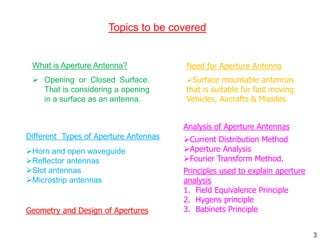
What is Aperture Antenna?
 Opening or Closed Surface.
That is considering a opening
in a surface as an antenna.
Topics to be covered
Need for Aperture Antenna
Surface mountable antennas
that is suitable for fast moving
Vehicles, Aircrafts & Missiles.
Different Types of Aperture Antennas
Horn and open waveguide
Reflector antennas
Slot antennas
Microstrip antennas
Analysis of Aperture Antennas
Current Distribution Method
Aperture Analysis
Fourier Transform Method.
Principles used to explain aperture
analysis
1. Field Equivalence Principle
2. Hygens principle
3. Babinets Principle
Geometry and Design of Apertures
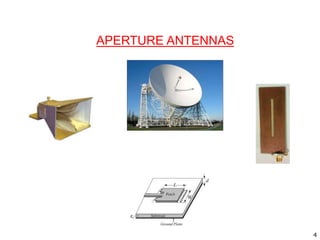
APERTURE ANTENNAS
4
Analysis of Aperture Antennas
 The radiation characteristics of wire antennas can be
determined once the current distribution on the wire is
known.
 For many configurations, however, the current
distribution is not known exactly and only physical
intuition or experimental measurements can provide a
reasonable approximation to it.
 For Apertures primarily not on the current distribution
but on reasonable approximations of the fields on or in
the vicinity of the antenna structure.
 One such technique is the Field Equivalence Principle.
5
 By the equivalence principle, the fields outside an imaginary closed surface are obtained
by placing over the closed surface suitable electric- and magnetic-current densities which
satisfy the boundary conditions.
 The current densities are selected so that the fields inside the closed surface are zero and
outside they are equal to the radiation produced by the actual sources.
 Thus the technique can be used to obtain the fields radiated outside a closed surface by
sources enclosed within it.
 The formulation is exact but requires integration over the closed surface. The degree of
accuracy depends on the knowledge of the tangential components of the fields over the
closed surface.
Field Equivalence Principle
6
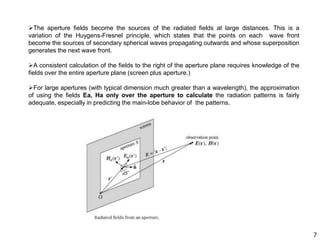
The aperture fields become the sources of the radiated fields at large distances. This is a
variation of the Huygens-Fresnel principle, which states that the points on each wave front
become the sources of secondary spherical waves propagating outwards and whose superposition
generates the next wave front.
A consistent calculation of the fields to the right of the aperture plane requires knowledge of the
fields over the entire aperture plane (screen plus aperture.)
For large apertures (with typical dimension much greater than a wavelength), the approximation
of using the fields Ea, Ha only over the aperture to calculate the radiation patterns is fairly
adequate, especially in predicting the main-lobe behavior of the patterns.
7
The procedure that must be followed to solve a problem on field
calculations of rectangular aperture using the radiation integrals
 Select a closed surface over which the total electric and magnetic field
Ea and Ha are known
 Form the equivalent current densities Js and Ms over S with H1 = Ha and
E1 = Ea.
 Determine the A and F potentials where the integration is over the closed
surface S.
 Determine the radiated E and H-fields from A and F Potentials.
8
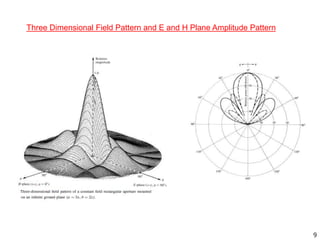
Three Dimensional Field Pattern and E and H Plane Amplitude Pattern
9
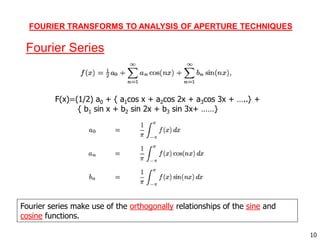
Fourier Series
Fourier series make use of the orthogonally relationships of the sine and
cosine functions.
F(x)=(1/2) a0 + { a1cos x + a2cos 2x + a3cos 3x + …..} +
{ b1 sin x + b2 sin 2x + b3 sin 3x+ ……}
10
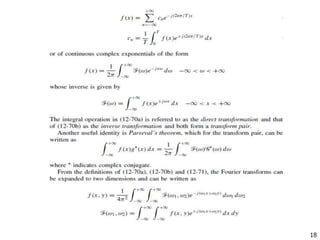
FOURIER TRANSFORMS TO ANALYSIS OF APERTURE TECHNIQUES
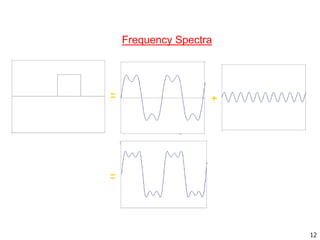
= +
=
Frequency Spectra
11
= +
=
Frequency Spectra
12
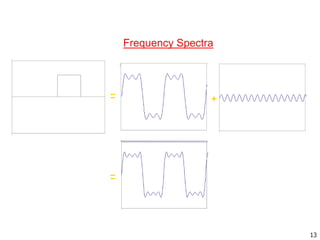
= +
=
Frequency Spectra
13
= +
=
Frequency Spectra
14
= +
=
Frequency Spectra
15
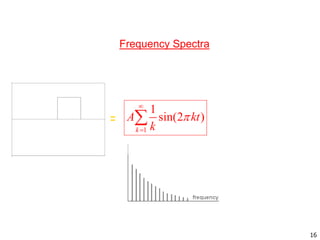
=
1
1
sin(2 )
k
A kt
k




16
Frequency Spectra
17
Frequency Spectra
18
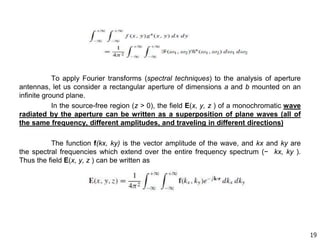
To apply Fourier transforms (spectral techniques) to the analysis of aperture
antennas, let us consider a rectangular aperture of dimensions a and b mounted on an
infinite ground plane.
In the source-free region (z > 0), the field E(x, y, z ) of a monochromatic wave
radiated by the aperture can be written as a superposition of plane waves (all of
the same frequency, different amplitudes, and traveling in different directions)
The function f(kx, ky) is the vector amplitude of the wave, and kx and ky are
the spectral frequencies which extend over the entire frequency spectrum (− kx, ky ).
Thus the field E(x, y, z ) can be written as
19
SLOT ANTENNA
 For a fast moving vehicle, it is usually necessary to design antennas
that don’t protrude appreciably from the surface of the vehicle.
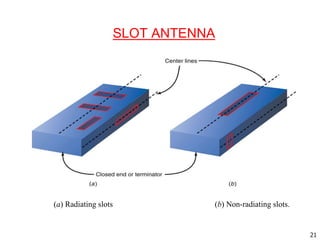
 The Slot antenna is simply an opening cut in a sheet of a
conductor which is energized in some appropriate manner, such
as via a coaxial cable or waveguide.
 Slot antenna where the slot aperture may in fact be filled by an
insulating dielectric fit above the requirement of a smooth surface
perfectly.
 Slot antenna may be fed by a transmission line connected across it at
lower frequencies or is fed by the waveguide at microwave
frequencies.
20
SLOT ANTENNA
(a) Radiating slots (b) Non-radiating slots.
21
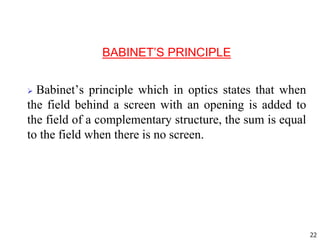
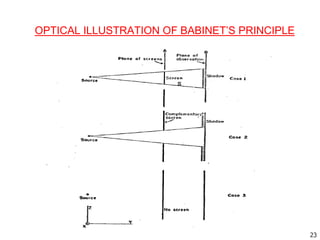
BABINET’S PRINCIPLE
 Babinet’s principle which in optics states that when
the field behind a screen with an opening is added to
the field of a complementary structure, the sum is equal
to the field when there is no screen.
22
OPTICAL ILLUSTRATION OF BABINET’S PRINCIPLE
23
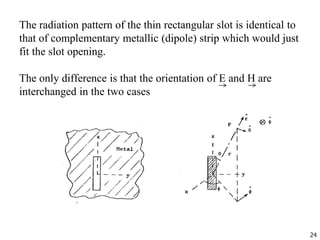
The radiation pattern of the thin rectangular slot is identical to
that of complementary metallic (dipole) strip which would just
fit the slot opening.
The only difference is that the orientation of E and H are
interchanged in the two cases
24
The orientation of E and H are interchanged in the two cases
25
REFERENCES:
1. Constantine A.Balanis, ―Antenna Theory Analysis and
Design, Third edition, JohN Wiley India Pvt Ltd., 2005.
2. R.E.Collin, "Foundations for Microwave Engineering",
Second edition,IEEE Press, 2001
6/2/2021
26

Aperture antennas

  • 1.
    Aperture Antennas 1 D.Gopinath, AP/ECE RIT,Rajapalayam Academic Year 2020-21 ODD Semester
  • 2.
    Classification of Antennas Wire-TypeAntennas Aperture-Type Antennas Dipoles Horn and open waveguide Monopoles Reflector antennas Biconical antennas Slot antennas Loop antennas Microstrip antennas Helical antennas Linearly polarised antennas Circularly polarised antennas Element antennas Antenna array Narrow-band Broad-band Transmitting Receiving 2
  • 3.
    3 What is ApertureAntenna?  Opening or Closed Surface. That is considering a opening in a surface as an antenna. Topics to be covered Need for Aperture Antenna Surface mountable antennas that is suitable for fast moving Vehicles, Aircrafts & Missiles. Different Types of Aperture Antennas Horn and open waveguide Reflector antennas Slot antennas Microstrip antennas Analysis of Aperture Antennas Current Distribution Method Aperture Analysis Fourier Transform Method. Principles used to explain aperture analysis 1. Field Equivalence Principle 2. Hygens principle 3. Babinets Principle Geometry and Design of Apertures
  • 4.
  • 5.
    Analysis of ApertureAntennas  The radiation characteristics of wire antennas can be determined once the current distribution on the wire is known.  For many configurations, however, the current distribution is not known exactly and only physical intuition or experimental measurements can provide a reasonable approximation to it.  For Apertures primarily not on the current distribution but on reasonable approximations of the fields on or in the vicinity of the antenna structure.  One such technique is the Field Equivalence Principle. 5
  • 6.
     By theequivalence principle, the fields outside an imaginary closed surface are obtained by placing over the closed surface suitable electric- and magnetic-current densities which satisfy the boundary conditions.  The current densities are selected so that the fields inside the closed surface are zero and outside they are equal to the radiation produced by the actual sources.  Thus the technique can be used to obtain the fields radiated outside a closed surface by sources enclosed within it.  The formulation is exact but requires integration over the closed surface. The degree of accuracy depends on the knowledge of the tangential components of the fields over the closed surface. Field Equivalence Principle 6
  • 7.
    The aperture fieldsbecome the sources of the radiated fields at large distances. This is a variation of the Huygens-Fresnel principle, which states that the points on each wave front become the sources of secondary spherical waves propagating outwards and whose superposition generates the next wave front. A consistent calculation of the fields to the right of the aperture plane requires knowledge of the fields over the entire aperture plane (screen plus aperture.) For large apertures (with typical dimension much greater than a wavelength), the approximation of using the fields Ea, Ha only over the aperture to calculate the radiation patterns is fairly adequate, especially in predicting the main-lobe behavior of the patterns. 7
  • 8.
    The procedure thatmust be followed to solve a problem on field calculations of rectangular aperture using the radiation integrals  Select a closed surface over which the total electric and magnetic field Ea and Ha are known  Form the equivalent current densities Js and Ms over S with H1 = Ha and E1 = Ea.  Determine the A and F potentials where the integration is over the closed surface S.  Determine the radiated E and H-fields from A and F Potentials. 8
  • 9.
    Three Dimensional FieldPattern and E and H Plane Amplitude Pattern 9
  • 10.
    Fourier Series Fourier seriesmake use of the orthogonally relationships of the sine and cosine functions. F(x)=(1/2) a0 + { a1cos x + a2cos 2x + a3cos 3x + …..} + { b1 sin x + b2 sin 2x + b3 sin 3x+ ……} 10 FOURIER TRANSFORMS TO ANALYSIS OF APERTURE TECHNIQUES
  • 11.
  • 12.
  • 13.
  • 14.
  • 15.
  • 16.
  • 17.
  • 18.
  • 19.
    To apply Fouriertransforms (spectral techniques) to the analysis of aperture antennas, let us consider a rectangular aperture of dimensions a and b mounted on an infinite ground plane. In the source-free region (z > 0), the field E(x, y, z ) of a monochromatic wave radiated by the aperture can be written as a superposition of plane waves (all of the same frequency, different amplitudes, and traveling in different directions) The function f(kx, ky) is the vector amplitude of the wave, and kx and ky are the spectral frequencies which extend over the entire frequency spectrum (− kx, ky ). Thus the field E(x, y, z ) can be written as 19
  • 20.
    SLOT ANTENNA  Fora fast moving vehicle, it is usually necessary to design antennas that don’t protrude appreciably from the surface of the vehicle.  The Slot antenna is simply an opening cut in a sheet of a conductor which is energized in some appropriate manner, such as via a coaxial cable or waveguide.  Slot antenna where the slot aperture may in fact be filled by an insulating dielectric fit above the requirement of a smooth surface perfectly.  Slot antenna may be fed by a transmission line connected across it at lower frequencies or is fed by the waveguide at microwave frequencies. 20
  • 21.
    SLOT ANTENNA (a) Radiatingslots (b) Non-radiating slots. 21
  • 22.
    BABINET’S PRINCIPLE  Babinet’sprinciple which in optics states that when the field behind a screen with an opening is added to the field of a complementary structure, the sum is equal to the field when there is no screen. 22
  • 23.
    OPTICAL ILLUSTRATION OFBABINET’S PRINCIPLE 23
  • 24.
    The radiation patternof the thin rectangular slot is identical to that of complementary metallic (dipole) strip which would just fit the slot opening. The only difference is that the orientation of E and H are interchanged in the two cases 24
  • 25.
    The orientation ofE and H are interchanged in the two cases 25
  • 26.
    REFERENCES: 1. Constantine A.Balanis,―Antenna Theory Analysis and Design, Third edition, JohN Wiley India Pvt Ltd., 2005. 2. R.E.Collin, "Foundations for Microwave Engineering", Second edition,IEEE Press, 2001 6/2/2021 26