The document provides an overview of antennas, explaining their function as devices that convert electric power into electromagnetic waves for wireless communication. It discusses various types of antennas such as dipole, horn, parabolic dish, and antenna arrays, detailing their advantages, disadvantages, and applications. Antennas are essential for enabling wireless communication in situations where cables are impractical, such as in aviation and satellite communication.
What is Antenna?
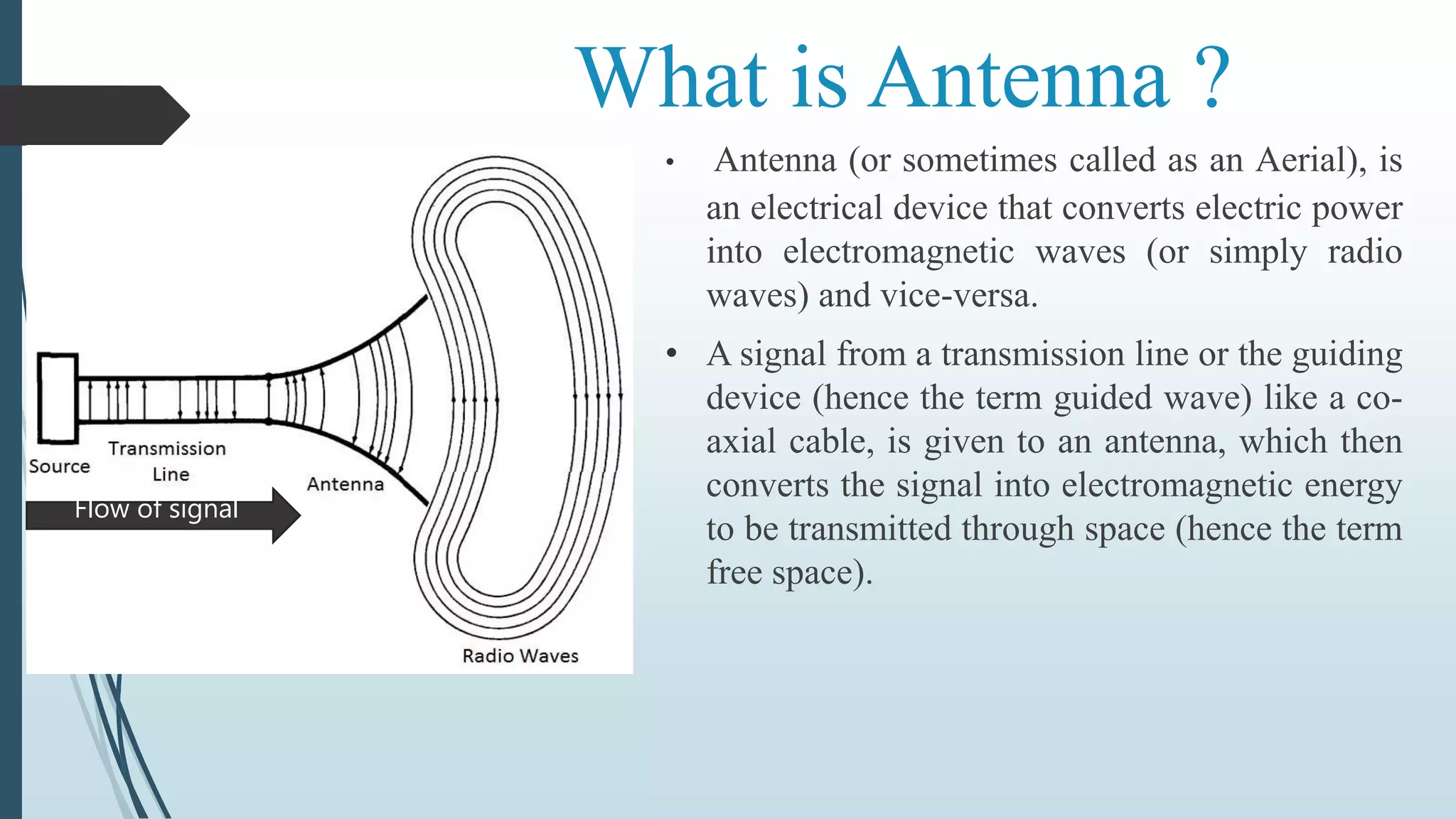
• Antenna (or sometimes called as an Aerial), is
an electrical device that converts electric power
into electromagnetic waves (or simply radio
waves) and vice-versa.
• A signal from a transmission line or the guiding
device (hence the term guided wave) like a co-
axial cable, is given to an antenna, which then
converts the signal into electromagnetic energy
to be transmitted through space (hence the term
free space).
Flow of signal
3.
Why do weneed Antennas?
There are several reasons as to why we need or why we use antennas,
but an important reason as to why we use antennas is that they provide a
simple way to transfer signals (or data) where other methods are
impossible.
For example, take the case of an Aeroplane. The pilot needs to
frequently communicate with the ATC personnel. If would not make any
sense if we tie up a cable (of dynamically variable length) to the tail of
the plane and connect it to the ATC.
Wireless communication is the only feasible option and Antennas are the
gateway for that. There are many situations or applications where cables
are preferred over wireless communication with antennas (like high
speed ethernet or the connection between gaming console and the T.V.,
for example).
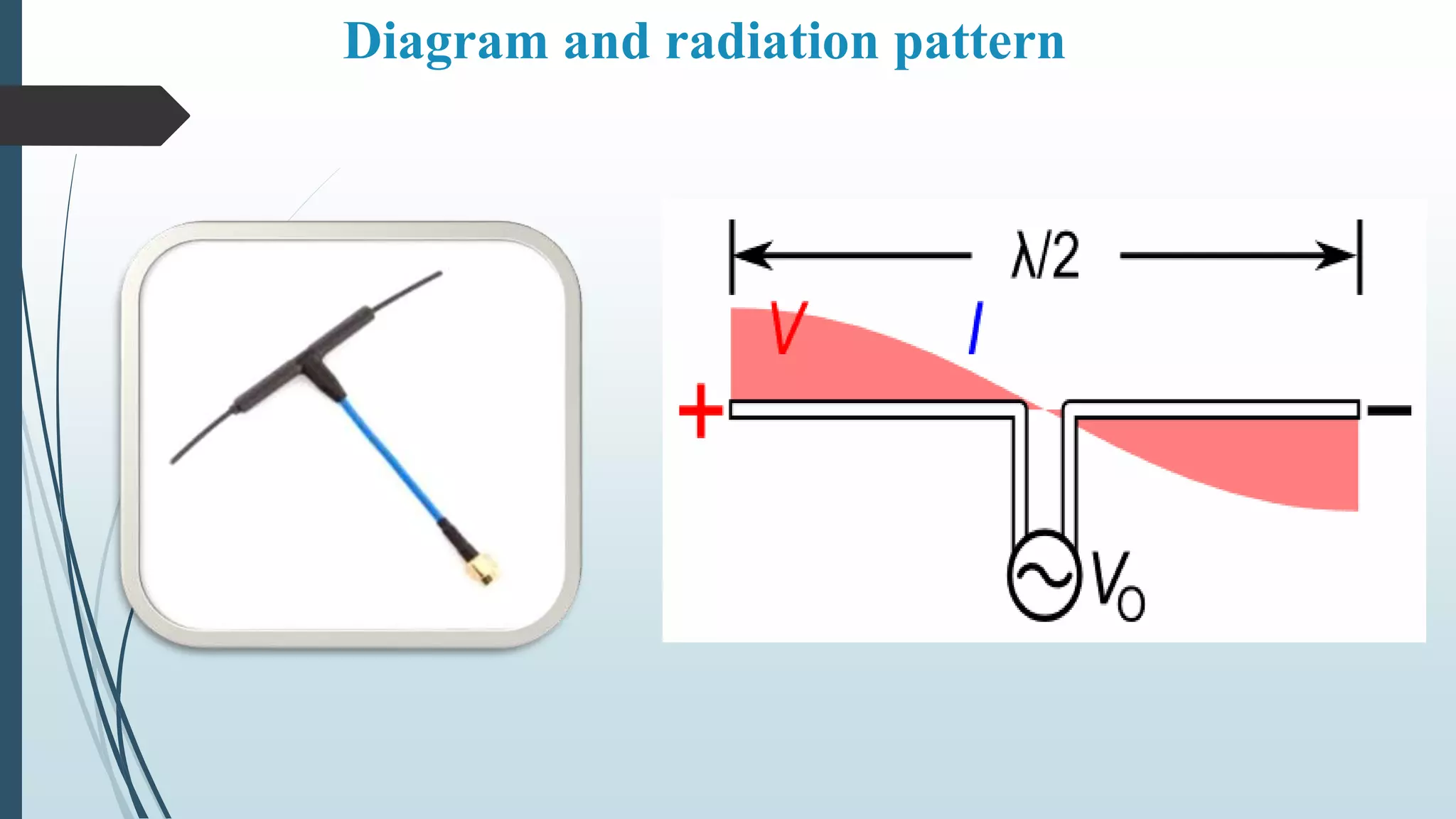
1) λ/2 Antenna{Dipole Antenna }
In radio and telecommunications a dipole antenna or doublet is the simplest and most
widely used class of antenna.The dipole is any one of a class of antennas producing a
radiation pattern approximating that of an elementary electric dipole with a radiating
structure supporting a line current so energized that the current has only one node at each
end.
This antenna introduce by German physicist Heinrich Hertz first demonstrated the existence
of radio waves in 1887 using what we now know as a dipole antenna (with capacitive-end-
loading).
A dipole antenna commonly consists of two identical conductive elements such as metal
wires or rods. The driving current from the transmitter is applied, or for receiving antennas
the output signal to the receiver is taken, between the two halves of the antenna. Each side
of the feedline to the transmitter or receiver is connected to one of the conductors.
Advantages & Disadvantagesof Dipole Antenna
Advantages :-
Balance:-Dipole antennas offer the advantage of receiving balanced signals. The two-pole design
enables the device to receive signals from a variety of frequencies. It also helps the device sort out
problems caused by conflicting signals without losing reception quality.
Design Options :- In addition to the basic, television-top dipole antenna, many other forms exist.
Folded dipole antennas have ends that turn back toward the center to help maximize the signal
strength. Other options include the half-wave dipole, the folded dipole and the half-wave folded
dipole.
Disadvantages :-
Size :-Although the indoor dipole antennas are usually small, the outdoor versions can be large and
difficult to manage. They often require more than one person to install, as the poles might be tall and
unwieldy. The size makes these outdoor versions difficult to transport, move and install when
necessary.
Moving It :- If you're using a small, TV-top dipole antenna, you must try multiple combinations of
pole placements before finding the best reception position. Both poles typically rotate and extend,
making it a hassle to move one and then the other continuously while seeking maximum reception.
8.
2) Horn Antenna
Horn antenna coverts the electric power in to the radio waves and vice versa .it is usually used with
a radio transmitter or radio receiver
A horn antenna or microwave horn is an antenna that consist of a flaring metal waveguide shaped
like a horn to direct radio waves in a beam
It provides a gradual transmission structure to match the impedance of a tube to the impedance of
free space ,enabling the waves from the tube to radiate efficiently into space
Horns are widely used as antennas at UHF and microwave frequencies, above 300MHz.
9.
Advantages & DisadvantagesOf Horn Antenna
Advantages of Horn Antenna:
➨It is simple in construction.
➨It delivers adequate directivity.
➨It offers bandwidth of about 10%.
➨Horn antenna along with parabolic reflector disc can deliver high gain.
Disadvantages of Horn Antenna:
➨Horn antenna radiates energy in spherical wave front shape, as a result horn
antenna does not provide sharp/directive beam.
➨Usually gain of horn antenna is limited to 20dB. This is due to the fact that in
order to increase the gain when the horn opening is made larger, the length of horn
also becomes excessive.
10.
3) Parabolic DishAntenna
The parabolic reflector or dish antenna is the form of
antenna which finds many uses in domestic satellite
television reception, terrestrial microwave data links,
general satellite communications and many more.
Its size means that it is generally limited to use above
1GHz, although larger antennas may be used for
frequencies down to about 100MHz.
The parabolic reflector antenna or dish antenna is known
for its distinctive shape, its high gain, and narrow beam
widths. It is the performance which can be achieved by
using one is the reason it is so widely used at higher
frequencies.
The standard definition of a parabola is - Locus of a point,
which moves in such a way that its distance from the fixed
point (called focus) plus its distance from a straight line
(called directrix) is constant.
Cassegrain Antenna
11.
Radiation Pattern OfParabolic Dish Antenna
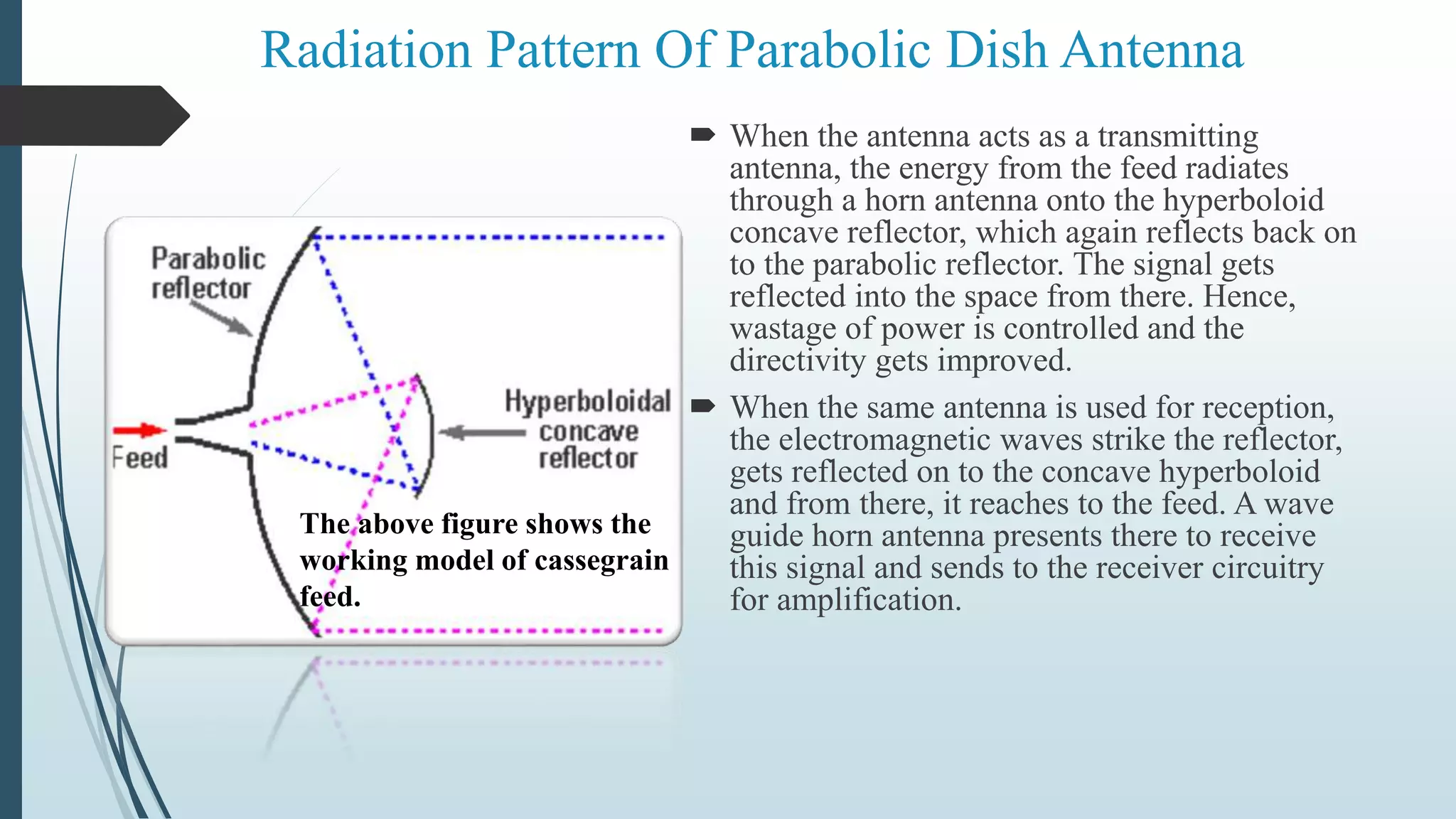
When the antenna acts as a transmitting
antenna, the energy from the feed radiates
through a horn antenna onto the hyperboloid
concave reflector, which again reflects back on
to the parabolic reflector. The signal gets
reflected into the space from there. Hence,
wastage of power is controlled and the
directivity gets improved.
When the same antenna is used for reception,
the electromagnetic waves strike the reflector,
gets reflected on to the concave hyperboloid
and from there, it reaches to the feed. A wave
guide horn antenna presents there to receive
this signal and sends to the receiver circuitry
for amplification.
The above figure shows the
working model of cassegrain
feed.
12.
Advantages & DisadvantagesOf parabolic dish
Antenna
Advantages Of Parabolic Reflector Antenna −
Reduction of minor lobes
Wastage of power is reduced
Equivalent focal length is achieved
Feed can be placed in any location, according to our convenience
Adjustment of beam (narrowing or widening) is done by adjusting the reflecting surfaces
Disadvantage Of A Parabolic Reflector Antenna −
Some of the power that gets reflected from the parabolic reflector is obstructed. This
becomes a problem with small dimension paraboloid.
applications of Parabolic reflector antenna −
The Cassegrain feed parabolic reflector is mainly used in satellite communications.
Also used in wireless telecommunication systems.
13.
4) Antenna array
An antenna array is a radiating system, which
consists of individual radiators and elements.
Each of this radiator, while functioning has its
own induction field. The elements are placed so
closely that each one lies in the neighbouring
one’s induction field. Therefore, the radiation
pattern produced by them, would be the vector
sum of the individual ones. The following image
shows another example of an antenna array.
The spacing between the elements and the length
of the elements according to the wavelength are
also to be kept in mind while designing these
antennas.
The antennas radiate individually and while in
array, the radiation of all the elements sum up, to
form the radiation beam, which has high gain,
high directivity and better performance, with
minimum losses.
14.
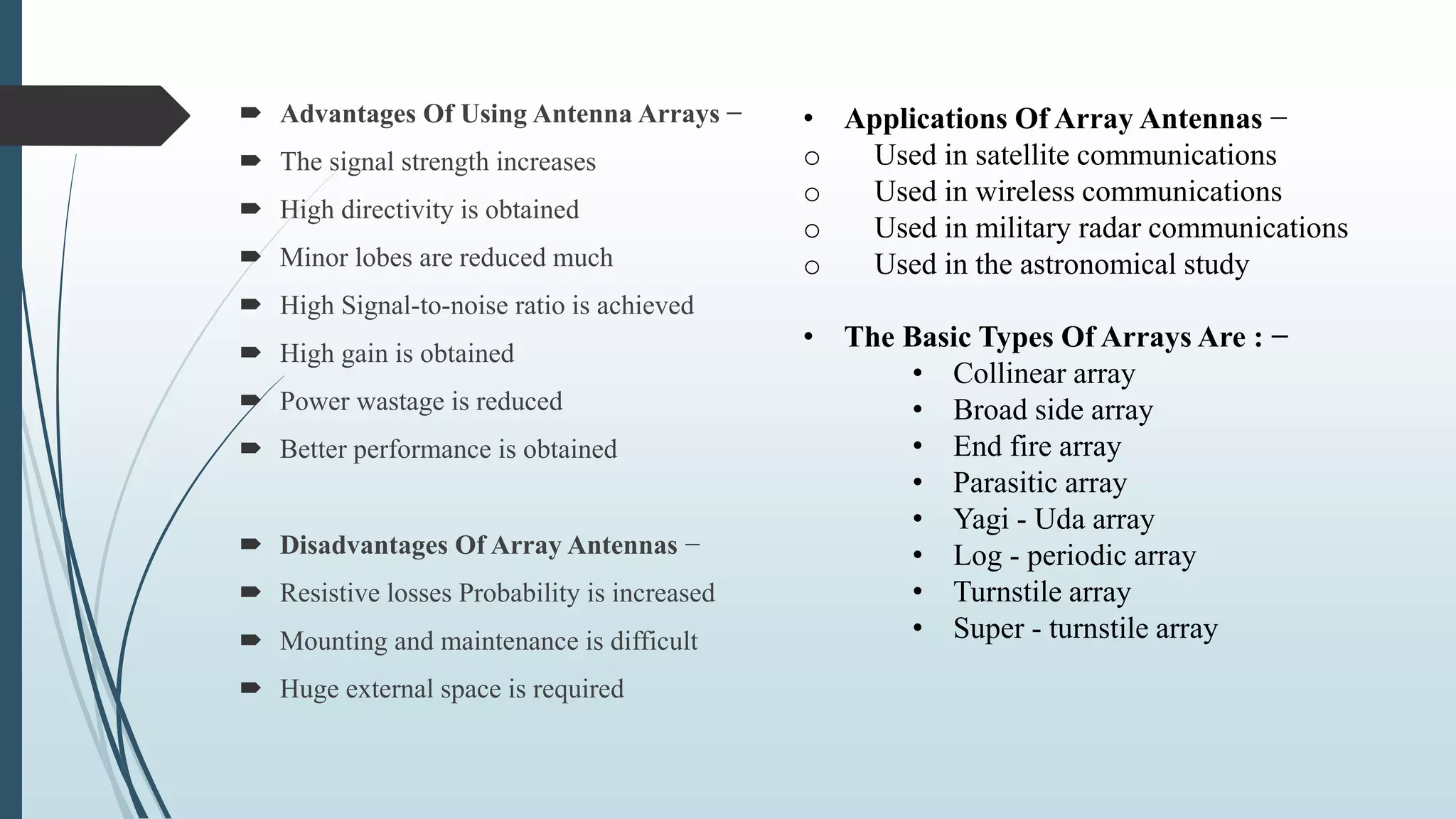
Advantages OfUsing Antenna Arrays −
The signal strength increases
High directivity is obtained
Minor lobes are reduced much
High Signal-to-noise ratio is achieved
High gain is obtained
Power wastage is reduced
Better performance is obtained
Disadvantages Of Array Antennas −
Resistive losses Probability is increased
Mounting and maintenance is difficult
Huge external space is required
• Applications Of Array Antennas −
o Used in satellite communications
o Used in wireless communications
o Used in military radar communications
o Used in the astronomical study
• The Basic Types Of Arrays Are : −
• Collinear array
• Broad side array
• End fire array
• Parasitic array
• Yagi - Uda array
• Log - periodic array
• Turnstile array
• Super - turnstile array